
Deposit Interest, Maturity and Deposit-Renewal Concepts
Deposit Interest, Maturity and Deposit-Renewal Concepts. A detailed chapter in Deposits & Bank Accounts, with explanations and examples for Indian banking examinations.
By Akhilesh Saini · Reviewed 7 Oct 2026
1. A deposit rate is a price paid by the bank
When a bank accepts an interest-bearing deposit, it is borrowing from the depositor.
Interest is the price paid for using that funding.
Deposit rates depend on factors such as:
- monetary policy;
- market interest rates;
- bank liquidity;
- funding needs;
- deposit tenor;
- competition;
- deposit size;
- premature-withdrawal option; and
- asset-liability management.
2. Banks determine deposit rates within RBI rules
RBI no longer fixes one common savings or term-deposit rate for every bank.
Banks have freedom within the regulatory framework.
They must:
- maintain a Board-approved interest policy;
- disclose rates in advance;
- apply rates consistently;
- avoid arbitrary negotiation outside the disclosed structure; and
- follow rules on tenor, bulk deposits and premature withdrawal.
3. Interest rate vs effective yield
An FD may quote:
- nominal annual interest rate;
- compounding frequency;
- payout frequency.
The maturity amount depends on compounding.
Example:
₹1,00,000 at 7% for one year.
If simple annual interest:
₹7,000.
If interest is compounded more frequently, the effective yield can be slightly higher.
Always distinguish:
quoted rate
from
effective annual return.
4. Periodic payout vs cumulative deposit
Periodic payout
Interest may be paid:
- monthly;
- quarterly;
- half-yearly;
- annually;
depending on product.
Cumulative
Interest is reinvested until maturity.
This creates compounding.
A retiree wanting regular income may prefer payout.
A saver building a corpus may prefer cumulative.
5. Minimum tenor
RBI allows banks to determine term-deposit tenors subject to a minimum regulatory tenor for domestic rupee deposits.
The current minimum domestic tenor is a current rule and should be maintained in the website data layer.
The conceptual lesson is:
a term deposit cannot be shorter than the regulatory minimum applicable to the product.
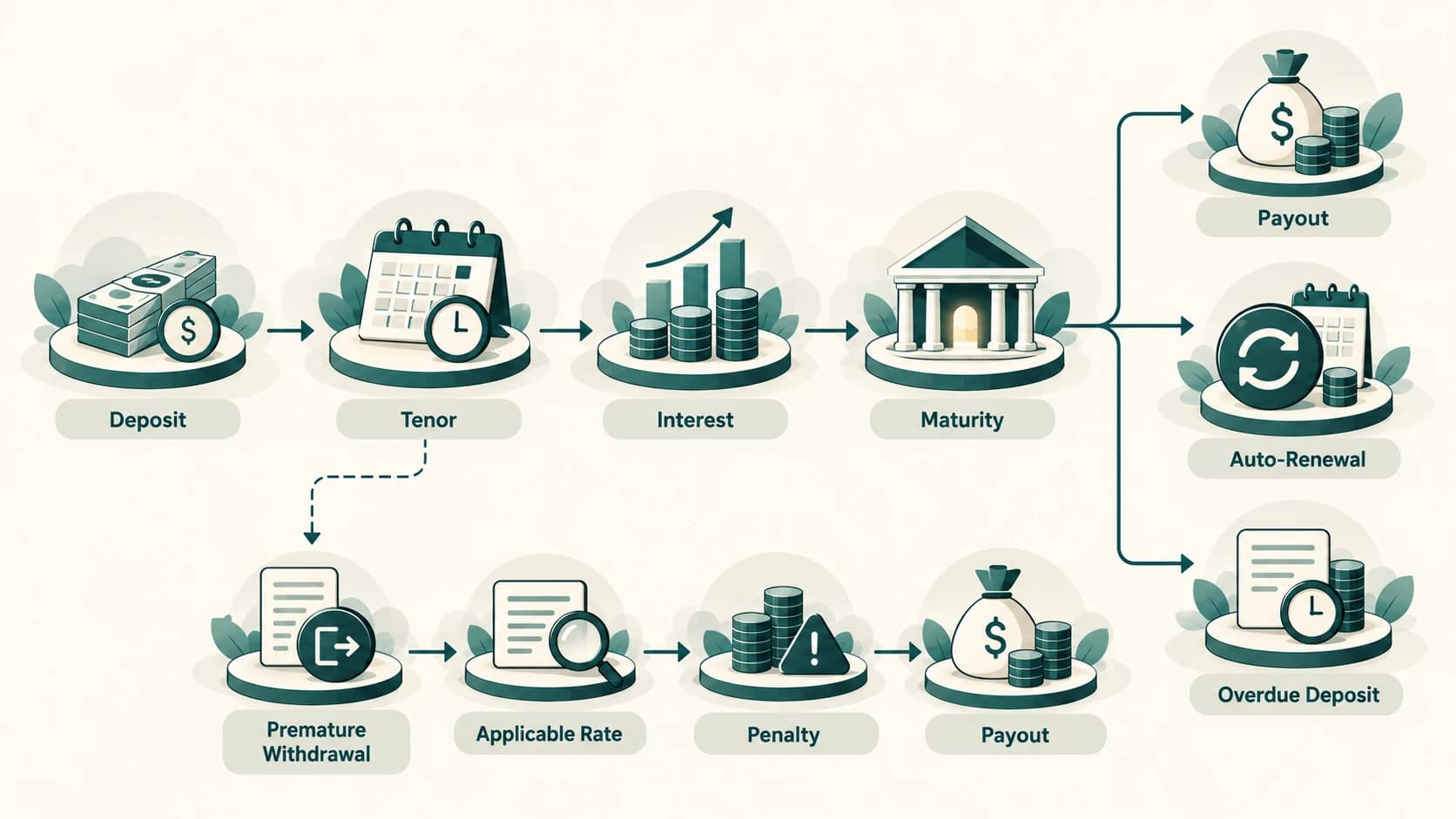
6. Maturity
A term deposit matures when its contracted tenor ends.
At maturity, depending on customer instruction, the bank may:
- pay principal + interest to another account;
- renew principal;
- renew principal + interest;
- or hold the matured amount under the applicable overdue-deposit treatment.
7. Maturity value
For a cumulative FD:
Maturity Value = Principal + Accumulated Interest
For a periodic-payout FD:
most interest has already been paid during the tenor, so the principal is normally returned at maturity.
8. Auto-renewal
A customer may instruct the bank to renew the deposit automatically.
Possible structures:
- renew principal only;
- renew principal + interest;
- renew for same tenor;
- renew for a selected tenor.
Auto-renewal terms are governed by the product and bank policy.
9. Overdue deposit
An overdue deposit is a term deposit whose maturity proceeds have not been paid/renewed promptly.
Under RBI's framework, if a term deposit matures and remains unpaid, the unclaimed amount earns:
- the savings-account rate; or
- the contracted rate on the matured term deposit,
whichever is lower, under the applicable rule.
This discourages customers from assuming that a matured FD automatically continues at the old FD rate indefinitely.
10. Renewal of overdue deposit
If an overdue deposit is later renewed, the bank follows its regulatory/Board-approved policy.
Treatment can depend on:
- date of maturity;
- date of renewal;
- tenor;
- interest schedule.
Students should not assume automatic backdated renewal at the highest available rate.
11. Deposit maturing on a non-business day
If a term deposit matures on a non-business working day, RBI's framework requires interest for the intervening non-business day under the prescribed method.
This prevents customers from losing interest merely because the maturity date falls on a bank holiday.
12. Premature withdrawal
Premature withdrawal means the depositor closes a term deposit before maturity.
It is a contractual/regulatory right for eligible callable deposits.
The bank then recalculates interest based on:
- actual period the deposit remained;
- rate applicable to that period/amount; and
- applicable premature-withdrawal penalty.
13. Contracted rate vs applicable rate on premature withdrawal
Suppose:
- customer books a 3-year FD at 7.5%;
- closes it after 14 months;
- the bank's 14-month rate on original booking date was 6.5%;
- penalty is 1 percentage point.
The customer will not automatically receive 7.5%.
Illustratively:
Applicable base rate = 6.5%
Less penalty = 1.0%
Effective rate = 5.5%
The actual bank method must follow disclosed policy.
14. Why does premature withdrawal reduce interest?
The bank priced the deposit based on an expected tenor.
Early withdrawal changes:
- funding duration;
- liquidity position;
- asset-liability planning.
The lower rate/penalty partly reflects that disruption.
15. Penalty must be disclosed
RBI requires banks to have a Board-approved premature-withdrawal policy.
The components of penalty should be disclosed to depositors at acceptance.
If the required penalty terms are not properly disclosed, the bank cannot simply invent a penalty later.
16. Non-callable term deposit
A non-callable deposit has no premature-withdrawal option under the agreed terms, subject to regulatory restrictions.
Because the bank receives more predictable funding, the rate may differ from a callable deposit.
17. Why small/ordinary individual deposits receive protection
RBI requires premature-withdrawal availability for individual term deposits up to the prescribed threshold.
This ensures ordinary depositors retain an exit option.
The threshold itself can change and belongs in current data.
18. Senior-citizen deposit rates
Banks may offer higher term-deposit rates to resident senior citizens under their policy.
This is not a universal RBI-mandated fixed premium across all banks.
Important distinction:
bank has discretion to formulate senior-citizen schemes within the framework.
19. NRI senior-citizen benefit
RBI's deposit-interest directions do not provide the normal resident senior-citizen additional-interest benefit to NRE/NRO deposits.
Do not assume:
age alone guarantees the same extra rate on every resident and non-resident deposit.
20. Floating-rate term deposit
Banks may offer floating-rate domestic term deposits linked to a transparent external benchmark under RBI rules.
This means the deposit rate may reset with the benchmark instead of staying fixed throughout.
21. Sweep / flexi deposits
A sweep arrangement links:
- transaction account; and
- term deposit.
When balance exceeds a threshold, excess money may be placed into term deposit.
When transaction funds are needed, part may be broken or swept back.
This combines liquidity and term-deposit return.
But exact mechanics vary by bank.
22. Loan against fixed deposit
Banks commonly offer loans or overdrafts against their own term deposits.
Instead of breaking the FD, the customer borrows against it.
Benefits can include:
- deposit continues;
- borrowing rate may be relatively low because deposit secures the loan;
- customer preserves investment tenor.
This belongs partly to Module 06 because it is also a secured-lending concept.
23. Deposit rate and monetary policy
When RBI changes monetary policy, deposit rates may change.
But not immediately or equally across banks.
Banks consider:
- liquidity;
- funding gap;
- competition;
- loan growth;
- deposit mix;
- maturity profile.
Therefore:
repo cut does not mean every FD rate falls the next day by the same amount.
24. Tax is separate from bank interest calculation
Deposit interest can have income-tax consequences.
Banks may deduct tax at source under tax law where applicable.
However:
- tax thresholds;
- forms;
- exemptions;
- rates
change through fiscal legislation.
They should not be permanently hard-coded into an evergreen Banking Awareness lesson unless needed for a current exam update.
Quick check - BA-05-03
- Does premature withdrawal always earn the originally contracted FD rate?
- What is an overdue term deposit?
- What is a non-callable deposit?
- Why may cumulative FD maturity value exceed a periodic-payout FD with the same nominal rate?
- Can banks offer floating-rate term deposits?
- Is the same senior-citizen additional rate compulsory at every bank?
Quick answers
- No.
- A matured deposit whose proceeds remain unpaid/unrenewed.
- A term deposit without premature-withdrawal option under the permitted framework.
- Because interest is reinvested and compounds.
- Yes, subject to the regulatory framework.
- No.