
Bank Accounts: Ownership, Nomination and Account Operations
Bank Accounts: Ownership, Nomination and Account Operations. A detailed chapter in Deposits & Bank Accounts, with explanations and examples for Indian banking examinations.
By Akhilesh Saini · Reviewed 7 Oct 2026
1. An account has more than one legal/operational dimension
Students often treat "whose account is it?" as one question.
Actually several questions may exist:
- Who owns the funds?
- Who may operate the account?
- Is the account single or joint?
- Is there a mandate/power of attorney?
- Is there a nominee?
- Is there a survivorship clause?
- Is the account held by/for a minor?
- What happens after death?
These concepts overlap but are not identical.
2. Single account
A single account is held in the name of one depositor.
That person is normally:
- owner of the funds, subject to the factual/legal source of money; and
- authorised operator.
The account can still have:
- a nominee;
- an authorised mandate holder; or
- legal restrictions.
3. Joint account
A joint account has two or more account holders.
Joint holding does not automatically tell you who can operate the account.
The operating mandate matters.
Examples include:
- jointly;
- either or survivor;
- anyone or survivor;
- former or survivor;
- latter or survivor.
4. "Jointly"
If operation is "jointly":
the required holders must act/sign together according to the mandate.
This provides control but can reduce convenience.
5. "Either or survivor"
During the lifetime of both holders, either may operate according to the mandate.
After one holder dies, the survivor may operate/receive according to the survivorship terms and bank procedure.
This is commonly used by spouses or family members.
6. "Anyone or survivor"
Used where there are more than two holders.
Any one may operate during joint lives under the mandate; after deaths, the surviving holder(s) act according to the terms.
7. "Former or survivor"
The first-named holder — the "former" — operates the account during both holders' lifetimes.
The second holder — the "survivor" — becomes entitled to operate after the former's death, subject to the mandate and bank procedure.
8. "Latter or survivor"
The reverse idea applies: the latter-named holder operates during joint lives, with survivorship treatment on death.
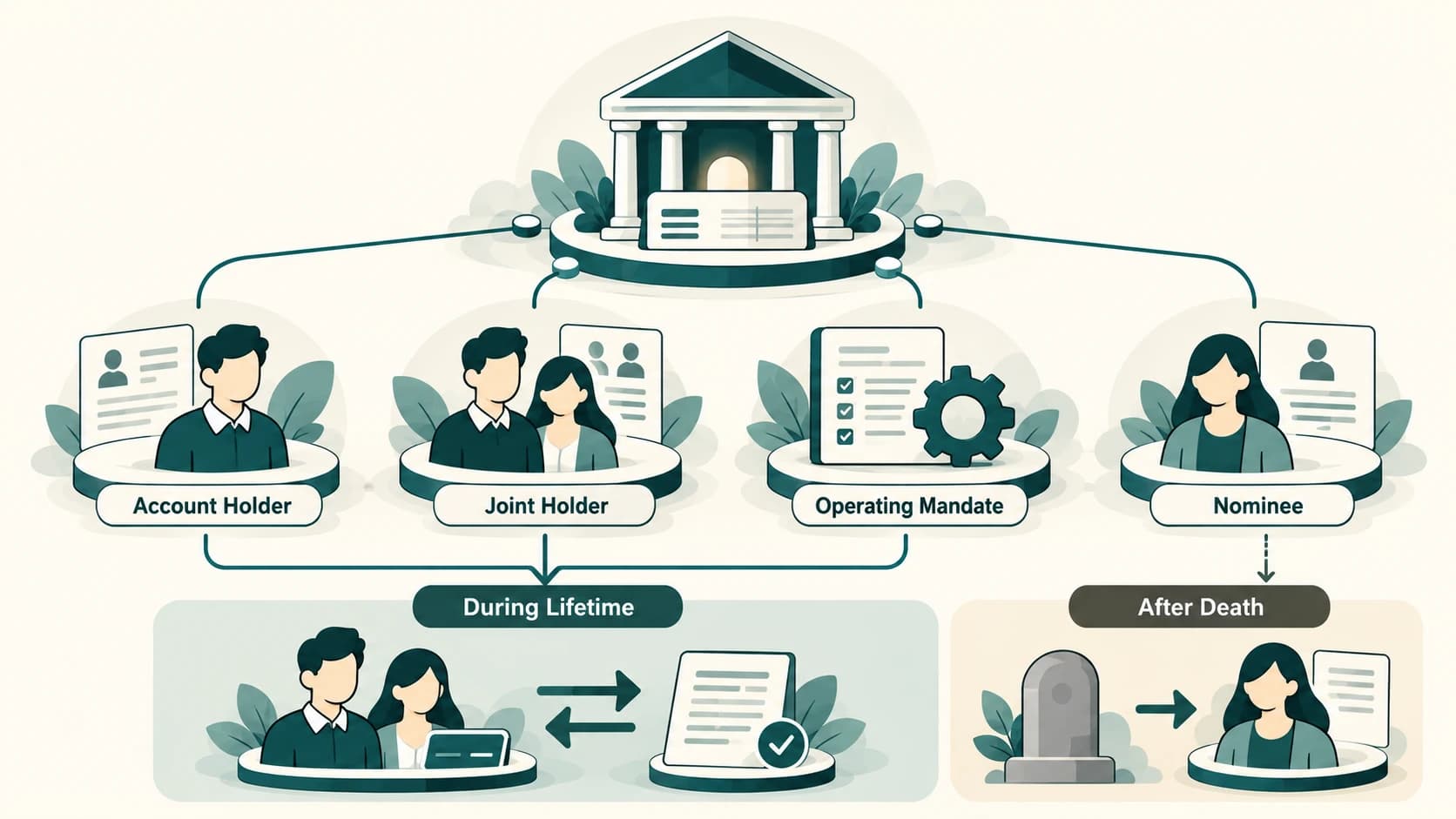
9. Operating authority is not always beneficial ownership
Suppose A gives B authority to sign cheques.
That does not necessarily mean B owns the money.
Likewise:
- nominee;
- attorney;
- guardian; and
- joint operator
are distinct legal roles.
10. Mandate and power of attorney
An account holder may authorise another person to perform specified operations.
This authority may arise through:
- bank mandate;
- power of attorney; or
- other accepted legal authority.
The authorised person acts for the account holder but does not automatically become owner of the funds.
11. Nomination: basic purpose
Nomination makes claim settlement easier after a depositor's death.
The depositor names one or more individuals who can receive the deposit proceeds under the nomination framework.
The key practical benefit is:
the bank gets a clear person or sequence of persons to whom it can settle its liability according to law.
12. Nominee is not simply "joint holder"
A nominee:
- need not operate the account during the depositor's lifetime;
- does not automatically become a normal joint account holder;
- becomes relevant on death under the nomination framework.
Do not confuse nominee with co-owner.
13. Modern multiple-nomination framework
The Banking Laws (Amendment) Act, 2025 modernised nomination rules for bank deposits.
With effect from 1 November 2025, depositors can nominate up to four persons.
For deposit accounts, nominations may be:
- simultaneous; or
- successive.
Simultaneous nomination
Multiple nominees are named at the same time.
The depositor specifies the percentage/share for each nominee.
The total allocation must equal 100%.
Successive nomination
Nominees are ranked in sequence.
The next nominee becomes operative if the earlier nominee is not alive/available under the statutory framework.
This creates continuity in claim settlement.
14. Nomination does not erase succession law
Nomination helps the bank discharge its obligation efficiently.
It should not be understood as a universal rewrite of all inheritance rights.
For exam-quality understanding:
nomination identifies who may receive from the bank under the nomination framework; ultimate beneficial succession can still depend on applicable personal/succession law.
15. Nomination for joint accounts
Where an account is jointly held, nomination is made according to the applicable rules by the depositors.
The nominee becomes relevant after the conditions in the joint/survivorship arrangement and death of holders are satisfied.
A nomination does not override the operating mandate during the account holders' lifetime.
16. Nomination for minors
Where a nominee is a minor, the framework permits appointment of an adult to receive on behalf of the minor under applicable nomination rules.
Where the deposit itself is in the name of a minor, the nomination is made by the person lawfully entitled to act on behalf of the minor, subject to current rules.
17. Minor accounts
A minor of any age may hold:
- savings deposit;
- fixed deposit;
- recurring deposit
through a natural or legally appointed guardian under RBI's framework.
Banks may allow minors above a specified age to operate savings accounts independently according to their risk-management policy.
RBI's long-standing framework permits banks to allow independent savings operation by minors above 10 years, subject to bank-set limits.
18. Minor account safeguards
Banks may offer facilities such as:
- ATM/debit card;
- internet banking;
- cheque book
subject to safeguards.
A key principle is:
minor accounts should not be allowed to become overdrawn merely through ordinary operation.
19. What happens when a minor becomes major?
When the minor reaches majority:
- balance should be confirmed;
- fresh specimen signature is obtained;
- fresh operating instructions may be required; and
- KYC/status may need updating.
The account then transitions from guardian/minor operation to normal adult operation.
20. Sole proprietorship account
A sole proprietorship is not a separate legal person in the same way as a company.
The proprietor and business are closely linked.
This matters in:
- account opening;
- ownership;
- deposit insurance; and
- claim handling.
Under DICGC rules, deposits in an individual's own name and deposits held as sole proprietor are aggregated in the same capacity/right for insurance purposes.
21. HUF, partnership, company and trust accounts
Banks also maintain deposit accounts for:
- Hindu Undivided Families;
- partnerships;
- companies;
- trusts;
- societies;
- associations;
- Government bodies; and
- institutions.
Authority to operate comes from:
- legal status;
- constitutional documents;
- resolutions;
- partnership terms;
- trusteeship;
- mandates; and
- KYC documentation.
Module 05 focuses on deposit concepts rather than full account-opening law.
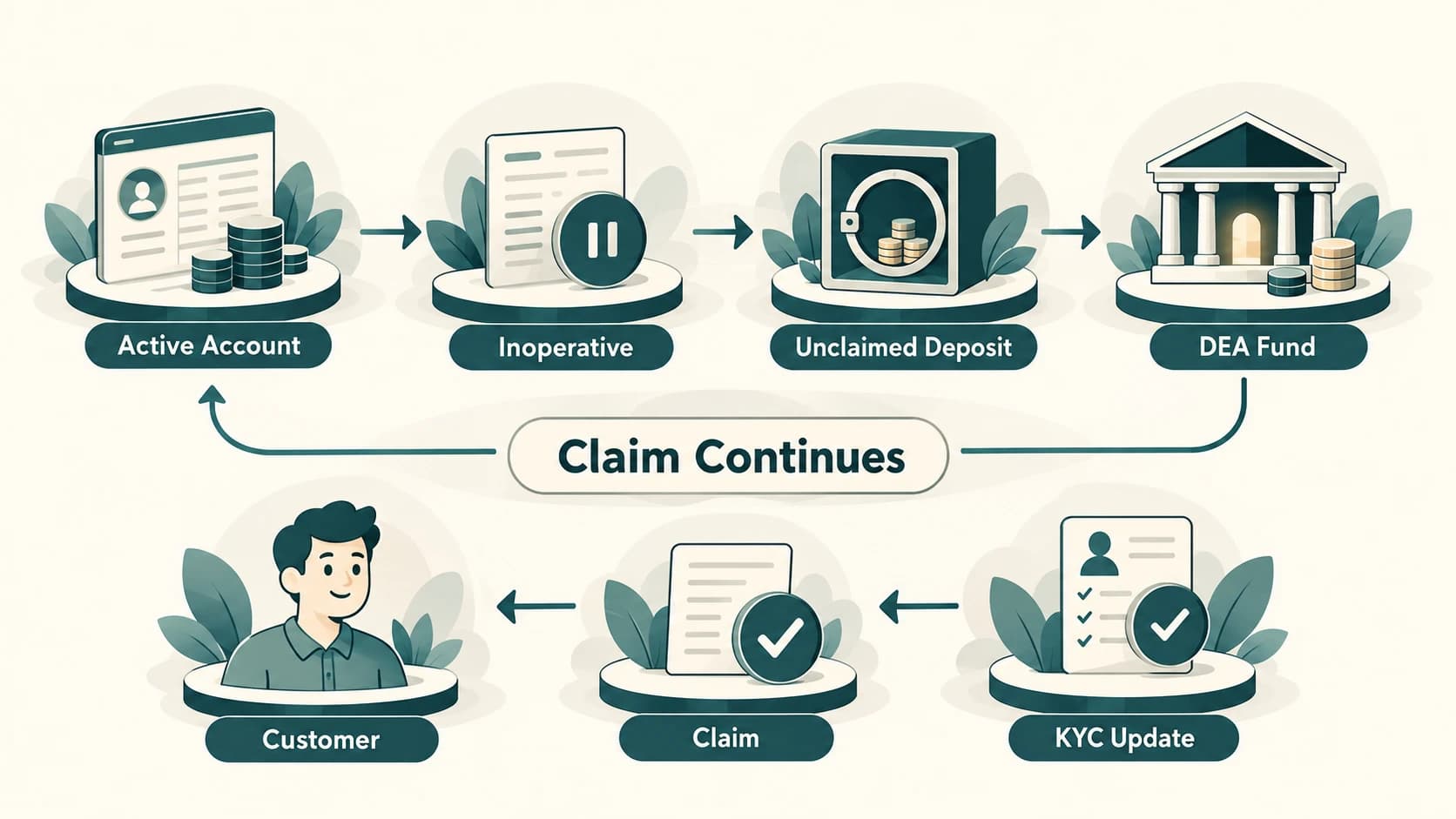
22. Inoperative account
An account may be classified as inoperative when there have been no customer-induced transactions for the prescribed period under RBI rules.
Inoperative does not mean:
- account has been confiscated;
- customer loses ownership; or
- bank can keep the money.
The purpose is mainly risk management and fraud prevention.
23. Activation of inoperative accounts
RBI's revised framework requires banks to make KYC-updation/activation facilities available through all branches, including non-home branches.
Banks are also expected to facilitate reactivation through permitted channels such as:
- V-CIP where available; and
- authorised Business Correspondents in the prescribed framework.
This is intended to reduce inconvenience to customers.
24. Unclaimed deposits
If a deposit remains unclaimed for the prescribed long period, it falls under the unclaimed-deposit framework.
Under current RBI rules, amounts unclaimed for 10 years or more are transferred by banks to the Depositor Education and Awareness Fund - DEA Fund.
This does not extinguish the customer's claim.
The customer/legal claimant can still claim the money through the bank, subject to verification and procedure.
25. UDGAM
RBI operates the UDGAM portal to help people search for unclaimed deposits across participating banks.
The portal is a search/facilitation mechanism.
It does not itself make the claimant owner or pay the amount automatically.
26. Account closure vs inoperative vs unclaimed
| Status | Meaning |
|---|---|
| Active | Normal customer operation |
| Inoperative | No prescribed customer-induced activity for required period |
| Unclaimed | Amount remains unclaimed for long period under applicable framework |
| Closed | Account relationship terminated and balance settled/handled |
These are not interchangeable.
27. Death of a depositor
When an account holder dies, claim treatment depends on factors including:
- single/joint account;
- nomination;
- survivorship clause;
- legal heirs;
- term-deposit maturity;
- bank's Board-approved policy.
Where valid nomination/survivorship applies, the bank can settle in a simplified way after due verification.
28. Why survivorship clause matters
A joint account does not automatically mean the survivor can freely take the balance under every circumstance.
The operating instruction and survivorship clause matter.
This is why banks encourage customers to understand terms such as:
- either or survivor;
- former or survivor.
29. Nomination is operational risk reduction
From the customer's perspective, nomination can:
- reduce paperwork;
- reduce claim delays;
- reduce uncertainty;
- simplify bank settlement.
From the bank's perspective, it creates a clearer discharge process.
It should therefore be viewed as an important banking-safety habit.
Quick check - BA-05-02
- Is a nominee automatically a joint account holder?
- What does "either or survivor" broadly mean?
- How many nominees can a depositor now name under the modern framework?
- What is the difference between simultaneous and successive nomination?
- Does transfer of an unclaimed deposit to DEA Fund extinguish the customer's claim?
- Can a minor hold a bank deposit?
Quick answers
- No.
- Either holder may operate during joint lives; the survivor can act after death according to mandate/procedure.
- Up to four.
- Simultaneous allocates shares among nominees; successive establishes an order.
- No.
- Yes, through guardian and, subject to bank rules, independently for certain savings accounts after the prescribed age.