
Bank Deposits: Savings, Current, Fixed and Recurring Deposits
Bank Deposits: Savings, Current, Fixed and Recurring Deposits. A detailed chapter in Deposits & Bank Accounts, with explanations and examples for Indian banking examinations.
By Akhilesh Saini · Reviewed 7 Oct 2026
1. What is a bank deposit?
When a customer places money with a bank, the amount becomes a deposit liability of the bank.
From the customer's point of view:
the deposit is an asset.
From the bank's point of view:
the same deposit is a liability because the bank owes money to the customer.
This is one of the most basic accounting ideas in banking.
2. Why do banks accept deposits?
Deposits allow banks to:
- provide safe money-holding facilities;
- support payments;
- mobilise household and business savings;
- fund lending and investments; and
- connect savers with borrowers through financial intermediation.
Banks do not normally keep every deposited rupee idle in cash.
They maintain required reserves/liquidity and deploy part of their funding into:
- loans;
- Government securities;
- other permitted investments; and
- settlement balances.
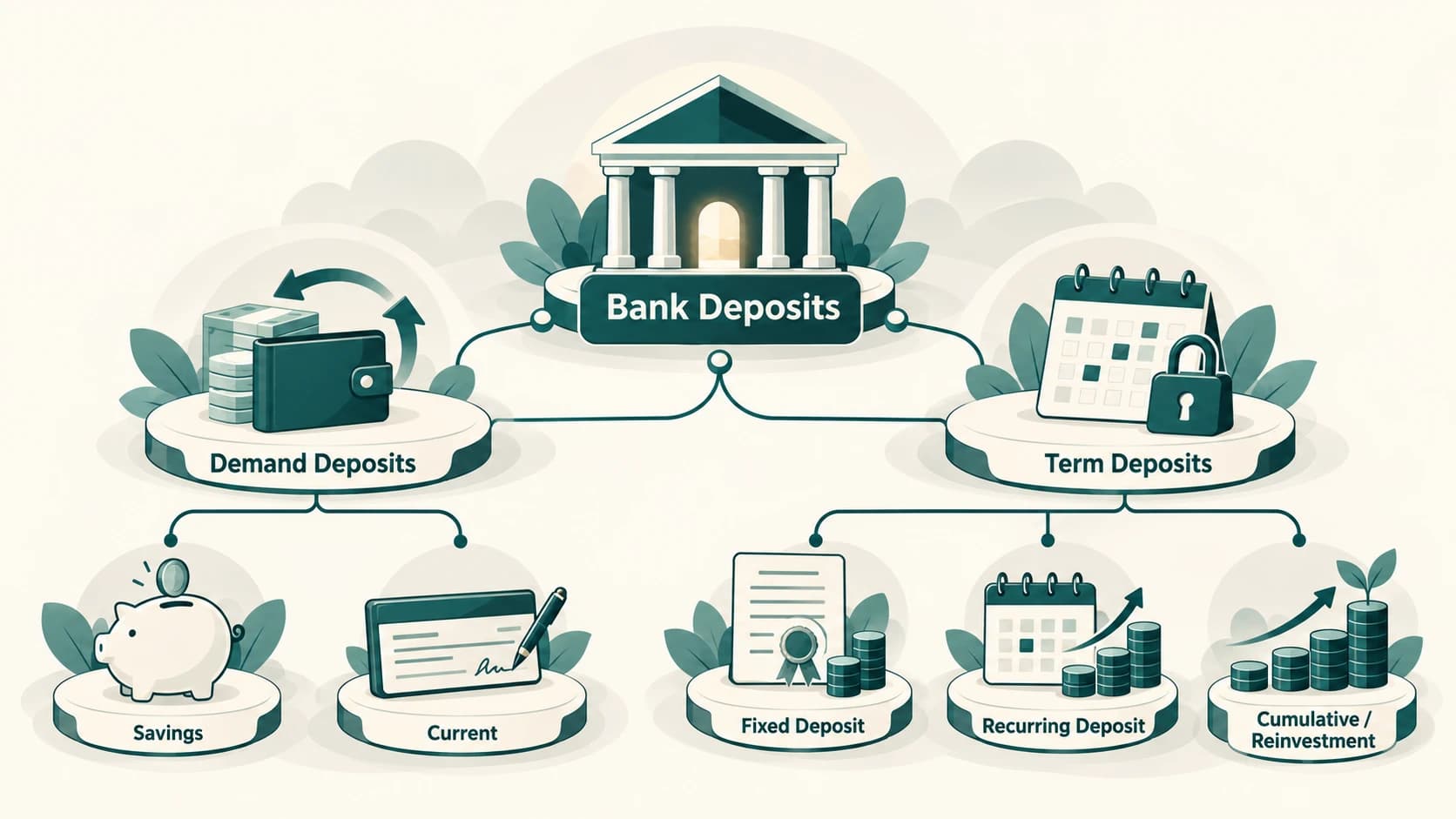
3. Two broad deposit categories
A useful exam classification is:
Demand deposits
Withdrawable on demand.
Examples:
- savings deposits;
- current-account deposits.
Term deposits
Accepted for a fixed period.
Examples:
- fixed deposits;
- recurring deposits;
- reinvestment deposits;
- cumulative deposits;
- cash certificates and similar fixed-period products.
This classification is more fundamental than individual product names.
4. Demand deposit
RBI defines a demand deposit broadly as a deposit withdrawable on demand.
The customer does not have to wait for a predetermined maturity date.
Savings and current accounts are therefore demand deposits, even though their features differ greatly.
5. Term deposit
A term deposit is accepted for a fixed period.
The customer agrees that the funds will ordinarily remain for the contracted tenor.
The bank can therefore plan its funding more predictably than with a demand deposit.
Term deposits generally pay a higher rate than ordinary transaction accounts because the customer gives up some liquidity.
6. Savings account
A savings deposit is an interest-bearing demand deposit designed mainly for personal savings and routine transactions.
Typical features include:
- deposits and withdrawals;
- digital payments;
- ATM/debit-card access;
- cheque facility where offered;
- interest on the balance;
- nomination;
- joint holding; and
- internet/mobile banking.
The account remains withdrawable on demand.
7. Savings-account interest
Under RBI's deposit-interest framework:
- interest is calculated on a daily product basis;
- banks set a uniform rate for balances up to the prescribed threshold; and
- differential rates may be offered for end-of-day balances above that threshold.
The exact interest rate is decided by the bank under its approved policy and disclosed schedule.
RBI does not prescribe one common savings rate for every bank.
Simple example
Suppose a savings account carries 3% per annum for the relevant balance slab.
If the end-of-day balance is ₹1,00,000 for an entire 365-day year:
Interest ≈
₹1,00,000 × 3%
= ₹3,000
In practice, interest is calculated from daily balances and credited at the interval permitted by regulation.
8. Why daily-product calculation matters
Under a daily-product method, each day's closing balance contributes to the interest calculation.
This means:
- money deposited earlier can earn interest for more days;
- withdrawals reduce the balance used for later days; and
- interest is not based only on one arbitrary monthly minimum balance.
9. Current account
A current account is a non-interest-bearing demand deposit designed mainly for frequent transactions.
It is commonly used by:
- businesses;
- firms;
- companies;
- institutions;
- professionals; and
- customers needing high transaction frequency.
Typical characteristics:
- frequent deposits/withdrawals;
- cheque and payment use;
- cash-management features;
- overdraft or credit linkage where separately sanctioned;
- normally no interest.
10. Why current accounts normally do not earn interest
Current accounts are built primarily for:
- transaction convenience;
- high frequency;
- payment operations; and
- business cash management.
The bank must be ready to honour withdrawals continuously.
The regulatory framework therefore treats ordinary current accounts as non-interest-bearing.
Do not confuse:
no interest on current account
with
bank earns nothing from current-account customers.
Banks may earn fees, transaction income or obtain stable low-cost funding.
11. Savings vs current account
| Feature | Savings Account | Current Account |
|---|---|---|
| Type | Demand deposit | Demand deposit |
| Typical user | Individuals / eligible entities | Businesses and high-transaction users |
| Interest | Yes | Normally no |
| Withdrawable on demand | Yes | Yes |
| Main purpose | Saving + transactions | Transactions / cash management |
| Transaction frequency | Moderate / product-based | Typically high |
| Overdraft | Separate arrangement | Common in business banking where sanctioned |
12. Fixed deposit
A fixed deposit, or FD, is a term deposit placed for a chosen tenor.
At opening:
- principal is deposited;
- tenor is chosen;
- interest rate is agreed under the bank's schedule;
- maturity date is determined.
At maturity, the depositor receives:
- principal; plus
- interest according to the product structure.
13. Fixed deposit vs savings account
A savings account provides:
- high liquidity;
- frequent access; and
- a lower transaction-oriented rate.
A fixed deposit provides:
- lower liquidity;
- a fixed tenor; and
- typically higher interest for locking funds.
This is a classic liquidity-return trade-off.
14. Recurring deposit
A recurring deposit, or RD, is a form of term deposit in which the customer deposits a fixed or agreed amount periodically.
Instead of investing one lump sum on day one, the customer builds a deposit over time.
Example:
₹5,000 per month for 24 months.
Each instalment remains with the bank for a different period, so interest calculation differs from a simple one-time FD.
15. Why recurring deposits are useful
RDs are designed for disciplined saving.
They suit customers who:
- earn monthly income;
- cannot invest a large lump sum; and
- want to accumulate toward a future goal.
16. Reinvestment / cumulative deposit
In a reinvestment deposit, interest as it becomes due is added back to the deposit and earns further interest under the contracted structure.
This creates compounding.
The customer typically receives principal plus accumulated interest at maturity.
17. Simple-interest vs cumulative deposit intuition
Periodic payout deposit
Interest is paid out periodically.
The depositor receives cash flow during the deposit period.
Cumulative/reinvestment deposit
Interest is added back.
The maturity amount becomes larger because interest itself earns interest.
The correct product depends on whether the customer values:
- current income; or
- future accumulation.
18. Callable and non-callable deposits
Callable deposit
The depositor can withdraw before maturity under the applicable premature-withdrawal rules.
Non-callable deposit
Premature withdrawal is not available, subject to the regulatory framework and product terms.
Banks may offer differential interest based on non-callability.
Because the bank receives more predictable funding, a non-callable deposit may carry a different rate.
19. Why non-callability is regulated
Without safeguards, a customer could accidentally lock essential savings without understanding the consequence.
RBI therefore prescribes conditions around when banks may offer deposits without premature-withdrawal option.
The exact threshold is current regulatory data.
20. Bulk deposit
A bulk deposit is a single rupee term deposit above the threshold prescribed for the relevant bank category.
Banks may offer differential rates on bulk deposits.
This does not mean:
every large depositor can privately negotiate any rate.
Rates must still follow the bank's disclosed regulatory framework.
21. Fixed deposit is a bank liability
If a person places ₹5 lakh in an FD:
Customer balance sheet:
Asset: ₹5 lakh bank deposit
Bank balance sheet:
Liability: ₹5 lakh deposit
The bank may invest/lend part of its funding, but it remains obligated to repay the depositor according to contract and law.
22. Deposit is not the same as investment-market security
A bank deposit differs from:
- mutual fund units;
- shares;
- corporate bonds;
- crypto-assets; or
- market-linked securities.
A deposit creates a debtor-creditor relationship with the bank.
Investment products can expose the investor directly to market value changes.
This distinction becomes especially important when discussing DICGC insurance.
23. Basic Savings Bank Deposit Account - BSBDA
A BSBDA is a basic savings product intended to provide core banking services without requiring a conventional minimum balance.
Important exam points include:
- it is a savings deposit;
- it is not restricted only to poor customers;
- a person generally cannot hold another savings account in the same bank alongside a BSBDA under the applicable framework;
- other deposit products such as FD/RD can still be held.
Detailed financial-inclusion treatment belongs in Module 09.
24. Deposit product names can vary
Banks use marketing names such as:
- flexi deposit;
- sweep deposit;
- money multiplier;
- smart deposit;
- cumulative deposit.
Do not let product branding confuse you.
Ask:
- Is it a demand deposit or term deposit?
- Is it callable or non-callable?
- Is interest fixed or floating?
- Is interest paid periodically or reinvested?
- Is there a sweep link to another account?
The legal/economic structure matters more than marketing.
Quick check - BA-05-01
- Is a savings account a demand deposit or term deposit?
- Does an ordinary current account earn interest?
- What is the main difference between FD and RD?
- What is a cumulative/reinvestment deposit?
- Why are non-callable deposits different from ordinary FDs?
- From a bank's perspective, is a customer deposit an asset or liability?
Quick answers
- Demand deposit.
- No.
- FD normally begins with a lump sum; RD builds through periodic instalments.
- Interest is reinvested and compounds until maturity.
- Premature withdrawal is unavailable under product/regulatory terms.
- Liability.