
Inflation, Monetary Transmission and Policy Stance
Inflation, Monetary Transmission and Policy Stance. A detailed chapter in Monetary Policy, Liquidity & Inflation, with explanations and examples for Indian banking examinations.
By Akhilesh Saini · Reviewed 7 Oct 2026
1. Why inflation belongs in a monetary-policy module
Monetary policy is not mainly about changing a number called the repo rate.
The repo rate is a tool.
The macroeconomic objective is price stability, while keeping growth in mind.
To understand why RBI tightens or eases, you must understand:
- what inflation is;
- where it comes from;
- what expectations do; and
- how policy reaches the real economy.
2. What is inflation?
Inflation is a sustained increase in the general price level.
If the price of one vegetable rises for one week, that is not automatically economy-wide inflation.
Inflation is about a broad and persistent rise in prices.
3. Headline inflation
Headline inflation includes the entire CPI basket.
It includes:
- food;
- fuel;
- housing;
- services;
- clothing;
- miscellaneous consumption; and
- other covered categories.
India's formal monetary-policy target is based on headline CPI inflation.
4. Core inflation
Core inflation tries to capture more persistent underlying inflation by excluding especially volatile components, commonly food and fuel.
Core inflation is useful analytically.
But:
India's statutory target is headline CPI, not core CPI.
5. Food inflation
Food carries significant weight in household spending, especially in India.
Food inflation can be driven by:
- weather;
- crop output;
- supply disruptions;
- storage;
- transport;
- global commodity prices;
- Government interventions; and
- seasonal patterns.
Monetary policy cannot produce onions, wheat or vegetables.
But RBI still watches food inflation because persistent food-price shocks can affect:
- household expectations;
- wages;
- demand for higher incomes; and
- prices of other goods/services.
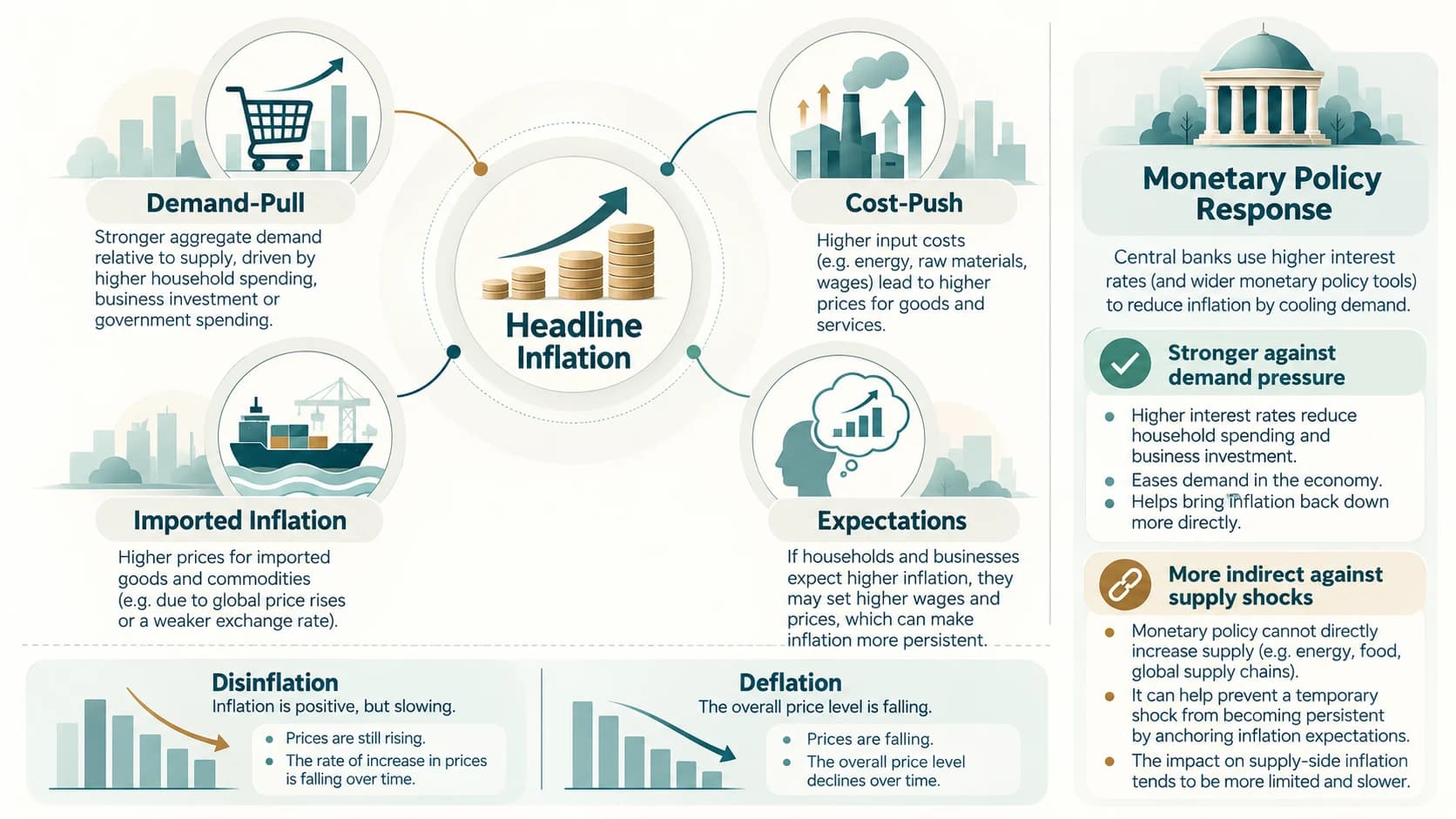
6. Demand-pull inflation
Demand-pull inflation occurs when aggregate demand grows faster than the economy's ability to supply goods and services.
Simple intuition:
too much spending chasing limited capacity.
Monetary tightening can be effective here because higher interest rates can moderate:
- borrowing;
- consumption;
- investment; and
- overall demand.
7. Cost-push inflation
Cost-push inflation arises from rising production costs.
Examples:
- crude oil;
- imported inputs;
- wages;
- electricity;
- freight;
- taxes;
- supply disruptions.
Monetary policy cannot directly reduce a global oil price shock.
But it can prevent temporary cost shocks from becoming persistent through:
- expectations;
- wages;
- broader pricing behaviour.
8. Imported inflation
If imported goods such as crude oil become more expensive, domestic prices can rise.
This can happen because:
- world prices rise; or
- the domestic currency depreciates.
Exchange-rate conditions therefore matter for inflation.
9. Inflation expectations
People make decisions based partly on what they expect prices to do.
If workers expect high inflation, they may demand higher wages.
If firms expect costs to rise, they may raise prices sooner.
If savers expect inflation, they may change portfolio decisions.
Therefore:
inflation expectations can become self-reinforcing.
A credible inflation target helps anchor expectations.
10. Real interest rate intuition
Approximate real interest rate:
Nominal interest rate - expected inflation
If a deposit yields 6% but inflation is expected at 5%:
approximate real return ≈ 1%.
Real rates influence:
- saving;
- borrowing;
- investment; and
- monetary-policy restrictiveness.
11. What is monetary-policy transmission?
Transmission is the process through which a change in monetary policy affects:
- financial-market rates;
- bank funding costs;
- deposit rates;
- loan rates;
- asset prices;
- exchange rates;
- expectations;
- consumption;
- investment;
- output; and
- inflation.
The chain takes time.
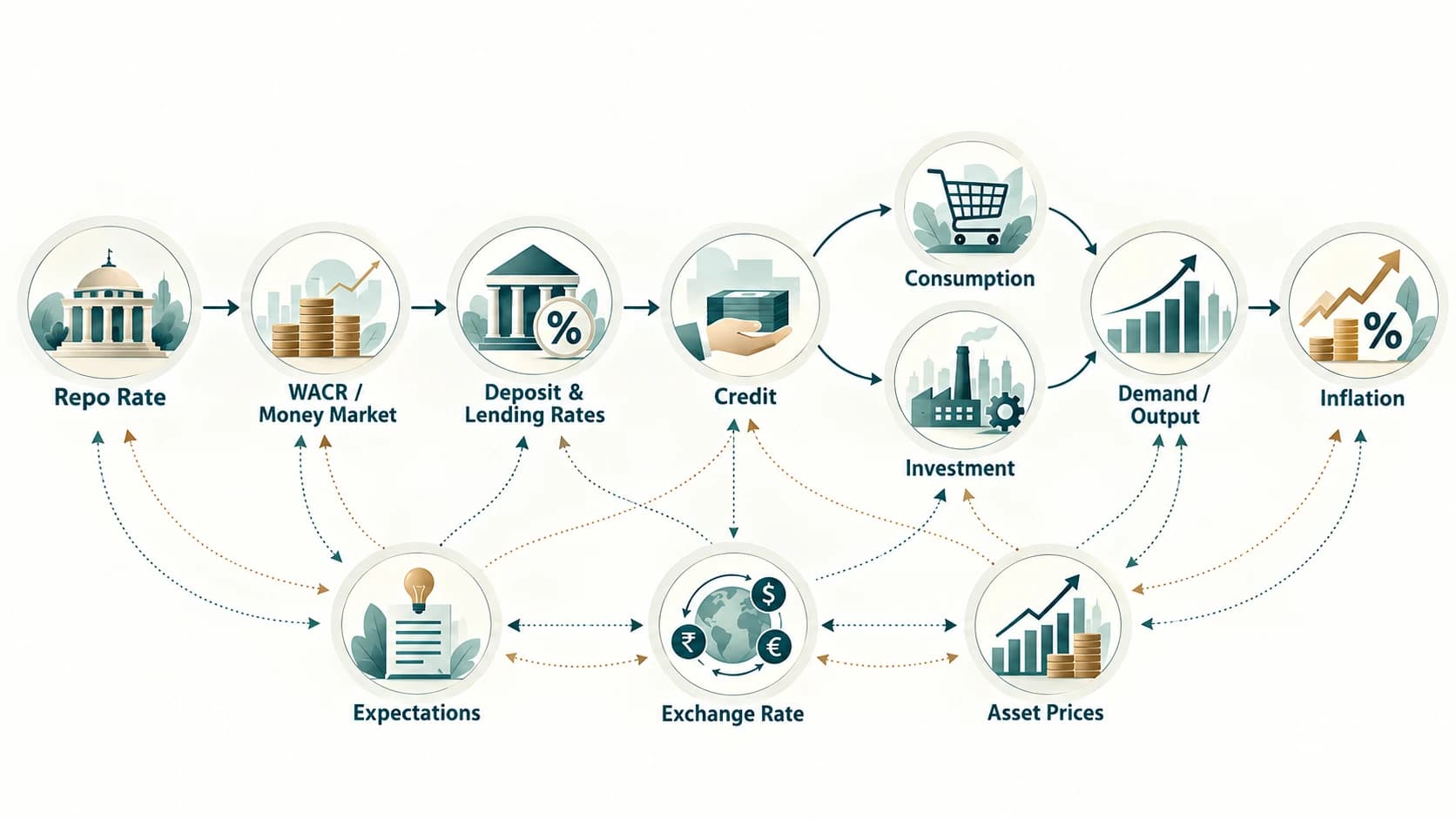
12. A simplified transmission chain
Suppose RBI raises repo.
Possible chain:
Repo ↑
→ overnight rates ↑
→ money-market/bond rates ↑
→ banks' funding and benchmark loan rates ↑
→ borrowing becomes costlier
→ credit/demand/investment may moderate
→ pricing pressure may ease
→ inflation moves lower over time.
This is a directional model, not a guaranteed mechanical sequence.
13. Interest-rate channel
The policy rate influences short-term money-market rates.
Those influence:
- bond yields;
- deposit rates;
- bank lending benchmarks; and
- other borrowing costs.
Higher rates can discourage some borrowing and spending.
Lower rates can support borrowing and spending.
14. Bank-lending channel
Banks are a major source of credit in India.
Monetary policy can affect:
- bank liquidity;
- funding cost;
- lending rates;
- willingness to lend; and
- credit demand.
The transmission is stronger when banks' loan pricing is closely linked to external benchmarks.
15. External Benchmark Lending Rate - EBLR
RBI's external benchmark framework, introduced for specified floating-rate loans from October 2019, strengthened transmission.
Eligible benchmarks include prescribed external benchmarks such as the policy repo rate or certain market benchmarks under the regulatory framework.
If a loan is explicitly linked to repo:
repo change can pass through more directly at the next reset.
Detailed loan-pricing systems are covered in Module 06.
16. MCLR transmission
MCLR is an internal bank benchmark linked to banks' marginal funding costs.
Transmission through MCLR can be slower because:
- deposit rates reprice gradually;
- the bank's funding mix changes over time; and
- loan reset dates vary.
Therefore repo changes need not immediately change every outstanding loan rate.
17. Expectations channel
Policy communication can affect the economy even before loans reset.
If RBI credibly signals concern about inflation:
- markets may expect higher future rates;
- bond yields can move;
- currency markets may react;
- firms may revise pricing/investment decisions.
Expectations are therefore an important monetary-policy channel.
18. Exchange-rate channel
Higher domestic interest rates can, all else equal, make domestic assets more attractive.
This can influence capital flows and the exchange rate.
A stronger currency can reduce some imported inflation.
But exchange rates depend on many global factors, so this channel is not mechanical.
19. Asset-price channel
Interest rates influence:
- bond prices;
- equity valuations;
- property financing;
- financial wealth.
Changes in asset prices can affect spending and investment.
20. Why transmission is not immediate
Transmission lags because:
- old deposits mature slowly;
- loans reset periodically;
- banks differ in funding mix;
- borrowers differ in rate type;
- market expectations can offset or amplify policy;
- credit demand changes;
- liquidity conditions matter;
- global financial conditions matter; and
- fiscal policy may push in the opposite direction.
Therefore RBI evaluates the effect of earlier policy decisions before reacting again.
21. What is a monetary-policy stance?
A stance communicates the broad direction or bias of policy.
It is not the same thing as the repo rate itself.
Historically, RBI has used language such as:
- accommodative;
- neutral;
- withdrawal of accommodation; and
- calibrated tightening.
The exact wording and meaning must always be read in the context of the MPC resolution.
22. Neutral stance
Broadly, a neutral stance signals flexibility to move in either direction depending on incoming data.
It does not mean:
- rates will never change; or
- monetary policy has no opinion about inflation/growth.
23. Accommodative stance
An accommodative stance broadly signals a bias toward supporting growth/easier monetary conditions, subject to inflation objectives.
This may be associated with:
- lower rates;
- easier liquidity; or
- willingness to support demand.
But stance and rate action can differ.
24. Tightening stance
A tightening-oriented stance signals greater concern about inflation or excessive demand/financial conditions.
A rate hike is a tightening action.
But an MPC can also hold the rate while communicating a restrictive/tightening bias.
25. Stance vs action
Possible combinations include:
- repo unchanged + stance changed;
- repo cut + stance neutral;
- repo hiked + stance tightening;
- repo unchanged + stance accommodative.
Therefore exam questions should read both lines separately.
26. Policy rate vs policy stance vs liquidity stance
Three different concepts:
Policy rate
What is the repo rate?
Policy stance
What broad direction/bias is the MPC communicating?
Liquidity operations
What is RBI doing to keep money-market rates aligned with the policy framework?
A central bank can inject liquidity for operational reasons even during a tightening cycle.
That does not automatically mean policy has become accommodative.
27. Why would RBI inject liquidity while raising repo?
This sounds contradictory until the framework is understood.
Suppose the MPC wants a higher policy rate to restrain inflation.
At the same time, a temporary tax-payment shock creates severe liquidity shortage.
RBI may inject short-term liquidity to keep WACR near the new higher repo rate.
That injection supports transmission of the tighter rate, not necessarily easing.
This is a very important advanced distinction.
28. Supply shock vs demand shock
Demand shock
Example:
credit and spending grow too fast.
Monetary tightening can directly reduce demand.
Supply shock
Example:
crop failure raises food prices.
Higher interest rates cannot produce more food.
But if the shock persists, policy may still respond to prevent:
- second-round inflation;
- unanchored expectations; and
- broader price increases.
29. Inflation below target can also be a problem
The framework has a lower tolerance level as well as an upper level.
Very low inflation or deflation can indicate:
- weak demand;
- falling pricing power;
- delayed spending;
- higher real debt burden; and
- weak growth.
Price stability therefore does not mean "the lower inflation, the better".
30. Disinflation vs deflation
Disinflation
Inflation is still positive but slowing.
Example:
6% → 5% → 4%.
Prices are still rising, but more slowly.
Deflation
Overall price level is falling.
Example:
inflation = -1%.
Do not confuse them.
31. Stagflation
Stagflation broadly combines:
- high inflation; and
- weak/stagnant growth.
This creates a difficult policy trade-off because tightening can further weaken activity while easing can worsen inflation.
32. Soft landing
A "soft landing" is a situation where inflation is brought under control without causing a severe recession or sharp growth collapse.
This is one of the central challenges of monetary-policy calibration.
33. Transmission in the Indian banking system
RBI's 2025-26 Annual Report noted steady transmission during the easing cycle and highlighted the growing role of external benchmark-linked lending.
The durable lesson is:
Transmission becomes faster where loan rates are directly linked to the policy benchmark, but remains heterogeneous across banks and products.
34. Policy credibility
If households and firms believe RBI will return inflation toward target:
- expectations stay more stable;
- less aggressive future action may be required.
If credibility weakens:
- people may expect persistent inflation;
- wages and prices may adjust faster;
- greater tightening may be needed.
Credibility is therefore a monetary-policy asset.
Quick check - BA-04-05
- What is headline inflation?
- What is core inflation?
- Is India's formal target headline CPI or core CPI?
- What is monetary-policy transmission?
- What is the difference between stance and rate action?
- Why can RBI inject liquidity even during a tightening phase?
Quick answers
- Inflation measured using the full CPI basket.
- A measure of underlying inflation that excludes especially volatile components such as food and fuel.
- Headline CPI.
- The process through which policy affects financial conditions, borrowing, spending, output and inflation.
- The stance communicates directional bias; rate action changes the policy rate.
- To correct temporary liquidity mismatches and keep overnight rates aligned with the chosen policy rate.