
Liquidity Management: LAF, OMOs, VRR/VRRR and Related Tools
Liquidity Management: LAF, OMOs, VRR/VRRR and Related Tools. A detailed chapter in Monetary Policy, Liquidity & Inflation, with explanations and examples for Indian banking examinations.
By Akhilesh Saini · Reviewed 7 Oct 2026
1. What does "liquidity" mean here?
In monetary-policy operations, system liquidity refers broadly to the availability of central-bank balances/funds in the banking system for settlement and reserve needs.
A banking system can be in:
- surplus liquidity; or
- deficit liquidity.
This is different from saying one individual bank is profitable or unprofitable.
Liquidity is about the availability of usable funds.
2. Why must RBI manage liquidity?
The MPC can set the repo rate, but that rate will not influence the economy effectively if actual overnight money-market rates move far away from it.
Therefore RBI manages liquidity to keep the WACR broadly aligned with the policy repo rate.
This is the operating link between:
policy decision
and
money-market conditions.
3. Liquidity Adjustment Facility - LAF
The Liquidity Adjustment Facility (LAF) is the framework through which RBI injects or absorbs liquidity using monetary-policy operations.
The broad toolkit includes:
- variable-rate repo;
- variable-rate reverse repo;
- SDF;
- MSF;
- fixed reverse repo where RBI chooses to use it; and
- other permitted liquidity operations.
Do not reduce LAF to only one repo auction.
It is a broader operating framework.
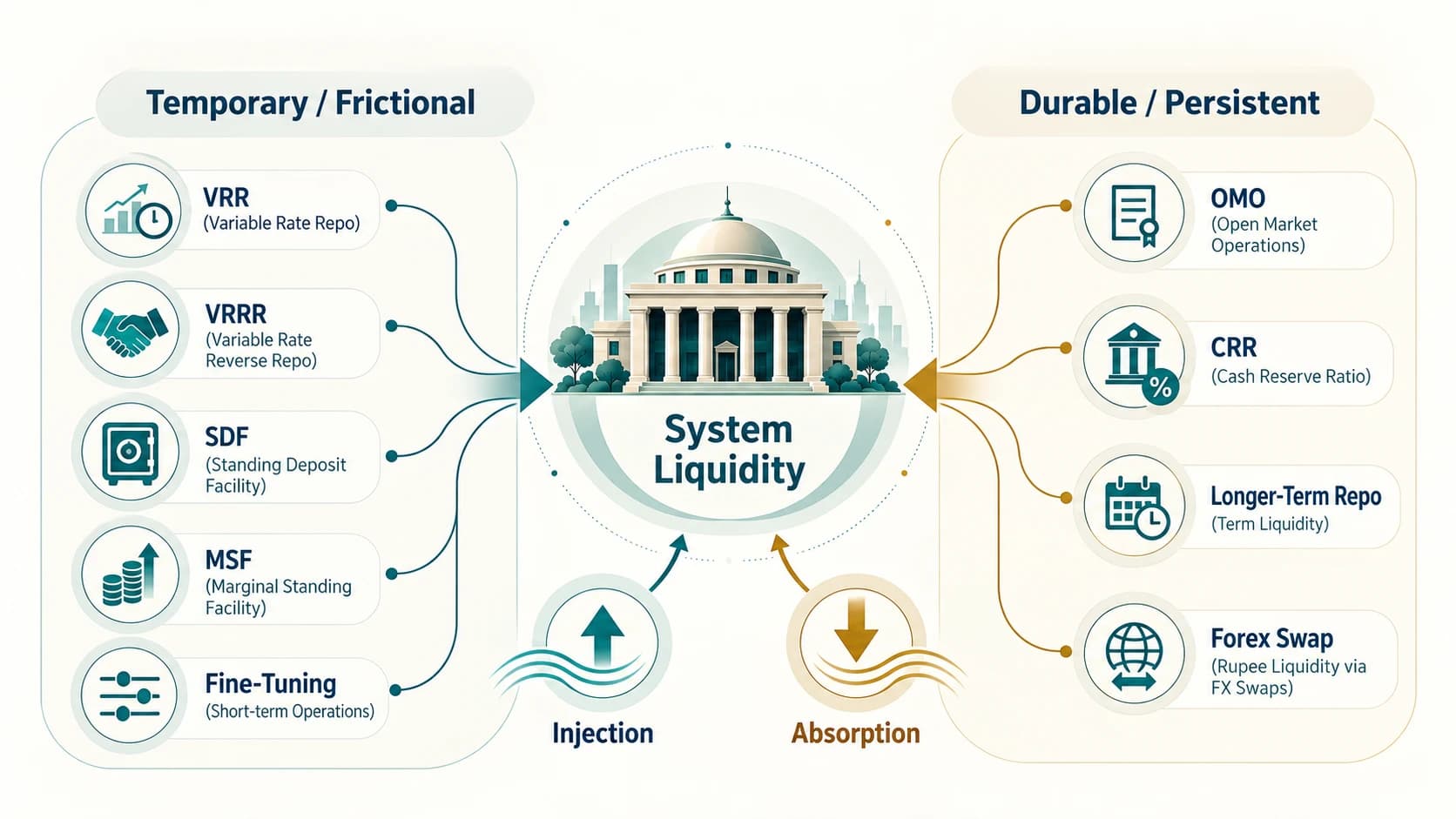
4. Injection vs absorption
Liquidity injection
RBI supplies funds to the banking system.
Examples:
- repo/VRR;
- OMO purchases;
- certain forex buy/sell swap structures;
- CRR cuts.
Liquidity absorption
RBI removes or parks surplus funds from the banking system.
Examples:
- SDF;
- VRRR;
- OMO sales;
- certain forex operations;
- CRR increases.
5. Frictional vs durable liquidity
This distinction makes the entire toolkit easier to understand.
Frictional or temporary liquidity
Short-lived mismatch caused by factors such as:
- tax payments;
- Government cash movements;
- currency demand;
- settlement flows; or
- temporary market conditions.
RBI can use short-tenor operations to smooth these mismatches.
Durable liquidity
Persistent/systemic liquidity surplus or deficit.
RBI may use tools such as:
- outright OMOs;
- longer-term repo operations;
- forex swaps; and
- CRR changes.
The exact mix depends on market conditions.
6. Revised liquidity framework from September 2025
RBI reviewed its liquidity-management framework in light of structural changes such as:
- 24×365 payment systems; and
- changes in Government fund-release arrangements.
The revised framework retained:
- WACR as the operating target; and
- a symmetric 50-basis-point corridor around repo.
A major change was:
the old 14-day VRR/VRRR auction was discontinued as the fixed "main operation".
Transient liquidity is now managed more flexibly, primarily through:
- 7-day VRR/VRRR; and
- other tenors from overnight to 14 days,
depending on conditions.
This is an important update because older books may still say:
"14-day VRR/VRRR is the main liquidity-management tool."
That is no longer the current operating description after the 2025 review.
7. Variable Rate Repo - VRR
A Variable Rate Repo (VRR) auction injects liquidity.
Banks and eligible participants bid for funds.
Rather than RBI simply lending every participant at one fixed rate, the auction determines allotment/cut-off based on bids and the announced operation.
Intuition
System faces short-term shortage.
RBI says:
"I will inject ₹X through a repo auction."
Participants submit bids.
Funds are allotted according to the auction mechanism.
8. Variable Rate Reverse Repo - VRRR
A VRRR auction absorbs surplus liquidity.
RBI invites participants to place funds for a specified tenor.
Intuition
System has excess cash.
RBI says:
"I will absorb ₹X for this tenor."
Participants submit bids.
The resulting cut-off reflects demand for the facility.
9. VRR vs VRRR
| VRR | VRRR |
|---|---|
| Injects liquidity | Absorbs liquidity |
| RBI provides funds | RBI takes surplus funds |
| Used in tight conditions | Used in surplus conditions |
| Variable-rate auction | Variable-rate auction |
10. Fine-tuning operations
Liquidity can change unexpectedly even within a reserve-maintenance cycle.
RBI therefore conducts fine-tuning operations of appropriate tenor.
These can be:
- injection;
- absorption;
- overnight; or
- multi-day.
The key word is flexibility.
Modern liquidity management is not a rigid timetable in which the same operation must always occur every fortnight.
11. Standing facilities vs discretionary operations
This is a valuable distinction.
Standing facilities
Available to eligible participants under the applicable framework:
- SDF;
- MSF.
Banks can access them at the corridor edges.
Discretionary RBI operations
RBI decides whether, when and how much to conduct:
- VRR;
- VRRR;
- OMO;
- forex swap;
- fixed reverse repo; and
- other operations.
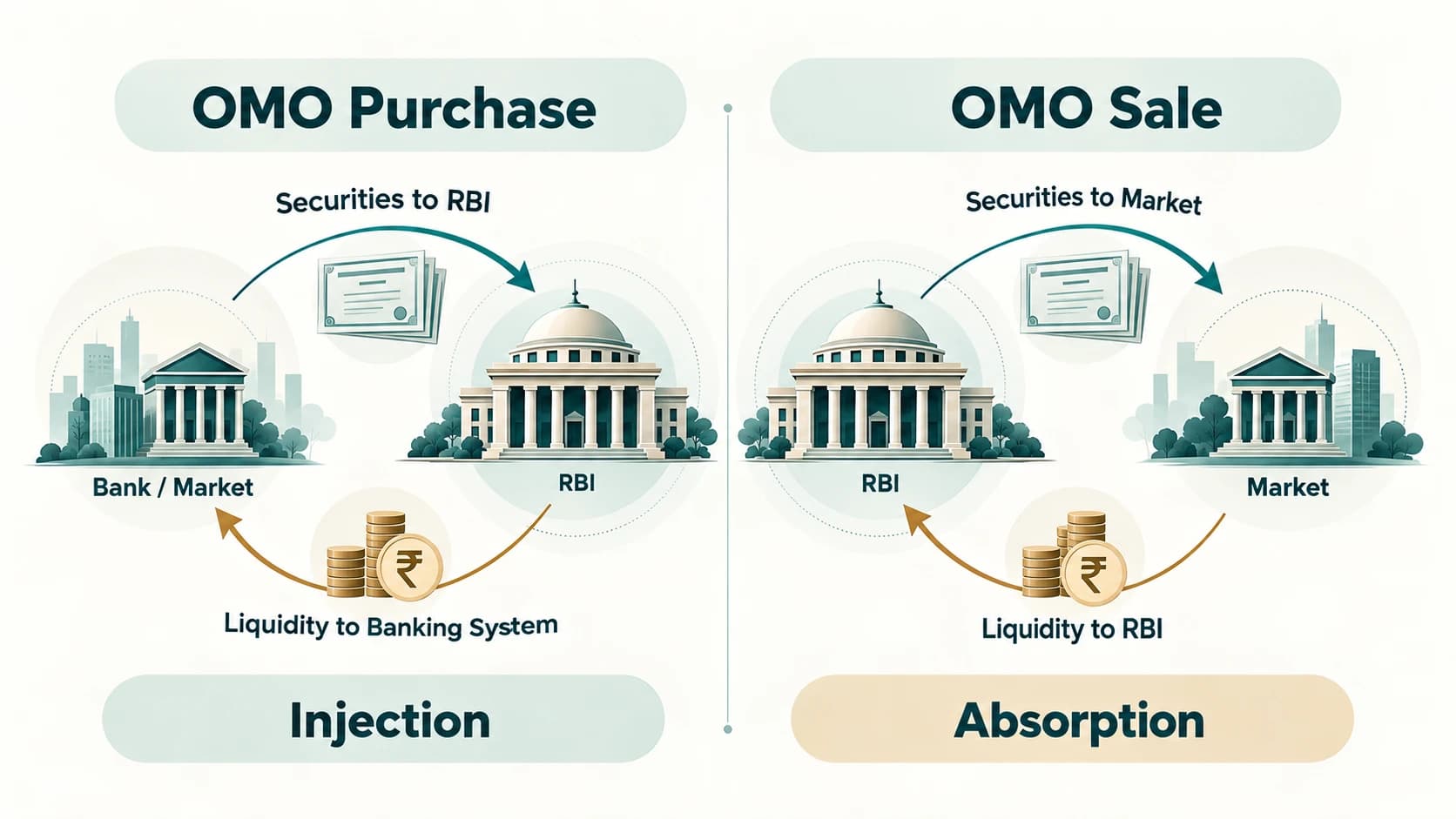
12. Open Market Operations - OMO
An Open Market Operation (OMO) is RBI's outright purchase or sale of Government securities in the market.
OMO purchase
RBI buys Government securities.
RBI pays money into the banking/financial system.
Result:
liquidity is injected.
OMO sale
RBI sells Government securities.
Market participants pay RBI.
Result:
liquidity is absorbed.
13. Repo vs OMO
This is one of the most important distinctions in the chapter.
Repo
- temporary transaction;
- collateralised;
- reversed later.
OMO
- outright purchase/sale;
- ownership of the security changes outright;
- used especially for more durable liquidity adjustment.
Think:
Repo = lend against security temporarily.
OMO = buy or sell the security outright.
14. OMO purchase example
RBI buys ₹10,000 crore of Government securities from market participants.
RBI credits funds into the financial system.
Bank reserves/liquidity increase.
This can:
- ease liquidity;
- influence money-market rates;
- support transmission.
15. OMO sale example
RBI sells ₹10,000 crore of Government securities.
Participants pay RBI.
Funds leave the banking system.
Liquidity decreases.
This can help absorb persistent surplus liquidity.
16. Forex swaps and rupee liquidity
RBI's foreign-exchange operations can affect domestic rupee liquidity.
For example, a USD/INR buy/sell swap can inject rupee liquidity for the swap tenor while managing the foreign-exchange leg under specified terms.
The mechanics are more advanced, but the exam concept is:
Forex operations can be monetary-liquidity tools as well as foreign-exchange-management operations.
17. Market Stabilisation Scheme - MSS
The Market Stabilisation Scheme is another liquidity-absorption mechanism.
Under MSS, Government securities/Treasury Bills can be issued for sterilisation purposes, with the proceeds impounded rather than used for normal Government spending.
MSS is not the everyday primary tool, but it remains useful to understand historically and conceptually.
18. Sterilisation
Suppose RBI buys a large amount of foreign currency.
It pays rupees into the system.
That can increase domestic liquidity.
If RBI does not want that extra liquidity to remain, it may use an operation such as:
- OMO sale; or
- another absorption instrument
to neutralise the monetary effect.
This is called sterilisation.
19. Government cash balances as a liquidity driver
Government transactions can materially change banking-system liquidity.
When large tax payments move funds from bank accounts to Government balances with RBI:
- liquidity can tighten.
When Government spends:
- funds move back into the banking system;
- liquidity can increase.
This is why RBI watches Government cash flows closely.
20. Currency in circulation as a liquidity driver
When the public withdraws more cash:
- deposits/reserve balances can move into physical currency;
- banking-system liquidity can tighten.
When currency returns to banks:
- liquidity can improve.
Seasonal cash demand therefore affects RBI liquidity operations.
21. Capital flows and forex operations
Foreign capital movements can affect:
- exchange rates;
- RBI forex operations; and
- rupee liquidity.
This is another reason modern liquidity management must be flexible rather than mechanical.
22. Why WACR matters
Call money is unsecured overnight lending between eligible financial institutions.
The weighted average rate in this market provides a useful signal of immediate liquidity conditions.
If WACR stays:
- near SDF for long periods, liquidity may be very abundant;
- near MSF, liquidity may be tight;
- near repo, the operating framework is transmitting the policy signal effectively.
This is simplified but conceptually useful.
23. LAF corridor does not mean every market rate must stay inside it
The corridor is designed to influence overnight rates.
It is not a legal ceiling/floor for every financial interest rate.
For example:
- a home-loan rate;
- a corporate bond yield;
- an unsecured credit-card rate
can be far above the MSF rate.
The corridor concerns the central bank's overnight operating framework.
24. Liquidity surplus is not automatically "good"
Too much liquidity can:
- push money-market rates below the policy signal;
- encourage risk-taking;
- weaken monetary control; and
- complicate inflation management.
Too little liquidity can:
- create funding stress;
- push rates sharply higher;
- disrupt payments and credit.
RBI therefore aims for liquidity conditions consistent with monetary-policy transmission, not "maximum liquidity".
25. Current operations can change frequently
The architecture of the framework is relatively stable.
But individual operations change daily or weekly.
Examples:
- amount of a VRR auction;
- tenor;
- OMO purchase size;
- net LAF absorption;
- SDF usage.
These belong in current data/current affairs, not in permanent module prose.
Quick check - BA-04-04
- What is the operating target of monetary policy?
- Which operation injects liquidity: VRR or VRRR?
- What is the difference between repo and OMO?
- What happens to liquidity when RBI buys Government securities outright?
- What changed in the liquidity framework after the 2025 review?
- Give two examples of durable-liquidity tools.
Quick answers
- WACR.
- VRR.
- Repo is a temporary collateralised transaction; OMO is an outright purchase/sale.
- Liquidity is injected.
- WACR and the 50-bps corridor were retained, while the rigid 14-day "main operation" was replaced by more flexible 7-day and other overnight-to-14-day VRR/VRRR operations.
- Examples: OMO, CRR change, longer-term repo, forex swaps.