
CRR and SLR
CRR and SLR. A detailed chapter in Monetary Policy, Liquidity & Inflation, with explanations and examples for Indian banking examinations.
By Akhilesh Saini · Reviewed 7 Oct 2026
1. Why reserve requirements exist
Banks do not keep every rupee of deposits idle.
They use deposits and other funding to:
- make loans;
- buy securities;
- meet withdrawals;
- settle payments; and
- maintain liquidity.
Reserve and liquidity requirements place minimum constraints on this balance-sheet structure.
The two classic Indian Banking Awareness terms are:
- Cash Reserve Ratio - CRR
- Statutory Liquidity Ratio - SLR
They are related but very different.
2. Cash Reserve Ratio - CRR
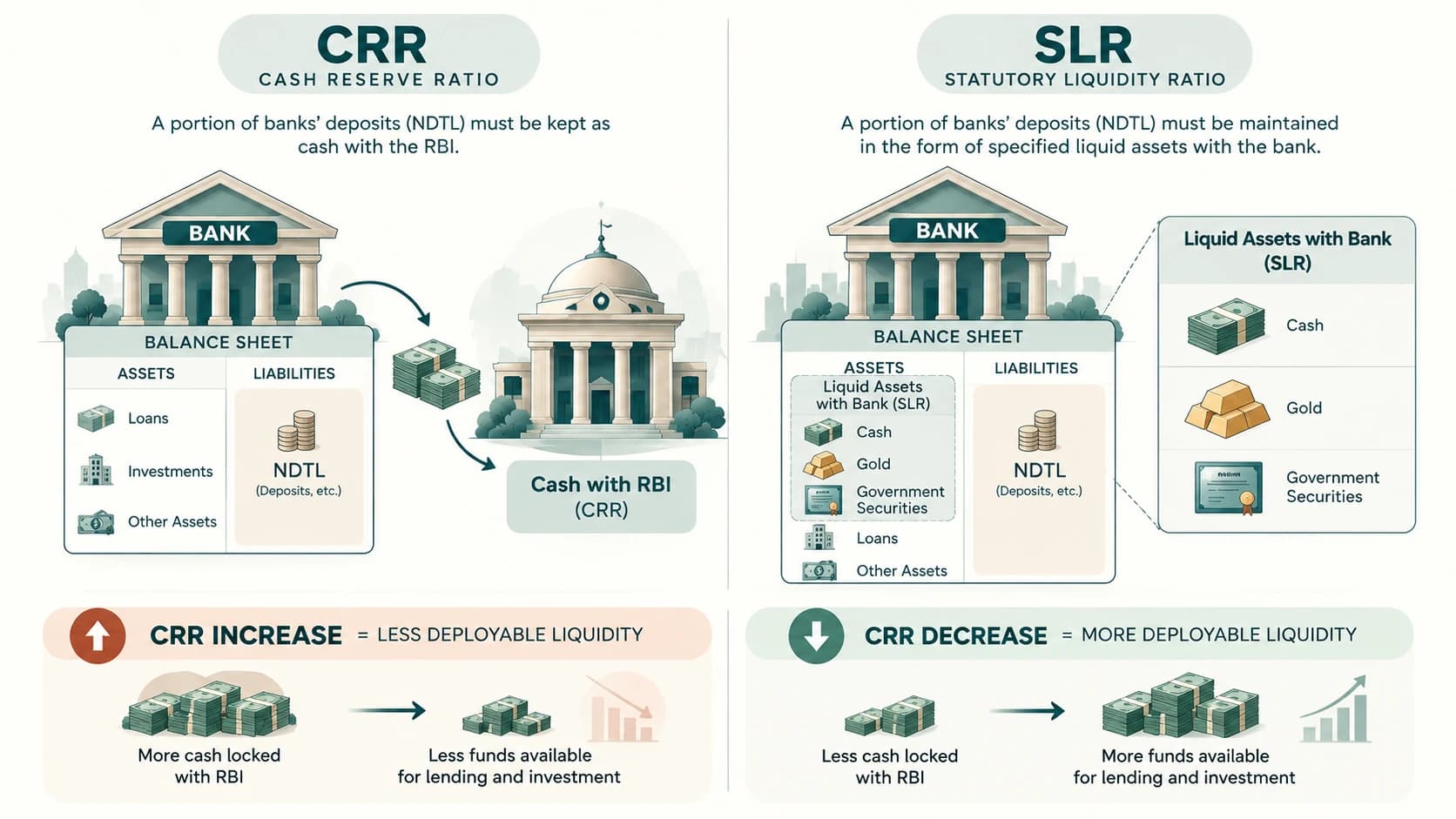
CRR is the prescribed proportion of a bank's Net Demand and Time Liabilities (NDTL) that must be maintained as cash balance with RBI.
The current ratio is notified by RBI and can change.
Key characteristics
CRR:
- is linked to NDTL;
- is maintained with RBI;
- is a cash reserve;
- affects the amount of funds available to banks; and
- is a powerful liquidity instrument.
3. What is NDTL?
NDTL stands for:
Net Demand and Time Liabilities
A bank's liabilities include deposits and other obligations.
Demand liabilities
Generally payable on demand.
Examples can include:
- current deposits;
- demand portion of savings deposits; and
- certain other immediately payable liabilities.
Time liabilities
Payable after a specified period.
Examples include:
- fixed deposits;
- time portion of savings deposits; and
- other term liabilities.
The exact regulatory computation is technical.
For Banking Awareness, the important idea is:
CRR and SLR are calculated with reference to the bank's prescribed demand-and-time-liability base.
4. Example of CRR
Suppose a bank's relevant NDTL for a simplified example is:
₹1,000 crore
and CRR is:
3%.
Required CRR balance:
₹1,000 crore × 3%
= ₹30 crore.
That ₹30 crore must be maintained with RBI according to the applicable rules.
5. Does RBI pay interest on CRR?
Banks do not receive interest on the required CRR balance.
This creates an opportunity cost because those funds cannot be deployed into loans or interest-earning securities.
6. What happens when CRR rises?
All else equal:
CRR rises → more cash must be kept with RBI → less deployable bank liquidity.
This can:
- tighten liquidity;
- reduce lendable resources;
- put upward pressure on money-market/funding conditions; and
- reinforce monetary tightening.
7. What happens when CRR falls?
All else equal:
CRR falls → less cash locked with RBI → more liquidity released to banks.
This can:
- increase deployable funds;
- ease liquidity;
- support credit; and
- improve banks' ability to meet funding needs.
But it does not force banks to lend.
Banks still consider:
- credit demand;
- borrower quality;
- capital;
- risk;
- funding costs; and
- economic conditions.
8. CRR as a liquidity tool vs repo rate as a price tool
A useful distinction:
Repo rate
Changes the price of central-bank liquidity / policy signal.
CRR
Changes the quantity of reserve balances banks must maintain.
This is why repo is often described as a price instrument and CRR as a quantity/liquidity instrument.
9. Statutory Liquidity Ratio - SLR
SLR is the prescribed proportion of a bank's demand and time liabilities that must be maintained in specified liquid assets.
These can include assets such as:
- cash;
- gold; and
- unencumbered approved securities, especially Government securities,
subject to the regulatory framework.
Unlike CRR:
SLR assets are generally maintained by the bank itself rather than as a cash balance with RBI.
10. Example of SLR
Suppose relevant liabilities are:
₹1,000 crore
and SLR is:
18%.
The bank must maintain:
₹180 crore
in eligible liquid assets under the applicable SLR framework.
This is conceptually different from maintaining ₹30 crore cash with RBI under a 3% CRR.
11. Why does SLR exist?
SLR supports:
- liquidity;
- a minimum buffer of liquid assets;
- banking-system resilience; and
- historically, monetary/credit-management objectives.
Government securities form an important part of SLR holdings.
12. CRR vs SLR - master comparison
| Feature | CRR | SLR |
|---|---|---|
| Full form | Cash Reserve Ratio | Statutory Liquidity Ratio |
| Maintained primarily as | Cash balance | Eligible liquid assets |
| Maintained with | RBI | Bank itself |
| Base | Prescribed NDTL/D-T liabilities | Prescribed DTL/NDTL framework |
| Interest income | Required CRR itself earns no interest | Eligible assets such as G-Secs can earn return |
| Main intuition | Cash reserve / liquidity withdrawal | Liquid-asset buffer |
| Can affect lending capacity | Yes | Yes |
| Current value can change | Yes | Yes |
13. Do CRR and SLR add together mechanically?
Students sometimes calculate:
CRR + SLR = "total money permanently blocked".
That is too simplistic.
CRR and SLR differ in:
- asset type;
- location;
- return;
- regulatory treatment; and
- operational purpose.
SLR Government securities remain assets of the bank and may be usable in permitted liquidity operations.
CRR is a cash balance with RBI.
So adding the percentages does not tell you a bank's true "unlendable" share.
14. CRR vs cash kept in branch vaults
Cash physically held in:
- branch counters;
- ATMs; or
- bank vaults
is not automatically the same as CRR.
CRR is a regulatory reserve balance maintained with RBI under the CRR framework.
15. SLR vs Government securities portfolio
Banks can hold Government securities for many reasons:
- SLR compliance;
- liquidity management;
- investment;
- treasury operations;
- collateral; and
- market-making.
Therefore:
Not every Government security held by a bank exists only because of SLR.
16. CRR and liquidity cycles
CRR changes can release or absorb durable banking-system liquidity.
For example:
a 100-basis-point CRR reduction frees a larger quantity of reserve balances than a small overnight fine-tuning operation.
This is why CRR is often used when RBI wants to make a durable adjustment to system liquidity.
17. Reserve requirements and monetary transmission
Suppose RBI cuts repo but banking-system liquidity is extremely tight.
Transmission may be weaker.
If RBI simultaneously ensures sufficient liquidity, banks may find it easier to transmit lower policy rates.
Conversely, a CRR increase can reinforce tightening.
Monetary policy therefore involves both:
- interest-rate signals; and
- liquidity conditions.
18. Current-value discipline
CRR and SLR are classic examples of:
Evergreen concept + Current Update
Students should permanently learn:
- what CRR means;
- what SLR means;
- how they differ; and
- how changes affect liquidity.
The actual percentage should come from current RBI data.
Quick check - BA-04-03
- Where is CRR maintained?
- What type of assets are used for SLR?
- Does the required CRR balance earn interest?
- What is the usual liquidity effect of a CRR cut?
- Is SLR maintained as a cash balance with RBI?
- Why is it misleading simply to add CRR and SLR and call the total "blocked money"?
Quick answers
- With RBI.
- Prescribed liquid assets such as cash, gold and eligible unencumbered approved securities.
- No.
- It releases banking-system liquidity.
- No; SLR assets are maintained by the bank under the prescribed framework.
- Because CRR and SLR differ in asset type, location, return and usability.