
Repo Rate, SDF, MSF and Bank Rate
Repo Rate, SDF, MSF and Bank Rate. A detailed chapter in Monetary Policy, Liquidity & Inflation, with explanations and examples for Indian banking examinations.
By Akhilesh Saini · Reviewed 7 Oct 2026
1. Start with the policy corridor, not four isolated definitions
Repo rate, SDF, MSF and Bank Rate are often taught as four unrelated one-line definitions.
That makes them hard to remember.
The better approach is to see the modern monetary-policy operating framework as a corridor.
At the centre:
Policy Repo Rate
Below it:
Standing Deposit Facility - SDF
Above it:
Marginal Standing Facility - MSF
And in the current framework:
Bank Rate is aligned with the MSF rate.
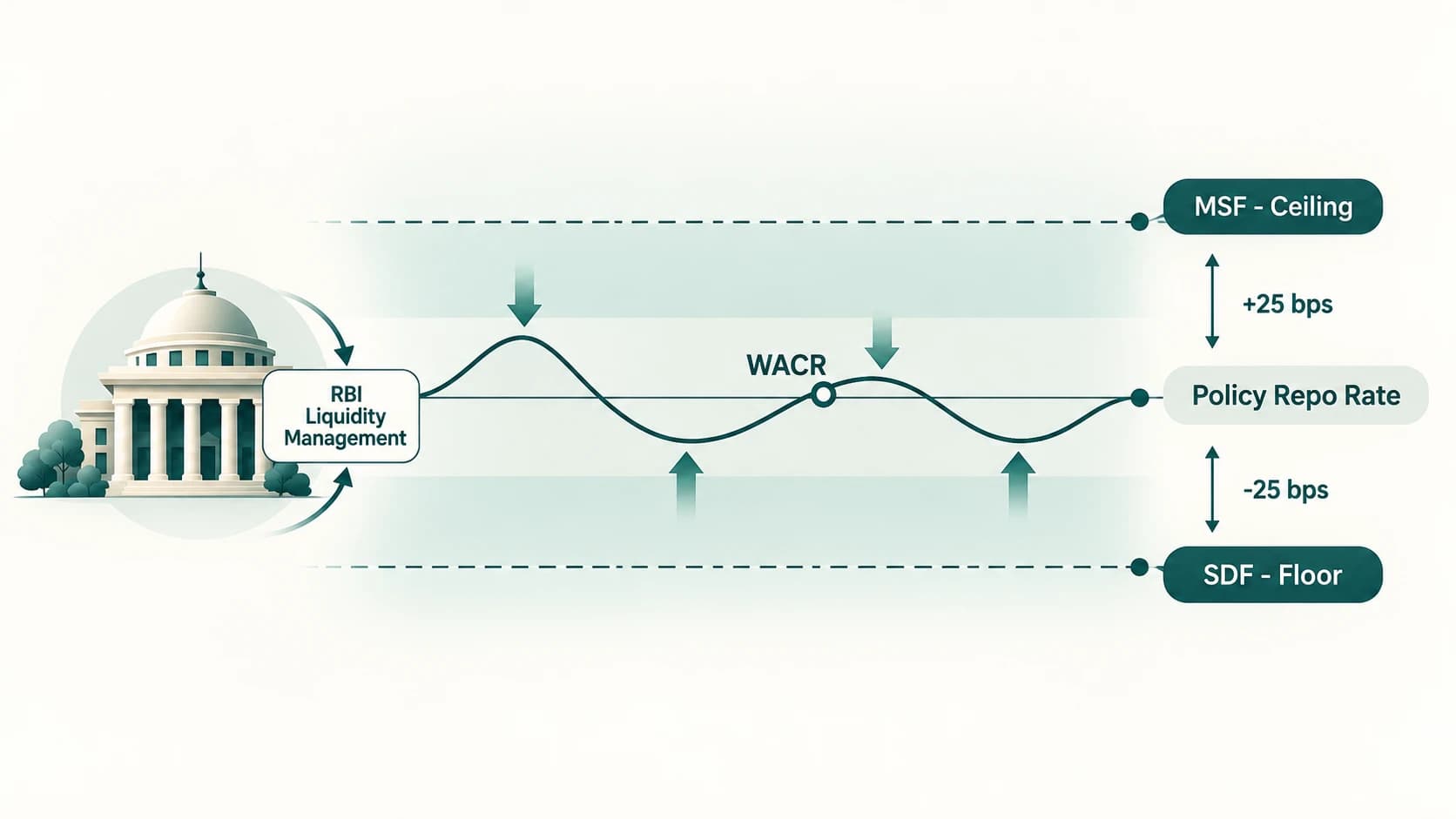
The corridor helps RBI influence the overnight money-market rate around the policy repo rate.
2. The policy repo rate
RBI defines the repo rate as the rate at which it provides liquidity under the Liquidity Adjustment Facility against eligible collateral such as Government securities and other approved securities.
For exam preparation, the policy repo rate is the key policy rate.
It signals the monetary-policy position of the MPC.
The common shorthand
You will often read:
"Repo rate is the rate at which RBI lends to banks."
This is directionally useful but incomplete.
A more accurate statement is:
The policy repo rate is the key rate at which RBI provides collateralised liquidity under the monetary-policy operating framework and serves as the central policy rate around which the operating corridor is organised.
3. Why does changing repo matter?
If the policy repo rate rises, RBI is signalling tighter monetary conditions.
Over time, this can place upward pressure on:
- overnight money-market rates;
- market yields;
- external benchmark-linked lending rates;
- other bank lending rates;
- deposit rates; and
- overall borrowing costs.
If repo falls, the opposite tendency can occur.
But transmission is not mechanical or instantaneous.
We study that in BA-04-05.
4. Standing Deposit Facility - SDF
The Standing Deposit Facility (SDF) allows eligible LAF participants to place overnight funds with RBI without providing collateral.
This is the crucial difference from reverse repo.
SDF is:
- an absorption facility;
- available at the discretion of eligible participants;
- uncollateralised; and
- the floor of the LAF corridor.
5. Why was SDF introduced?
Before SDF, the fixed reverse repo rate traditionally formed the floor of the policy corridor.
Reverse repo requires RBI to provide Government securities as collateral when it absorbs liquidity.
That can create a practical constraint because the amount RBI can absorb depends partly on its stock of eligible securities.
SDF removes that collateral constraint.
This gives RBI a standing uncollateralised tool for absorbing excess liquidity.
6. SDF as a financial-stability tool
RBI explicitly describes SDF as both:
- a liquidity-management tool; and
- a financial-stability tool.
Why?
Because it gives banks a safe overnight place to park surplus funds with the central bank while establishing the lower bound of the corridor.
7. SDF rate relative to repo
Under the current symmetric corridor design:
SDF is 25 basis points below repo.
If repo = 5.50%, then:
SDF = 5.25%.
A basis point is one-hundredth of a percentage point.
25 basis points = 0.25 percentage point.
8. Marginal Standing Facility - MSF
The Marginal Standing Facility (MSF) is an overnight borrowing facility through which eligible banks can obtain liquidity from RBI in exceptional or marginal situations.
MSF is the upper bound or ceiling of the LAF corridor.
Banks can access MSF by drawing against eligible securities within the applicable framework, including the permitted dip into their SLR portfolio.
9. Why is MSF above repo?
MSF is a standing backstop facility.
If ordinary money-market funding becomes expensive or scarce, a bank has access to central-bank overnight liquidity at the MSF rate.
Because MSF is intended as a marginal safety valve rather than normal cheap funding, it is priced above the policy repo rate.
Under the current corridor:
MSF = Repo + 25 basis points.
10. The LAF corridor
The normal symmetric corridor can be visualised as:
MSF - ceiling
↓
Policy Repo Rate - centre
↓
SDF - floor
With the current 50-basis-point full corridor:
- MSF is 25 bps above repo;
- SDF is 25 bps below repo.
The purpose is to help keep the overnight operating target close to the policy rate.
11. Weighted Average Call Rate - WACR
The Weighted Average Call Rate (WACR) is the operating target of monetary policy.
This is a very important conceptual point.
The MPC determines the policy repo rate.
RBI's day-to-day liquidity operations aim to keep the overnight call-money rate broadly aligned with that policy rate.
Think of it as:
MPC chooses the signal → RBI manages liquidity so the overnight market reflects the signal.
12. Policy rate vs operating target
| Concept | Role |
|---|---|
| Policy Repo Rate | Key policy rate decided by MPC |
| WACR | Operating target that RBI tries to align around repo |
| SDF | Floor of corridor |
| MSF | Ceiling of corridor |
This distinction is more advanced than the typical one-line exam note but makes the framework much easier to understand.
13. Bank Rate
RBI defines the Bank Rate as the standard rate at which it is prepared to buy or rediscount eligible bills of exchange or commercial paper under the statutory framework.
Historically, Bank Rate was a major monetary-policy signal.
In the modern operating framework, that original rediscount role is much less important.
Today:
Bank Rate is aligned with the MSF rate.
It is also used as a reference for certain penal interest rates, including reserve-requirement shortfalls.
14. Bank Rate vs repo
A common outdated statement says:
"Bank Rate is for long-term lending and repo is for short-term lending."
That is not a good description of the modern framework.
Better distinction:
- Repo is the key modern policy rate within the LAF framework.
- Bank Rate is a statutory rate under Section 49 of the RBI Act, now aligned to MSF and used in specified contexts including penalties.
15. Fixed Reverse Repo Rate
Reverse repo is the mirror image of repo in which RBI absorbs liquidity against collateral.
But after the introduction of SDF:
SDF replaced the fixed reverse repo rate as the floor of the LAF corridor.
The fixed reverse repo rate did not disappear from RBI's toolkit.
It remains available at RBI's discretion for specified purposes.
This is why old books that say:
"Reverse repo is always the floor of the corridor"
are outdated.
16. SDF vs reverse repo
| SDF | Reverse Repo |
|---|---|
| Absorbs liquidity | Absorbs liquidity |
| Uncollateralised | Collateralised |
| Standing facility | Repo/reverse-repo operation at RBI's discretion |
| Current corridor floor | No longer the normal corridor floor |
| Introduced in 2022 | Older instrument |
17. Repo vs MSF
| Repo | MSF |
|---|---|
| Key policy rate | Marginal overnight backstop rate |
| Centre of corridor | Ceiling of corridor |
| Normal policy signal | Safety valve for unexpected liquidity need |
| Lower than MSF | Higher than repo |
18. Repo transaction intuition
Suppose a bank needs short-term funds.
In a repo transaction:
- the bank provides eligible securities;
- RBI provides funds;
- the transaction includes an agreement to reverse later; and
- the implied interest cost reflects the repo rate/auction terms.
Economically, repo is collateralised borrowing.
19. Why are Government securities used?
Government securities are widely used as collateral because they are:
- highly standardised;
- liquid;
- considered low credit-risk in domestic-currency terms; and
- central to the financial system.
This links monetary-policy operations to Module 15 on Government securities.
20. Basis-point calculation
If repo changes:
from 5.25% to 5.50%,
the increase is:
0.25 percentage point
or
25 basis points.
Do not say "repo increased by 0.25%" if the exam expects basis points; that phrase can be ambiguous.
Quick check - BA-04-02
- Which rate is the key policy rate?
- Which rate is the floor of the LAF corridor?
- Which rate is the ceiling?
- Does SDF require collateral?
- What happened to fixed reverse repo after SDF was introduced?
- With a repo rate of 5.50%, what are SDF and MSF under a ±25 bps corridor?
Quick answers
- Policy repo rate.
- SDF.
- MSF.
- No.
- It remains in RBI's toolkit but SDF became the normal corridor floor.
- SDF 5.25%; MSF 5.75%.