
Monetary Policy Framework and the Monetary Policy Committee
Monetary Policy Framework and the Monetary Policy Committee. A detailed chapter in Monetary Policy, Liquidity & Inflation, with explanations and examples for Indian banking examinations.
By Akhilesh Saini · Reviewed 7 Oct 2026
1. What is monetary policy?
Monetary policy is the framework through which a central bank influences monetary and financial conditions in order to achieve macroeconomic objectives.
In India, monetary policy is conducted by the Reserve Bank of India within the statutory framework of the RBI Act.
Monetary policy influences:
- short-term interest rates;
- banking-system liquidity;
- credit conditions;
- deposit and lending rates;
- financial-market yields;
- aggregate demand;
- inflation expectations;
- economic activity; and
- ultimately inflation and growth.
A central bank does not directly decide the price of every loan, every deposit or every good in the economy.
Instead, it changes the financial conditions that influence the behaviour of:
- banks;
- households;
- firms;
- investors; and
- financial markets.
2. Primary objective of monetary policy in India
The amended RBI Act states that the primary objective of monetary policy is to maintain price stability while keeping in mind the objective of growth.
That sentence contains an important hierarchy.
Price stability is the primary objective.
Growth is not ignored, but the framework does not treat inflation control and growth as unrelated goals.
Persistent high inflation can itself damage growth by:
- reducing purchasing power;
- increasing uncertainty;
- distorting saving and investment decisions;
- increasing risk premiums;
- hurting fixed-income households; and
- destabilising financial conditions.
At the same time, excessively tight monetary conditions can weaken credit, demand and investment.
This is why India's framework is called flexible inflation targeting, not strict inflation targeting.
3. What is flexible inflation targeting?
A strict inflation-targeting framework would focus narrowly on keeping inflation at a numerical target at all times.
A flexible inflation-targeting framework recognises that:
- inflation can temporarily deviate because of food, fuel, weather or external shocks;
- monetary policy works with a lag;
- aggressive reaction to every short-term price movement can create unnecessary output volatility; and
- growth and financial conditions matter while inflation is brought toward target over time.
Therefore, the central bank aims to anchor inflation around a target while allowing limited short-term variation.
4. India's statutory inflation target
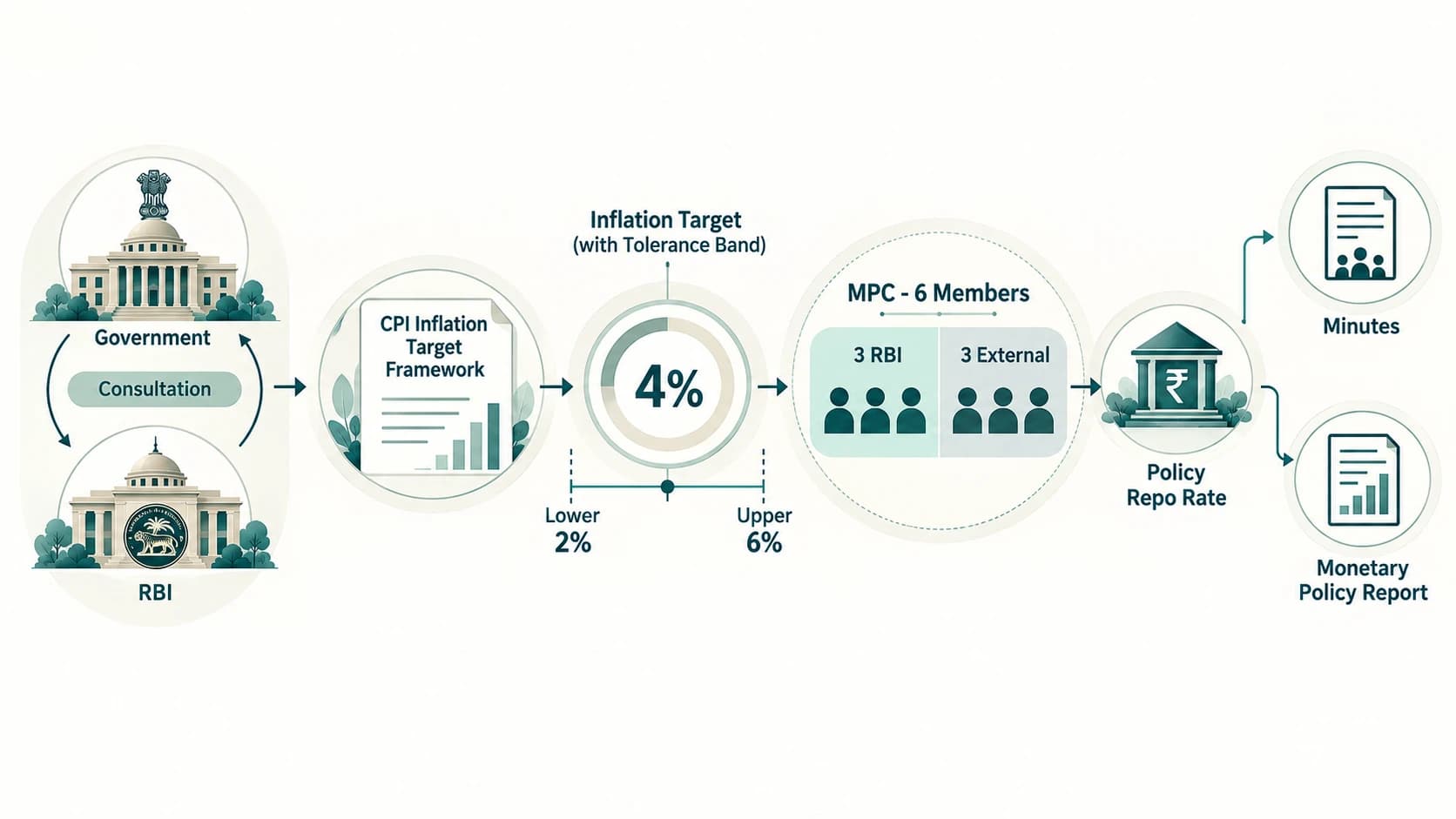
Under Section 45ZA of the RBI Act, the Central Government, in consultation with RBI, determines the inflation target in terms of the Consumer Price Index (CPI) once every five years.
For the period:
1 April 2026 to 31 March 2031
the notified framework retains:
- Inflation target: 4%
- Upper tolerance level: 6%
- Lower tolerance level: 2%
This is a target centred at 4%, not a target of "any inflation between 2% and 6%".
The centre of the framework remains 4%.
The tolerance band recognises short-term uncertainty and shocks.
5. Why headline CPI rather than WPI?
India's formal inflation target uses headline Consumer Price Index inflation.
This is important for exams.
Headline CPI:
- covers the retail prices faced by consumers;
- includes food and fuel;
- includes goods and services within the CPI basket; and
- is the nominal anchor for the monetary-policy framework.
Wholesale Price Index inflation is useful for understanding producer/wholesale price pressures but it is not the statutory inflation target used by the MPC.
Exam memory
MPC targets headline CPI inflation, not WPI inflation.
6. Inflation target vs tolerance band
A frequent mistake is to say:
"RBI's inflation target is 2% to 6%."
That is incomplete.
The correct description is:
The inflation target is 4%, with a lower tolerance level of 2% and an upper tolerance level of 6%.
This distinction matters because the long-term anchor is the midpoint.
7. What counts as failure to meet the inflation target?
Under the statutory framework, failure occurs if average inflation:
- remains above the upper tolerance level, or
- remains below the lower tolerance level
for three consecutive quarters.
Failure is therefore not triggered by one unusually high or low monthly CPI print.
If failure occurs
RBI must send a report to the Central Government setting out:
- the reasons for failure;
- the remedial actions proposed; and
- the estimated time required to return inflation to target.
This creates a formal accountability mechanism.
8. The Monetary Policy Committee
The Monetary Policy Committee, or MPC, determines the policy rate required to achieve the inflation target.
The MPC was given statutory status through amendments to the RBI Act in 2016.
It has six members:
Three RBI members
- Governor of RBI - Chairperson, ex officio
- Deputy Governor in charge of Monetary Policy - ex officio
- One RBI officer nominated by the Central Board
Three external members
Three experts are appointed by the Central Government.
The current external members, appointed in October 2024 for the applicable term, are:
- Prof. Ram Singh
- Shri Saugata Bhattacharya
- Dr. Nagesh Kumar
9. Who decides the repo rate: RBI Governor or MPC?
The policy repo rate is determined by the Monetary Policy Committee, not by the Governor acting alone.
The Governor:
- chairs the MPC;
- participates in discussion;
- has one ordinary vote like every other member; and
- has a second or casting vote if votes are equally divided.
This is an important exam distinction.
10. MPC voting rules
Under the RBI Act:
- each member has one vote;
- decisions are made by majority;
- the Governor has a casting vote if there is a tie;
- quorum is four members;
- at least one of those present must be the Governor or, in the Governor's absence, the Deputy Governor who is an MPC member; and
- each member's vote is recorded.
Each member also writes a statement explaining the reasoning behind the vote.
This makes monetary-policy decision-making transparent and accountable.
11. How often does the MPC meet?
The RBI Act requires at least four MPC meetings in a year.
In practice, RBI publishes an annual schedule and monetary-policy meetings occur more frequently than this statutory minimum.
Do not memorise a fixed number of meetings as if the law requires six.
The statutory wording is:
at least four.
12. What does the MPC actually decide?
The MPC's central statutory task is to determine the policy rate required to achieve the inflation target.
The policy resolution generally communicates:
- repo-rate decision;
- voting pattern;
- monetary-policy stance;
- assessment of inflation;
- assessment of growth;
- risks to the outlook; and
- projections.
Some liquidity, regulatory or financial-market measures may be announced around the same policy event, but not every RBI announcement is an MPC decision.
13. MPC resolution vs Governor's statement vs RBI measures
Students often treat everything announced on "monetary policy day" as one decision.
It helps to separate:
MPC Resolution
Contains the committee's policy-rate decision, stance and macro assessment.
Governor's Statement
Communicates the policy context and may announce or explain additional RBI measures.
RBI operational/regulatory measures
Can be decisions of the Reserve Bank outside the MPC's narrow statutory voting function.
This distinction is useful in questions asking:
"Who decided the repo rate?"
Answer: MPC.
14. MPC minutes
RBI publishes the minutes of an MPC meeting on the 14th day after the meeting, subject to the statutory publication framework.
The minutes include:
- the resolution;
- how each member voted; and
- each member's statement explaining the vote.
This allows students and markets to see whether the committee is:
- unanimous;
- divided;
- more concerned about inflation;
- more concerned about growth; or
- uncertain about future risks.
15. Monetary Policy Report
RBI publishes the Monetary Policy Report (MPR) once every six months.
The report explains areas such as:
- inflation dynamics;
- inflation outlook;
- growth outlook;
- risks;
- macroeconomic conditions;
- operating framework; and
- projection performance.
Do not confuse:
MPC Resolution - policy meeting decision
with
Monetary Policy Report - detailed periodic analytical report.
16. Why forward-looking policy matters
Monetary policy affects the economy with a lag.
Suppose inflation is high today because of a temporary food shock.
A rate increase today may take months to affect:
- bank lending rates;
- borrowing;
- investment;
- consumption; and
- inflation.
Therefore the MPC cannot make decisions only from the latest monthly inflation number.
It must assess:
- expected inflation;
- growth;
- wages;
- commodity prices;
- food conditions;
- fiscal policy;
- global rates;
- exchange rates;
- credit growth;
- financial conditions; and
- expectations.
That is why monetary policy is forward-looking and data-dependent.
17. Inflation target and growth objective
A good exam answer should avoid two extremes.
Wrong extreme 1:
RBI only cares about inflation.
Wrong extreme 2:
RBI gives inflation and growth exactly equal priority at all times.
Better answer:
Price stability is the primary objective of monetary policy, while the framework also keeps the objective of growth in mind.
18. What information does the MPC examine?
MPC deliberations use a broad information set including:
- CPI inflation;
- food and fuel prices;
- core inflation indicators;
- GDP and activity indicators;
- credit conditions;
- liquidity;
- financial-market conditions;
- household inflation expectations;
- business expectations;
- external-sector developments;
- commodity prices;
- exchange-rate conditions; and
- global monetary policy.
This is why a single data point rarely tells you with certainty what the MPC will do.
Quick check - BA-04-01
- What is the primary objective of monetary policy in India?
- What measure of inflation is the formal target?
- What is the current statutory inflation target for 2026-31?
- How many members does the MPC have?
- Who has the casting vote if the MPC is tied?
- How many consecutive quarters outside the tolerance band constitute failure?
Quick answers
- Price stability while keeping in mind the objective of growth.
- Headline CPI inflation.
- 4%, with a tolerance range from 2% to 6%.
- Six.
- The RBI Governor.
- Three consecutive quarters.