
RBI Regulation, Supervision and Licensing of Banks
RBI Regulation, Supervision and Licensing of Banks. A detailed chapter in Reserve Bank of India, with explanations and examples for Indian banking examinations.
By Akhilesh Saini · Reviewed 7 Oct 2026
1. Why do banks need special regulation?
Banks are unusual businesses.
They:
- hold public deposits;
- create credit;
- operate payment channels;
- are highly interconnected;
- use leverage; and
- can transmit distress rapidly through the financial system.
If a manufacturing company fails, the damage can be serious.
If a large bank fails disorderly, the consequences can include:
- depositor losses or panic;
- payment disruption;
- credit contraction;
- contagion to other institutions; and
- broader economic instability.
That is why banking regulation is much more intensive than ordinary company regulation.
2. Regulation, supervision and enforcement are different
Regulation
Regulation means setting the rules.
Examples:
- minimum capital;
- governance standards;
- exposure limits;
- liquidity rules;
- asset classification;
- permitted activities;
- customer-related rules; and
- ownership requirements.
Supervision
Supervision means assessing how an institution actually operates.
Examples:
- risk assessment;
- review of data;
- on-site examination;
- discussions with management;
- analysis of controls;
- stress testing;
- follow-up monitoring.
Enforcement
Enforcement involves action when legal or regulatory requirements are violated.
Examples can include:
- monetary penalties;
- restrictions;
- directions;
- corrective orders; and
- other statutory action.
Easy memory line
Regulation writes the rulebook. Supervision checks the institution. Enforcement acts on violations.
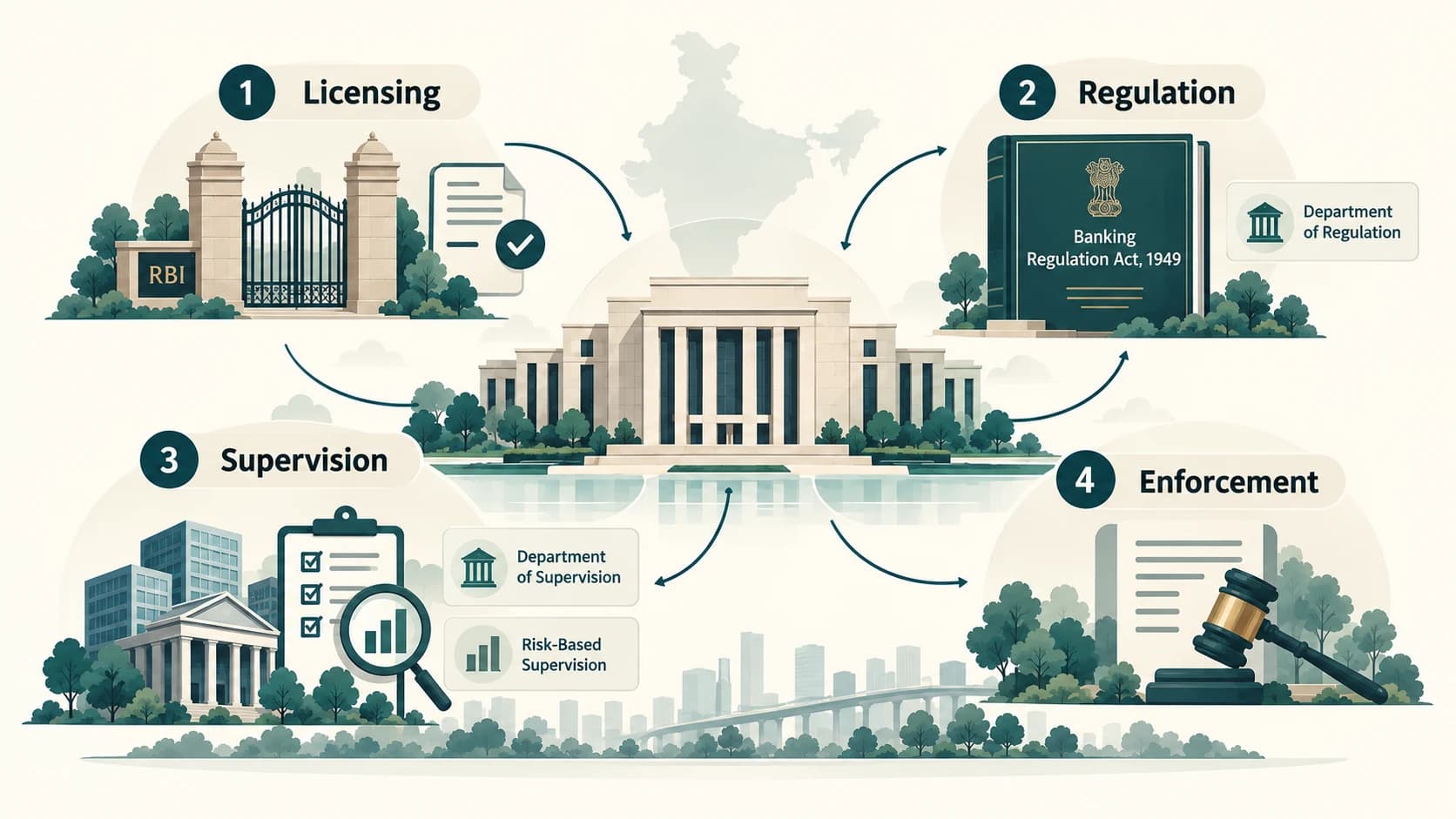
3. Main legal foundation
The Banking Regulation Act, 1949 is a core law for bank regulation.
Important provisions include RBI powers concerning:
- licensing of banking companies;
- opening/transferring places of business;
- inspection;
- directions;
- management;
- capital/liquidity requirements; and
- restructuring/amalgamation-related matters.
The RBI Act also provides important powers, while other financial laws govern specialised areas.
4. Department of Regulation
RBI's Department of Regulation (DoR) is the primary regulatory department for a wide range of RBI-regulated financial entities.
Its regulatory universe includes, among others:
- commercial banks;
- co-operative banks;
- NBFCs;
- Asset Reconstruction Companies;
- All India Financial Institutions; and
- Credit Information Companies.
Modern RBI regulatory architecture separates prudential concerns from conduct/operations through specialised divisions.
For exams, the key point is not every internal desk name.
Remember:
DoR sets much of the prudential and conduct framework for RBI-regulated financial institutions.
5. Department of Supervision
The Department of Supervision (DoS) carries out supervision of a broad range of entities within RBI's supervisory mandate.
This includes categories such as:
- Scheduled Commercial Banks, subject to the applicable exclusions/framework;
- Local Area Banks;
- Payments Banks;
- Small Finance Banks;
- Urban Co-operative Banks;
- NBFCs;
- Asset Reconstruction Companies;
- Credit Information Companies; and
- All India Financial Institutions.
Exact jurisdictional arrangements can evolve and should be verified from current RBI material when detailed questions are asked.
6. Why regulation and supervision were unified functionally
Historically, different departments handled regulation and supervision for banks, NBFCs and co-operative banks.
RBI later moved toward:
- a unified Department of Regulation; and
- a unified Department of Supervision
to deal more holistically with interconnected risks and reduce gaps or supervisory arbitrage.
This is a useful illustration of how central-bank organisation changes in response to a more complex financial system.
7. Bank licensing
Section 22 of the Banking Regulation Act deals with licensing of banking companies.
A company cannot simply call itself a bank and start accepting public deposits for banking merely because it has registered under company law.
Banking requires the appropriate legal licence.
Why licensing is important
Before allowing a new bank, RBI considers issues such as:
- promoter suitability;
- financial strength;
- capital;
- ownership structure;
- governance;
- business plan;
- risk management;
- public interest; and
- ability to comply with banking regulation.
Licensing is therefore a prudential gatekeeping function.
8. On-tap licensing
India has evolved from occasional licensing rounds to continuing or on-tap licensing frameworks for certain bank categories.
"On tap" means eligible applicants can apply under an ongoing framework rather than waiting for a one-time licensing window.
The exact entry-capital requirements, promoter criteria and structural rules are current regulatory data and should be sourced from RBI's latest licensing guidelines or regulatory handbook.
Do not memorise an old capital figure forever.
9. Universal banks and differentiated banks
A universal bank conducts a broad commercial-banking business subject to regulation.
Differentiated banks have more specialised mandates or restrictions.
Examples include:
- Small Finance Banks;
- Payments Banks; and
- Local Area Banks.
These were introduced for objectives including competition and financial inclusion.
Their business-model differences were introduced in Module 02.
10. Banking licence vs scheduled-bank status
This is a very important confusion.
A banking licence relates to permission to carry on banking business under the Banking Regulation Act framework.
Scheduled status relates to inclusion in the Second Schedule to the RBI Act.
They are different legal concepts.
A question asking:
"Is this bank scheduled?"
is not asking the same thing as:
"Does this entity hold a banking licence?"
11. Branch authorisation
The Banking Regulation Act also provides a statutory framework for opening or shifting places of business.
Over time, branch authorisation policy has been liberalised and differentiated by bank type and location.
The broad principle remains:
RBI can regulate where and how banking presence expands, subject to the prevailing branch-authorisation framework.
Detailed branch rules are current regulatory content, not fixed forever.
12. Prudential regulation
"Prudential" regulation aims to make institutions financially sound and able to absorb risk.
Major areas include:
- capital;
- liquidity;
- large exposures;
- connected lending restrictions;
- asset classification;
- provisioning;
- concentration risk;
- governance;
- risk management; and
- disclosure.
Detailed Basel and capital-adequacy concepts are covered in Module 14.
13. Conduct regulation
A bank can be financially strong and still treat customers unfairly.
Conduct-related regulation addresses how financial services are delivered.
Examples include:
- deposit practices;
- transparency;
- fair lending;
- customer due diligence;
- grievance redress;
- digital-lending conduct; and
- customer protection.
Module 12 studies KYC, AML and customer protection in detail.
14. Inspection powers
Section 35 of the Banking Regulation Act gives RBI important inspection powers.
Inspection allows the supervisor to examine:
- books;
- records;
- operations;
- management;
- risk controls; and
- compliance.
Modern supervision combines on-site inspection with extensive off-site data and analytics.
15. Power to issue directions
Section 35A of the Banking Regulation Act empowers RBI to issue directions in specified circumstances.
Directions can be used to protect:
- public interest;
- banking policy;
- depositors; and
- sound management.
This is an important reason RBI circulars and Master Directions carry regulatory force within their statutory scope.
16. Risk-Based Supervision - RBS
Older bank supervision relied heavily on point-in-time inspection frameworks.
Modern RBI supervision uses Risk-Based Supervision (RBS).
RBS asks:
- What are the most important risks in this institution?
- How likely are they to materialise?
- How strong are governance and controls?
- Is capital adequate for the risk?
- Could the institution create wider systemic problems?
- What supervisory intensity is appropriate?
Supervisory resources are then focused according to risk.
Why RBS is better than pure checklist supervision
A bank can formally comply with many rules yet still have rapidly growing hidden risks.
Risk-based supervision tries to detect:
- business-model weakness;
- concentration;
- poor governance;
- technology risk;
- liquidity vulnerability;
- asset-quality deterioration; and
- emerging systemic problems.
17. On-site and off-site supervision
On-site supervision
Supervisors examine the institution directly, its systems, governance, records and operations.
Off-site supervision
RBI receives and analyses returns, data and supervisory information without being physically present at the bank.
Modern supervision uses both.
Continuous data monitoring helps detect changes between formal inspections.
18. Board for Financial Supervision
The Board for Financial Supervision (BFS) provides high-level oversight of supervisory work within RBI's jurisdiction.
It supports focused attention on the safety and soundness of regulated entities and the financial system.
For exams, associate BFS with:
supervision of financial institutions
not with:
- printing banknotes;
- preparing the Union Budget; or
- setting stock-market listing rules.
19. Corrective action and intervention
Supervision has little value if serious weaknesses are identified but nothing can be done.
RBI can use tools such as:
- supervisory directions;
- restrictions;
- corrective-action frameworks;
- governance intervention;
- enforcement action; and
- resolution/reconstruction tools under the applicable law.
The exact response depends on:
- type of institution;
- severity;
- legal powers; and
- systemic implications.
Prompt Corrective Action and detailed resolution topics are covered later in Module 14.
20. Does RBI regulate every financial institution in India?
No.
India has a multi-regulator financial architecture.
Examples:
- RBI - banks and many other financial entities, payment systems, forex and central banking functions;
- SEBI - securities market;
- IRDAI - insurance;
- PFRDA - pension sector.
There can also be overlapping interfaces.
Do not assume:
"All finance = RBI."
21. Does RBI supervise every entity it regulates in exactly the same way?
No.
Regulation and supervision can differ across:
- commercial banks;
- co-operative banks;
- NBFCs;
- payment operators;
- AIFIs;
- credit information companies; and
- other regulated entities.
The same RBI umbrella does not mean identical rules.
22. Regulation is dynamic
Banking regulation changes because:
- financial products evolve;
- technology changes;
- risks change;
- crises reveal weaknesses;
- international standards evolve; and
- consumer behaviour changes.
Therefore current regulatory thresholds should be separated from evergreen concepts.
Quick check - BA-03-05
- What is the difference between regulation and supervision?
- Which Act contains the core banking-company licensing provision?
- Is scheduled-bank status the same as a banking licence?
- What is Risk-Based Supervision?
- Which section of the Banking Regulation Act is commonly associated with inspection?
- Does RBI regulate the securities market in the same way SEBI does?
Quick answers
- Regulation sets rules; supervision assesses the actual institution and its risk/compliance.
- Banking Regulation Act, 1949.
- No.
- A supervisory approach that focuses attention and resources on the material risks of an institution and the quality of its controls.
- Section 35.
- No. SEBI is the principal securities-market regulator.