
Reserve Bank of India
The Reserve Bank of India sits at the centre of the Indian monetary and banking system. A student who understands RBI clearly can later understand monetary policy, CRR and liquidity, bank regulation, currency management, government borrowing, payment systems, financial stability and many other Banking Awareness topics far more easily. This module builds that central-bank mental model before the course moves into detailed monetary-policy instruments in Module 04.
Recommended prerequisites: Module 01 - Money & Banking Foundations; Module 02 - Evolution & Structure of Indian Banking.
Purpose of this module: The Reserve Bank of India sits at the centre of the Indian monetary and banking system. A student who understands RBI clearly can later understand monetary policy, CRR and liquidity, bank regulation, currency management, government borrowing, payment systems, financial stability and many other Banking Awareness topics far more easily. This module builds that central-bank mental model before the course moves into detailed monetary-policy instruments in Module 04.
What you will learn
By the end of Module 03, you should be able to:
- explain why India created a central bank and place the establishment of RBI in historical context;
- explain the legal foundation, ownership, governance and board structure of RBI;
- distinguish the Governor, Deputy Governors, Central Board, Local Boards, departments and specialist supervisory boards;
- explain the major functions of RBI without confusing monetary policy with fiscal policy;
- explain who issues banknotes, coins and the one-rupee note in India;
- describe the banknote life cycle from demand estimation to printing, distribution, sorting and destruction;
- explain currency chests and the role of commercial banks in currency distribution;
- explain how RBI acts as banker to the Central and State Governments;
- explain how RBI acts as banker to banks and why it is called lender of last resort;
- distinguish regulation, supervision, licensing, inspection and enforcement;
- explain the basic legal powers RBI uses to regulate and supervise banks; and
- recognise which RBI facts are evergreen concepts and which leadership, organisational and regulatory facts require current verification.
Before you begin: RBI is not a commercial bank
A commercial bank deals directly with households and businesses by accepting deposits, making loans and providing payment services.
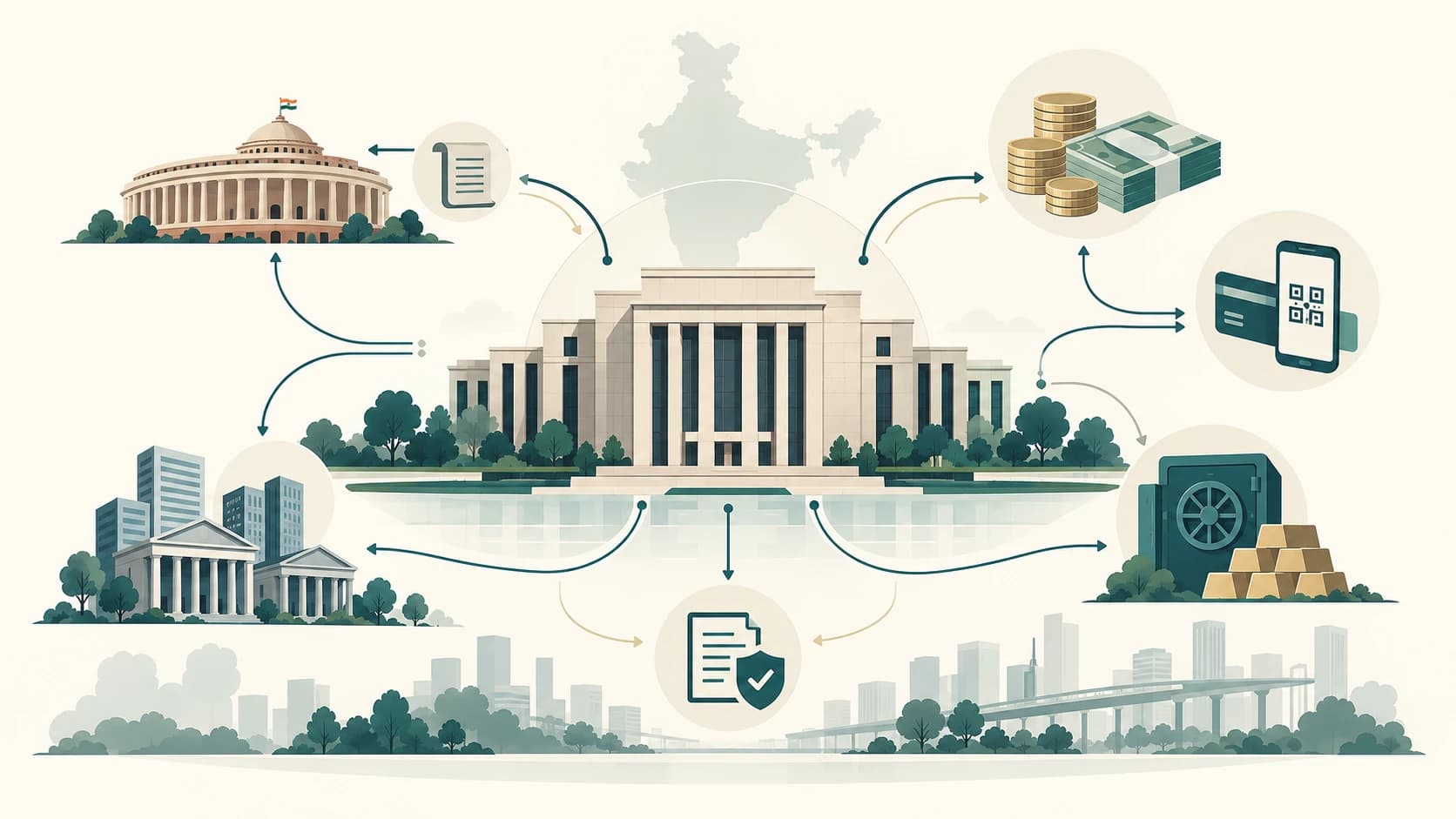
RBI is the central bank of India. Its job is much broader and system-level. It is responsible for functions such as:
- monetary policy;
- issue and management of banknotes;
- regulation and supervision of much of the banking and financial system;
- management of payment and settlement systems;
- management of foreign exchange reserves;
- banker to governments;
- banker to banks;
- government debt management; and
- developmental and financial-stability functions.
RBI therefore does not compete with ordinary banks for savings accounts or retail home-loan customers.
A useful mental model is:
Commercial banks operate inside the banking system. RBI helps operate, regulate and stabilise the system itself.
Chapters
RBI: Origin, Structure and Governance
RBI: Origin, Structure and Governance. A detailed chapter in Reserve Bank of India, with explanations and examples for Indian banking examinations.
Functions of the RBI
Functions of the RBI. A detailed chapter in Reserve Bank of India, with explanations and examples for Indian banking examinations.
Currency Issue and Currency Management in India
Currency Issue and Currency Management in India. A detailed chapter in Reserve Bank of India, with explanations and examples for Indian banking examinations.
RBI as Banker to Government and Banks
RBI as Banker to Government and Banks. A detailed chapter in Reserve Bank of India, with explanations and examples for Indian banking examinations.
RBI Regulation, Supervision and Licensing of Banks
RBI Regulation, Supervision and Licensing of Banks. A detailed chapter in Reserve Bank of India, with explanations and examples for Indian banking examinations.