
Currency Issue and Currency Management in India
Currency Issue and Currency Management in India. A detailed chapter in Reserve Bank of India, with explanations and examples for Indian banking examinations.
By Akhilesh Saini · Reviewed 7 Oct 2026
1. Currency management is more than printing notes
A common exam misconception is that currency management simply means "RBI prints money".
RBI does not operate every printing press directly, and currency management includes much more than production.
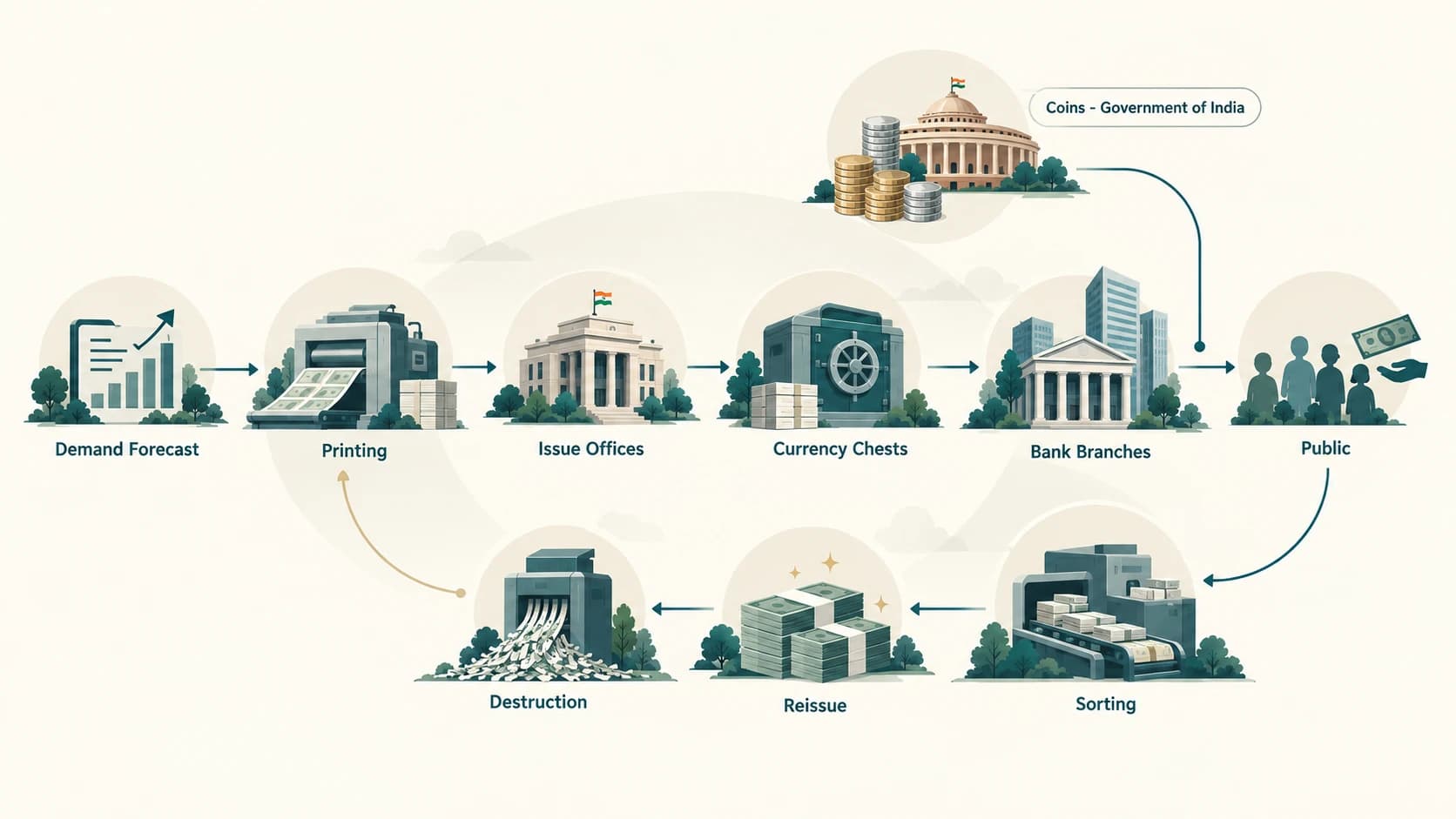
The full life cycle involves:
forecasting demand → production → issue → distribution → circulation → sorting → withdrawal of unfit notes → destruction
It also requires coordination between:
- RBI;
- Government of India;
- banknote-printing presses;
- mints;
- currency chests;
- bank branches; and
- the public.
2. Who has the right to issue banknotes?
Section 22 of the RBI Act gives RBI the sole right to issue banknotes in India, subject to the law.
This makes RBI the nation's note-issuing authority.
But one important exception must be remembered:
The one-rupee note is a Government of India liability, not an RBI liability.
Coins are also Government of India liabilities.
RBI plays the major distribution role for coins supplied by Government.
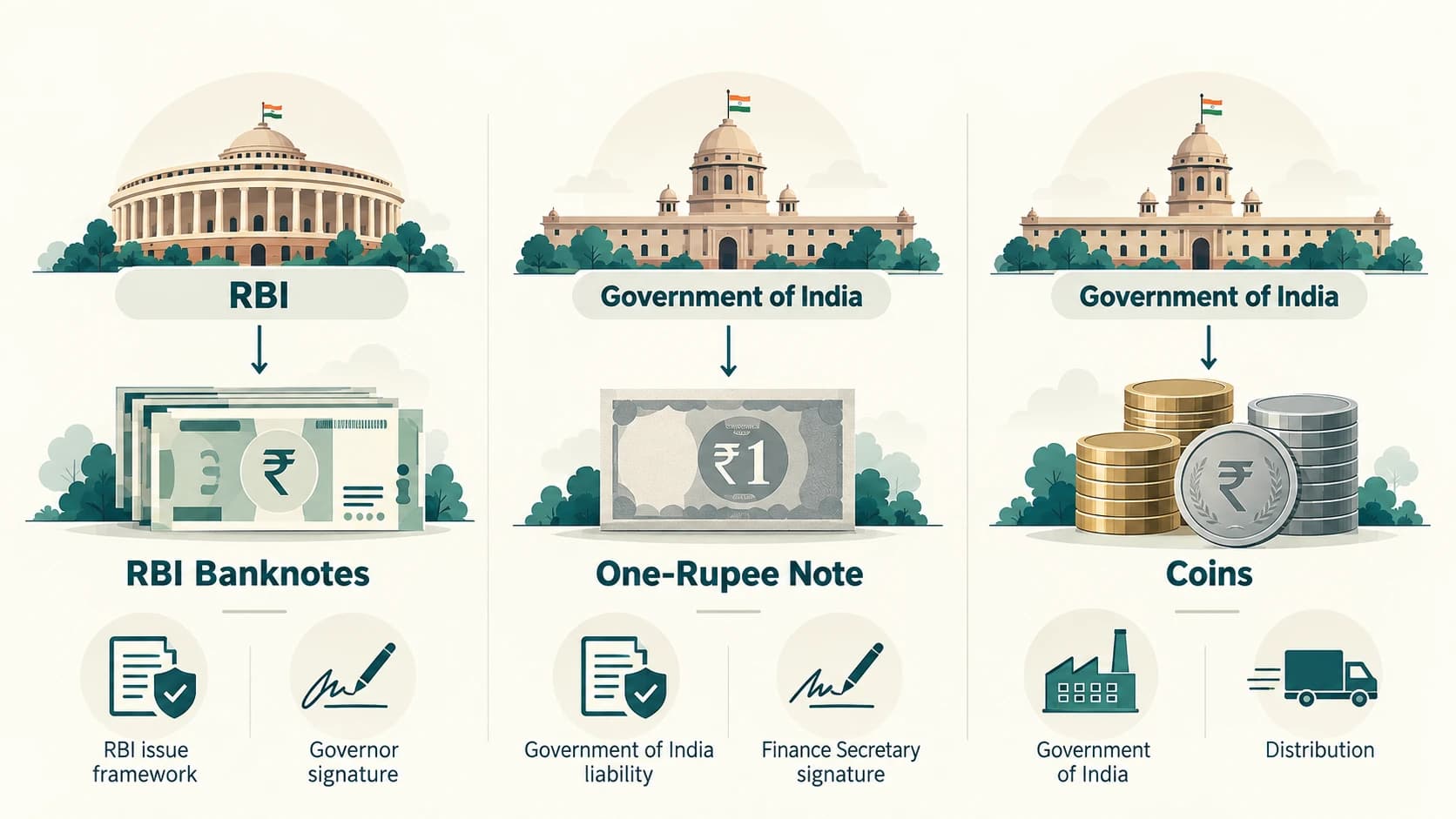
3. Banknote vs coin vs one-rupee note
| Instrument | Issuing responsibility / liability |
|---|---|
| RBI banknotes | Issued by RBI under RBI Act framework; guaranteed by Central Government |
| One-rupee note | Government of India liability; treated in law with the character of rupee coin |
| Coins | Designed/minted/issued under Government of India framework; distributed through RBI/banking system |
Exam memory aid
RBI issues banknotes. Government issues coins and the ₹1 note.
This is one of the most frequently tested currency facts.
4. Who decides the design of RBI banknotes?
Under the RBI Act, the design, form and material of banknotes are approved by the Central Government after considering the recommendations of RBI's Central Board.
So the correct answer is not:
"RBI alone decides every banknote design."
There is an RBI-Government statutory process.
5. Issue Department
The RBI Act requires banknote issue to be conducted through a distinct Issue Department, separate from the Banking Department.
Why does this matter?
Because note issue creates a currency liability. The law therefore maintains a separate accounting framework for the assets backing the issue of banknotes.
For Banking Awareness, remember:
- Issue Department = banknote issue accounting/function;
- Banking Department = other banking assets/liabilities and operations of RBI.
6. Minimum Reserve System - exam-oriented concept
India moved historically from a proportional-reserve approach to a minimum reserve system for banknote issue.
Under the statutory framework, the Issue Department must maintain minimum specified assets, historically including minimum values of:
- gold coin and bullion; and
- foreign securities.
The commonly tested minimum reserve figure is ₹200 crore, including ₹115 crore in gold.
This is a legal/accounting backing concept.
It does not mean each ₹100 note is individually backed by ₹100 worth of gold.
Modern currency value rests on legal tender status, sovereign/central-bank credibility, monetary stability and the financial system rather than a one-for-one commodity backing model.
7. The banknote life cycle
Stage 1 - Forecast demand
RBI estimates how many banknotes of each denomination are likely to be required.
Demand depends on factors such as:
- growth in currency use;
- replacement of unfit notes;
- seasonal demand;
- denomination mix; and
- inventory requirements.
Stage 2 - Place indents with printing presses
Based on expected demand, RBI places orders/indents with authorised currency presses.
Stage 3 - Print banknotes
Banknotes are printed at four main currency presses:
Government-owned through SPMCIL
- Nashik
- Dewas
Owned through RBI's wholly owned subsidiary BRBNMPL
- Mysuru
- Salboni
These locations are useful static-GK facts for banking exams.
Stage 4 - Receive and issue
Printed banknotes enter RBI's currency-management network through Issue Offices and related arrangements.
Stage 5 - Distribution through currency chests and banks
RBI cannot physically operate a cash counter in every town.
It therefore uses a network that includes currency chests maintained by authorised bank branches.
Currency chests hold banknotes and rupee coins on behalf of RBI.
They help:
- distribute fresh/fit currency;
- receive surplus currency;
- balance regional demand;
- supply nearby bank branches; and
- route unfit notes back into the processing system.
Stage 6 - Circulation
Currency moves through:
- banks;
- ATMs;
- businesses;
- households;
- cash-management networks; and
- government transactions.
Stage 7 - Sorting and fitness assessment
Notes return to banks and currency chests.
They are sorted to identify:
- notes fit for recirculation;
- soiled notes;
- mutilated/damaged notes; and
- suspected counterfeit notes.
Stage 8 - Reissue or destruction
Fit notes are recirculated.
Unfit notes are removed and destroyed through authorised secure processes.
This is part of RBI's Clean Note Policy.
8. Currency chests
A currency chest is not merely a large bank vault owned for the bank's own cash.
It is a specialised storehouse authorised by RBI where banknotes and rupee coins are stocked on behalf of RBI for distribution.
Why are currency chests needed?
India is geographically large and cash demand varies across regions.
Currency chests reduce the need to move every consignment directly between an RBI office and every commercial-bank branch.
They create a decentralised distribution network under RBI oversight.
Accounting intuition
Cash placed into or withdrawn from a currency chest is treated within RBI's currency-management accounting framework.
A commercial bank maintaining a chest therefore acts partly as an operational arm of the currency-distribution system.
9. Small Coin Depots
RBI also authorises Small Coin Depots for distribution of small coins.
The number of currency chests and small coin depots is current data and should not be embedded permanently in diagrams or evergreen prose.
10. Banknotes and legal tender
A legal tender is money that is legally tenderable for the discharge of a debt or obligation subject to the governing law.
RBI banknotes retain legal-tender status unless withdrawn under legal provisions.
A denomination can be:
- legal tender;
- no longer printed;
- being withdrawn from circulation; or
- demonetised.
These are not always the same thing.
Example of a common confusion
A note can remain legal tender even when printing or active circulation policy changes.
Therefore exam questions should be answered using the exact wording:
- "legal tender";
- "withdrawn from circulation";
- "printing discontinued"; or
- "demonetised".
Do not treat them as synonyms.
11. ₹1 note
The ₹1 note is special because it is a Government of India liability.
Historically, its design carries Government of India treatment rather than the normal RBI-note pattern.
For exam memory:
₹1 note = Government liability; other RBI banknotes = RBI issue framework.
12. Coins
Government of India is responsible for:
- design of coins; and
- minting of coins.
RBI's role is primarily in their distribution as supplied by Government.
The principal mints are located at:
- Mumbai;
- Hyderabad;
- Kolkata; and
- Noida.
13. What is the Clean Note Policy?
The basic idea is to ensure that the public has access to:
- clean;
- genuine; and
- serviceable
banknotes.
RBI and banks therefore work to:
- remove soiled/unfit notes;
- improve sorting;
- provide exchange facilities;
- ensure currency quality; and
- manage counterfeit-note detection procedures.
Detailed cyber/fraud protection belongs in Module 12, but physical-currency integrity is part of currency management.
14. Counterfeit notes: a key distinction
A counterfeit note is not money merely because it resembles a banknote.
A suspected counterfeit note must be handled under prescribed processes.
The public should not expect RBI or a bank to "exchange" a counterfeit note for genuine money as if it were merely damaged currency.
Do not confuse:
- soiled note;
- mutilated note; and
- counterfeit note.
They are different categories.
15. Who signs banknotes?
RBI banknotes carry the signature of the RBI Governor.
The one-rupee note follows the Government of India framework and traditionally bears the signature of the Finance Secretary.
Because office-holders change, the name of the signatory on newly issued series is current data; the institutional rule is the evergreen concept.
16. Currency management and digital money
Physical currency remains important even as digital payments expand.
A rise in digital payments does not eliminate the central bank's currency responsibilities.
RBI must simultaneously manage:
- physical banknotes;
- payment systems; and
- emerging forms such as Central Bank Digital Currency.
CBDC is covered later in Module 11 because its operational and technological context belongs to digital payments.
Quick check - BA-03-03
- Who has the sole right to issue RBI banknotes in India?
- Who is responsible for coins?
- Why is the ₹1 note special?
- What is a currency chest?
- Name the four banknote-printing locations.
- What is the difference between "withdrawn from circulation" and "demonetised"?
Quick answers
- RBI under the RBI Act framework.
- Government of India designs/mints/issues coins; RBI distributes them through the banking system.
- It is a Government of India liability and is treated differently from normal RBI banknotes.
- An authorised storehouse holding banknotes/coins on behalf of RBI for currency distribution.
- Nashik, Dewas, Mysuru and Salboni.
- A note can be withdrawn from active circulation arrangements yet still retain legal-tender status; demonetisation removes legal-tender status under the legal process.