
RBI as Banker to Government and Banks
RBI as Banker to Government and Banks. A detailed chapter in Reserve Bank of India, with explanations and examples for Indian banking examinations.
By Akhilesh Saini · Reviewed 7 Oct 2026
1. A central bank has two unusual customers
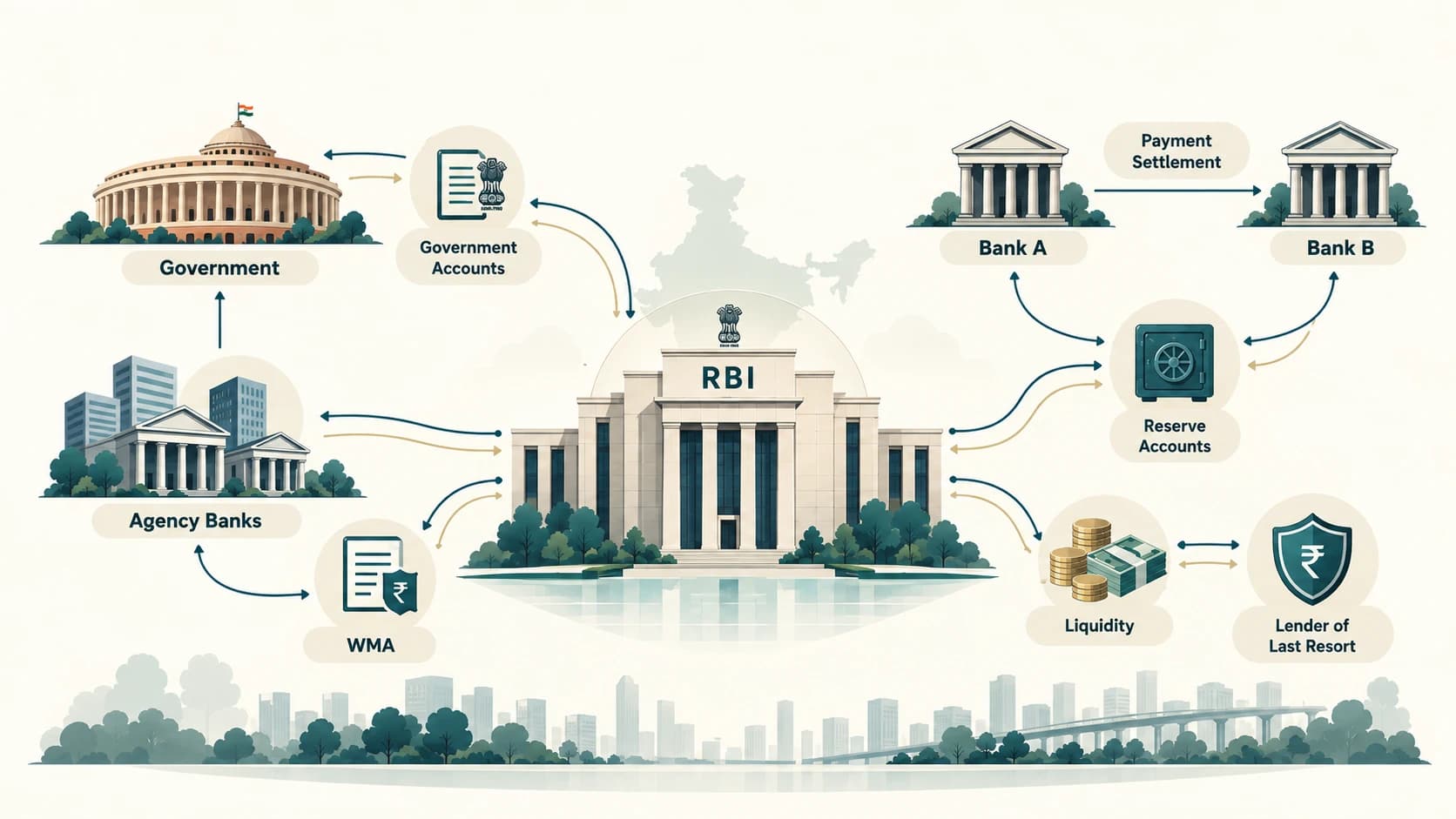
RBI is not a normal retail bank, but it performs banking functions for two system-level groups:
- Governments
- Banks
That is the origin of the expressions:
- banker to government; and
- banker to banks.
These roles are essential to understanding public finance, reserve balances and payment settlement.
2. Legal foundation for banker-to-government role
The RBI Act requires RBI to transact specified banking business of the Central Government.
RBI may also transact State Government business through agreements.
This is why government-banking arrangements are not simply commercial contracts identical to an ordinary corporate bank account.
They form part of RBI's statutory central-banking responsibility.
3. What does RBI do as banker to Government?
A. Receive money for Government
Government receives:
- taxes;
- non-tax revenue;
- fees;
- borrowing proceeds; and
- other receipts.
RBI and its agency-bank network facilitate accounting and settlement of many government transactions.
B. Make payments for Government
Government must make payments such as:
- salaries;
- pensions;
- transfers;
- departmental expenditure;
- interest payments; and
- redemption of government debt.
RBI's government-banking framework helps execute and account for such transactions.
C. Maintain Government accounts
RBI maintains the principal banking relationship and accounts for Government.
It also consolidates transactions reported by authorised agency banks.
D. Government remittances and settlement
Government receipts may occur across thousands of branches and digital channels.
Agency banks collect or pay on behalf of government and report/settle these transactions through RBI's system.
4. Why are agency banks needed?
RBI has a limited physical office network compared with commercial banks.
It therefore appoints selected banks as agency banks to conduct government business on its behalf.
Agency banks can perform authorised functions such as:
- receipt of Government revenue;
- Government payments;
- pension payments; and
- other notified Government transactions.
The current list of agency banks is living information and should be sourced from RBI when displayed.
5. Ways and Means Advances - WMA
Government cash inflows and outflows do not arrive evenly every day.
For example:
- tax collections may arrive later;
- salaries and scheme payments may be due now.
This can produce temporary cash mismatches.
RBI provides Ways and Means Advances (WMA) to governments to bridge temporary mismatches between receipts and payments.
Key concept
WMA is:
- temporary;
- interest-bearing; and
- designed for cash-flow mismatch management.
It is not the same as a long-term Government development loan.
Detailed current WMA limits and rules can change and should be handled as current data rather than hard-coded in an evergreen lesson.
6. WMA vs Government borrowing
Do not confuse:
WMA
- short-term temporary cash support.
with
market borrowing
- Government raises funds through Treasury Bills, dated securities, State Development Loans and other instruments.
RBI can have roles in both, but the objectives are different.
7. RBI as adviser and agent
RBI can advise Government on monetary, banking, financial-market and debt-management matters.
It also acts as an agent in areas such as public debt management.
However, advising Government does not mean RBI decides all Government economic policy.
Government and RBI have distinct constitutional/statutory responsibilities.
8. RBI as banker to banks
Commercial banks maintain current accounts with RBI.
These accounts are central to:
- statutory reserve maintenance;
- settlement of inter-bank obligations;
- payment systems;
- securities transactions;
- foreign-exchange transactions; and
- central-bank liquidity operations.
In simple terms:
A customer settles with another customer through banks; banks ultimately settle with each other through central-bank money and settlement infrastructure.
9. Why central-bank settlement matters
Suppose a customer of Bank A sends money to a customer of Bank B.
At the customer level:
- Bank A debits the sender;
- Bank B credits the receiver.
But Bank A and Bank B must also settle the obligation between themselves.
RBI accounts and authorised settlement systems allow this inter-bank obligation to be settled in central-bank money.
This reduces settlement risk and provides a common trusted settlement asset.
10. e-Kuber
RBI uses e-Kuber, its Core Banking Solution, in central banking operations.
Bank current accounts with RBI and Government-related banking operations use RBI's centralised systems.
For exam purposes, remember e-Kuber as RBI's central banking platform, not as an ordinary consumer UPI app.
11. Reserve balances
Banks maintain balances with RBI for reasons including:
- statutory reserve requirements;
- settlement needs; and
- operational liquidity.
Module 04 will explain CRR and monetary-policy liquidity tools in depth.
Here the key idea is:
RBI is the institution at which banks themselves hold important settlement and reserve balances.
12. Lender of last resort
The phrase "lender of last resort" describes the central bank's ability to provide liquidity to protect financial stability when a bank cannot obtain adequate funds from normal market sources.
RBI explains this role in terms of supporting a bank that is solvent but facing temporary liquidity problems, with the objective of protecting depositors and preventing wider instability.
Why "last resort"?
A bank should normally fund itself through:
- deposits;
- money markets;
- inter-bank borrowing;
- sale/repo of eligible assets; and
- other ordinary funding channels.
Central-bank emergency support is not supposed to replace normal funding discipline.
13. Lender of last resort is not a guarantee against failure
A central bank cannot make an economically insolvent institution healthy merely by lending more money indefinitely.
Liquidity support can buy time and prevent disorderly failure, but if losses exceed capital, deeper resolution or restructuring may be necessary.
Therefore:
Liquidity support solves a liquidity problem; it does not automatically solve insolvency.
14. Banker to banks vs regulator of banks
These are separate RBI roles.
As banker to banks, RBI:
- holds accounts;
- settles transactions;
- provides eligible liquidity facilities.
As regulator/supervisor, RBI:
- sets rules;
- monitors risks;
- inspects institutions;
- takes supervisory/enforcement actions.
The same central bank performs both roles, but the functions should not be confused.
15. Banker to Government vs fiscal policy
RBI handling Government accounts does not mean RBI is the Government's finance department.
Fiscal decisions about:
- taxation;
- spending;
- subsidies;
- fiscal deficit targets; and
- the Union Budget
are Government decisions.
RBI's banker/debt-manager functions support financial execution and market operations within its statutory framework.
Quick check - BA-03-04
- What is an agency bank?
- Why does Government need WMA?
- Is WMA a permanent long-term Government loan?
- Why do banks maintain accounts with RBI?
- What does lender of last resort mean?
- Is banker-to-banks the same as regulator-of-banks?
Quick answers
- A bank authorised to conduct specified Government banking business on RBI's behalf.
- To bridge temporary mismatches between Government receipts and payments.
- No.
- For reserve, settlement and central-banking operations.
- Central-bank liquidity support when normal funding is unavailable, especially for a solvent institution facing temporary liquidity stress.
- No. They are different functions.