
Functions of the RBI
Functions of the RBI. A detailed chapter in Reserve Bank of India, with explanations and examples for Indian banking examinations.
By Akhilesh Saini · Reviewed 7 Oct 2026
1. Do not memorise RBI as a random list
Students often try to memorise ten or fifteen RBI functions as disconnected points. A better approach is to group them into a few system-level roles.
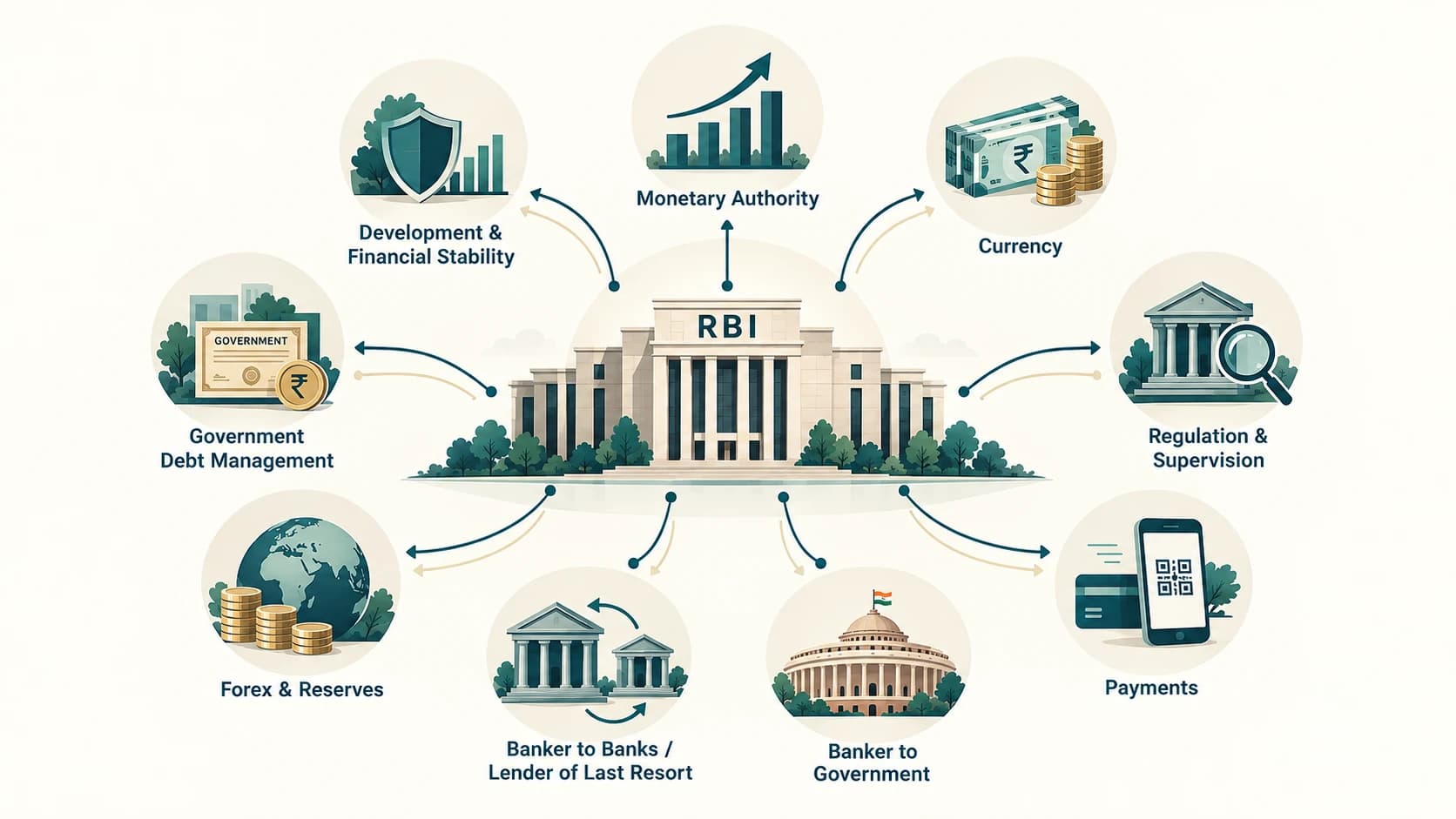
RBI can be understood as:
- monetary authority;
- issuer and manager of currency;
- regulator and supervisor of the financial system;
- regulator and overseer of payment and settlement systems;
- banker to governments;
- banker to banks and lender of last resort;
- manager of foreign exchange and foreign exchange reserves;
- government debt manager;
- financial-stability institution; and
- developmental and inclusion-oriented institution.
Some functions overlap. That is normal.
2. Monetary authority
RBI formulates, implements and monitors monetary policy.
Monetary policy deals with the monetary and financial conditions that influence:
- inflation;
- liquidity;
- interest rates;
- credit conditions; and
- economic activity.
The modern framework includes the Monetary Policy Committee and an inflation-targeting structure.
However, the detailed topics belong to Module 04, including:
- Monetary Policy Committee;
- repo rate;
- Standing Deposit Facility;
- Marginal Standing Facility;
- Bank Rate;
- CRR;
- liquidity operations;
- OMOs; and
- monetary transmission.
Common confusion: monetary policy vs fiscal policy
Monetary policy is associated primarily with RBI.
Fiscal policy concerns government taxation, expenditure, borrowing and budgetary policy.
RBI can interact with fiscal operations as banker and debt manager to government, but it does not prepare the Union Budget.
3. Issuer and manager of currency
RBI has the sole right under the RBI Act to issue banknotes, subject to the statutory framework and the special treatment of the one-rupee note.
Its currency-management function includes:
- estimating demand for banknotes;
- placing indents with printing presses;
- distributing notes;
- managing currency chests;
- maintaining note quality;
- withdrawing unfit notes;
- destroying soiled/unfit notes; and
- supporting public confidence in genuine currency.
Coins are issued by the Government of India and circulated through RBI's distribution system.
This function is studied in detail in BA-03-03.
4. Regulator of the financial system
RBI lays down rules for a wide range of financial institutions under different statutes.
Its regulatory work can cover matters such as:
- licensing;
- ownership and governance;
- capital adequacy;
- liquidity requirements;
- exposure norms;
- income recognition;
- asset classification;
- provisioning;
- conduct;
- deposit-related rules;
- lending practices;
- KYC;
- resolution/restructuring frameworks; and
- permitted activities.
The exact rules differ by type of institution.
A commercial bank, a co-operative bank, an NBFC and a payment operator do not all operate under exactly the same rulebook.
5. Supervisor of financial institutions
Regulation creates rules.
Supervision checks how institutions are actually operating and whether risks are being controlled.
RBI supervision can include:
- off-site monitoring;
- data analysis;
- risk assessment;
- on-site examination;
- supervisory discussions;
- stress and vulnerability analysis;
- follow-up actions; and
- corrective interventions.
Modern supervision is increasingly risk-based rather than a simple checklist exercise.
The purpose is not merely to catch technical violations. It is also to identify emerging vulnerabilities before they become failures.
6. Regulator and supervisor of payment and settlement systems
Modern banking would stop functioning if payments could not move safely between people and institutions.
RBI has statutory responsibilities for payment and settlement systems.
Its objectives include:
- safe and efficient payment infrastructure;
- reliable settlement;
- systemic resilience;
- innovation with safeguards; and
- public confidence.
Detailed systems such as NEFT, RTGS, UPI, IMPS and other retail-payment arrangements are covered in Module 11.
7. Banker to the Government
RBI acts as banker to the Central Government and, through statutory agreements, to State Governments.
Its work includes:
- receiving government money;
- making government payments;
- maintaining government banking accounts;
- facilitating remittances;
- managing temporary cash mismatches through Ways and Means Advances;
- investing surplus balances where applicable;
- consolidating government transactions conducted through agency banks; and
- providing banking information and support.
This role is explained in BA-03-04.
8. Debt manager to governments
Governments borrow from the market by issuing securities.
RBI performs important debt-management functions, including operational support for issuance and management of government securities.
This includes activities connected with:
- auctions;
- Treasury Bills;
- dated Government securities;
- State Government securities;
- servicing of debt; and
- cash/debt management coordination.
Do not confuse:
RBI as debt manager/agent
with
RBI itself borrowing for its own ordinary commercial needs.
Detailed G-Sec concepts appear in Module 15.
9. Banker to banks
Banks maintain accounts with RBI.
These accounts support:
- reserve requirements;
- inter-bank settlement;
- payment systems;
- transactions in securities and foreign exchange; and
- access to certain central-bank facilities.
This is why RBI is often called the banker's bank.
10. Lender of last resort
A central bank may provide liquidity support when a bank that is otherwise viable/solvent faces severe temporary liquidity pressure and cannot obtain funds elsewhere on acceptable terms.
This is the idea of lender of last resort.
The objective is not to guarantee that no bank can ever fail.
It is to prevent a temporary liquidity problem from unnecessarily causing disorderly failure and wider financial instability.
Liquidity is not solvency
- Liquidity problem: the institution may have sound assets but cannot meet immediate cash obligations.
- Solvency problem: the value of assets/capital may be insufficient to cover liabilities/losses.
Lender-of-last-resort support is fundamentally a liquidity-stability concept.
11. Manager of foreign exchange
RBI has major responsibilities in India's foreign-exchange framework.
Its work includes:
- implementation and administration of foreign-exchange regulations under FEMA;
- monitoring foreign-exchange markets;
- managing authorised dealer arrangements; and
- supporting orderly market conditions.
Detailed foreign-exchange-market concepts are studied later.
12. Manager of foreign exchange reserves
India holds foreign exchange reserves for reasons including:
- external liquidity;
- confidence;
- intervention capacity;
- ability to meet external obligations; and
- resilience against external shocks.
RBI manages the country's foreign exchange reserves subject to the legal and policy framework.
The reserve portfolio may include foreign currency assets, gold and other reserve assets.
Do not confuse bank reserves with RBI and foreign exchange reserves of the country. They are completely different concepts.
13. Financial stability
Financial stability means the financial system can continue performing its essential functions even when stressed.
RBI contributes to financial stability through:
- regulation;
- supervision;
- macro-financial analysis;
- liquidity management;
- payment-system oversight;
- crisis-management tools;
- lender-of-last-resort functions; and
- coordination with other authorities.
A central bank therefore watches both individual institutions and system-wide connections.
14. Developmental role
RBI has historically played an important developmental role in India.
Examples include support for:
- financial inclusion;
- rural credit;
- institutional development;
- payment innovation;
- financial literacy;
- deepening of financial markets; and
- expansion of formal finance.
Over decades, RBI was involved in the creation or development of important financial institutions and financial infrastructure.
Modern RBI still performs developmental functions, but those functions operate alongside the need to maintain stability and sound regulation.
15. Research, statistics and communication
A modern central bank requires large amounts of reliable data.
RBI:
- collects banking and economic data;
- conducts surveys;
- publishes statistical databases;
- produces research;
- publishes the RBI Bulletin and reports;
- communicates policy decisions;
- issues directions and circulars; and
- produces financial-stability analysis.
This research is not academic decoration. It supports policy, regulation and supervision.
16. A practical function map
| RBI role | Basic question it answers |
|---|---|
| Monetary authority | What monetary conditions are appropriate for price stability and growth? |
| Currency issuer | How will genuine, adequate-quality banknotes reach the economy? |
| Regulator | What rules should regulated institutions follow? |
| Supervisor | Are institutions managing risks and complying safely? |
| Payment-system authority | Can money move and settle safely? |
| Banker to Government | How are government banking transactions handled? |
| Banker to banks | How do banks settle with each other and maintain central-bank accounts? |
| Lender of last resort | How can temporary systemic liquidity stress be contained? |
| Forex/reserve manager | How are India's external monetary assets and forex framework managed? |
| Debt manager | How are government borrowing operations supported? |
| Developmental institution | How can finance become deeper, safer and more inclusive? |
Quick check - BA-03-02
- Does RBI prepare the Union Budget?
- What is the difference between regulation and supervision?
- Why is RBI called banker's bank?
- What does lender of last resort broadly mean?
- Name two developmental roles of RBI.
Quick answers
- No. The Union Budget is a fiscal/government function.
- Regulation sets rules; supervision assesses institutions and their risks/compliance in practice.
- Banks maintain accounts/reserves with RBI and use it for central settlement and certain facilities.
- Central-bank liquidity support in exceptional circumstances, especially for a viable institution facing temporary liquidity stress.
- Examples include financial inclusion, financial literacy, market development and institutional development.