
RBI: Origin, Structure and Governance
RBI: Origin, Structure and Governance. A detailed chapter in Reserve Bank of India, with explanations and examples for Indian banking examinations.
By Akhilesh Saini · Reviewed 7 Oct 2026
1. Why did India need a central bank?
Before RBI, important monetary and banking functions were divided among different institutions.
The Government controlled currency issue through the Controller of Currency. The Imperial Bank of India performed important government-banking functions. Yet a growing economy needed an institution that could look at currency, credit, banking reserves and financial stability from the perspective of the system as a whole.
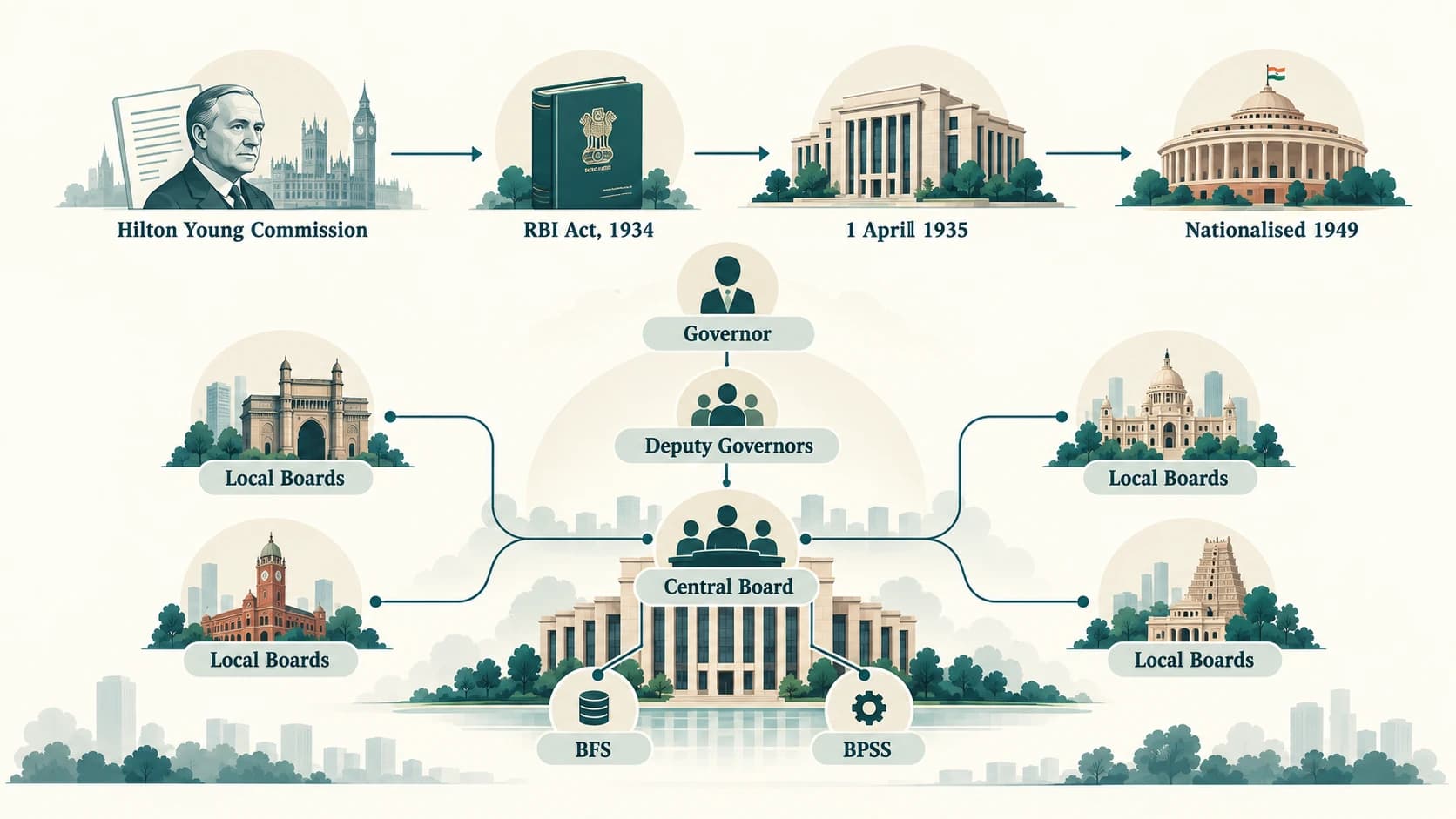
The Royal Commission on Indian Currency and Finance, commonly associated with the Hilton Young Commission, recommended the creation of a central bank. RBI's official history traces the origins of the institution to this recommendation.
The purpose was not merely to create another bank. A central bank was needed to:
- bring currency and credit management under a specialised institution;
- maintain monetary stability;
- hold and manage banking reserves;
- act as banker to government and the banking system; and
- develop a more coherent financial architecture.
2. The RBI Act, 1934
The Reserve Bank of India Act, 1934 is the foundational statute that constitutes RBI.
The Act was enacted in 1934, and RBI commenced operations on 1 April 1935.
The preamble to the Act historically emphasised three broad ideas:
- regulation of the issue of banknotes;
- keeping of reserves with a view to monetary stability; and
- operation of the currency and credit system of the country to its advantage.
The role of RBI has expanded enormously since 1935, and many of its modern powers also arise from other laws, especially the Banking Regulation Act, the Payment and Settlement Systems Act and foreign-exchange legislation.
Exam distinction
RBI Act, 1934 creates and governs RBI and provides many central-banking powers.
Banking Regulation Act, 1949 provides major powers for regulating banking companies.
Do not treat these two Acts as interchangeable.
3. Important establishment milestones
| Event | Key fact |
|---|---|
| Hilton Young Commission | Recommended creation of a central bank for India |
| RBI Act | 1934 |
| RBI commenced operations | 1 April 1935 |
| Original Central Office | Kolkata |
| Central Office permanently shifted | Mumbai, 1937 |
| RBI originally | Privately owned shareholders' bank |
| Nationalisation | Effective 1 January 1949 |
| Present ownership | Fully owned by Government of India |
First Governor and first Indian Governor
Sir Osborne Smith was the first Governor of RBI.
C. D. Deshmukh was the first Indian Governor of RBI.
These are classic Banking Awareness facts and should not be confused with the first Finance Minister or first Chairman of another financial institution.
4. What did RBI take over when it started?
RBI's official historical material explains that, when operations began, the Bank took over:
- currency-related functions previously performed by the Government's Controller of Currency; and
- management of Government accounts and public debt functions previously handled through the Imperial Bank of India.
This is useful because it shows the three traditional central-banking pillars present from the beginning:
currency issuer + banker to government + banker to banks/monetary authority
5. RBI is a statutory central bank
RBI is not a company created merely under company law and it is not a department of an ordinary commercial bank.
It is a statutory institution created by an Act of the legislature.
This matters because its:
- powers;
- governance;
- permitted business;
- relationship with government;
- banknote-issue role; and
- many monetary and financial functions
are rooted in legislation.
6. Management under the RBI Act
Section 7 of the RBI Act places the general superintendence and direction of the affairs and business of RBI in the Central Board, subject to the statutory framework.
The Governor is the chief executive figure and chairs the Central Board.
The Act also contains a provision under which the Central Government may, after consultation with the Governor, give directions to RBI in the public interest.
This is why simplistic statements such as either:
"RBI is completely independent of the Government"
or
"RBI is simply a department of the Finance Ministry"
are both misleading.
A better exam-quality description is:
RBI is a statutory central bank with important operational and policy responsibilities under law, while its governance and accountability framework includes significant roles for the Central Government, including appointments, ownership and statutory powers.
7. Central Board of Directors
The Central Board is the principal governance body of RBI.
Under the RBI Act, its composition includes:
- the Governor;
- up to four Deputy Governors;
- directors nominated by the Central Government from the four Local Boards;
- other directors nominated by the Central Government; and
- Government officials nominated to the Board.
For most Banking Awareness questions, you do not need to memorise every name on the Board. The important concepts are:
- the Governor chairs the institution;
- Deputy Governors support major functional portfolios;
- the Central Board provides overall governance;
- nominated directors bring outside and regional perspectives; and
- Government nominees form part of the statutory governance structure.
8. Governor and Deputy Governors
Governor
The Governor is the chief executive of RBI and the most visible institutional authority.
The Governor:
- chairs the Central Board;
- represents RBI in major policy and institutional settings;
- oversees the institution's overall work;
- plays a central role in monetary-policy and financial-stability communication; and
- signs RBI banknotes, subject to the currency framework.
Deputy Governors
RBI can have up to four Deputy Governors under the Act.
Functional portfolios are distributed among them. These portfolios may include areas such as:
- regulation;
- supervision;
- monetary policy and research;
- currency management;
- government and bank accounts;
- payment systems;
- financial markets;
- foreign exchange;
- consumer protection;
- financial inclusion;
- information technology; and
- internal administration.
Important: portfolios and office-holders change. These are living facts, not permanent textbook facts.
9. Local Boards
The RBI Act provides for four Local Boards corresponding broadly to:
- Western Area;
- Eastern Area;
- Northern Area; and
- Southern Area.
Their role is advisory. They can advise the Central Board on matters referred to them and perform duties delegated under the statutory framework.
For exams, remember:
Local Boards do not replace the Central Board and are not separate regional central banks.
India has one central bank: the Reserve Bank of India.
10. Important RBI boards and committees
Board for Financial Supervision - BFS
RBI constituted the Board for Financial Supervision (BFS) to strengthen focused supervision of the financial sector under RBI's jurisdiction.
Its role is associated with the supervisory framework, inspection/surveillance and oversight of supervised financial institutions.
Board for Regulation and Supervision of Payment and Settlement Systems - BPSS
The payment-system framework has its own specialist governance arrangements, including the Board for Regulation and Supervision of Payment and Settlement Systems (BPSS).
Detailed payment-system regulation belongs in Module 11, but for this module remember that RBI's work is not limited to banks and currency. It also oversees the infrastructure through which payments are cleared and settled.
11. Departments are functional, not separate regulators
RBI has specialised departments for different functions.
Examples include:
- Department of Regulation;
- Department of Supervision;
- Department of Currency Management;
- Department of Government and Bank Accounts;
- Monetary Policy Department;
- Department of Payment and Settlement Systems;
- Foreign Exchange Department;
- Financial Markets departments;
- Consumer Education and Protection Department;
- Financial Inclusion and Development Department;
- Department of Economic and Policy Research; and
- Department of Statistics and Information Management.
These departments are parts of RBI. They are not independent regulators in the way that RBI and SEBI are separate statutory institutions.
12. RBI's institutional evolution
RBI's role has changed as India's economy has changed.
Early RBI functions centred heavily on:
- note issue;
- government banking;
- reserves;
- exchange management; and
- traditional central banking.
After Independence, RBI also became deeply involved in:
- banking-system expansion;
- rural and agricultural credit;
- institution building;
- developmental finance; and
- financial inclusion.
Following financial-sector reforms, greater attention shifted toward:
- market-oriented monetary policy;
- prudential regulation;
- risk-based supervision;
- financial markets;
- payment systems;
- financial stability; and
- modern regulatory technology.
This does not mean the older functions disappeared. Modern RBI performs both traditional central-banking functions and newer regulatory/developmental functions.
13. Common confusion: ownership vs policy independence
RBI is fully owned by the Government of India.
But ownership alone does not answer every question about central-bank decision-making.
Central banking requires a balance between:
- statutory mandate;
- professional policy analysis;
- operational decision-making;
- democratic accountability; and
- coordination with government.
For exam purposes, avoid ideological or absolute descriptions. Focus on the statutory structure.
Quick check - BA-03-01
- Under which law was RBI established?
- On what date did RBI commence operations?
- Was RBI originally government-owned?
- Who was the first Indian Governor of RBI?
- What is the principal governance body of RBI?
- Why should Deputy Governor portfolios be treated as current data?
Quick answers
- Reserve Bank of India Act, 1934.
- 1 April 1935.
- No. It began as a privately owned shareholders' bank and was nationalised in 1949.
- C. D. Deshmukh.
- Central Board of Directors.
- Because office-holders, tenure and functional portfolio allocations can change.