
Small Finance Banks, Payments Banks and Local Area Banks
Small Finance Banks, Payments Banks and Local Area Banks. A detailed chapter in Evolution & Structure of Indian Banking, with explanations and examples for Indian banking examinations.
By Akhilesh Saini · Reviewed 7 Oct 2026
1. Why differentiated banks were created
A universal bank is designed to provide a broad range of banking services. But policymakers may also want institutions focused on specific gaps such as:
- small-ticket credit;
- low-income customers;
- unserved and underserved areas;
- migrant remittances;
- low-cost payments; or
- geographically local banking.
This led to the idea of differentiated banks - banks whose licences/business models are designed around a narrower or specialised purpose.
Three exam-relevant categories are:
- Small Finance Banks (SFBs);
- Payments Banks (PBs); and
- Local Area Banks (LABs).
They are not identical and should never be memorised as one generic “small bank” category.
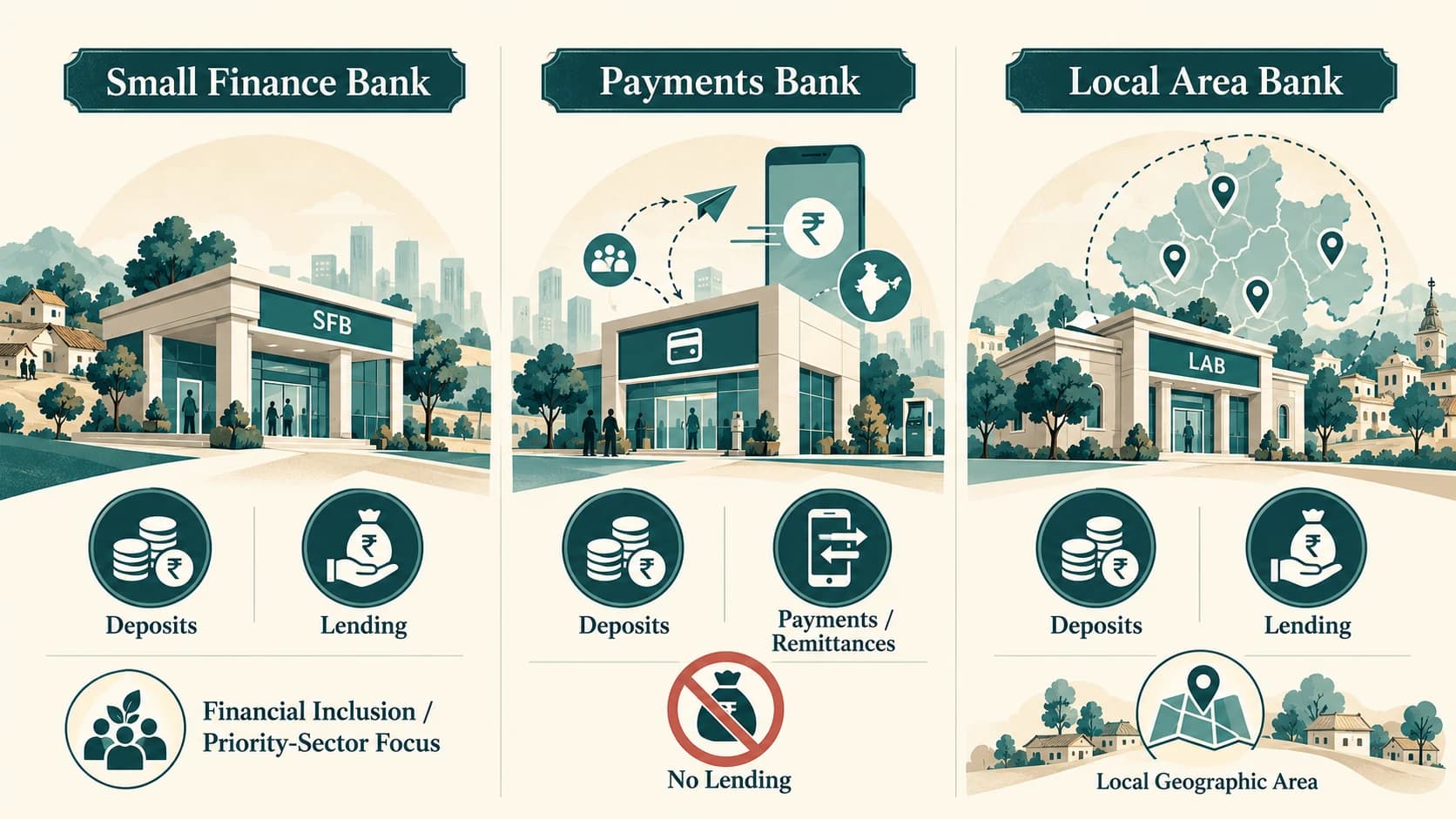
2. Small Finance Banks - the basic idea
RBI introduced the SFB framework to further financial inclusion through:
- savings vehicles; and
- supply of credit
to segments such as:
- small business units;
- small and marginal farmers;
- micro and small enterprises; and
- other entities in the unorganised sector.
Unlike Payments Banks, SFBs can lend.
They can also accept deposits and provide ordinary banking/payment services, subject to their regulatory framework.
3. What makes an SFB different from an ordinary universal bank?
The key difference is not that an SFB is “physically small”.
The SFB framework imposes a strong inclusion orientation.
Under RBI's Priority Sector Lending Directions, 2025, SFBs have an overall priority-sector target of 75% of ANBC or CEOBSE, whichever is higher.
RBI financial-awareness material also highlights the small-ticket nature of their lending model: at least 50% of the loan portfolio is to consist of loans and advances up to ₹25 lakh under the applicable framework.
These numerical requirements are current regulatory facts and should therefore be displayed with an as-of date rather than treated as timeless concepts.
4. Current Small Finance Banks - reviewed 7 October 2026
RBI's Banks in India directory lists 11 SFBs:
- AU Small Finance Bank Limited
- Capital Small Finance Bank Limited
- Equitas Small Finance Bank Limited
- ESAF Small Finance Bank Limited
- Suryoday Small Finance Bank Limited
- Ujjivan Small Finance Bank Limited
- Utkarsh Small Finance Bank Limited
- slice Small Finance Bank Limited
- Jana Small Finance Bank Limited
- Shivalik Small Finance Bank Limited
- Unity Small Finance Bank Limited
The list is current-sensitive because mergers, conversions and new licences can alter it.
5. Can an SFB become a universal bank?
RBI provides a path for voluntary transition of an eligible Small Finance Bank into a Universal Bank, subject to prescribed conditions and RBI approval.
This is another reason not to treat bank categories as permanently fixed labels.
A specialised bank may evolve if it meets the regulatory framework for transition.
6. Payments Banks - the basic idea
Payments Banks were designed primarily to advance financial inclusion through:
- small savings/demand-deposit accounts;
- payments; and
- remittance services,
particularly for customers such as migrant workers, low-income households, small businesses and other users needing low-cost transaction services.
Their business model is intentionally restricted.
7. The most important Payments Bank rule: no lending
A Payments Bank cannot undertake lending activities.
This is one of the highest-value exam facts in this lesson.
If a question asks which differentiated bank can accept deposits but cannot lend, the answer is generally Payments Bank.
8. What can Payments Banks do?
Under RBI's framework, Payments Banks can perform activities such as:
- accept permitted demand deposits;
- provide payment and remittance services;
- issue ATM/debit cards;
- act as Business Correspondents of other banks subject to rules; and
- distribute permitted non-risk-sharing financial products under applicable regulations.
They cannot issue credit cards under the Payments Bank model and cannot make loans.
9. Current maximum balance at a Payments Bank
RBI increased the maximum end-of-day balance per individual customer from ₹1 lakh to ₹2 lakh in 2021.
RBI's financial-awareness material continues to describe Payments Banks as able to hold demand deposits from the public up to ₹2 lakh per customer.
10. Payments Bank deposits vs fixed deposits
RBI financial-awareness material summarises the model as:
- demand deposits permitted within the prescribed balance limit;
- recurring/fixed deposits not accepted under the Payments Bank model; and
- no loans and advances.
This sharply differentiates Payments Banks from full-service universal banks and SFBs.
11. Current Payments Bank status - reviewed 7 October 2026
RBI's banking directory has listed the following Payments Banks:
- Airtel Payments Bank Limited;
- India Post Payments Bank Limited;
- Fino Payments Bank Limited;
- Paytm Payments Bank Limited;
- Jio Payments Bank Limited; and
- NSDL Payments Bank Limited.
However, RBI announced the winding up of Paytm Payments Bank Limited in July 2026.
Therefore, for the website's current list, do not simply display “6 operating Payments Banks” based on an older directory snapshot. The current-status component should treat Paytm Payments Bank separately as winding up / historical-transition status and verify the latest RBI position whenever the module is reviewed.
The other five names listed in the RBI directory are:
- Airtel Payments Bank
- India Post Payments Bank
- Fino Payments Bank
- Jio Payments Bank
- NSDL Payments Bank
12. Are all Payments Banks scheduled?
No.
This is an excellent example of overlapping classification systems.
RBI's banking reports have identified Jio Payments Bank and NSDL Payments Bank as non-scheduled commercial banks, while other Payments Banks have appeared in scheduled-bank lists.
Therefore:
Payments Bank = business model
Scheduled/non-scheduled = Second-Schedule status
Never assume one from the other.
13. Local Area Banks - the basic idea
Local Area Banks are small geographically focused private-sector banking institutions designed to mobilise local savings and provide credit within a limited area.
The original LAB scheme envisaged an area of operation covering three contiguous districts. RBI later permitted eligible LABs to expand into two additional districts.
The central concept is geographical concentration.
14. Current Local Area Banks - reviewed 7 October 2026
RBI's Banks in India directory lists two LABs:
- Coastal Local Area Bank Limited
- Krishna Bhima Samruddhi Local Area Bank Limited
RBI banking reports have treated these two LABs as non-scheduled commercial banks.
15. SFB vs Payments Bank vs LAB - comparison
| Feature | Small Finance Bank | Payments Bank | Local Area Bank |
|---|---|---|---|
| Main objective | Financial inclusion through savings + credit | Payments, remittances + small demand deposits | Local savings mobilisation + local credit |
| Can accept deposits? | Yes | Yes, restricted model | Yes |
| Can lend? | Yes | No | Yes |
| Geographic restriction | Not defined like LAB | Not a LAB-style district restriction | Yes, local-area model |
| Strong inclusion focus | Yes | Yes | Yes/local development focus |
| Can issue debit card? | Yes | Yes | Yes subject to rules |
| Credit card under category model | Possible subject to banking/card rules | Payments Banks cannot issue credit cards | Subject to applicable bank rules |
| Current list changes? | Yes | Yes | Yes |
16. Why Payments Banks still matter if they cannot lend
Lending is not the only valuable financial service.
For many users, the major barriers to formal finance can be:
- receiving wages or transfers;
- sending remittances;
- making digital payments;
- holding a safe transaction balance; and
- accessing services through low-cost technology.
Payments Banks were designed around this transaction-and-inclusion role.
17. Why SFBs matter
SFBs combine:
- deposit-taking;
- payment services; and
- actual lending,
with a regulatory structure intended to direct a large share of credit toward priority and smaller-ticket segments.
This makes them particularly important for financial inclusion and for bank-exam questions on PSL.
18. Why LABs are less visible but still exam-relevant
Only a small number of LABs remain, so they receive less public attention than SFBs or Payments Banks.
But they are useful in exams because they test whether the candidate understands:
- differentiated banking;
- geographical restrictions; and
- scheduled vs non-scheduled status.
19. Current-data warning
This lesson contains several facts that can change:
- SFB names;
- Payments Bank names/status;
- deposit-balance limits for Payments Banks;
- SFB regulatory thresholds;
- scheduled status; and
- conversion/merger status.
20. Common exam confusions
SFB vs Payments Bank
SFB can lend. Payments Bank cannot lend.
Payments Bank vs payment app
A payment app or wallet provider is not automatically a Payments Bank. A Payments Bank is a licensed banking entity.
LAB vs RRB
LABs and RRBs are separate institutional categories with different legal and ownership frameworks.
“Small” in SFB vs small geographical area
Small Finance Bank refers to the specialised financial-inclusion banking model, not necessarily a tiny geographic footprint. Geographic restriction is more characteristic of LABs.
Quick check - BA-02-06
- Which differentiated bank can lend: SFB or Payments Bank?
- What is the current Payments Bank end-of-day balance limit per individual customer in RBI financial-awareness material?
- How many SFBs does RBI's current directory list at this review date?
- Which two LABs are currently listed by RBI?
- Why should Paytm Payments Bank not be counted mechanically from an older directory?
Quick-check answers: SFB; ₹2 lakh; 11; Coastal Local Area Bank and Krishna Bhima Samruddhi Local Area Bank; because RBI announced its winding up in July 2026, so current operating-status data requires an update.