
Public, Private and Foreign Banks in India
Public, Private and Foreign Banks in India. A detailed chapter in Evolution & Structure of Indian Banking, with explanations and examples for Indian banking examinations.
By Akhilesh Saini · Reviewed 7 Oct 2026
1. Ownership is a different classification lens
After learning scheduled status, we can now classify banks by ownership/control.
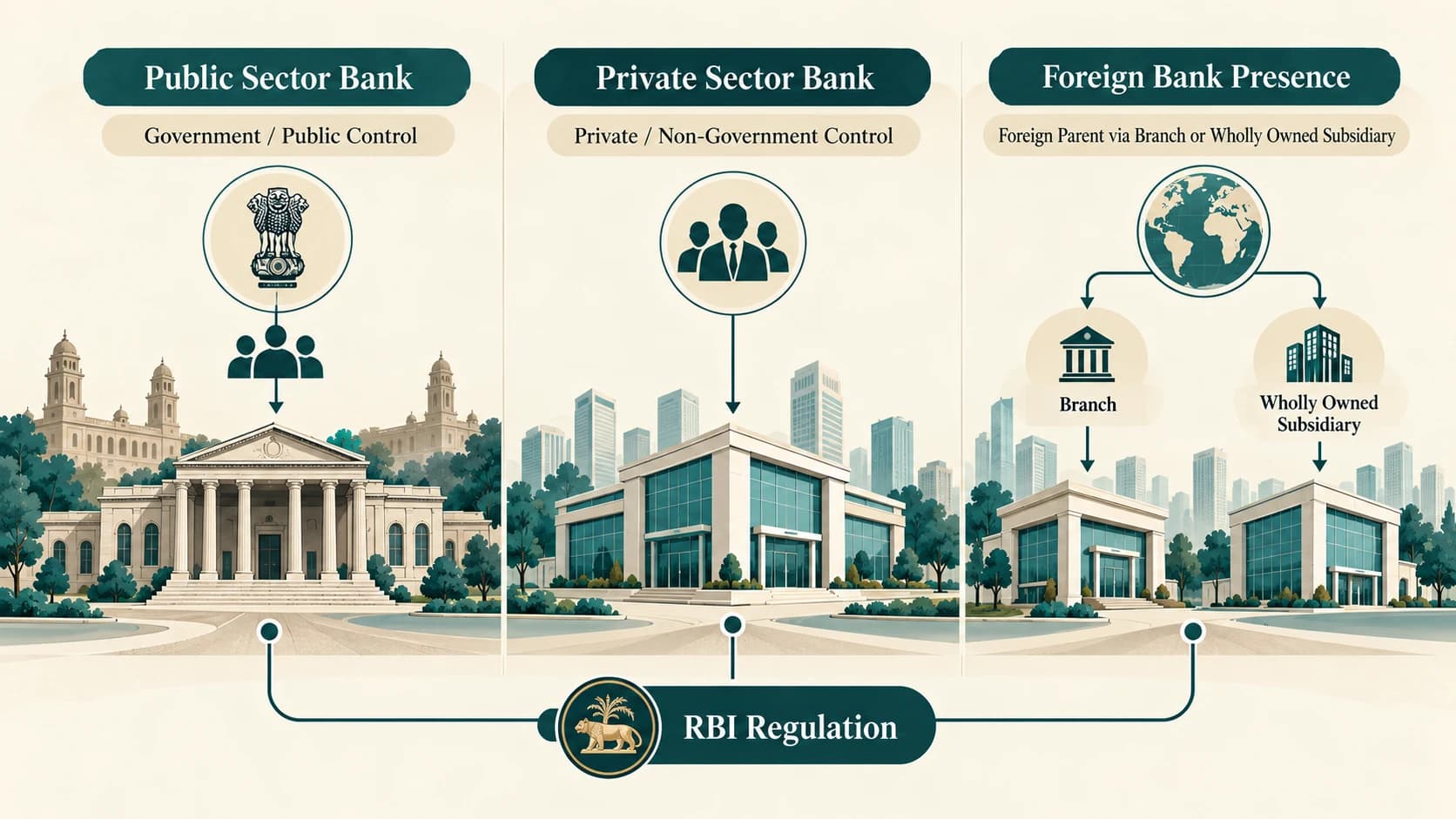
The three broad labels commonly used in bank-exam preparation are:
- Public Sector Banks;
- Private Sector Banks; and
- Foreign Banks / foreign-bank presence in India.
These labels answer the question:
Who owns or controls the banking institution?
They do not, by themselves, tell you whether the bank is scheduled, how large it is, whether it is digital, or whether it has a differentiated licence.
2. Public Sector Banks
Public Sector Banks (PSBs) are banks in which the Government has controlling ownership under the applicable statutory/ownership structure.
They include:
- State Bank of India; and
- the other nationalised/public-sector banks currently recognised by the Department of Financial Services.
Current Public Sector Banks - reviewed 7 October 2026
The Department of Financial Services currently lists 12 PSBs:
- Bank of Baroda
- Bank of India
- Bank of Maharashtra
- Canara Bank
- Central Bank of India
- Indian Bank
- Indian Overseas Bank
- Punjab & Sind Bank
- Punjab National Bank
- State Bank of India
- UCO Bank
- Union Bank of India
This is a current list, not an eternal fact. It must be updated if future amalgamations, ownership changes or legislation alter the PSB structure.
3. State Bank of India is a PSB but not a “nationalised bank” in exactly the same historical sense
Exam materials often loosely group SBI and nationalised banks together under “public sector”. That is fine for the ownership category, but historically their origins differ.
- SBI arose from the transformation of the Imperial Bank under the State Bank of India Act, 1955.
- The nationalised banks trace their public ownership to the bank-nationalisation legislation of 1969/1970 and 1980.
So:
Public Sector Bank is the broader current category.
4. Private Sector Banks
Private-sector banks are banking institutions whose ownership/control is primarily outside the Government public-sector structure and which operate under RBI licensing and regulation.
They include both:
- older private-sector banks; and
- new-generation private-sector banks licensed during the reform era.
Current RBI private-sector-bank list - reviewed 7 October 2026
RBI's Banks in India directory lists the following 21 private-sector banks:
- Axis Bank Limited
- Bandhan Bank Limited
- CSB Bank Limited
- City Union Bank Limited
- DCB Bank Limited
- Dhanlaxmi Bank Limited
- Federal Bank Limited
- HDFC Bank Limited
- ICICI Bank Limited
- IndusInd Bank Limited
- IDFC FIRST Bank Limited
- Jammu & Kashmir Bank Limited
- Karnataka Bank Limited
- Karur Vysya Bank Limited
- Kotak Mahindra Bank Limited
- Nainital Bank Limited
- RBL Bank Limited
- South Indian Bank Limited
- Tamilnad Mercantile Bank Limited
- YES Bank Limited
- IDBI Bank Limited
Exam caution - IDBI Bank
Students sometimes try to classify IDBI Bank solely from historical ownership or the word “IDBI”. For current exam preparation, follow the current RBI classification. RBI's bank directory places IDBI Bank in the private-sector-bank list.
This is a good example of why current official lists are preferable to old coaching notes.
5. Old private-sector banks vs new private-sector banks
The distinction is historical rather than a separate legal category that students always need to use.
Older private-sector banks
Several private banks existed before the 1991-93 reform period, often with regional roots.
Examples include institutions such as:
- Federal Bank;
- Karnataka Bank;
- Karur Vysya Bank;
- South Indian Bank; and
- City Union Bank.
New-generation private-sector banks
RBI reopened entry for new private-sector banks in the reform era, beginning with the 1993 licensing framework.
Banks such as HDFC Bank, ICICI Bank, Axis Bank and later entrants became associated with this new-generation phase.
For most exams, the important point is the reform-era re-entry of private banking, not a rigid memorisation of every “old” vs “new” label.
6. Foreign banks in India
Foreign banks are banks with foreign parentage that have banking presence in India under RBI's regulatory framework.
They can operate through different forms, including:
- branch presence of an overseas-incorporated bank; and
- Wholly Owned Subsidiary (WOS) structures where permitted.
RBI notes that foreign banks may operate in India as branches or WOS entities.
Examples of foreign-bank presence
Prominent examples include:
- Standard Chartered Bank;
- HSBC;
- Deutsche Bank;
- Bank of America;
- Barclays Bank;
- Mizuho Bank;
- MUFG Bank;
- DBS Bank India Limited;
- SBM Bank (India) Limited; and
- J.P. Morgan Chase Bank.
RBI's Banks in India directory currently lists 44 foreign banks with banking presence in India. Because entries can change, the full list is best maintained as current structured data rather than memorised permanently.
7. Branch vs wholly owned subsidiary
This distinction matters.
Foreign-bank branch
A branch is part of the overseas banking legal entity operating in India under Indian regulatory requirements.
Wholly Owned Subsidiary
A WOS is an Indian-incorporated banking subsidiary controlled by the foreign parent, subject to RBI's WOS framework and Indian banking regulation.
The customer may simply experience both as “foreign banks”, but the legal form differs.
8. Are foreign banks regulated by RBI?
Yes. Foreign banks operating in India are subject to RBI regulation and applicable Indian banking laws for their Indian operations.
Do not confuse:
foreign ownership
with
absence of Indian regulation.
9. Public vs private vs foreign - comparison
| Feature | Public Sector Bank | Private Sector Bank | Foreign Bank Presence |
|---|---|---|---|
| Main ownership/control lens | Government/public-sector control | Non-government/private ownership | Foreign parent/control |
| RBI regulation in India | Yes | Yes | Yes |
| Can offer deposits/loans? | Yes, subject to licence/rules | Yes, subject to licence/rules | Yes, subject to Indian licence/rules |
| Can be scheduled? | Yes | Yes | Yes |
| Category tells you technology level? | No | No | No |
| Current membership can change? | Yes | Yes | Yes |
10. Ownership does not determine customer service model
A PSB may provide advanced digital banking.
A private bank may have a large physical branch network.
A foreign bank may focus more strongly on corporate, trade, institutional or affluent-customer segments.
Therefore, ownership category should not be used as a shortcut for assumptions about:
- technology;
- profitability;
- safety;
- branch reach; or
- customer segment.
11. Public-sector consolidation and exam questions
Because several former PSBs have been merged, old question banks may contain bank names that no longer exist as independent PSBs.
Examples:
- Dena Bank -> Bank of Baroda;
- Vijaya Bank -> Bank of Baroda;
- Oriental Bank of Commerce -> Punjab National Bank;
- United Bank of India -> Punjab National Bank;
- Syndicate Bank -> Canara Bank;
- Andhra Bank -> Union Bank of India;
- Corporation Bank -> Union Bank of India;
- Allahabad Bank -> Indian Bank.
13. Common exam confusions
Public-sector bank vs scheduled bank
A PSB can be scheduled, but “public sector” is ownership and “scheduled” is Second-Schedule status.
Private bank vs unregulated bank
Private banks are licensed and regulated by RBI.
Foreign bank vs foreign financial company
Not every foreign financial company operating in India is a bank. Banking presence requires the relevant banking licence/regulatory status.
SBI vs nationalised bank
SBI is a Public Sector Bank, but its historical path is different from the banks nationalised in 1969/1980.
Quick check - BA-02-05
- How many PSBs does DFS currently list?
- Which authority's current directory should be preferred for private-bank classification?
- Is IDBI Bank currently listed by RBI among private-sector banks?
- Can foreign banks operate through a branch or WOS structure?
- Does private ownership mean a bank is outside RBI regulation?
Quick-check answers: 12; RBI; yes; yes; no.