
Evolution & Structure of Indian Banking
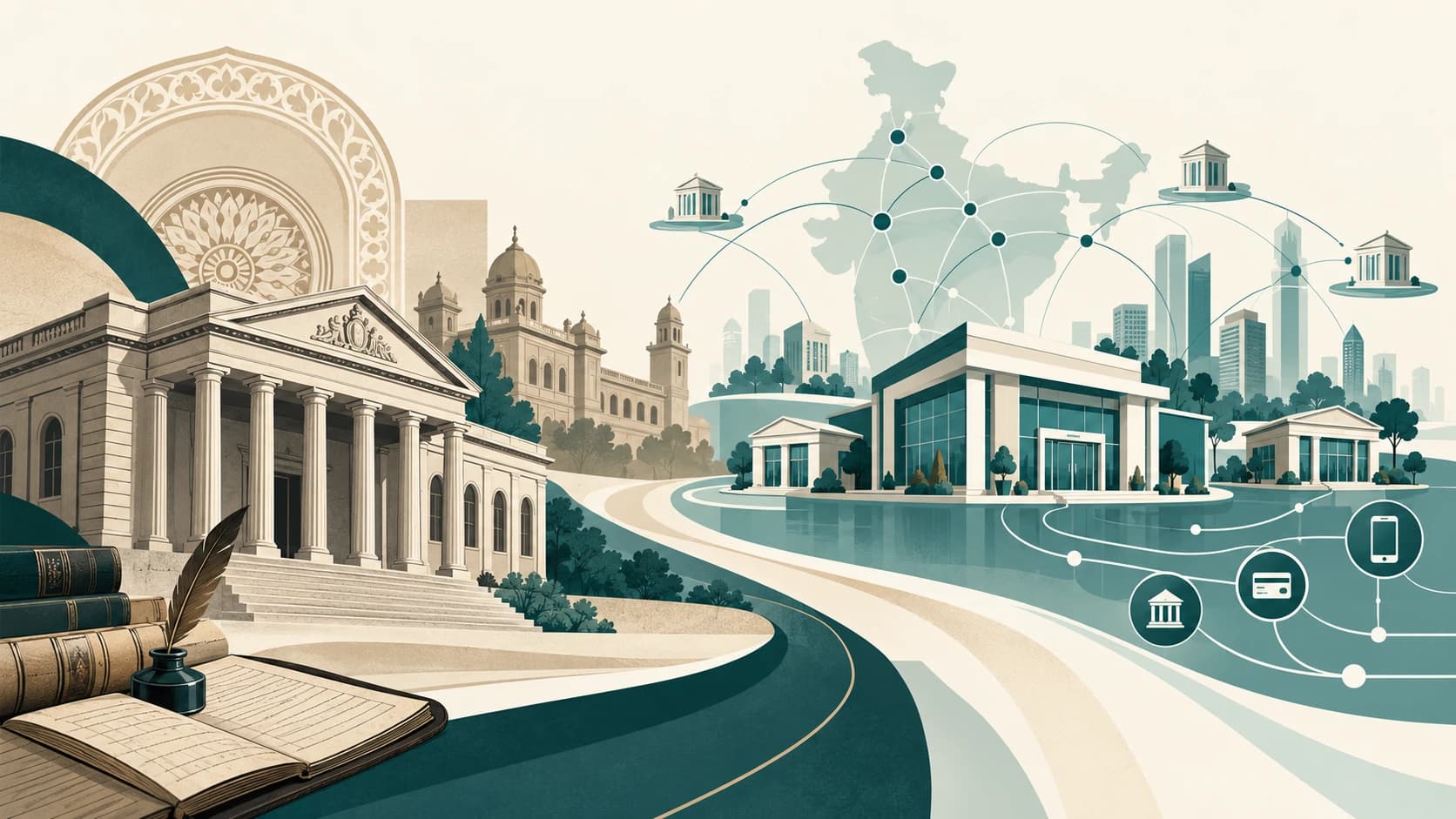
Banking-awareness questions become much easier once you can see the Indian banking system as a map rather than a list of unrelated institutions. This module explains how Indian banking evolved, why nationalisation and later liberalisation happened, how the present system is organised, what “scheduled bank” actually means, how ownership categories differ, and why Small Finance Banks, Payments Banks and Local Area Banks exist.
Recommended prerequisite: Module 01 - Money & Banking Foundations.
Purpose of this module: Banking-awareness questions become much easier once you can see the Indian banking system as a map rather than a list of unrelated institutions. This module explains how Indian banking evolved, why nationalisation and later liberalisation happened, how the present system is organised, what “scheduled bank” actually means, how ownership categories differ, and why Small Finance Banks, Payments Banks and Local Area Banks exist.
What you will learn
By the end of Module 02, you should be able to:
- place the major milestones in Indian banking history in the correct sequence;
- explain the significance of the Presidency Banks, Imperial Bank of India, RBI and State Bank of India;
- explain why 14 major banks were nationalised in 1969 and 6 more in 1980;
- explain the logic of the post-1991 banking reforms and re-entry of new private sector banks;
- describe the present Indian banking and financial-system structure without mixing banks, NBFCs, financial institutions and regulators;
- distinguish scheduled from non-scheduled banks and understand the importance of the Second Schedule to the RBI Act;
- distinguish public-sector, private-sector and foreign banks using the correct classification lens;
- explain the business models of Small Finance Banks, Payments Banks and Local Area Banks; and
- recognise which facts in this module are permanent concepts and which current lists must be periodically refreshed.
A warning before you begin: Indian banks can be classified in several different ways
A major source of confusion in banking-awareness preparation is that students try to place every bank into one single classification tree. Indian banking does not work that neatly.
The same institution can simultaneously be described through several lenses:
- legal/schedule status: scheduled or non-scheduled;
- institutional type: commercial bank or co-operative bank;
- ownership: public sector, private sector or foreign-controlled/presence;
- business model: universal bank, Small Finance Bank, Payments Bank, Local Area Bank, Regional Rural Bank, etc.; and
- geographical or customer mandate: national, regional, local, rural/underserved-focused and so on.
For example, a Small Finance Bank is not simply a rival category to “private bank” in every context. Most SFBs are privately owned, but “Small Finance Bank” describes their licensing/business model, while “private sector” describes an ownership classification.
Keep this idea in mind throughout the module.
Chapters
History and Evolution of Banking in India
History and Evolution of Banking in India. A detailed chapter in Evolution & Structure of Indian Banking, with explanations and examples for Indian banking examinations.
Bank Nationalisation, Reforms and Liberalisation
Bank Nationalisation, Reforms and Liberalisation. A detailed chapter in Evolution & Structure of Indian Banking, with explanations and examples for Indian banking examinations.
Structure of the Indian Banking and Financial System
Structure of the Indian Banking and Financial System. A detailed chapter in Evolution & Structure of Indian Banking, with explanations and examples for Indian banking examinations.
Scheduled, Non-Scheduled and Banking-Company Classifications
Scheduled, Non-Scheduled and Banking-Company Classifications. A detailed chapter in Evolution & Structure of Indian Banking, with explanations and examples for Indian banking examinations.
Public, Private and Foreign Banks in India
Public, Private and Foreign Banks in India. A detailed chapter in Evolution & Structure of Indian Banking, with explanations and examples for Indian banking examinations.
Small Finance Banks, Payments Banks and Local Area Banks
Small Finance Banks, Payments Banks and Local Area Banks. A detailed chapter in Evolution & Structure of Indian Banking, with explanations and examples for Indian banking examinations.