
Bank Nationalisation, Reforms and Liberalisation
Bank Nationalisation, Reforms and Liberalisation. A detailed chapter in Evolution & Structure of Indian Banking, with explanations and examples for Indian banking examinations.
By Akhilesh Saini · Reviewed 7 Oct 2026
1. Nationalisation and liberalisation are not opposites to memorise - they are responses to different problems
Students often learn Indian banking history as two slogans:
- nationalisation = government control;
- liberalisation = private banks.
That is too simplistic.
Nationalisation was intended to align a large part of the banking system more closely with development and social-policy objectives. Later reforms sought to improve efficiency, competition, prudential discipline, capital strength and market functioning while preserving financial stability and inclusion goals.
Both phases shaped the system that exists today.
2. Why were major banks nationalised?
Before nationalisation, policymakers were concerned about issues such as:
- concentration of bank credit among established industrial and business groups;
- insufficient credit flow to agriculture and small borrowers;
- limited branch penetration in many rural and semi-urban areas;
- weak alignment between bank lending and planned-development priorities; and
- the need to mobilise savings across a wider population.
The policy response was to bring major commercial banks into public ownership.
3. First phase - 1969
In 1969, 14 major commercial banks were nationalised.
For examination purposes, the most important fact is the number 14 and the year 1969.
The deeper significance was that banking policy increasingly emphasised:
- branch expansion;
- rural banking;
- priority-sector orientation;
- deposit mobilisation; and
- use of the banking system as an instrument of economic development.
RBI historical material notes the substantial branch expansion that followed the nationalisation era.
4. Second phase - 1980
In 1980, 6 more commercial banks were nationalised.
Exam memory rule:
1969 -> 14 banks
1980 -> 6 banks
Do not confuse these with later amalgamations, which reduced the number of public-sector banks but did not “reverse” the historical nationalisation events.
5. What changed after nationalisation?
Nationalisation helped accelerate the movement toward what is often called social banking.
Important developments included:
- rapid branch expansion into rural and semi-urban centres;
- greater institutional focus on agriculture and weaker sections;
- stronger role for priority-sector lending;
- mobilisation of household savings into formal banking; and
- greater geographical spread of banking services.
These achievements should be understood together with the challenges that later became visible.
6. Why did reform become necessary?
A system dominated by public ownership and administered structures can still face financial weaknesses. By the late 1980s and early 1990s, reform discussions focused on problems including:
- low operational efficiency in parts of the banking system;
- weak profitability;
- inadequate recognition of stressed assets;
- limited competition;
- high statutory pre-emption of bank resources;
- directed-credit structures;
- insufficient capital; and
- the need for stronger prudential supervision.
The 1991 balance-of-payments crisis provided the broader economic context for India's liberalisation and structural reforms.
7. Narasimham Committee I - 1991
The Committee on the Financial System chaired by M. Narasimham became a major reference point for banking reform.
At a high level, the reform agenda included:
- stronger prudential norms;
- improved income recognition and asset classification;
- capital adequacy;
- reduction of excessive pre-emptions;
- more competition;
- operational autonomy; and
- a more market-oriented financial system.
The detailed technical implementation evolved through multiple RBI and Government measures over time.
Important exam caution
Do not memorise every recommendation as if it was implemented instantly or exactly in the form proposed. A committee recommends; the Government and RBI subsequently decide policy and implementation.
8. Entry of new private-sector banks - 1993
RBI issued guidelines for entry of new banks in the private sector in January 1993.
The policy rationale included:
- greater competition;
- higher productivity and efficiency;
- technology upgradation; and
- improved financial intermediation.
This led to the emergence of new-generation private-sector banks alongside older private-sector banks.
Private-bank licensing was revised in later rounds, including 2001 and 2013, and RBI later moved toward an on-tap framework for universal-bank licensing.
9. Narasimham Committee II - 1998
A second Narasimham Committee reviewed banking-sector reforms and further emphasised issues such as:
- stronger banking systems;
- asset quality;
- capital and provisioning;
- consolidation; and
- improved governance and efficiency.
For most banking recruitment exams, understanding the direction of reform is more important than memorising every technical recommendation.
10. Prudential regulation becomes central
One of the most important changes of the reform era was the move toward a banking system evaluated not only by how much credit it distributes but also by how safely and transparently it operates.
Key ideas include:
- capital adequacy;
- recognition of non-performing assets;
- provisioning;
- exposure norms;
- risk management;
- supervision; and
- disclosure.
These are studied in detail in Modules 07 and 14.
11. Interest-rate and market reforms
Banking liberalisation also involved gradual movement away from highly administered financial prices toward market-linked mechanisms, while RBI continued to use monetary-policy and regulatory tools.
This reform path eventually contributed to modern benchmark-based loan pricing, market-based government borrowing, deeper financial markets and contemporary monetary-policy transmission.
Those topics belong mainly in Modules 04, 06 and 15.
12. Technology and competition
New private-sector entry coincided with rapid improvements in banking technology. Competition encouraged investment in:
- core banking;
- electronic payments;
- ATMs;
- internet banking;
- mobile channels; and
- customer-service innovation.
Public-sector banks also modernised extensively. Therefore, avoid the simplistic idea that “digital bank = private bank”. Technology is used across ownership categories.
13. Consolidation of public-sector banks
Modern reform has also included consolidation.
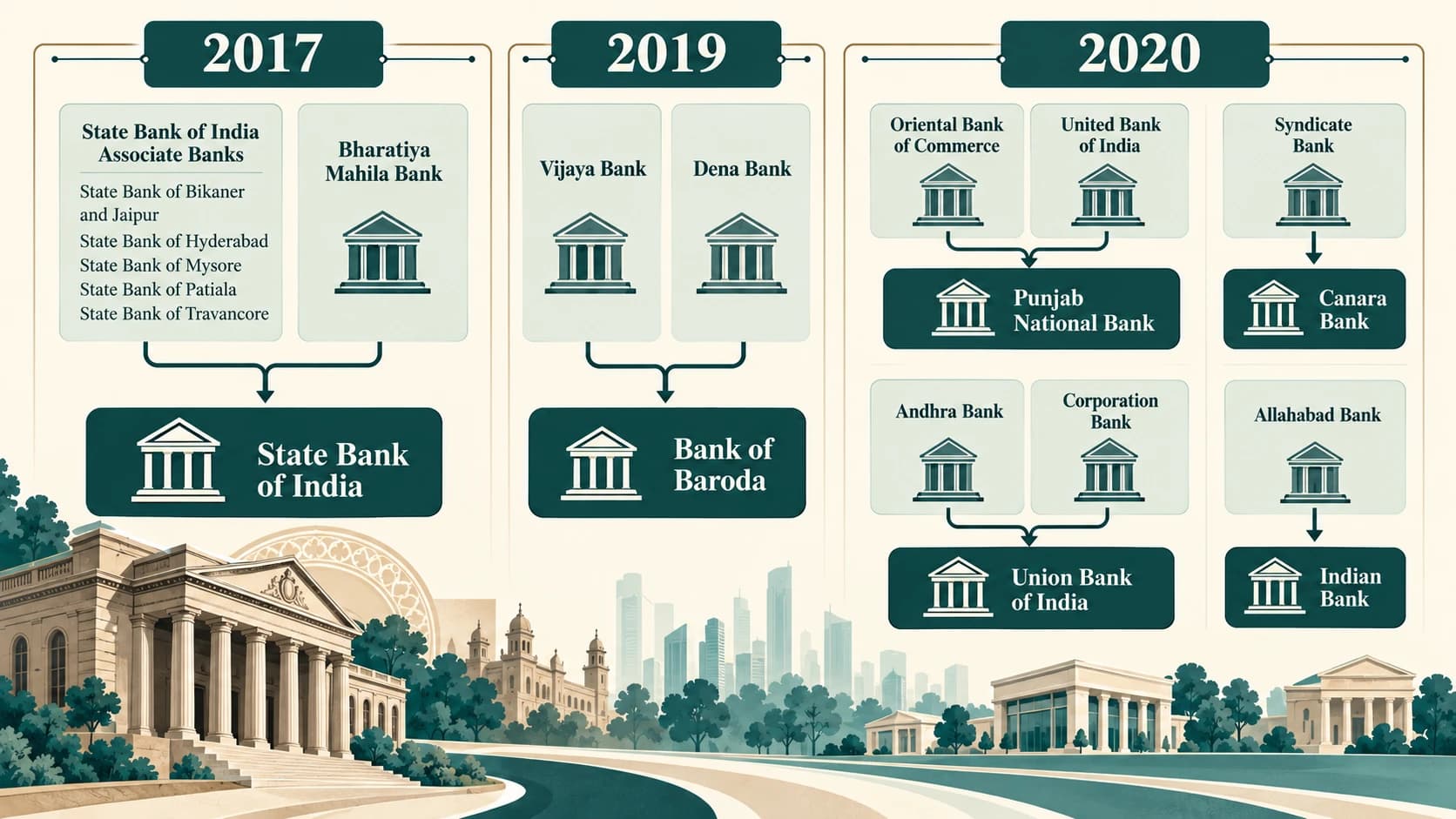
SBI consolidation - 2017
With effect from 1 April 2017, the remaining SBI associate banks and Bharatiya Mahila Bank were merged into State Bank of India.
Bank of Baroda amalgamation - 2019
With effect from 1 April 2019:
- Vijaya Bank; and
- Dena Bank
were amalgamated with Bank of Baroda.
Major amalgamations - 2020
With effect from 1 April 2020:
- Oriental Bank of Commerce + United Bank of India -> Punjab National Bank;
- Syndicate Bank -> Canara Bank;
- Andhra Bank + Corporation Bank -> Union Bank of India; and
- Allahabad Bank -> Indian Bank.
The Department of Financial Services currently lists 12 Public Sector Banks.
14. Nationalisation vs amalgamation
These are different concepts.
Nationalisation changes ownership/control by bringing a private enterprise into public ownership through law/policy.
Amalgamation/merger combines banking entities into another bank or a new combined entity.
A nationalised bank can later be merged with another public-sector bank.
15. Liberalisation did not eliminate social objectives
Even in the post-reform system, Indian banking continues to pursue inclusion and development objectives through mechanisms such as:
- priority-sector lending;
- Regional Rural Banks;
- Small Finance Banks;
- financial-inclusion schemes;
- Business Correspondents; and
- specialised institutions.
So the best way to understand the modern system is:
competition + prudential regulation + financial inclusion, rather than “public model replaced by private model”.
16. What should you remember for exams?
| Topic | Core fact |
|---|---|
| First major bank nationalisation | 1969 - 14 banks |
| Second nationalisation | 1980 - 6 banks |
| Narasimham Committee I | 1991 reform era |
| New private-sector bank licensing | RBI guidelines in 1993 |
| Major reform themes | Competition, prudential norms, capital, asset quality, efficiency |
| SBI associate-bank consolidation | 2017 |
| BOB + Vijaya + Dena | 2019 |
| Major PSB amalgamations | 2020 |
| Current PSBs | 12, subject to future update |
17. Common exam confusions
Nationalisation vs regulation
A bank can be privately owned and still heavily regulated by RBI. Regulation does not imply government ownership.
Public-sector bank vs central bank
A PSB such as SBI or PNB is a commercial bank. RBI is the central bank.
Liberalisation vs deregulation
Liberalisation increased competition and market orientation, but banking remained a highly regulated industry because bank failures can have systemic consequences.
Narasimham Committee recommendation vs law
Committee reports influence policy; they are not themselves statutes.
Quick check - BA-02-02
- How many major banks were nationalised in 1969?
- How many more were nationalised in 1980?
- Which committee is most closely associated with the 1991 banking reform agenda?
- In which year did RBI issue new-private-sector-bank entry guidelines after the long post-nationalisation gap?
- How many Public Sector Banks does DFS currently list?
Quick-check answers: 14; 6; Narasimham Committee on the Financial System; 1993; 12.