
History and Evolution of Banking in India
History and Evolution of Banking in India. A detailed chapter in Evolution & Structure of Indian Banking, with explanations and examples for Indian banking examinations.
By Akhilesh Saini · Reviewed 7 Oct 2026
1. Why banking history matters for exams
Banking history is not important merely because examinations sometimes ask dates. It explains why the current banking structure looks the way it does.
India's banking system did not appear in its present form. It developed through several broad phases:
- early organised and joint-stock banking;
- the Presidency Banks;
- the Imperial Bank era;
- creation of the Reserve Bank of India;
- post-Independence institution building;
- bank nationalisation and social banking;
- financial-sector reform and liberalisation; and
- differentiated banking, digitalisation and consolidation.
If you remember the logic of these phases, the dates become easier to retain.
2. The Presidency Banks
The Reserve Bank's historical material identifies three Presidency Banks as major institutional predecessors in organised Indian banking:
- Bank of Bengal - established in 1806;
- Bank of Bombay - established in 1840; and
- Bank of Madras - established in 1843.
They were associated with the three major Presidencies under British administration. They performed important banking functions for commerce and government and, for part of their history, had note-issuing privileges. The Paper Currency Act, 1861 centralised the note-issue function with the Government, ending the Presidency Banks' note-issuing role.
Exam idea
Do not confuse:
- Presidency Banks with RBI; or
- Imperial Bank of India with RBI.
The Presidency Banks were commercial banking institutions. RBI later became the country's central bank.
3. Imperial Bank of India - 1921
The three Presidency Banks were amalgamated in 1921 to form the Imperial Bank of India.
The Imperial Bank performed important commercial-banking functions and also acted as banker to government in areas where a central bank was not yet present. After RBI began operations, the Imperial Bank also served as RBI's agent at centres where RBI did not have its own offices.
The Imperial Bank is especially important because it later became the foundation of the State Bank of India.
4. Creation of the Reserve Bank of India - 1935
The Reserve Bank of India Act, 1934 provided the statutory basis for India's central bank. RBI commenced operations on 1 April 1935.
RBI's establishment separated core central-banking functions - such as currency and credit-system management and central banking responsibilities - from ordinary commercial banking.
RBI itself was originally established with private shareholding and was later brought into public ownership with effect from 1 January 1949.
The detailed functions, governance and powers of RBI are covered in Module 03.
5. Banking regulation after Independence
The banking system required a stronger statutory framework as the number and importance of banking institutions grew.
The Banking Regulation Act, 1949 became the central law governing banking companies and gives RBI major regulatory, licensing, inspection and supervisory powers.
For exam purposes, remember the basic legal pair:
- Reserve Bank of India Act, 1934 - establishes and governs RBI and includes the Second Schedule relevant to scheduled-bank status;
- Banking Regulation Act, 1949 - central legislation for regulation of banking business.
Do not assume that the RBI Act and Banking Regulation Act perform the same function.
6. From Imperial Bank to State Bank of India - 1955
The Imperial Bank of India was transformed into the State Bank of India (SBI) on 1 July 1955.
The policy objective included wider banking reach, including expansion into areas that had limited access to formal banking.
The State Bank of India (Subsidiary Banks) Act, 1959 subsequently brought several former state-associated banks into the SBI group as subsidiaries. Over time, those associate banks were consolidated, and the remaining SBI associate banks were ultimately merged into SBI in 2017.
High-value sequence
Presidency Banks -> Imperial Bank of India -> State Bank of India
This sequence is much more important than memorising disconnected dates.
7. Social control and the road to nationalisation
By the 1960s, policymakers were concerned that commercial-bank credit was concentrated in certain industries, business groups and urban centres, while agriculture, small industry and many rural areas remained underserved.
This period saw stronger efforts to align bank credit with national development priorities. The next major turning point was the nationalisation of large commercial banks in 1969.
Nationalisation is covered in depth in BA-02-02, but the historical milestones are:
- 1969: 14 major commercial banks nationalised;
- 1980: 6 more commercial banks nationalised.
RBI historical material describes 1969 as a watershed that significantly expanded the role of public-sector banking and contributed to branch expansion into the hinterland.
8. Regional Rural Banks - a specialised rural-banking layer
Regional Rural Banks emerged in the 1970s as a specialised institutional response to rural credit needs. Their detailed ownership structure, mandate and consolidation belong in Module 08, but historically they represent another stage in the effort to widen formal banking access beyond metropolitan and urban centres.
Do not confuse RRBs with co-operative banks. They are distinct institutional forms.
9. The reform era beginning in 1991
By the late 1980s and early 1990s, the banking system faced concerns such as:
- low profitability;
- weak asset quality;
- high pre-emptions of bank resources;
- directed credit and administered structures;
- inadequate capital in parts of the system; and
- limited competition.
The broader economic reforms beginning in 1991 were accompanied by major financial-sector reforms. The Narasimham Committee on the Financial System (1991) became central to the reform process.
A major shift was the reopening of banking to new private-sector entrants. RBI issued Guidelines on Entry of New Private Sector Banks in 1993.
This did not mean that public-sector banks disappeared. Instead, the system moved toward a more competitive structure in which public-sector banks, old private-sector banks, new private-sector banks and foreign-bank presence coexisted under stronger prudential regulation.
10. Technology changes the banking model
The reform era also overlapped with major technological change:
- computerisation;
- core banking systems;
- ATMs;
- electronic clearing;
- internet banking;
- mobile banking; and
- later, instant digital-payment systems.
Technology changed how banks delivered services even when the underlying legal category of the bank remained the same.
This is a useful exam distinction:
A digital channel does not automatically create a new category of bank.
A conventional commercial bank can be highly digital, while a Payments Bank is a distinct regulatory/licensing category.
11. Differentiated banking after 2014
A further stage in banking evolution was the creation of differentiated bank models intended to serve particular financial-inclusion and payment needs.
RBI issued licensing frameworks for:
- Payments Banks; and
- Small Finance Banks
in 2014. These were designed with different permitted activities and target purposes rather than simply copying the full universal-bank model.
Local Area Banks pre-date them, but all three illustrate an important policy idea: not every bank needs the same geographical reach or business model.
12. Consolidation in the modern period
The Indian banking system has also experienced significant consolidation.
Important examples include:
- SBI associate banks and Bharatiya Mahila Bank merged into SBI with effect from 1 April 2017;
- Vijaya Bank and Dena Bank amalgamated with Bank of Baroda with effect from 1 April 2019; and
- a major set of public-sector-bank amalgamations took effect from 1 April 2020.
The result is that the Department of Financial Services currently lists 12 Public Sector Banks.
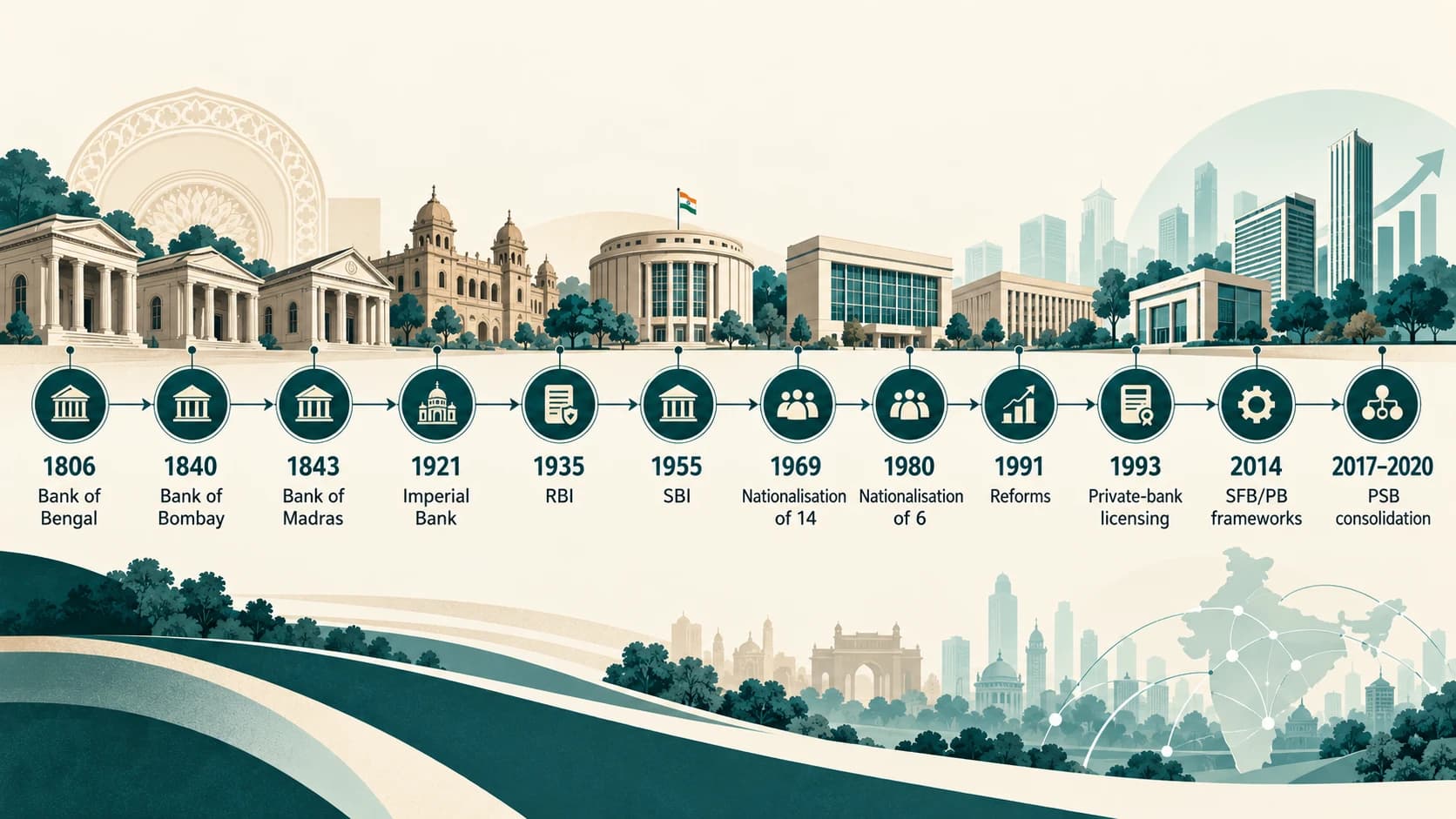
13. The evolution in one timeline
| Period / year | Development | Why it matters |
|---|---|---|
| 1806 | Bank of Bengal established | First of the Presidency Banks |
| 1840 | Bank of Bombay established | Presidency banking expands |
| 1843 | Bank of Madras established | Completes the three Presidency Banks |
| 1921 | Presidency Banks amalgamated into Imperial Bank of India | Major commercial-banking consolidation |
| 1935 | RBI begins operations | India gets a central bank |
| 1949 | RBI nationalised; Banking Regulation Act era | Public ownership of RBI and stronger banking regulation |
| 1955 | Imperial Bank becomes State Bank of India | Large state-linked commercial bank with expansion role |
| 1959 | SBI subsidiary-bank framework | Integration of several state-associated banks |
| 1969 | 14 major banks nationalised | Social-banking/public-sector expansion phase |
| 1980 | 6 more banks nationalised | Public-sector share expands further |
| 1991 | Narasimham reform era begins | Prudential, competitive and market-oriented reforms |
| 1993 | New private-sector bank licensing reopened | Competition and new-generation banks |
| 2014 | SFB and Payments Bank licensing frameworks | Differentiated banking model |
| 2017-2020 | Major public-sector consolidation | Fewer, larger PSBs |
| 2020s | Digitalisation, specialised licensing and continuing consolidation | Current phase of banking evolution |
14. Common exam confusions
RBI vs SBI
- RBI is the central bank and regulator.
- SBI is a commercial bank.
Imperial Bank vs RBI
- Imperial Bank was a commercial banking institution with certain agency/government-banking functions.
- RBI became India's central bank in 1935.
Nationalisation of RBI vs nationalisation of commercial banks
- RBI was brought into public ownership in 1949.
- 14 major commercial banks were nationalised in 1969, followed by 6 more in 1980.
1991 reforms vs 1993 private-bank entry
The reform process began in the early 1990s; RBI's new-private-bank licensing guidelines were issued in 1993.
Quick check - BA-02-01
- Which three banks are called the Presidency Banks in Indian banking history?
- What institution was created from their amalgamation in 1921?
- When did RBI begin operations?
- When did the Imperial Bank of India become SBI?
- Why is 1969 considered a major turning point in Indian banking history?
Quick-check answers: Bank of Bengal, Bank of Bombay and Bank of Madras; Imperial Bank of India; 1 April 1935; 1 July 1955; because 14 major commercial banks were nationalised and the public/social-banking phase expanded significantly.