
Essential Banking Terminology
Essential Banking Terminology. A detailed chapter in Money & Banking Foundations, with explanations and examples for Indian banking examinations.
By Akhilesh Saini · Reviewed 7 Oct 2026
This lesson creates the vocabulary used throughout the Banking Awareness course.
Do not try to memorise every term as an isolated definition. Connect each term to a bank's balance sheet and business model.
1. Asset
An asset is a resource or claim expected to provide economic value.
For a bank, common assets include:
- cash/balances;
- loans and advances;
- investments; and
- certain other receivables/assets.
A loan to a customer is a bank asset because the customer owes repayment to the bank.
2. Liability
A liability is an obligation owed to another party.
For a bank, important liabilities include:
- customer deposits;
- borrowings; and
- other amounts payable.
A deposit is a liability to the bank because the bank owes money to the depositor according to the account terms.
3. Equity / Capital
Equity is the residual interest after liabilities are deducted from assets.
Basic accounting identity:
Assets = Liabilities + Equity
Banking regulation uses more specialised concepts of regulatory capital, CET1, Tier 1, Tier 2 and capital adequacy. Those belong to Module 14.
At foundation level, remember:
Capital provides a loss-absorbing cushion; deposits are not the same thing as bank capital.
4. Liquidity
Liquidity is the ability to meet obligations when they fall due without unacceptable loss or disruption.
An asset can also be described as liquid if it can be converted into usable funds quickly with little loss of value.
Cash is highly liquid. A long-term illiquid loan cannot normally be turned into cash as quickly or predictably.
RBI liquidity guidance emphasises a bank's capacity to fund assets and meet expected and unexpected cash/collateral obligations at reasonable cost. [Source 7]
5. Solvency
Solvency concerns whether an institution's financial position is fundamentally sound enough for its assets/value and capital to cover obligations and absorb losses.
A bank can face a liquidity problem without necessarily being insolvent.
Example:
- A bank owns sound long-term assets but cannot obtain enough cash today to meet unusually large withdrawals: liquidity stress.
- A bank's assets have suffered such large losses that their value is insufficient relative to obligations/capital: solvency concern.
In practice the two can interact: prolonged liquidity stress can damage solvency, and doubts about solvency can trigger withdrawals and liquidity stress.
6. Profitability
Profitability measures whether the bank earns adequate income relative to expenses, assets or capital.
Common measures include:
- net profit;
- return on assets (RoA);
- return on equity (RoE); and
- net interest margin (NIM).
Profitability is not the same as liquidity or solvency.
7. Revenue / income
Bank income can include:
- interest income; and
- non-interest income such as fees and other permitted income.
8. Expense
Expenses include:
- interest paid;
- employee/operating costs;
- technology/infrastructure costs;
- provisions/losses; and
- other costs.
9. Net Interest Income (NII)
NII = Interest earned - Interest paid
It is an amount over a period.
10. Net Interest Margin (NIM)
Conceptually, NIM measures net interest income relative to a bank's average interest-earning assets. RBI banking-statistics material uses this concept in assessing bank performance. [Source 6]
NIM is a ratio/percentage.
NII vs NIM
- NII = amount
- NIM = ratio
Do not interchange them.
11. Yield
Yield is the return generated by an asset relative to its value/base, usually expressed as a percentage.
For bank assets, yield can refer to interest/return earned on loans or investments.
12. Cost of funds
The cost of funds is the cost a bank incurs to obtain the money/funding it uses.
Funding can come from:
- deposits;
- market borrowings;
- other bank borrowings; and
- other permitted sources.
RBI statistical definitions commonly measure cost-of-funds concepts using interest expense relative to relevant deposits/borrowings. [Source 6]
13. Spread
A spread is a difference between two rates/yields.
A simple example is:
Loan yield - funding cost
Spread is useful but does not equal net profit because other costs and losses remain.
14. Principal
The principal is the original or outstanding amount on which interest is calculated, depending on context.
For a loan, scheduled principal repayment reduces the amount owed.
15. Interest
Interest is the price paid/received for the use of funds over time.
16. Deposit
A deposit is money placed with an institution under specified repayment/withdrawal terms.
Within banking:
- deposits are claims/assets of customers; and
- liabilities of the bank.
Detailed deposit types are covered in Module 05.
17. Loan / advance
A loan or advance is credit extended to a borrower subject to agreed terms.
From the bank's perspective, a performing loan is generally an asset.
Detailed lending forms are covered in Module 06.
18. Credit
Credit is the broader concept of providing purchasing power/funds now against an obligation to repay or settle later.
Loans are a major form of credit, but credit can also include facilities such as overdrafts or other funded/non-funded arrangements.
19. Collateral / security
Collateral is an asset/property offered to support a credit obligation.
Security concepts such as pledge, hypothecation, mortgage and lien are covered in Module 06.
20. Default
A default occurs when a borrower fails to meet contractual obligations according to applicable terms/definitions.
Default is not automatically identical to NPA. NPA recognition follows regulatory asset-classification rules studied in Module 07.
21. Credit risk
Credit risk is the risk of loss because a borrower or counterparty does not meet its obligations.
22. Market risk
Market risk is the risk of loss from adverse movements in market variables such as interest rates, exchange rates or security prices.
23. Liquidity risk
Liquidity risk is the risk that an institution cannot meet obligations efficiently when due without unacceptable cost/loss. [Source 7]
24. Operational risk
Operational risk broadly concerns losses arising from failures or inadequacies in processes, people, systems or external events. Detailed regulatory definitions and capital treatment belong to Module 14.
25. Provision
A provision is an amount recognised/set aside in accounts to reflect expected/identified losses or obligations under applicable accounting/regulatory rules.
For banks, loan-loss provisions are especially important because not all borrowers will repay in full.
26. Write-off
A write-off is an accounting action reducing/removing an asset from the balance sheet according to applicable rules.
A write-off does not automatically mean the borrower has been legally forgiven or recovery efforts must stop. This distinction is studied in Module 07.
27. Reserve - be careful with the word
"Reserve" can mean different things depending on context.
Examples include:
- cash/reserve balances held with a central bank;
- accounting reserves within capital/equity; and
- statutory reserve requirements.
Never assume the meaning without reading the context.
28. Leverage
Leverage refers to the use of debt/obligations relative to equity/capital to finance assets.
Banks are naturally leveraged institutions because deposits and borrowings finance a large part of their assets, while regulatory capital is a smaller but crucial loss-absorbing layer.
29. Maturity
Maturity is the date or period at which a financial obligation/instrument becomes due according to its terms.
Examples:
- a one-year fixed deposit;
- a five-year loan;
- a 91-day Treasury Bill.
30. Maturity mismatch
A maturity mismatch arises when the timing of cash inflows from assets does not match the timing of cash outflows on liabilities.
Banks actively manage such mismatches rather than requiring every loan to have an identical matching deposit.
31. Credit-deposit ratio
The credit-deposit (CD) ratio broadly compares bank credit with deposits.
It is useful as an indicator of how much credit is outstanding relative to the deposit base, but it should not be interpreted mechanically as a rule that each rupee of credit came from a specific rupee of deposit.
32. Cash-deposit ratio
The cash-deposit ratio compares cash holdings with deposits under the relevant statistical definition.
It is one of the behavioural ratios that can influence monetary relationships such as the money multiplier.
33. Return on Assets (RoA)
RoA = Net profit / Average or relevant total assets, depending on the reporting convention.
It indicates how effectively assets generate profit.
34. Return on Equity (RoE)
RoE = Net profit / Equity (or specified capital-and-reserve base) under the applicable convention.
It measures profitability relative to shareholder funds.
RBI statistical material publishes bank-performance ratios including RoA and RoE. [Source 6]
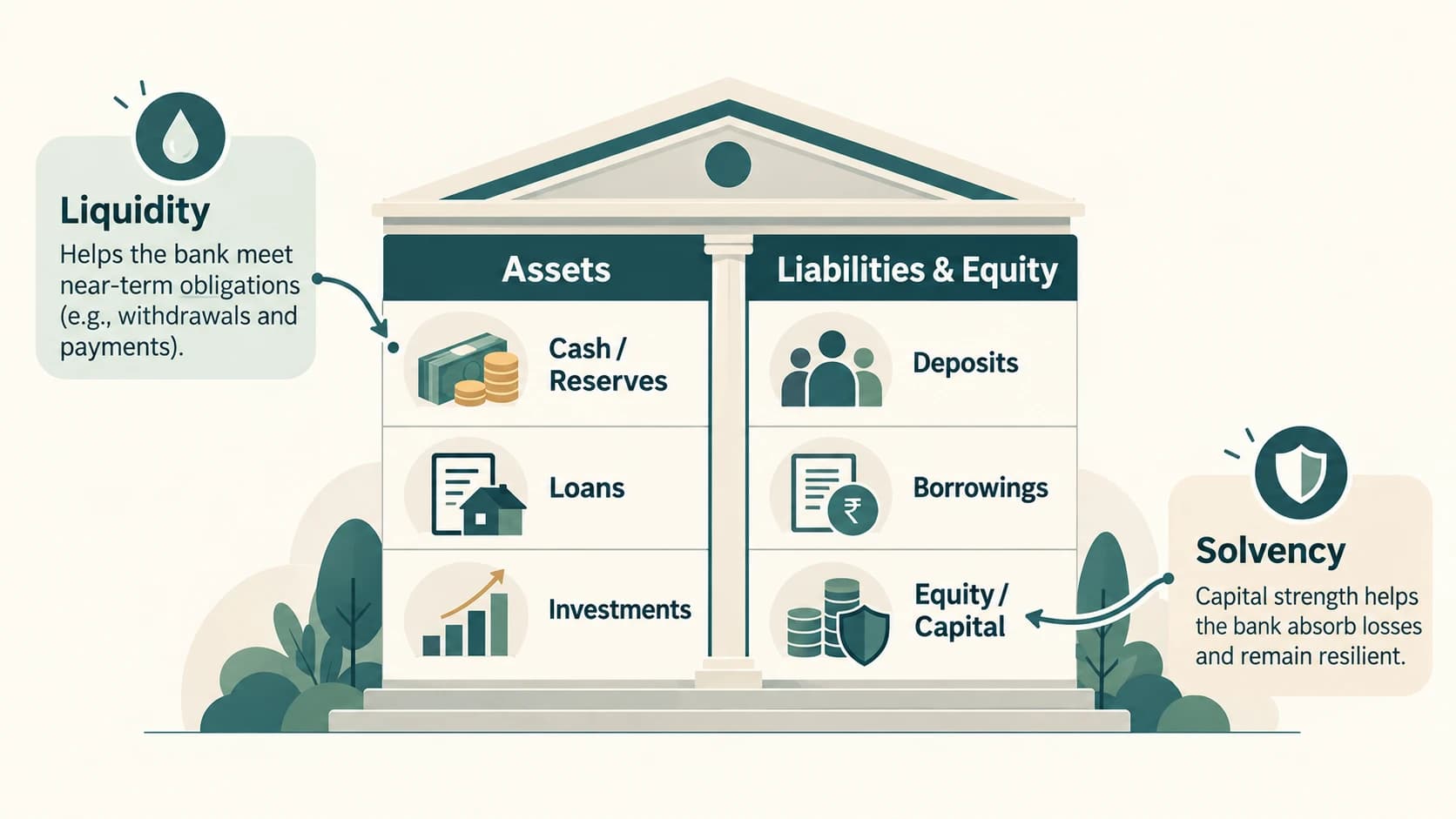
35. Balance-sheet view: put the vocabulary together
Imagine a bank with:
Assets
- cash/reserves: Rs. 10
- loans: Rs. 70
- investments: Rs. 30
Total assets = Rs. 110
Liabilities and equity
- deposits: Rs. 90
- borrowings: Rs. 10
- equity/capital: Rs. 10
Total liabilities + equity = Rs. 110
Now the vocabulary connects:
- deposits fund part of the asset base;
- loans and investments generate income but carry risk;
- cash/reserves support liquidity;
- equity absorbs losses;
- interest income and interest expense determine NII;
- NIM relates NII to earning assets;
- provisions reduce profit when credit losses are recognised/expected; and
- solvency and liquidity describe different dimensions of financial strength.
36. Common exam confusions
Bank deposit: asset or liability?
- asset for depositor;
- liability for bank.
Bank loan: asset or liability?
- liability for borrower;
- asset for bank.
Liquidity vs solvency
- liquidity = ability to meet obligations when due;
- solvency = underlying financial capacity/net worth/loss absorption.
Capital vs deposits
Deposits are bank liabilities. Capital is the loss-absorbing ownership/regulatory layer.
Provision vs write-off
Provision recognises/absorbs expected or identified loss through accounting; write-off removes/reduces the asset from the balance sheet according to rules. They are not identical concepts.
Quick check - BA-01-05
- A customer's savings-account balance is what from the bank's perspective?
- What is the basic difference between liquidity and solvency?
- Is NIM an amount or a ratio?
Answers: 1. A liability. 2. Liquidity concerns meeting obligations when due; solvency concerns underlying financial soundness/loss-absorbing capacity. 3. A ratio.