
Interest, Compounding and Real vs Nominal Returns
Interest, Compounding and Real vs Nominal Returns. A detailed chapter in Money & Banking Foundations, with explanations and examples for Indian banking examinations.
By Akhilesh Saini · Reviewed 7 Oct 2026
1. What is interest?
Interest is the price associated with using money across time.
From the lender's perspective, interest can compensate for:
- postponing current consumption;
- inflation;
- credit/default risk;
- liquidity risk;
- opportunity cost; and
- administrative/business costs.
From the borrower's perspective, interest is part of the cost of obtaining funds now and repaying later.
2. Principal, rate and time
Three basic variables appear repeatedly:
- Principal (P) - starting amount lent, borrowed or invested;
- Rate (r) - interest rate, usually stated per year; and
- Time (t) - duration.
Before solving an exam question, ensure the time unit and rate unit match.
Example:
A 12% annual rate applied for 6 months is not the same as applying 12% for a full year.
3. Simple interest
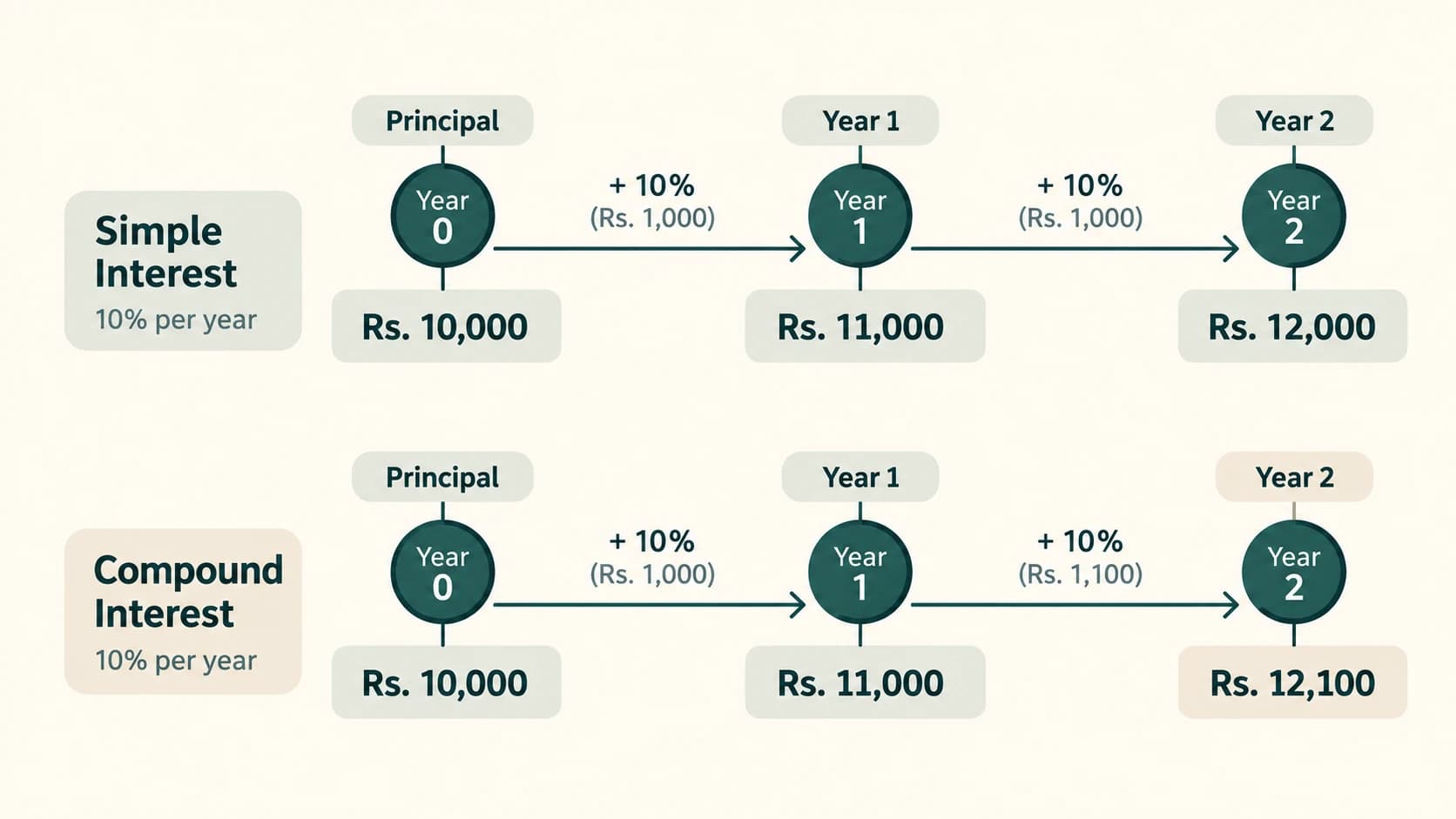
Under simple interest, interest is calculated only on the original principal.
Simple Interest = P x r x t
where r is written as a decimal.
Example
Principal = Rs. 10,000
Rate = 10% per year = 0.10
Time = 2 years
Interest:
10,000 x 0.10 x 2 = Rs. 2,000
Amount after 2 years:
Rs. 10,000 + Rs. 2,000 = Rs. 12,000
4. Compound interest
Under compounding, interest earned in one period becomes part of the balance on which later interest is calculated.
If interest is compounded annually:
A = P(1 + r)^n
where:
- A = final amount;
- P = principal;
- r = rate per compounding period; and
- n = number of compounding periods.
Example
Principal = Rs. 10,000
Rate = 10% annually
Time = 2 years
Year 1:
10,000 x 1.10 = Rs. 11,000
Year 2:
11,000 x 1.10 = Rs. 12,100
Compound interest = Rs. 2,100.
Under simple interest, the same example produced Rs. 2,000 interest. The additional Rs. 100 is interest earned on the first year's interest.
5. Why compounding frequency matters
A nominal annual rate can be compounded:
- annually;
- half-yearly;
- quarterly;
- monthly; or
- at another specified frequency.
If the stated nominal rate is 12% and compounding is monthly, the periodic rate is generally 1% per month for 12 periods, subject to the product's exact terms.
The effective annual return can therefore differ from the headline nominal annual rate.
6. Nominal rate vs effective annual rate
A nominal annual rate states an annualised rate without necessarily reflecting the full effect of intra-year compounding.
An effective annual rate (EAR) reflects the actual annual growth after compounding at the stated frequency.
If a nominal annual rate j is compounded m times per year:
EAR = (1 + j/m)^m - 1
Example:
12% nominal compounded monthly:
EAR = (1 + 0.12/12)^12 - 1
= (1.01)^12 - 1
Approximately 12.68%.
Exam questions may use simpler conventions, so always follow the assumptions given in the question.
7. Time value of money
A rupee today and a rupee one year from now are not economically identical because today's rupee can be:
- invested;
- used to repay expensive debt;
- spent; or
- held for liquidity.
This is the basic idea of the time value of money.
Future value
Future value asks:
What will today's money become after earning a specified return?
Present value
Present value asks:
What is a future amount worth today if we discount it at an appropriate rate?
Detailed discounting and valuation belong to finance courses, but the basic intuition is useful in banking.
8. Nominal return vs real return
A deposit may grow in rupee terms while its purchasing power grows much less.
Nominal return measures the percentage increase in money value.
Real return adjusts for inflation.
A commonly used approximation is:
Real return approximately = Nominal return - Inflation rate
Example:
- nominal return = 7%;
- inflation = 5%;
- approximate real return = 2%.
For greater precision:
Real return = (1 + nominal return) / (1 + inflation) - 1
With 7% nominal return and 5% inflation:
1.07 / 1.05 - 1 = about 1.90%
9. Nominal amount vs purchasing power
Suppose Rs. 1,00,000 becomes Rs. 1,07,000 in one year.
Nominally, wealth has increased by 7%.
But if the general price level also rises by 7%, the amount may buy roughly the same basket of goods as before.
This is why banking and monetary-policy discussions often distinguish nominal and real values.
10. Interest rates on loans
Loan interest can be structured in different ways.
Fixed rate
The contractual rate remains fixed for the specified period according to the loan terms.
Floating rate
The rate can change according to a benchmark/reset mechanism and contractual spread.
Detailed benchmark systems such as MCLR/external benchmark lending are covered in Module 06.
11. Reducing balance vs "flat-rate" intuition
Many loans charge interest on the outstanding principal, which declines as principal is repaid.
This differs from simply multiplying the original principal by a flat percentage for every year and calling that the economic cost.
Therefore, when comparing loans, do not compare only the headline percentage without understanding:
- calculation method;
- fees;
- compounding;
- reset terms; and
- repayment schedule.
12. EMI intuition
An Equated Monthly Instalment generally contains:
- an interest component; and
- a principal-repayment component.
In many standard amortising loans, the interest component is larger in early instalments because the outstanding principal is higher. As principal falls, the interest portion generally declines and principal repayment rises, assuming the rate and schedule remain unchanged.
Detailed EMI calculations are not required for this foundation module.
13. Opportunity cost
If money is used for one purpose, the benefit from the best alternative use is sacrificed.
Example:
A business with Rs. 10 lakh could:
- keep it in a deposit;
- repay a loan;
- buy machinery; or
- hold cash.
The return or benefit forgone from the best alternative is part of the economic opportunity cost.
14. Rule of 72 - optional mental shortcut
A rough mental shortcut is:
Years to double approximately = 72 / annual percentage rate
At 8%, money roughly doubles in around 9 years.
This is only a rule of thumb and should not replace exact compounding when precision is required.
15. Common exam confusions
Simple interest vs compound interest
Simple interest applies the rate to original principal; compound interest applies returns to an accumulating balance.
Nominal rate vs real rate
Nominal rate is stated in money terms; real rate adjusts for inflation.
Nominal annual rate vs effective annual rate
Compounding frequency can make the effective rate different from the quoted nominal rate.
Interest rate vs interest amount
A 10% rate is not Rs. 10,000 unless the principal/time combination makes the interest amount Rs. 10,000.
Quick check - BA-01-04
- What is the amount after two years on Rs. 10,000 at 10% compounded annually?
- If nominal return is 8% and inflation is 6%, what is the approximate real return?
- Why can a 12% nominal rate compounded monthly produce an effective annual rate above 12%?
Answers: 1. Rs. 12,100. 2. Approximately 2%. 3. Because interest is added during the year and later periods earn interest on the enlarged balance.