
How Banks Create Credit and Earn Money
How Banks Create Credit and Earn Money. A detailed chapter in Money & Banking Foundations, with explanations and examples for Indian banking examinations.
By Akhilesh Saini · Reviewed 7 Oct 2026
1. The two ideas students must keep separate
When learning bank business, distinguish:
- how bank lending and deposits interact in the monetary system, and
- how a bank earns profit from its balance sheet and services.
These are related, but they are not the same question.
2. A simplified bank balance sheet
A balance sheet has two broad sides:
Assets - resources or claims that are expected to provide value to the bank.
Examples:
- cash and balances;
- loans and advances;
- investments; and
- other assets.
Liabilities and equity/capital - obligations owed by the bank plus the owners' residual claim.
Examples:
- customer deposits;
- bank borrowings;
- other liabilities; and
- shareholders' capital/equity.
A crucial exam insight is:
A customer's deposit is an asset to the customer but a liability of the bank.
The bank owes that balance to the customer under the account terms.
By contrast:
A loan made by the bank is normally an asset of the bank.
The borrower owes principal and interest to the bank.
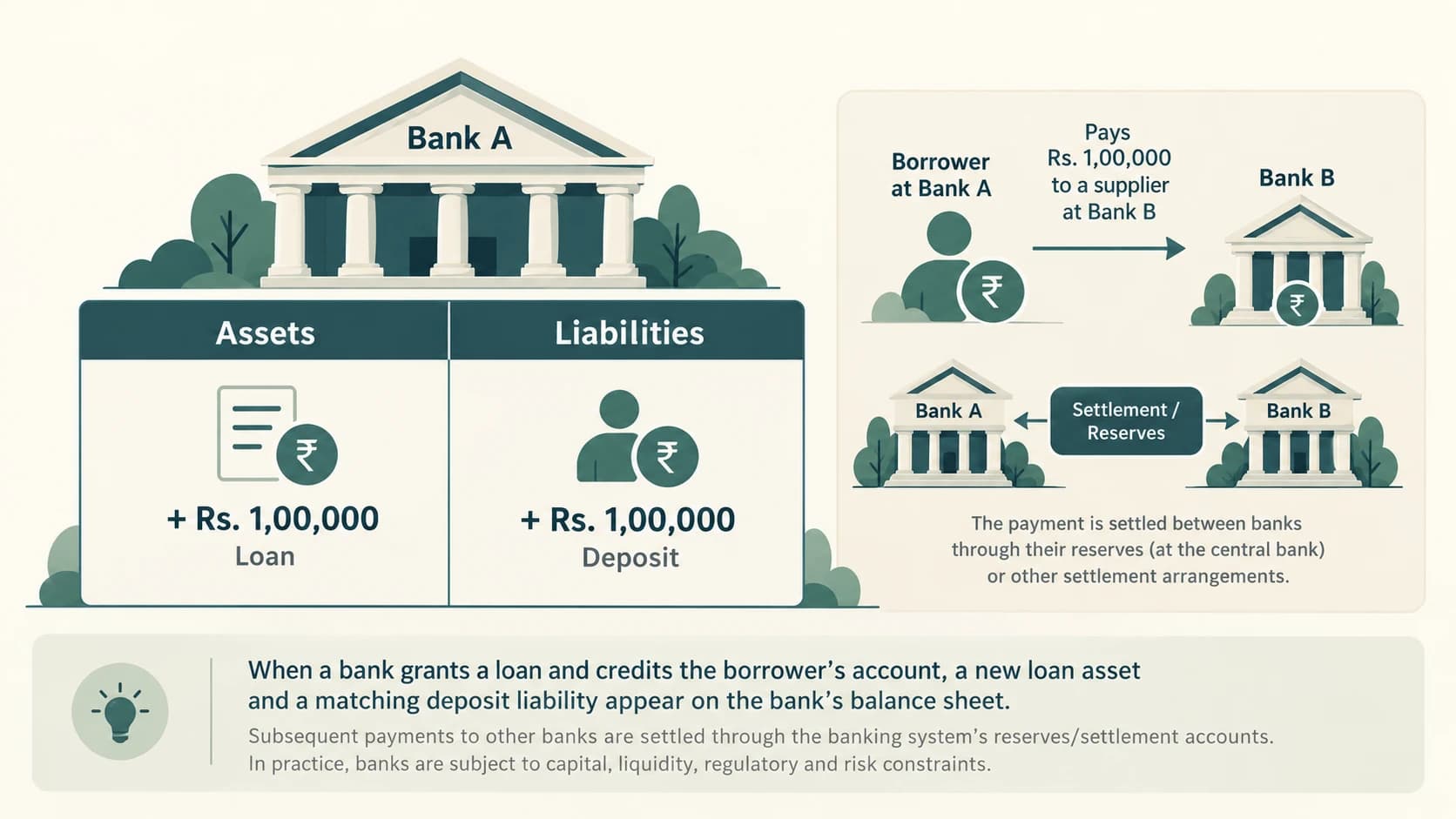
3. What happens when a bank grants a loan?
Use a simplified example.
Suppose Bank A approves a Rs. 1,00,000 business loan to Neha and credits the loan proceeds to Neha's deposit account at Bank A.
Ignoring fees and other details, the bank's balance sheet can initially change like this:
| Bank A | Increase |
|---|---|
| Asset: Loan to Neha | Rs. 1,00,000 |
| Liability: Neha's deposit | Rs. 1,00,000 |
The bank has created a loan asset and a matching deposit liability.
This illustrates why modern bank lending is more subtle than the story "the bank takes one person's physical cash and hands the same notes to another person."
4. What if Neha spends the loan?
Suppose Neha pays a supplier whose account is at Bank B.
Then:
- Neha's deposit at Bank A falls when payment is made.
- The supplier's deposit at Bank B rises.
- Bank A and Bank B must settle the payment through the banking/payment system.
- Settlement can involve transfers of reserves/central-bank balances between banks.
At the level of the banking system, deposits created through lending can move from one bank to another rather than simply disappearing when the borrower spends.
This is why banks care intensely about:
- funding;
- reserve/settlement balances;
- liquidity;
- capital;
- credit quality; and
- customer deposit behaviour.
5. Does a bank have unlimited power to create credit?
No.
The simplified loan-creates-deposit example is not a claim that banks can lend without limits.
Major constraints include:
A. Capital constraints
Banks must maintain adequate capital relative to risks. A bank cannot safely expand risky assets indefinitely without sufficient capital support.
Capital and Basel concepts are studied in Module 14.
B. Liquidity and settlement needs
Customers may withdraw or transfer deposits. Banks therefore need adequate liquidity and access to settlement balances/funding.
RBI liquidity guidance emphasises the ability to meet expected and unexpected cash and collateral obligations. [Source 7]
C. Reserve requirements and regulation
Banks operate under RBI rules, reserve requirements and prudential regulations.
Detailed CRR/SLR treatment appears in Module 04.
D. Credit risk
If borrowers do not repay, bank assets lose value and profits/capital can be damaged.
E. Availability of creditworthy demand
A bank cannot profitably lend merely because it wants a bigger loan book. It needs customers who want credit and satisfy the bank's underwriting standards.
F. Profitability and pricing
A loan must make economic sense after considering:
- funding cost;
- operating cost;
- expected credit loss;
- capital usage;
- competition; and
- regulatory requirements.
G. Market and macroeconomic conditions
Weak economic conditions can reduce loan demand or increase expected defaults.
6. The textbook money multiplier - useful but incomplete
A simplified textbook model often starts with a monetary base and a reserve ratio, then shows how repeated deposits and lending can support a multiple expansion of deposits.
The intuition is useful:
The banking system can support a stock of deposits/credit larger than the amount of physical currency or reserve money alone.
RBI itself publishes a money multiplier ratio in its monetary analysis, commonly relating broad money to reserve money. [Sources 2 and 3]
But do not treat a simple formula such as 1 / reserve ratio as a universal mechanical law that determines actual lending.
Actual credit creation depends on many factors including:
- capital;
- liquidity;
- regulation;
- currency preferences;
- deposit behaviour;
- central-bank operations;
- credit demand; and
- bank risk appetite.
For exams, learn both levels:
- the simplified multiplier intuition; and
- the real-world constraints.
7. How banks earn money
A bank's income is not simply "loan interest minus deposit interest," although that is an important part.
A. Interest income
Banks earn interest from interest-bearing assets such as:
- loans and advances; and
- interest-bearing investments.
B. Interest expense
Banks pay interest on many funding sources, such as:
- savings deposits;
- term deposits; and
- borrowings.
C. Net Interest Income (NII)
A simplified concept is:
Net Interest Income = Interest earned - Interest paid
This measures the rupee amount of net interest earnings over a period.
D. Interest spread
Spread is a rate difference, usually the gap between an earning yield/rate and a funding cost/rate.
Example:
- average yield on a loan portfolio: 9%;
- average relevant funding cost: 5%;
- simplified spread: 4 percentage points.
But a bank's full economics depend on far more than this simple subtraction.
E. Net Interest Margin (NIM)
RBI statistical material defines NIM using net interest income relative to average interest-earning assets (some RBI publications/tables may present closely related denominator conventions for specific datasets). [Source 6]
Conceptually:
NIM = Net interest income / Average interest-earning assets
NIM is a ratio, while NII is an amount.
This distinction is frequently useful in banking exams and interviews.
F. Non-interest income
Banks can also earn income from activities such as:
- fees and commissions;
- transaction/service charges;
- distribution of permitted financial products;
- foreign-exchange services;
- trade-finance services;
- treasury/investment activities; and
- other permitted banking services.
Exact accounting classifications can vary and should be studied in greater depth in later balance-sheet modules.
8. Major bank costs
Bank income must cover costs such as:
- interest paid to depositors and other fund providers;
- employee and branch/technology costs;
- payment and infrastructure costs;
- credit-loss provisions;
- fraud/operational losses;
- taxes; and
- the cost of maintaining adequate capital and liquidity.
So a high lending rate does not mean the entire interest amount is profit.
9. Credit creation vs profit creation
A bank can expand loans but still perform poorly if:
- loans are made to weak borrowers;
- defaults rise;
- funding becomes expensive;
- operating costs are excessive; or
- pricing does not compensate for risk.
Therefore:
More credit is not automatically more profit.
Quality of assets and risk-adjusted pricing matter.
10. A simplified bank-profit example
Suppose over a year a bank earns:
- Rs. 10 crore interest from loans/investments; and
- Rs. 2 crore fees/other income.
It pays/incurs:
- Rs. 6 crore interest expense;
- Rs. 3 crore operating expense; and
- Rs. 1 crore provisions/other losses.
Simplified result:
- Net Interest Income = 10 - 6 = Rs. 4 crore
- Total income before costs = 12 crore
- After the simplified listed costs, residual profit = 2 crore
Real bank financial statements are more complex, but this example shows why deposit cost, operating efficiency and credit quality all matter.
11. Common exam confusions
Deposit = bank asset
Wrong from the bank's perspective. A customer deposit is generally a bank liability.
Loan = bank liability
Wrong from the bank's perspective. A performing loan claim is generally a bank asset.
NII = NIM
Wrong. NII is an amount; NIM is a ratio.
Spread = profit
Wrong. Spread does not subtract all operating costs, provisions, taxes and other expenses.
Money multiplier = guaranteed lending formula
Wrong. It is a useful monetary relationship/teaching concept, not a guarantee that every bank will or can expand lending by a fixed mechanical multiple.
Quick check - BA-01-03
- From the bank's perspective, is a customer deposit an asset or liability?
- When a bank grants a loan by crediting the borrower's account, which two broad balance-sheet items initially rise?
- Name any three factors that constrain bank credit expansion.
Answers: 1. Liability. 2. A loan asset and a deposit liability. 3. Any three of capital, liquidity/settlement needs, reserve/regulatory requirements, credit risk, creditworthy demand, profitability/pricing, or macroeconomic conditions.