
Types of Money and Monetary Aggregates
Types of Money and Monetary Aggregates. A detailed chapter in Money & Banking Foundations, with explanations and examples for Indian banking examinations.
By Akhilesh Saini · Reviewed 7 Oct 2026
1. Why "how much money exists?" is not a simple question
If someone asks, "How much money is there in India?", should we count only notes and coins? Should a current-account balance count? What about a fixed deposit? What about a post-office deposit?
The answer depends on the definition of money being used.
That is why central banks publish different monetary aggregates. Each aggregate groups instruments according to institutional and liquidity characteristics.
For Indian banking examinations, the most important measures are:
- Reserve Money (often written M0 or RM in exam material);
- M1;
- M2;
- M3; and
- M4.
RBI continues to publish "Money Stock Measures" in its Bulletin as part of current statistics. [Source 3]
2. Forms of money: conceptual classification
Before studying the Indian aggregates, understand the broad conceptual forms.
A. Commodity money
A commodity with its own non-monetary use serves as money.
Historical examples include metal or other valued commodities.
B. Representative money
A claim or certificate represents an underlying commodity or asset and is redeemable according to the system's rules.
C. Fiat money
Modern sovereign currency is generally fiat money: its monetary acceptance is based on law, institutions, state authority and confidence in the monetary system rather than a promise to exchange every unit for a fixed quantity of gold.
D. Deposit or bank money
Balances in bank accounts can perform monetary functions because they can be transferred for payments under the banking and payment system.
This is why official money-supply measures do not stop at physical cash.
E. Digital forms and payment instructions
A crucial distinction:
A payment technology is not automatically a new type of money.
For example, when you use UPI to transfer Rs. 1,000 from your bank account, UPI is the payment mechanism/interface; the underlying money is generally the bank deposit being transferred.
Similarly, a debit card is an access/payment instrument, not a separate monetary aggregate by itself.
Digital currency issued by a central bank is conceptually different and is covered later in Module 11.
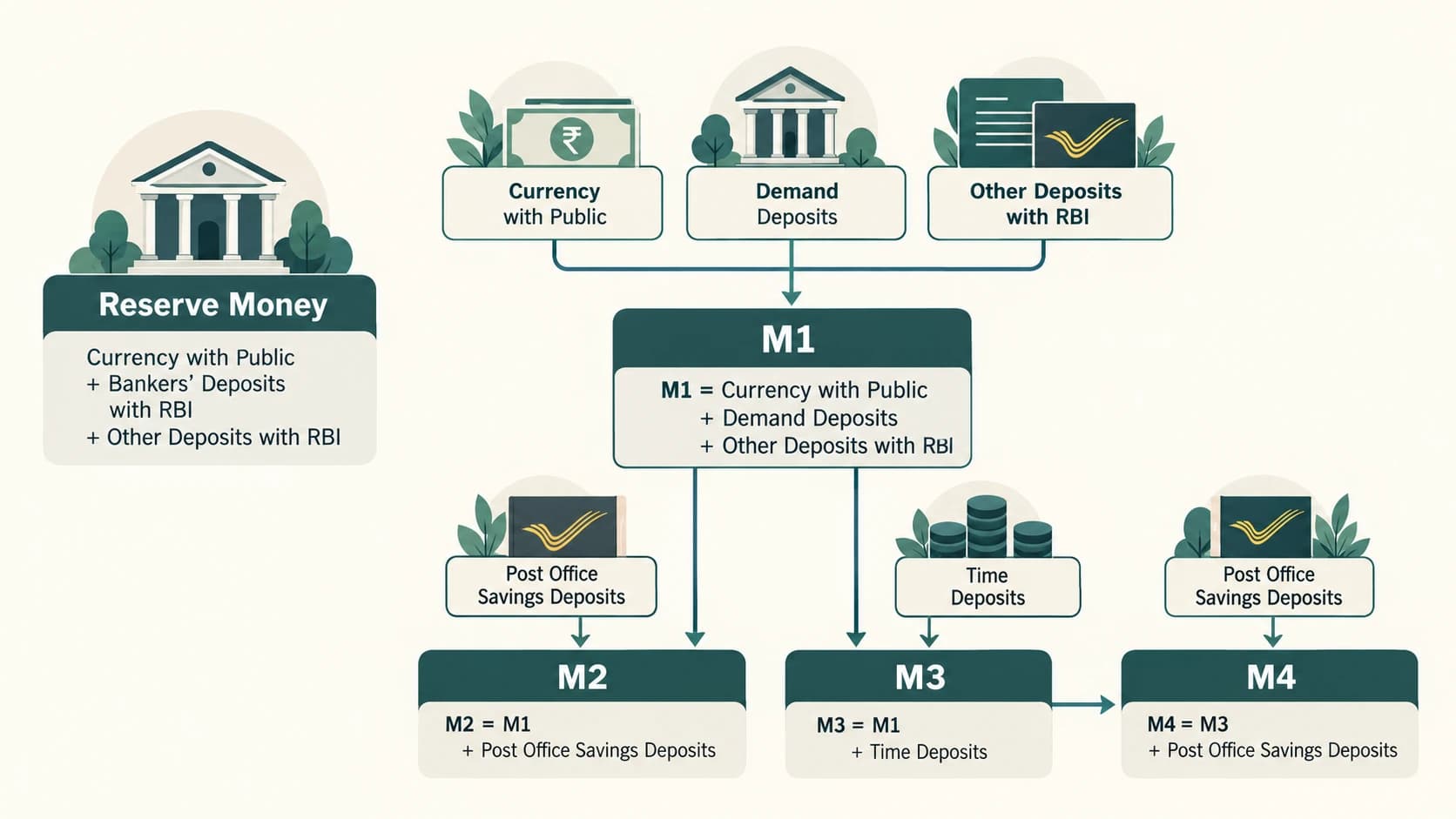
3. Reserve Money
RBI defines Reserve Money as:
Currency in circulation + bankers' deposits with the RBI + other deposits with the RBI. [Source 2]
Reserve Money is often called the monetary base, high-powered money, or M0 in exam-oriented material.
Components
- Currency in circulation - notes and coins in circulation, including cash held by banks.
- Bankers' deposits with RBI - balances banks maintain with the RBI.
- Other deposits with RBI - specified deposits held with the RBI outside bankers' deposits.
Important distinction: currency in circulation vs currency with the public
These are not identical.
Currency in circulation includes cash held by banks.
Currency with the public is broadly obtained by deducting cash held by banks from currency in circulation. RBI's statistical guide explicitly makes this distinction. [Source 3]
This difference is a classic objective-question trap.
4. M1 - Narrow Money
RBI defines M1 as:
M1 = Currency with the public + Demand deposits with the banking system + Other deposits with the RBI. [Sources 2 and 3]
M1 is commonly called narrow money because its components are highly liquid and closely available for transactions.
Demand deposits
A demand deposit is repayable according to demand-account terms rather than after a fixed maturity period.
Current-account deposits are a straightforward example. Certain savings balances also have transaction characteristics, but official statistical classification follows RBI definitions rather than casual everyday labels.
5. M2
RBI defines:
M2 = M1 + Savings deposits of post office savings banks. [Source 2]
A common mistake is to assume M2 is simply "M1 plus bank savings deposits." That is not the official Indian definition.
For exams, memorise the RBI formula, not an imported definition from another country's monetary system.
6. M3 - Broad Money
RBI defines:
M3 = M1 + Time deposits with the banking system. [Sources 2 and 3]
M3 is commonly called broad money and is one of India's most important monetary aggregates.
Why time deposits make M3 broader
A fixed/term deposit is generally less immediately usable for transactions than cash or a demand deposit, but it is still a monetary financial asset within the banking system. Adding time deposits therefore broadens the measure beyond M1.
7. M4
RBI defines:
M4 = M3 + All deposits with post office savings banks, excluding National Savings Certificates. [Source 2]
M4 is broader than M3 because it adds the relevant post-office deposits.
8. Formula table for revision
| Measure | RBI-style formula | Exam memory cue |
|---|---|---|
| Reserve Money | Currency in circulation + bankers' deposits with RBI + other deposits with RBI | Monetary base/high-powered money |
| M1 | Currency with public + demand deposits with banking system + other deposits with RBI | Narrow money |
| M2 | M1 + savings deposits of post office savings banks | M1 plus post-office savings deposits |
| M3 | M1 + time deposits with banking system | Broad money |
| M4 | M3 + all post-office deposits (excluding NSCs) | Broadest traditional measure among M1-M4 |
9. Do not imagine M1-M4 as a perfect four-step nesting ladder
Students often picture:
M1 -> M2 -> M3 -> M4
as though each measure is always obtained by simply adding to the immediately previous measure.
That is misleading because:
- M2 adds post-office savings deposits to M1;
- M3 instead adds banking-system time deposits to M1; and
- M4 adds specified post-office deposits to M3.
So memorise the actual formulas rather than relying only on the numbering.
10. Narrow money vs broad money
Narrow money
Narrow money focuses on the most liquid transaction-oriented components.
In India, M1 is the standard traditional narrow-money measure.
Broad money
Broad money includes less liquid deposit components in addition to transaction money.
In India, M3 is the commonly cited broad-money measure.
The distinction matters because an economy can have substantial purchasing power and financial balances in deposits even when physical currency grows slowly.
11. Stock, flow and date of measurement
Money supply is a stock measured at a point in time.
RBI Bulletin tables report money-stock items as outstanding on specified reporting dates. [Source 3]
This is different from a flow variable such as:
- new loans sanctioned during a month;
- interest earned during a quarter; or
- income received during a year.
12. What counts as "money" depends on the statistical boundary
Monetary measurement is not simply a philosophical question. A central bank must specify:
- which issuing institutions are included;
- which liabilities are included;
- how liquid those liabilities are; and
- which holders are treated as part of the public.
That is why different countries can use labels such as M1 or M2 with definitions that are not identical. For Indian examinations, use RBI's Indian definitions.
13. Reference-only: newer monetary and liquidity aggregates
RBI also publishes newer monetary measures and broader liquidity measures, including NM1, NM2, NM3 and L1-L3. [Source 2]
For a foundation module, the most important exam memory is:
- understand M1-M4 thoroughly;
- know that newer/broader liquidity measures exist; and
- study their detailed composition only if a specific exam or later module requires it.
Do not overload basic revision by treating every liquidity aggregate as equally important.
14. Common confusions
Currency in circulation vs currency with the public
Currency in circulation includes bank cash; currency with the public excludes cash held by banks.
Demand deposit vs time deposit
Demand deposits are repayable under demand-account terms; time deposits are placed for a specified maturity/tenor framework.
M1 vs M3
M1 is narrow money; M3 adds time deposits of the banking system to M1 and is broad money.
UPI vs money
UPI is a payment system/interface. It transfers underlying funds; it is not itself an M1/M3 monetary aggregate.
Debit card vs deposit
The card is an access instrument. The underlying bank-account balance is the financial claim.
Quick check - BA-01-02
- Which Indian monetary aggregate is commonly called broad money?
- Does M2 equal M1 plus bank time deposits?
- Why is currency with the public smaller than currency in circulation, other things equal?
Answers: 1. M3. 2. No. M2 is M1 plus savings deposits of post-office savings banks; M3 is M1 plus time deposits with the banking system. 3. Currency with the public excludes cash held by banks.