
What Is Money and Why Banking Exists
What Is Money and Why Banking Exists. A detailed chapter in Money & Banking Foundations, with explanations and examples for Indian banking examinations.
By Akhilesh Saini · Reviewed 7 Oct 2026
1. Start with the problem money solves
Imagine an economy with no commonly accepted money. A farmer has wheat and wants a bicycle. The bicycle seller does not want wheat; the seller wants shoes. The shoe maker may want milk, not wheat. Every exchange requires a double coincidence of wants: each person must possess exactly what the other person wants at the same time and in the required quantity.
This is the classic difficulty of barter. Barter can work in small or occasional exchanges, but it becomes increasingly inefficient when an economy has many people, many goods, complex production chains and transactions separated by time.
Money solves this coordination problem because people accept it not for its immediate consumption value, but because they expect other people to accept it in later transactions.
The Reserve Bank of India has described money as a means of payment that facilitates exchange and also performs the roles of a store of value and unit of account. For statistical and policy purposes, money is measured through selected liquid financial liabilities of money-creating institutions. [Source 2]
2. The main functions of money
A. Medium of exchange
Money allows a person to sell one thing and buy another without finding a direct barter match.
Example:
- A teacher receives a salary in rupees.
- The teacher does not need to find a grocer who wants teaching services.
- The teacher pays the grocer in money, which the grocer can then use elsewhere.
This dramatically lowers transaction costs.
B. Unit of account
Money provides a common measuring unit for prices and values.
If a laptop costs Rs. 60,000 and a phone costs Rs. 20,000, the price system immediately communicates that the laptop's money price is three times the phone's money price.
Without a common unit of account, an economy would need an enormous number of exchange ratios: wheat in terms of rice, rice in terms of shoes, shoes in terms of fuel, and so on.
C. Store of value
Money lets purchasing power be carried from the present into the future.
A person can earn today and spend later. This does not mean money is always a perfect store of value: inflation can reduce what a given amount of money can buy over time. Other assets such as land, gold or securities may preserve or increase value differently, but they are generally less directly usable for everyday payments.
D. Standard of deferred payment
Many textbooks also describe money as a standard for payments that occur in the future.
Examples include:
- repayment of a loan after one year;
- payment of interest every month;
- a salary payable at month-end; and
- an invoice payable after 30 days.
The future obligation can be expressed in a common monetary unit.
3. Useful characteristics of good money
A practical monetary instrument should generally have qualities such as:
- acceptability - people are willing to receive it;
- divisibility - it can represent small and large values;
- durability - it does not easily perish;
- portability - value can be transferred conveniently;
- recognisability - genuine units can be identified; and
- relative stability of value - extreme instability makes pricing and saving difficult.
Modern monetary systems achieve these characteristics through currency, regulated banking, payment systems and public confidence rather than through the intrinsic material value of notes or coins.
4. Money is not the same as currency
This distinction is frequently tested.
Currency usually refers to physical notes and coins.
Money is broader. It can include currency held by the public and certain bank deposits that can be used to make payments. India's official monetary aggregates therefore include both currency and qualifying deposits. [Sources 2 and 3]
A balance in a bank account may therefore be part of measured money even though it is not physical cash.
5. Money is not the same as wealth
Suppose a person owns:
- Rs. 50,000 in a savings account;
- a house worth Rs. 50 lakh;
- shares worth Rs. 5 lakh; and
- gold worth Rs. 2 lakh.
The person's wealth includes all these assets after considering liabilities. But all of these assets are not "money" in the monetary-statistics sense.
A house can be valuable but is not normally a medium of exchange. Shares can be sold for money, but they are not normally counted as currency or demand deposits.
A useful exam rule is:
All money is a financial asset to its holder, but not every asset or form of wealth is money.
6. Money is not the same as income
Income is a flow measured over a period of time, such as salary of Rs. 60,000 per month.
Money balances are a stock measured at a point in time, such as Rs. 1,20,000 in a bank account today.
Similarly:
- income is a flow;
- expenditure is a flow;
- savings during a year are a flow; while
- accumulated bank balance or wealth at a date is a stock.
This stock-versus-flow distinction becomes useful later in economics, banking and national-income topics.
7. Why banks exist
Banks do much more than provide a place to keep cash.
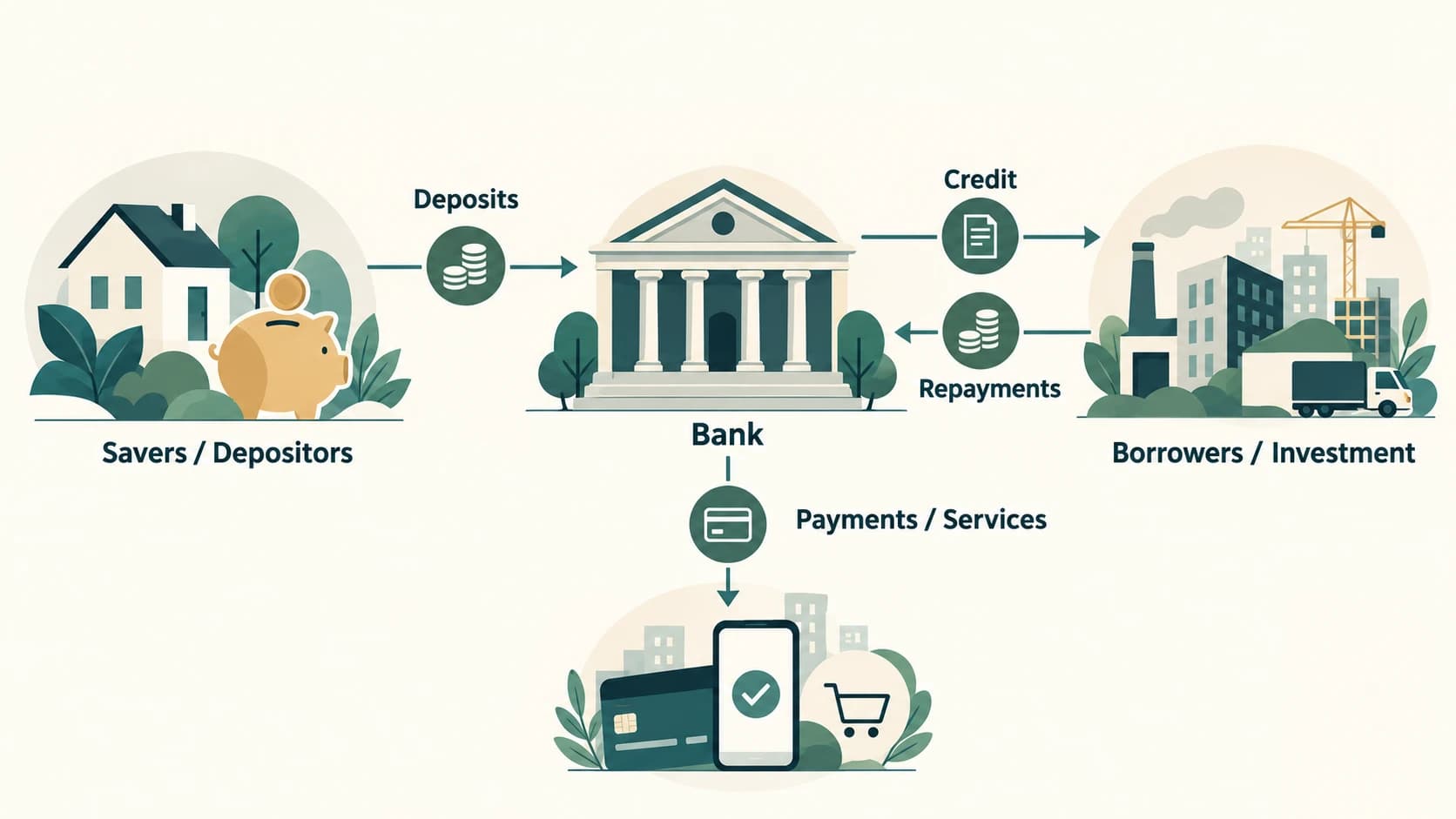
At a basic level, a bank connects people or institutions with surplus funds to people or institutions that need funds. This is called financial intermediation.
The RBI describes a well-functioning financial system as one that helps transfer resources from lenders to borrowers and allocates accumulated savings toward productive uses. [Source 5]
The saver-borrower problem
Suppose 10,000 households each have small savings. A manufacturing firm needs Rs. 20 crore for a new plant.
Without financial intermediaries, the firm would have to find and negotiate individually with thousands of savers. Savers would also have to evaluate the firm's credit risk, legal documents, repayment capacity and future prospects.
A bank simplifies this process:
- it accepts deposits from many customers;
- it assesses borrowers;
- it makes loans and other investments;
- it collects repayments;
- it manages liquidity so depositors can access funds under agreed terms; and
- it operates within a regulated financial system.
8. The legal idea of banking in India
Section 5(b) of the Banking Regulation Act, 1949 defines banking around accepting deposits of money from the public for lending or investment, with those deposits repayable on demand or otherwise and withdrawable by cheque, draft, order or otherwise. [Source 1]
For exam preparation, this definition gives three central ideas:
- acceptance of deposits from the public;
- use of funds for lending or investment; and
- repayment/withdrawal under the banking arrangement.
Do not reduce banking to "taking deposits and giving loans" in every context, because modern banks also provide payments, remittances, guarantees, trade finance, cash management, digital services and other financial services. But deposits and credit intermediation remain central to the legal and economic concept.
9. Core economic functions performed by banks
A. Financial intermediation
Banks channel funds between savers and borrowers.
B. Maturity transformation
Depositors may prefer relatively short or uncertain access periods, while borrowers may need long-term loans. Banks manage this mismatch through diversified funding, assets and liquidity management.
This does not mean every short-term deposit is directly handed to a long-term borrower. A bank manages its balance sheet as a whole.
C. Liquidity transformation
A depositor may hold a claim that can be accessed relatively easily, while the bank holds less-liquid assets such as multi-year loans. This creates a major responsibility: the bank must manage liquidity so it can meet obligations as they fall due.
RBI liquidity-risk guidance defines liquidity in terms of the capacity to fund asset growth and meet expected and unexpected cash and collateral obligations at reasonable cost without unacceptable losses. [Source 7]
D. Credit assessment and monitoring
Banks evaluate whether borrowers are likely to repay. They examine factors such as:
- income or cash flow;
- existing debt;
- business prospects;
- collateral where required;
- repayment history; and
- purpose of borrowing.
E. Payments and settlement services
Bank accounts are important because they allow customers to make and receive payments without physically moving cash for every transaction.
Modern examples include bank transfers, cards and digital-payment interfaces. These are studied in detail in Module 11.
F. Safekeeping, records and financial services
Banks maintain transaction records, provide account statements and support many services that reduce the cost of economic exchange.
10. A simple circular-flow example
Consider three people:
- Asha saves Rs. 1 lakh;
- a bank accepts the deposit; and
- Ravi needs business finance.
The bank does not merely act as a passive storage box. It assesses Ravi's loan application, prices the credit risk, maintains liquidity and regulatory buffers, and if it lends, receives an asset (the loan claim) while incurring or managing corresponding liabilities and funding needs.
That is why banks are central to both the payments system and the credit system.
11. Common exam traps
Trap 1: "Currency" and "money" are identical
Incorrect. Currency is only one component of money.
Trap 2: Anything valuable is money
Incorrect. Land, gold and shares are assets/wealth but are not automatically counted as money.
Trap 3: A bank simply stores all deposits in cash
Incorrect. A bank holds a portfolio of cash/reserves, loans, investments and other assets while managing withdrawals, payments, risk and regulation.
Trap 4: Banks exist only to lend
Incorrect. Payments, deposit services, risk management and many other functions are also central.
Quick check - BA-01-01
- Which function of money allows different goods and services to be expressed in a common price scale?
- Why is a house part of wealth but normally not money?
- What are the three central ideas in the Banking Regulation Act's definition of banking?
Answers: 1. Unit of account. 2. It has value but is not normally a directly usable medium of payment or a component of standard monetary aggregates. 3. Acceptance of public deposits, use for lending/investment, and repayment/withdrawal under the banking arrangement.