
Structure of the Indian Banking and Financial System
Structure of the Indian Banking and Financial System. A detailed chapter in Evolution & Structure of Indian Banking, with explanations and examples for Indian banking examinations.
By Akhilesh Saini · Reviewed 7 Oct 2026
1. The system is larger than “banks”
A common beginner mistake is to treat the Indian financial system as if every institution that lends money or handles finance is a bank.
That is incorrect.
The broader financial system contains several kinds of institutions, including:
- the Reserve Bank of India;
- commercial banks;
- co-operative banks;
- Regional Rural Banks;
- Small Finance Banks;
- Payments Banks;
- Local Area Banks;
- Non-Banking Financial Companies;
- All-India Financial Institutions and development institutions;
- securities-market institutions;
- insurance and pension institutions; and
- payment-system operators and other regulated entities.
These institutions may interact closely, but they are not legally or functionally identical.
2. RBI sits at the centre of the banking regulatory framework
For the banking system, the Reserve Bank of India is the central bank and principal banking regulator/supervisor.
Its major roles include:
- monetary policy;
- currency management;
- regulation and supervision of banks and several other financial entities;
- payment-system oversight;
- banker to government;
- banker to banks; and
- financial-stability functions.
The detailed study of RBI belongs in Module 03. For this module, the key idea is simply:
RBI is not one commercial bank among many. It sits above the banking system in its central-banking and regulatory role.
3. First major institutional split: commercial banks and co-operative banks
At a broad level, banks in India can be viewed as including:
Commercial banks
Commercial banks conduct banking business on a commercial/institutional basis and include multiple categories such as:
- public-sector banks;
- private-sector banks;
- foreign banks;
- Regional Rural Banks;
- Small Finance Banks;
- Payments Banks; and
- Local Area Banks,
depending on the classification being used.
RBI material describes commercial banks as including both scheduled and non-scheduled commercial banks regulated under the Banking Regulation Act.
Co-operative banks
Co-operative banks are organised on co-operative principles and include urban and rural co-operative structures.
Their governance and regulatory structure differs from ordinary banking companies in important ways. Co-operative banking is studied separately in Module 08.
4. Do not confuse “commercial bank” with “universal bank”
A commercial bank is a broad institutional description.
A universal bank generally refers to a bank permitted to undertake a broad range of banking and financial activities rather than operating under a narrow differentiated mandate.
Payments Banks, for example, are commercial banking entities in a broad regulatory sense but operate under a restricted/differentiated business model and cannot undertake lending.
Small Finance Banks, by contrast, can accept deposits and lend but have strong financial-inclusion and priority-sector obligations.
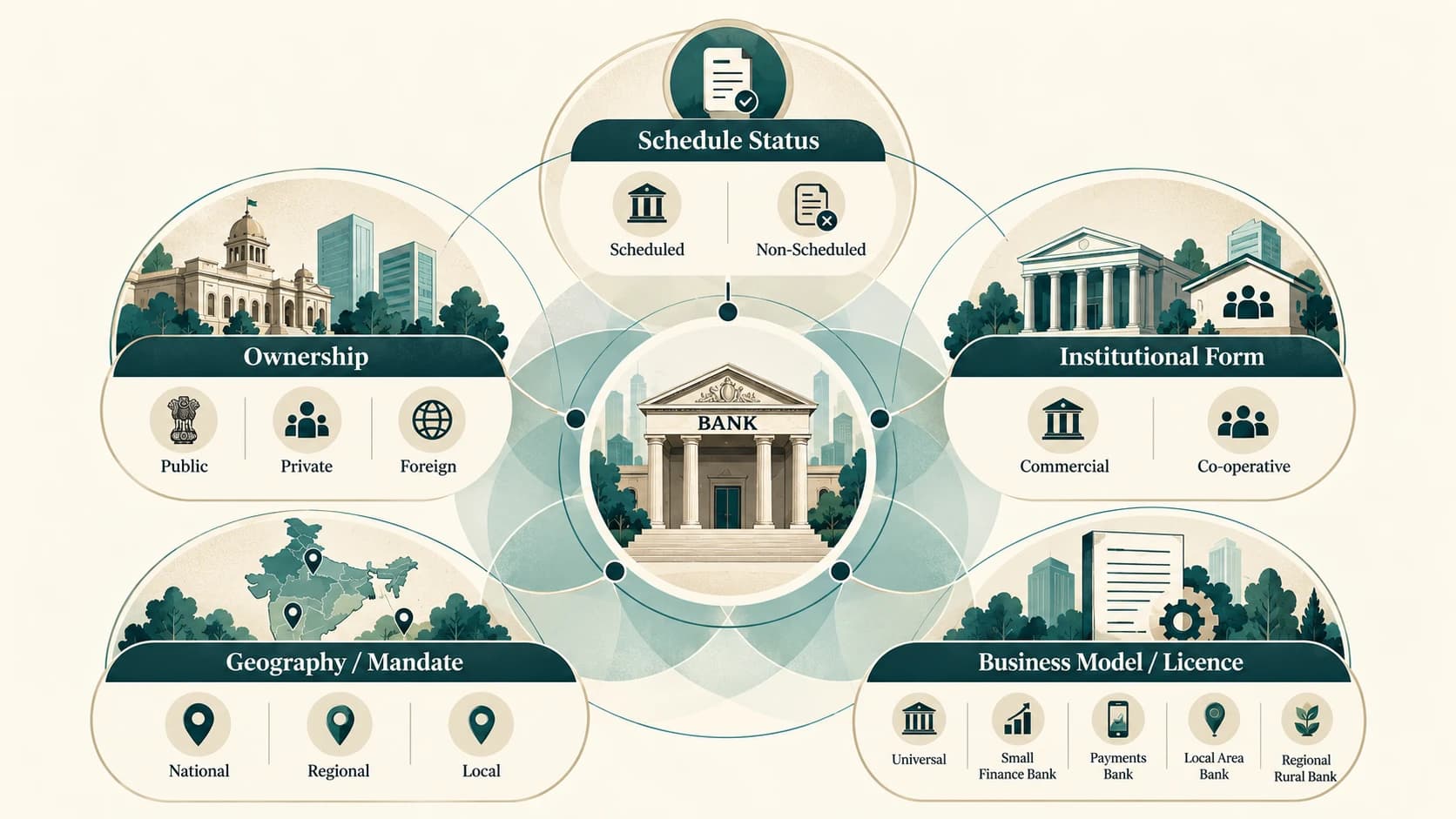
5. The system can be understood through five classification lenses
Lens 1 - Schedule status
- Scheduled bank
- Non-scheduled bank
This depends on inclusion in the Second Schedule to the RBI Act, 1934.
Lens 2 - Ownership
- Public-sector bank
- Private-sector bank
- Foreign-bank presence / foreign-controlled banking presence
Lens 3 - Institutional form
- Commercial bank
- Co-operative bank
Lens 4 - Business model or licence
- Universal bank
- Small Finance Bank
- Payments Bank
- Local Area Bank
- Regional Rural Bank
Lens 5 - Geography or mandate
- national/multi-state operations;
- regional focus;
- local-area restriction;
- rural and inclusion-oriented mandate.
These lenses overlap. They should not be forced into one mutually exclusive list.
6. A conceptual map of the Indian banking system
A useful study map is:
Reserve Bank of India
↓ regulates/supervises banking entities under applicable laws and directions
Banking system
- Commercial banks
- Public-sector banks
- Private-sector banks
- Foreign-bank presence
- Regional Rural Banks
- Small Finance Banks
- Payments Banks
- Local Area Banks
- Co-operative banks
- Urban co-operative banks
- Rural co-operative structure
Alongside the banking system are:
- NBFCs;
- All-India Financial Institutions;
- securities-market entities under SEBI;
- insurers under IRDAI;
- pension entities under PFRDA; and
- payment-system and financial-market infrastructure.
7. Where do NBFCs fit?
An NBFC may:
- lend;
- finance assets;
- invest;
- provide microfinance;
- undertake housing finance or other permitted financial activity.
But an NBFC is not automatically a bank.
Important differences between banks and NBFCs are covered in Module 10. At this stage, remember:
The ability to lend money does not, by itself, make an institution a bank.
8. Where do All-India Financial Institutions fit?
India also has specialised financial institutions such as:
- NABARD;
- SIDBI;
- EXIM Bank;
- National Housing Bank; and
- NaBFID.
These institutions perform development, refinance, specialised or infrastructure-finance functions. They should not be memorised as ordinary retail commercial banks.
Their detailed functions are covered in Module 10.
9. Where do Regional Rural Banks fit?
RRBs are specialised banks created to serve rural areas and combine elements of commercial banking with a regional/rural development mandate.
They have a distinctive ownership and sponsorship structure and are treated separately in Module 08.
For this module, remember that RRBs form part of the commercial-banking system and many are scheduled banks.
10. Where do Small Finance Banks fit?
Small Finance Banks are differentiated banks created to further financial inclusion while still performing both major sides of banking:
- accepting deposits; and
- extending credit.
They are therefore much closer to a full-service bank than Payments Banks, although their licensing and portfolio requirements are designed around inclusion and smaller borrowers.
11. Where do Payments Banks fit?
Payments Banks focus on:
- demand deposits within regulatory limits;
- payment services;
- remittances; and
- certain permitted distribution/business-correspondent activities.
They cannot undertake lending.
This restriction is one of the most frequently tested differences between Payments Banks and Small Finance Banks.
12. Where do Local Area Banks fit?
Local Area Banks are geographically restricted banks originally designed to mobilise rural savings and provide credit within a limited contiguous area.
They are commercial banks but have a much narrower geographical model than ordinary universal banks.
13. Regulators are not interchangeable
Different financial sectors have different primary regulators.
| Area | Primary regulator / authority |
|---|---|
| Banking and monetary system | RBI |
| Securities market | SEBI |
| Insurance | IRDAI |
| Pension sector | PFRDA |
| Insolvency ecosystem | IBBI within the IBC framework |
This table is simplified. Financial activities can involve overlapping laws and coordination, but it is a useful exam foundation.
14. Current structure snapshot - reviewed 7 October 2026
The following current numbers should be treated as living data rather than permanent conceptual facts:
- Department of Financial Services currently lists 12 Public Sector Banks.
- RBI's Banks in India directory lists 21 private-sector banks.
- RBI's directory lists 11 Small Finance Banks.
- RBI's directory lists 2 Local Area Banks.
- RBI's foreign-bank directory lists 44 foreign banks with banking presence in India.
- Payments-bank status requires special care because RBI announced the winding up of Paytm Payments Bank Limited in July 2026; therefore a simple static count copied from an older directory can become misleading.
15. Why the structure changes over time
Banking categories and institutional lists are not frozen because:
- banks merge;
- licences may be granted or cancelled;
- a specialised bank may convert into another form;
- scheduled status may change;
- regulatory frameworks evolve; and
- ownership/control classifications can change.
This is why BA-02-03 is classified as Evergreen + Current Update.
The system map is stable. The names and counts are not necessarily permanent.
16. Common exam confusions
Bank vs NBFC
Both may lend, but they are different legal/regulatory institution types.
RBI vs commercial bank
RBI is the central bank and regulator; commercial banks serve customers and conduct banking business.
Scheduled bank vs public-sector bank
Schedule status is a legal classification under the RBI Act. Public-sector status is an ownership classification.
Private bank vs Small Finance Bank
“Private” describes ownership; “Small Finance Bank” describes a differentiated banking licence/business model.
Quick check - BA-02-03
- Name the five classification lenses described in this lesson.
- Is every lender a bank?
- Can a Payments Bank lend?
- Is “scheduled bank” an ownership category?
- Which regulator is principally associated with the securities market?
Quick-check answers: Schedule status, ownership, institutional form, business model/licence and geographical/mandate lens; no; no; no; SEBI.