
Scheduled, Non-Scheduled and Banking-Company Classifications
Scheduled, Non-Scheduled and Banking-Company Classifications. A detailed chapter in Evolution & Structure of Indian Banking, with explanations and examples for Indian banking examinations.
By Akhilesh Saini · Reviewed 7 Oct 2026
1. The word “scheduled” has a precise legal meaning
In everyday language, “scheduled” might sound like something related to timetables. In Indian banking law it means something completely different.
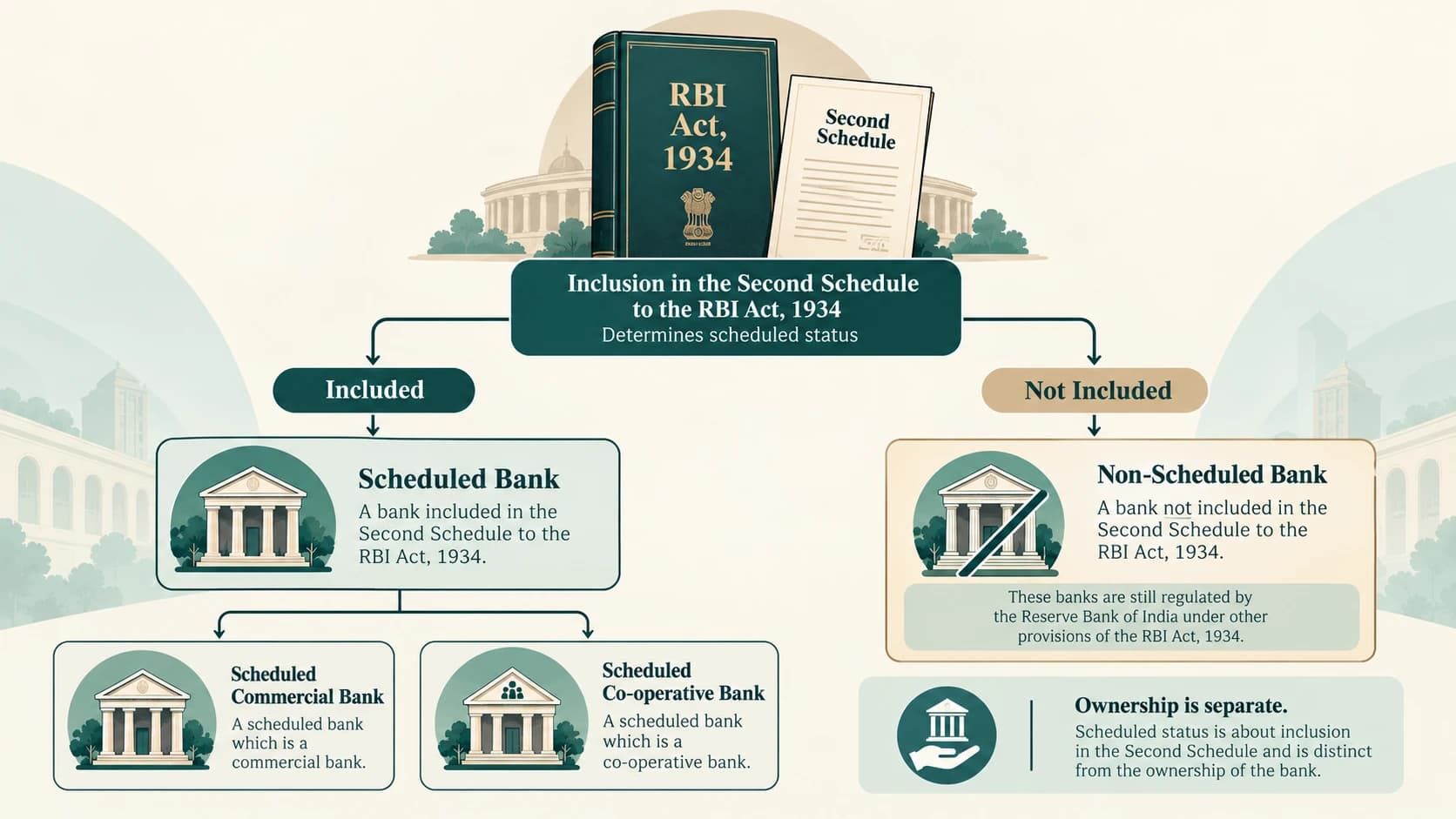
RBI defines a scheduled bank as a bank included in the Second Schedule to the Reserve Bank of India Act, 1934.
That simple sentence is one of the most important definitions in Banking Awareness.
Scheduled bank = bank included in the Second Schedule to the RBI Act, 1934.
2. What is the Second Schedule?
The RBI Act contains a Second Schedule listing scheduled banks. The list has been amended over time as institutions are added, removed, renamed, amalgamated or otherwise restructured.
Therefore:
- “scheduled” is a legal/status classification;
- it is not a synonym for “government bank”; and
- it is not a synonym for “commercial bank”.
3. Scheduled bank is broader than scheduled commercial bank
This distinction is frequently missed.
A scheduled bank can include more than one institutional type. Scheduled co-operative banks can also be included in the Second Schedule.
A Scheduled Commercial Bank (SCB) is a scheduled bank within the commercial-banking category.
So:
All scheduled commercial banks are scheduled banks, but not every scheduled bank must be a commercial bank.
This is a classic logical relationship worth remembering.
4. Commercial banks can be scheduled or non-scheduled
RBI's own directory concepts distinguish:
- Scheduled Commercial Banks; and
- Non-Scheduled Commercial Banks.
This means the phrase “commercial bank” alone does not tell you whether the bank is included in the Second Schedule.
5. Why scheduled status matters
Scheduled status matters because the RBI Act imposes specific obligations and creates the legal framework under which scheduled banks maintain prescribed reserves with RBI and participate in various central-bank arrangements subject to applicable rules.
One especially important statutory connection is Section 42 of the RBI Act, which deals with cash reserves of scheduled banks.
However, avoid simplistic statements such as:
“Every scheduled bank automatically gets every RBI facility.”
Access to particular facilities depends on the relevant scheme, eligibility criteria, regulation and bank category.
6. How does a bank become scheduled?
The exact eligibility rules depend on the category and current RBI directions. Inclusion in the Second Schedule is not simply a branding choice by the bank.
RBI evaluates eligibility and can issue category-specific norms. For example, RBI revised Second Schedule inclusion norms for Urban Co-operative Banks in 2024.
For exam preparation, the permanent concept matters more than category-specific thresholds:
Inclusion is determined under the RBI Act/RBI framework, not by the bank calling itself “scheduled”.
7. What is a non-scheduled bank?
A non-scheduled bank is a bank that is not included in the Second Schedule to the RBI Act.
Non-scheduled does not mean unregulated or illegal.
A non-scheduled commercial bank can still be a licensed banking entity regulated under applicable banking law and RBI directions.
This is important because students sometimes wrongly assume:
- scheduled = legal bank;
- non-scheduled = illegal bank.
That is false.
8. Current examples that show why the distinction matters
RBI's Report on Trend and Progress of Banking in India has noted examples of non-scheduled commercial banks such as:
- Jio Payments Bank Ltd.;
- NSDL Payments Bank Ltd.; and
- the two Local Area Banks.
At the same time, other Payments Banks have historically appeared in RBI's scheduled-bank lists.
Therefore, “Payments Bank” and “scheduled bank” are not the same classification.
A Payments Bank describes a business model. Scheduled status is a separate legal-status question.
9. What is a banking company?
The Banking Regulation Act defines banking and banking company for legal purposes.
At a foundational level:
- “banking” revolves around accepting deposits from the public for lending or investment, with repayment/withdrawal features specified by law;
- a “banking company” is a company that transacts the business of banking in India.
But Indian banking contains statutory banks and co-operative banks whose legal treatment cannot always be reduced to the ordinary Companies Act form.
For exams, do not assume these terms are perfect synonyms:
- bank;
- banking company;
- scheduled bank;
- scheduled commercial bank;
- public-sector bank.
Each label answers a different question.
10. A classification test you can use
When you see a bank name in a question, ask in this order:
Question 1: What kind of entity is it?
Commercial bank? Co-operative bank? NBFC? Financial institution?
Question 2: Is it in the Second Schedule?
If yes, it is scheduled.
Question 3: What is its ownership classification?
Public? Private? Foreign?
Question 4: Does it have a differentiated licence?
SFB? Payments Bank? LAB? RRB?
This prevents category-mixing mistakes.
11. Scheduled vs non-scheduled - exam table
| Feature | Scheduled Bank | Non-Scheduled Bank |
|---|---|---|
| Second Schedule to RBI Act | Included | Not included |
| Core nature | Legal/status category | Legal/status category |
| Can be commercial? | Yes | Yes |
| Does “scheduled” mean government-owned? | No | No |
| RBI regulation | Yes, under applicable framework | Yes, under applicable framework |
| Current list can change? | Yes | Yes |
12. Scheduled bank vs Scheduled Commercial Bank
| Term | Meaning |
|---|---|
| Scheduled Bank | Any bank included in Second Schedule to RBI Act |
| Scheduled Commercial Bank | A scheduled bank in the commercial-banking category |
| Scheduled Co-operative Bank | A co-operative bank included in the Second Schedule |
The exact population of each category should be taken from current RBI sources rather than memorised from old notes.
13. Why old coaching lists become dangerous
A banking list can become outdated when:
- a bank merges;
- a bank changes name;
- a licence is surrendered or wound up;
- an institution converts to another category; or
- scheduled status changes.
14. Common exam confusions
Scheduled vs nationalised
A scheduled bank need not be nationalised. Many private-sector and foreign banks are scheduled.
Scheduled vs commercial
A scheduled bank can also be a co-operative bank. “Scheduled” is not identical to “commercial”.
Non-scheduled vs unregulated
Non-scheduled means not in the Second Schedule, not “outside RBI regulation”.
Bank category vs schedule status
Small Finance Bank, Payments Bank and Local Area Bank describe business/licensing structures. Scheduled status is separately determined.
Quick check - BA-02-04
- Which schedule of which Act determines scheduled-bank status?
- Is every scheduled bank a public-sector bank?
- Can a commercial bank be non-scheduled?
- Is every scheduled bank necessarily a Scheduled Commercial Bank?
- Does non-scheduled mean illegal or unregulated?
Quick-check answers: Second Schedule to the RBI Act, 1934; no; yes; no; no.