
Fund-Based and Non-Fund-Based Credit
Fund-Based and Non-Fund-Based Credit. A detailed chapter in Lending, Credit & Interest Rates, with explanations and examples for Indian banking examinations.
By Akhilesh Saini · Reviewed 7 Oct 2026
1. Why the distinction matters
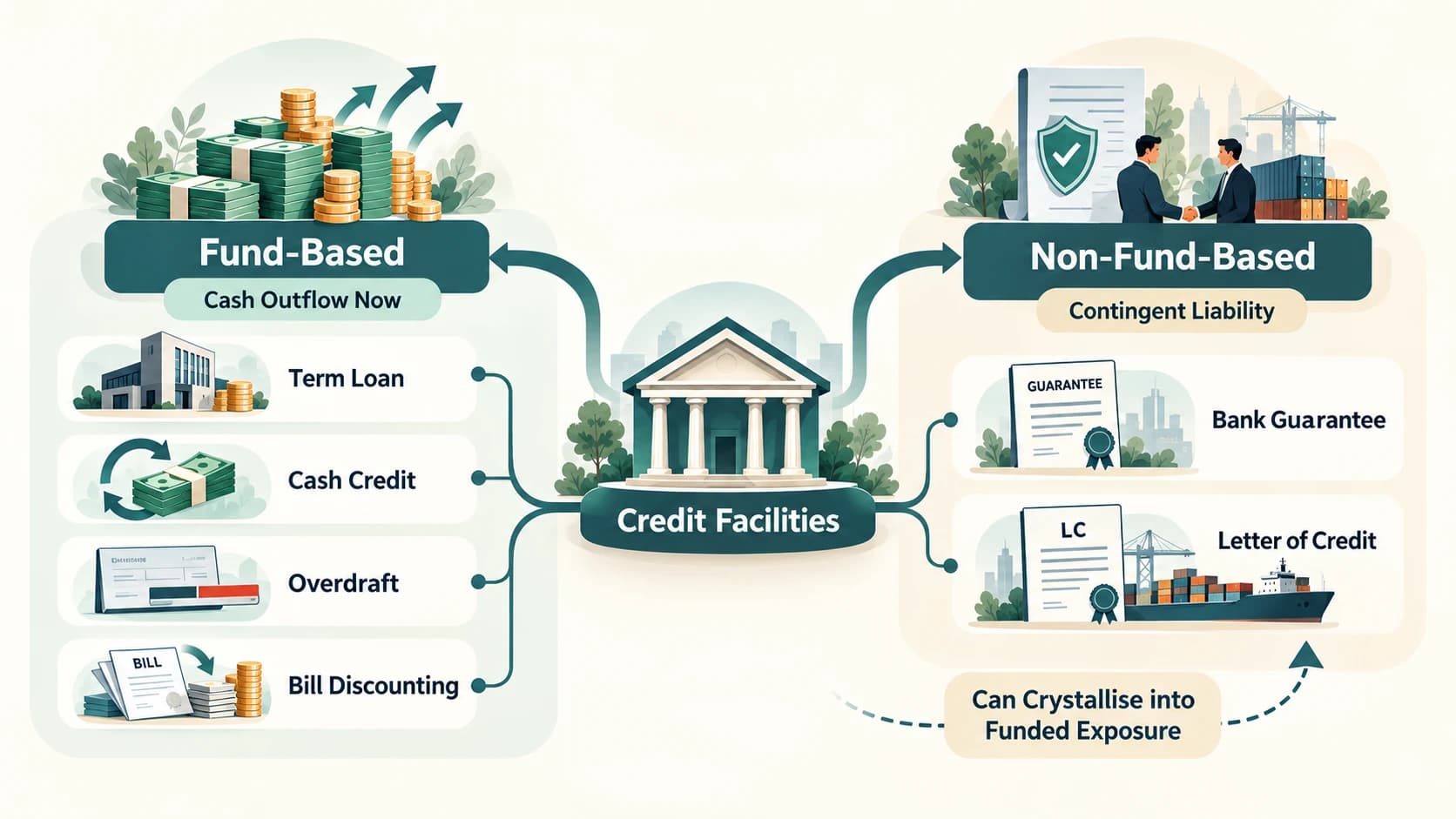
A bank can support a customer in two broad ways:
Fund-based
Bank's money is actually deployed.
Non-fund-based
Bank gives a commitment/guarantee instead of immediate cash.
This distinction is common in:
- business lending;
- trade finance;
- working-capital assessment;
- banking exams.
2. Fund-based credit
Fund-based facilities involve actual use/disbursement of bank funds.
Examples:
- term loan;
- cash credit;
- overdraft;
- demand loan;
- bill purchase/discounting;
- working-capital loan.
The bank records an actual funded asset/exposure.
3. Term loan
A term loan provides a fixed amount for a specified purpose and tenor.
Examples:
- machinery;
- housing;
- vehicle;
- education;
- project finance.
Repayment can be:
- EMI;
- instalments;
- bullet; or
- customised schedule.
4. Cash credit
Cash credit is a running working-capital account.
Borrower can draw within sanctioned limit/drawing power.
Interest is charged on utilisation subject to product terms.
5. Overdraft
Overdraft allows the customer to overdraw an account up to a sanctioned limit.
Examples:
- OD against property;
- OD against FD;
- business OD.
6. Bills purchased/discounted
A seller receives a bill/receivable due in future.
Bank may:
- purchase;
- discount; or
- negotiate
the bill.
The seller receives funds earlier; bank earns discount/interest and later collects payment.
This is fund-based because bank money is deployed.
7. Non-fund-based credit
In a non-fund-based facility, bank does not immediately give cash to the borrower.
Instead, bank undertakes a contingent obligation.
Examples:
- bank guarantee;
- letter of credit;
- co-acceptance.
If the customer performs, bank may never have to pay.
If the obligation crystallises/invokes, the non-fund exposure can become funded.
8. Why non-fund facilities still create risk
Suppose a bank issues a ₹1 crore guarantee.
No ₹1 crore may leave the bank on day one.
But if the borrower fails and guarantee is invoked:
bank may have to pay ₹1 crore.
So the bank has credit risk even without initial cash outflow.
9. Contingent liability
A non-fund-based facility creates a contingent liability.
"Contingent" means payment depends on a future event.
Examples:
- default;
- non-performance;
- failure to pay trade obligation.
Bank capital rules therefore assign credit-conversion factors/risk treatment to such exposures.
Detailed capital treatment belongs in Module 14.
10. Bank guarantee
A bank guarantee is a commitment by the bank to pay the beneficiary if the bank's customer fails to meet the guaranteed obligation, subject to the guarantee terms.
Parties:
- Applicant / customer
- Bank / guarantor
- Beneficiary
11. Financial guarantee
A financial guarantee mainly supports a payment obligation.
Example:
contractor must repay an advance.
Bank guarantees repayment if contractor fails.
12. Performance guarantee
A performance guarantee supports performance of a contractual obligation.
Example:
contractor promises to complete project.
If contractor fails within guarantee terms, beneficiary may invoke.
RBI treats guarantee business as a material contingent-risk activity.
13. Bank guarantee is not "free money"
Customer usually provides:
- margin;
- security;
- commission;
- documentation.
If guarantee is invoked:
bank pays beneficiary and then recovers from customer.
The customer's obligation to bank remains.
14. Letter of Credit - LC
A Letter of Credit is a bank undertaking used mainly in trade.
It assures the seller/beneficiary that payment will be made if stipulated documents and conditions are complied with.
Parties commonly include:
- applicant/buyer;
- issuing bank;
- beneficiary/seller;
- advising/confirming/negotiating bank where applicable.
15. Why LC is useful
Seller may worry:
Will buyer pay?
Buyer may worry:
Will seller ship goods?
LC uses bank intermediation.
Payment becomes linked to documentary compliance.
This reduces trade-payment risk.
16. LC is documentary, not quality guarantee
A bank examines documents.
It does not normally physically inspect whether goods are perfect.
Classic trade-finance principle:
Banks deal in documents, not goods.
17. LC can create funded exposure later
If issuing bank pays under LC:
the bank's liability becomes an actual funded exposure on customer if customer has not provided funds.
So:
non-fund facility can crystallise into fund-based exposure.
18. BG vs LC
| Bank Guarantee | Letter of Credit |
|---|---|
| Pays on failure/default under guarantee terms | Pays on compliant trade documents |
| Common in contracts/performance/payment obligations | Common in trade |
| Often secondary payment mechanism | Designed as primary documentary payment mechanism |
| Applicant + bank + beneficiary | Buyer/applicant + issuing bank + seller/beneficiary |
19. Co-acceptance of bills
In co-acceptance, bank adds its acceptance/commitment to a bill drawn on customer.
This improves payment assurance.
Because misuse can create hidden contingent liabilities, RBI requires safeguards.
20. Why banks charge commission on non-fund facilities
Bank may not deploy funds immediately, but it:
- assumes risk;
- allocates capital;
- performs assessment;
- uses balance-sheet capacity;
- incurs administration.
Therefore bank charges:
- commission;
- fees;
- margin requirements.
21. Fund-based vs non-fund-based - master comparison
| Feature | Fund-Based | Non-Fund-Based |
|---|---|---|
| Immediate bank funds | Yes | Usually no |
| Exposure | Funded | Contingent initially |
| Examples | Loan, CC, OD, bill discount | BG, LC |
| Income | Interest/discount + fees | Commission/fees |
| Can become funded? | Already funded | Yes, on invocation/crystallisation |
| Credit appraisal required | Yes | Yes |
22. Sanction limits
A borrower may have:
- fund-based limit;
- non-fund-based limit;
- interchangeability/sub-limits;
- overall exposure cap.
Example:
Total working-capital arrangement:
- CC ₹5 crore
- LC ₹3 crore
- BG ₹2 crore
Bank monitors both funded and contingent risks.
23. Margin in non-fund facilities
Bank may require customer to provide cash margin or security.
Example:
BG amount = ₹1 crore.
Cash margin = 20%.
Customer deposits ₹20 lakh margin.
Bank guarantees full ₹1 crore.
Margin reduces exposure but does not remove risk.
24. Non-fund-based facility and credit score
Businesses seeking BG/LC still undergo credit appraisal.
Because bank could eventually pay, non-fund limits can affect:
- total exposure;
- bureau information;
- risk assessment;
- pricing.
25. Non-fund-based does not mean "no risk"
This is the main exam takeaway.
The bank's cash may not leave immediately, but there is still:
- credit risk;
- legal risk;
- operational risk;
- capital usage.
Quick check - BA-06-03
- Give two examples of fund-based facilities.
- Give two examples of non-fund-based facilities.
- Why is a bank guarantee a contingent liability?
- Can an LC become a funded exposure?
- What is the difference between a financial and performance guarantee?
- Why does a bank charge commission on non-fund-based credit?
Quick answers
- Term loan, cash credit, overdraft, bill discounting.
- Bank guarantee and letter of credit.
- Bank pays only if the specified future event/default occurs.
- Yes.
- Financial guarantee supports payment; performance guarantee supports contractual performance.
- Because the bank assumes risk and uses capital/credit capacity.