
Loan Interest Rates and Benchmarking
Loan Interest Rates and Benchmarking. A detailed chapter in Lending, Credit & Interest Rates, with explanations and examples for Indian banking examinations.
By Akhilesh Saini · Reviewed 7 Oct 2026
1. A loan rate has more than one component
A borrower often asks:
"What is the interest rate?"
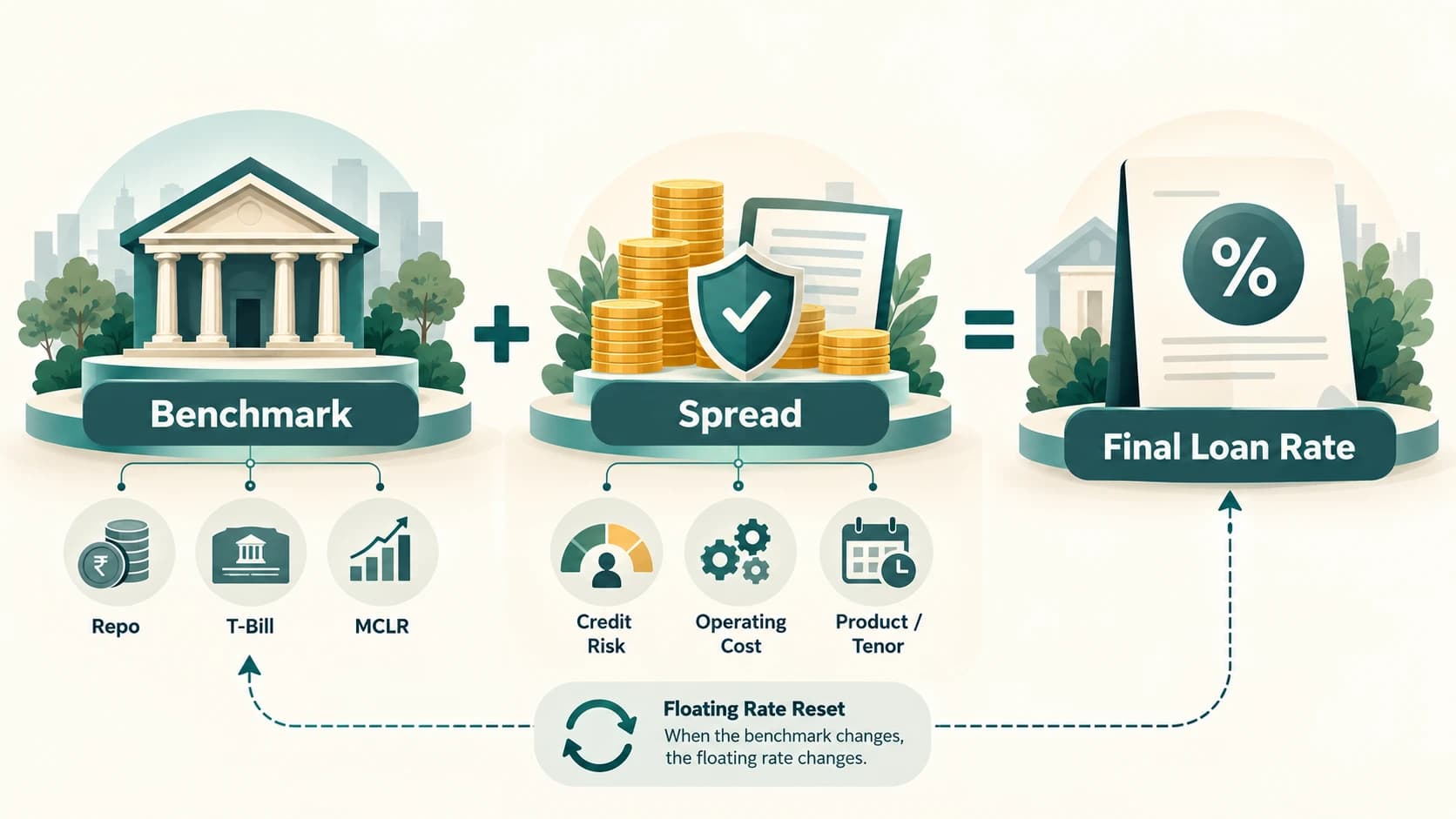
The final rate may contain:
Benchmark + Spread
The benchmark reflects a reference funding/market rate.
The spread reflects factors such as:
- credit risk;
- operating cost;
- product cost;
- tenor;
- business strategy;
- collateral;
- borrower profile.
2. Fixed-rate loan
A fixed-rate loan has a rate fixed according to the contract for the relevant period.
Benefits:
- repayment certainty;
- protection from benchmark increases.
Risks:
- borrower may not benefit when market rates fall;
- fixed rate can include premium.
Some products are fixed for entire tenor; others fixed for a limited period.
3. Floating-rate loan
A floating-rate loan changes when its benchmark resets.
Formula:
Loan Rate = Benchmark + Spread
Example:
Benchmark = 6%
Spread = 2%
Loan rate = 8%.
If benchmark rises to 6.5% and spread stays 2%:
new rate = 8.5%.
4. Hybrid loan
A hybrid loan combines:
- fixed-rate period; and
- floating-rate period,
or otherwise has both fixed and floating components.
5. Why benchmarks matter
Without a benchmark, a borrower may not understand why the bank changes the rate.
A benchmark creates a reference.
The challenge is choosing a benchmark that is:
- transparent;
- objective;
- responsive;
- relevant to funding conditions.
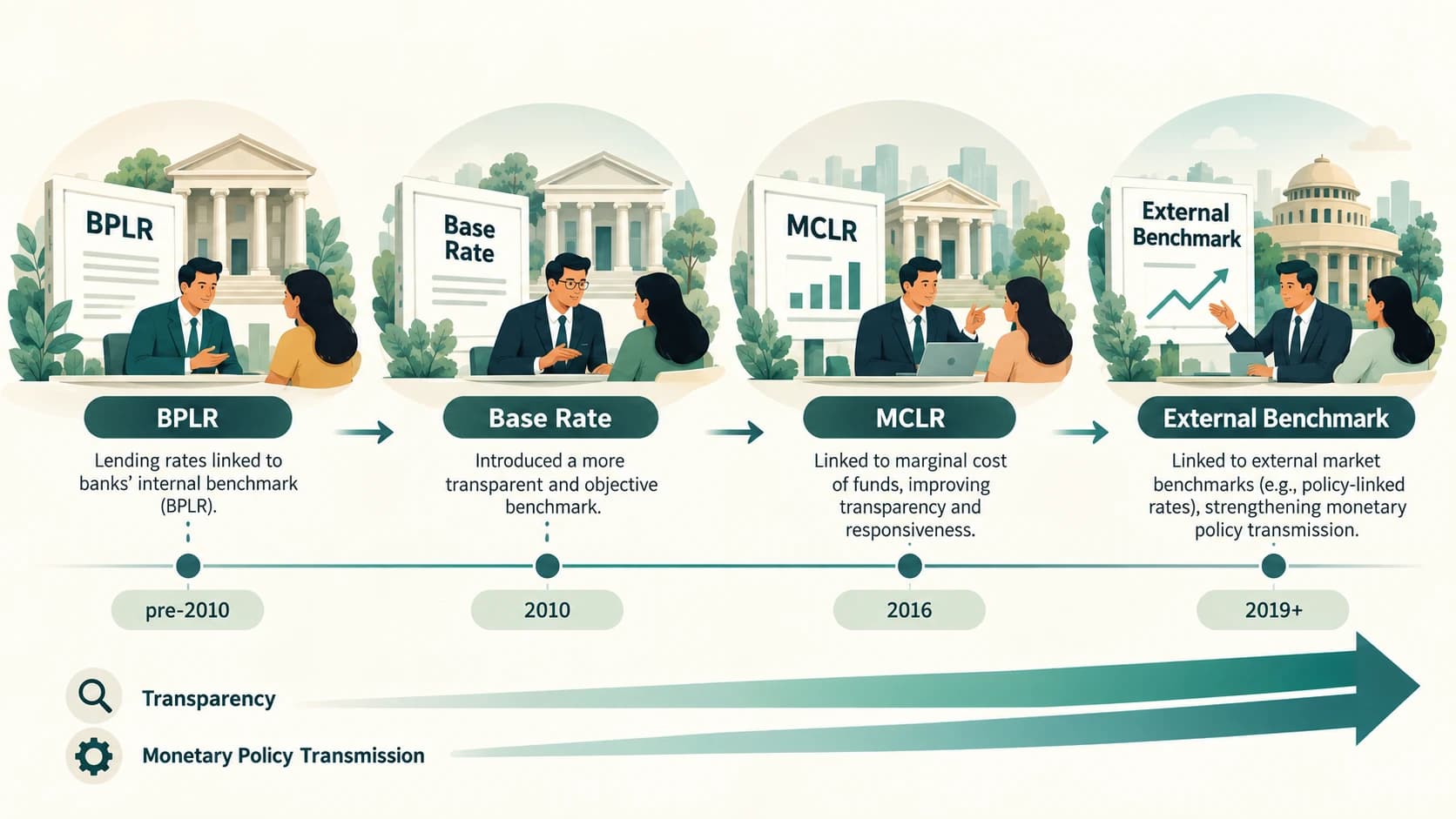
6. Historical benchmark evolution
India's bank lending-rate framework evolved through:
BPLR
↓
Base Rate
↓
MCLR
↓
External Benchmark for specified floating-rate loans
This reflects attempts to improve:
- transparency;
- policy transmission;
- borrower understanding.
7. BPLR
Benchmark Prime Lending Rate was an older benchmark system.
It was replaced for new lending because actual rates could be less transparent and policy transmission weak.
Old legacy loans may still retain historical benchmark arrangements.
8. Base Rate
From July 2010, banks used Base Rate as the internal benchmark for applicable new floating-rate rupee loans.
Base Rate included common lending-cost elements.
Applicable loans generally could not be priced below it except permitted exemptions.
9. MCLR
From 1 April 2016, Marginal Cost of Funds based Lending Rate - MCLR became the internal benchmark for applicable floating-rate rupee loans.
MCLR was designed to reflect marginal funding cost more quickly than older average-cost approaches.
10. MCLR components
Conceptually, MCLR includes:
- marginal cost of funds;
- negative carry on CRR;
- operating cost;
- tenor premium.
Banks publish MCLR for specified maturities such as:
- overnight;
- one month;
- three months;
- six months;
- one year.
They may also publish longer maturities.
11. MCLR reset
A floating-rate loan linked to MCLR resets according to the contracted reset periodicity.
RBI requires the reset period to be one year or lower.
This means:
repo changes do not automatically reprice an MCLR loan the same day.
Transmission depends on:
- MCLR movement;
- reset date;
- spread.
12. Why external benchmarking was introduced
RBI observed that policy-rate changes were not being transmitted quickly enough through internal benchmarks.
External benchmarks are publicly observable.
Therefore specified floating-rate loans were moved to an external benchmark regime.
13. External Benchmark Lending Rate - EBLR
Under RBI's framework, all new floating-rate:
- personal/retail loans; and
- loans to Micro and Small Enterprises
from 1 October 2019 were required to be benchmarked externally.
Floating-rate loans to Medium Enterprises entered this framework from 1 April 2020.
14. Permitted external benchmarks
Banks may use:
- RBI policy repo rate;
- Government of India 3-month Treasury Bill yield published by FBIL;
- Government of India 6-month Treasury Bill yield published by FBIL; or
- another benchmark market interest rate published by FBIL.
15. Uniform benchmark within a loan category
A bank must use a uniform external benchmark within a particular loan category.
It cannot arbitrarily use many different external benchmarks for identical category borrowers simply to obscure pricing.
This improves comparability.
16. Reset frequency under external benchmark
The interest rate under an external benchmark must reset at least once in three months.
That is why transmission can be faster than many older internal-benchmark loans.
17. Benchmark vs spread
Suppose:
Repo benchmark = 5.50%.
Bank spread = 2.10%.
Loan rate = 7.60%.
If repo changes, benchmark portion changes.
Spread may remain unchanged subject to contract/regulation.
Banks cannot disguise benchmark movements by arbitrary spread changes.
18. What goes into spread?
Spread can reflect:
- credit risk premium;
- operating cost;
- business strategy;
- borrower category;
- collateral;
- product characteristics.
A higher-risk borrower may pay a higher spread.
19. Credit risk premium
Credit risk premium compensates lender for expected borrower default risk.
Factors include:
- score/history;
- income;
- leverage;
- business risk;
- collateral;
- loan-to-value;
- repayment pattern.
20. Loan pricing is not only repo
A common misconception:
"Repo is 5.5%, so why is my loan 8%?"
Because final loan rate includes:
- benchmark;
- spread;
- product cost;
- risk;
- operating cost.
Repo is not a retail lending rate.
21. Fixed vs floating borrower decision
Fixed-rate loan
Better payment certainty.
Floating-rate loan
Can benefit from falling benchmark but also rise when benchmark rises.
The best choice depends on:
- risk tolerance;
- tenure;
- rate cycle;
- switching cost.
22. EMI and floating-rate reset
When the rate rises, the lender may adjust:
- EMI;
- tenor; or
- both.
RBI's borrower-protection framework requires transparent communication for EMI-based floating-rate personal loans.
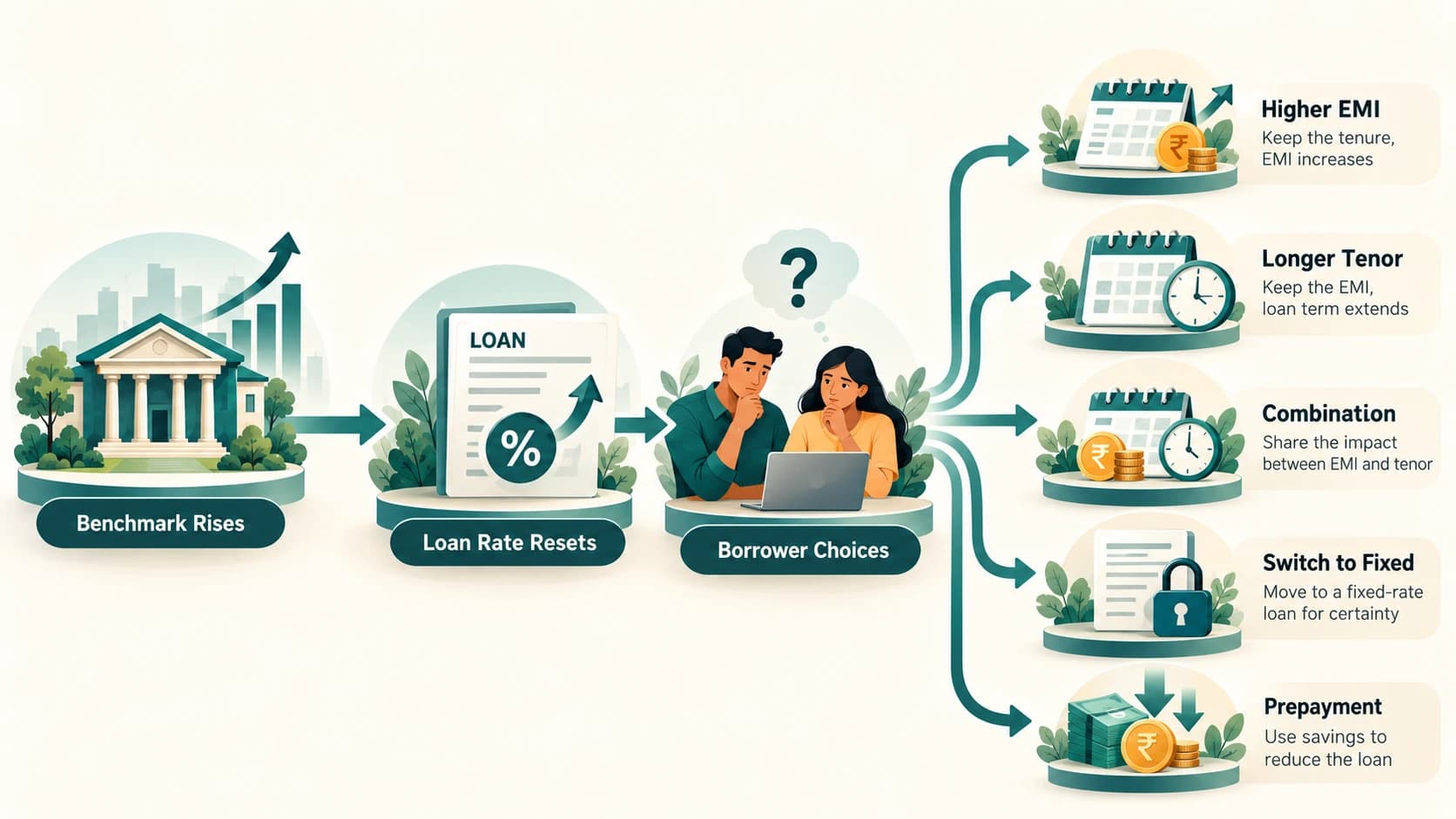
23. Borrower options on reset
Under the RBI framework for EMI-based floating-rate personal loans, borrowers must be given appropriate options, including:
- increase in EMI;
- elongation of tenor;
- combination of both;
- switch to fixed rate under Board-approved policy; and
- part/full prepayment.
The lender must communicate the impact of reset.
24. Negative amortisation risk
If EMI remains too low while rate rises sharply, interest due can approach/exceed payment.
This can cause:
- huge tenor extension;
- very slow principal reduction.
RBI's framework requires lenders to provide adequate headroom and transparent communication.
25. Key Facts Statement - KFS
A KFS is a standardised summary of key loan terms in simple language.
RBI expanded KFS requirements to retail and MSME term loans.
The purpose is to let the borrower understand:
- amount;
- tenor;
- rate;
- instalment;
- charges;
- APR;
- security;
- grievance details.
26. Annual Percentage Rate - APR
APR captures the annual cost of credit, including:
- interest; and
- applicable charges included under the framework.
This is useful because two loans with the same nominal interest rate can have different processing fees and total cost.
27. Example - nominal rate vs APR
Loan A:
- Interest 10%
- Low fees
Loan B:
- Interest 9.75%
- High fees
Loan B may still have a higher APR.
Therefore:
lower advertised interest does not always mean cheaper loan.
28. Penal charges, not penal interest
RBI changed the fair-lending framework so penalties for non-compliance with material loan terms are levied as penal charges, not as an additional penal interest rate added to the contracted rate.
The purpose is:
- discipline, not revenue enhancement;
- transparency;
- prevention of compounding penalties.
29. No capitalisation of penal charges
Penal charges should not themselves attract further interest.
This prevents:
interest on penalty on interest
from escalating unfairly.
Normal compounding of contracted interest can continue according to loan terms.
30. Penal charges must be disclosed
The lender must disclose:
- amount/quantum;
- reason;
- applicable circumstances.
Penal charges must be reasonable and not discriminatory within a similar product category.
31. Release of original property documents
After full repayment/settlement of a personal loan, RBI requires regulated entities to:
- release original movable/immovable property documents; and
- remove registered charges
within the prescribed timeline.
The current regulatory timeline is 30 days.
This is part of responsible lending conduct.
32. Compensation for lender delay
If delay is attributable to the lender, RBI's framework prescribes compensation.
33. Prepayment
Prepayment means paying principal before scheduled maturity.
Benefits:
- lower future interest;
- shorter loan life.
Charges depend on:
- loan type;
- fixed/floating structure;
- borrower category;
- applicable RBI rules.
Do not assume every loan can charge foreclosure fees.
34. Floating-rate personal loans
RBI has long restricted foreclosure/prepayment charges for certain floating-rate loans to individual borrowers.
The exact scope must be checked against current rules for the relevant regulated entity.
35. Rate transmission
External benchmarking connects Module 04 to lending.
Chain:
Repo changes
↓
External benchmark changes
↓
Loan rate resets
↓
EMI/tenor changes
↓
Borrowing demand changes
This is monetary-policy transmission through the banking system.
Quick check - BA-06-04
- What is the basic loan-rate formula?
- What does MCLR stand for?
- Why were external benchmarks introduced?
- Which loans are mandatorily linked to external benchmarks under the current framework?
- What is APR?
- What is the difference between penal charges and penal interest?
Quick answers
- Benchmark + spread.
- Marginal Cost of Funds based Lending Rate.
- To improve transparency and monetary-policy transmission.
- New floating-rate retail/personal loans and floating-rate MSME loans in the prescribed timeline.
- Annualised all-in cost of credit including applicable charges under the framework.
- Penal charge is a fee for non-compliance; penal interest adds an extra interest rate to the contracted rate.