
Credit Information Companies and Credit Scores
Credit Information Companies and Credit Scores. A detailed chapter in Lending, Credit & Interest Rates, with explanations and examples for Indian banking examinations.
By Akhilesh Saini · Reviewed 7 Oct 2026
1. Why credit information matters
A lender needs to know:
- Does this borrower already owe money elsewhere?
- Did the borrower repay past loans on time?
- Are there overdue accounts?
- Has the borrower applied for many loans recently?
- Is total indebtedness high?
Without a shared credit-information system, a borrower could take loans from many institutions without each lender seeing the full picture.
2. Credit Information Company - CIC
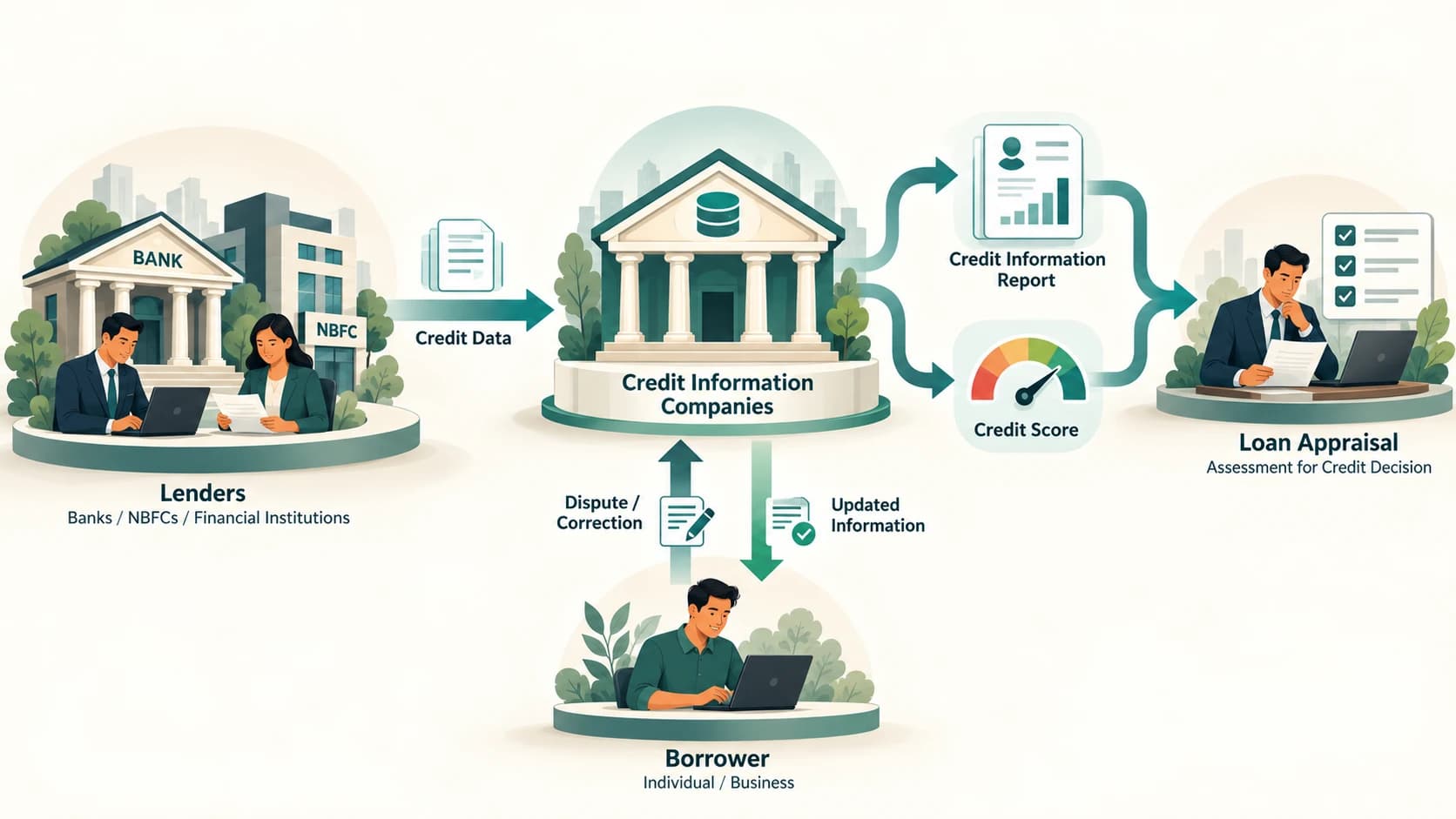
A Credit Information Company collects and maintains credit information supplied by member credit institutions.
It produces:
- Credit Information Reports - CIRs;
- credit scores;
- analytics.
CICs operate under the Credit Information Companies (Regulation) Act, 2005 and RBI regulation.
3. Major RBI-registered CICs
The four well-known RBI-registered CICs are:
- TransUnion CIBIL Limited
- Equifax Credit Information Services Private Limited
- Experian Credit Information Company of India Private Limited
- CRIF High Mark Credit Information Services Private Limited
"Credit bureau" is the common informal phrase.
"CIC" is the statutory/regulatory term.
4. Credit institution
Credit institutions include entities that report/consume credit information under the legal framework.
Examples include:
- banks;
- NBFCs;
- housing finance companies;
- AIFIs;
- credit-card issuers;
- other regulated lenders.
5. Credit Information Report - CIR
A CIR contains a borrower's credit-history information.
For an individual, it can include:
- loan accounts;
- credit cards;
- sanctioned limits;
- outstanding balances;
- repayment history;
- overdue amounts;
- enquiries;
- account status;
- lender information.
It is not the same as a bank statement.
6. What is a credit score?
RBI's financial-literacy material describes a credit score as a three-digit number that indicates a borrower's creditworthiness, typically based on credit history and other factors.
A higher score generally suggests stronger repayment history.
But:
a score is a statistical risk indicator, not a guarantee.
7. RBI does not set the scoring formula
RBI has explicitly stated that it does not prescribe the methodology CICs must use to calculate credit scores.
The models are proprietary.
Therefore:
- score ranges/methodologies can differ;
- the same borrower may not have identical scores across all CICs.
8. Credit score vs credit report
Credit report
Detailed history.
Credit score
Compressed numerical summary of credit risk.
A lender can inspect both.
A high score with high current indebtedness may still lead to rejection.
9. Credit score vs credit rating
These are different.
Credit score
Commonly used for individuals/borrowers.
Credit rating
Usually assesses creditworthiness of:
- companies;
- debt securities;
- issuers;
- instruments.
Credit rating agencies such as CRISIL/ICRA/CARE are not the same as CICs.
10. What can affect a credit score?
Factors often include:
- repayment history;
- overdue/default;
- credit utilisation;
- age of credit history;
- credit mix;
- number/timing of enquiries;
- outstanding debt.
Exact weighting is proprietary.
11. Repayment history
Timely repayment is one of the strongest positive signals.
Late payment can reduce creditworthiness because it directly shows repayment behaviour.
12. Credit utilisation
For revolving credit such as credit cards:
Utilisation = Outstanding ÷ Credit Limit
High persistent utilisation can indicate stress.
Example:
Limit = ₹1,00,000.
Outstanding = ₹90,000.
Utilisation = 90%.
Lower utilisation does not guarantee approval, but persistent near-limit usage can be a risk signal.
13. Credit enquiries
When lenders access a borrower's credit report for an application, it creates a credit enquiry.
Many loan applications in a short period can signal:
- urgent borrowing;
- credit shopping;
- higher risk.
Checking one's own report is different from a lender's hard enquiry in typical bureau practice.
14. No credit history vs bad credit history
A person with no prior borrowing may have:
- no score; or
- thin credit file.
This does not automatically mean bad borrower.
It means the lender has less repayment-history evidence.
15. Credit score is only one input
Banks also consider:
- income;
- debt-to-income;
- employment/business;
- security;
- LTV;
- age;
- loan purpose;
- bank statements;
- internal score;
- fraud checks.
A high score cannot force a bank to approve a loan.
16. Credit report in lending decisions
RBI has long encouraged/required credit institutions to use CIRs as part of lending decisions.
This supports:
- better underwriting;
- reduction of over-indebtedness;
- detection of defaults;
- information sharing.
17. Reporting frequency
Credit reporting historically happened monthly.
From January 2025, RBI required credit information to be updated fortnightly:
- as on the 15th; and
- as on the last day of the month,
or at shorter mutually agreed intervals.
This makes CIRs more current.
18. Why frequent reporting matters
Suppose borrower takes a large loan on 2 January.
If bureau data updates only at month-end, another lender may not see it for weeks.
Fortnightly reporting reduces this information gap.
19. Free Full Credit Report - FFCR
Individuals whose credit history is held by a CIC are entitled to one free full credit report, including credit score, once in a calendar year from that CIC.
Since multiple CICs operate, an individual can access a free report from each CIC that holds their data under its process.
20. Why check your report?
Borrowers should review CIR to detect:
- wrong overdue;
- closed loan shown open;
- unknown loan/fraud;
- wrong limit;
- wrong personal information;
- duplicated account.
A bad data error can affect borrowing.
21. Correction of errors
If a CIR contains inaccurate information, the borrower can raise a dispute with:
- CIC; and/or
- reporting credit institution
according to the framework.
The reporting lender generally needs to verify and correct source data.
22. Complaint escalation
If a complaint about credit information is not resolved within the prescribed framework or the borrower remains dissatisfied, RBI's grievance mechanism may be available subject to eligibility.
RBI's financial-awareness material highlights the Integrated Ombudsman route for unresolved complaints.
23. Credit report is not a blacklist
A CIC does not "blacklist" people simply for having loans.
A credit report records credit behaviour.
Borrowing itself can be normal and positive.
The real issue is:
- repayment conduct;
- leverage;
- defaults;
- settlement status;
- enquiries.
24. "Settled" vs "closed"
Closed
Loan fully repaid according to terms.
Settled
Lender accepted less than full contractual dues as a settlement.
A settled status can be negative for future credit assessment.
25. Written-off account
A bank can write off a loan for accounting/tax/balance-sheet reasons.
That does not necessarily extinguish borrower's legal liability.
Credit reporting may continue according to applicable rules.
This topic is studied more deeply in Module 07.
26. Guarantor information
If a person guarantees another borrower's loan, that exposure can be relevant to credit assessment.
A guarantee is not harmless simply because the guarantor did not receive the money.
27. Joint loans
Co-borrowers can both have credit histories affected by repayment behaviour.
If one pays late, the account conduct can affect all borrowers associated with the facility.
28. Credit card and score
Credit-card behaviour contributes to credit history.
Important factors:
- timely payment;
- overdue;
- utilisation;
- limit;
- account age.
Paying only minimum due may avoid immediate delinquency but can keep high revolving debt and interest cost.
29. Credit score and interest rate
RBI financial-literacy material notes that, all else equal, higher creditworthiness can help a borrower access credit at a lower rate.
But banks do not use one universal pricing formula.
Score may influence:
- approval;
- spread;
- loan amount;
- margin;
- tenor.
30. Internal score vs bureau score
Banks may use their own internal models.
Therefore two borrowers with identical CIC scores may receive different decisions due to:
- income;
- employer;
- collateral;
- banking relationship;
- internal risk grade;
- fraud checks.
31. Credit-information privacy
Credit reports contain sensitive financial information.
Access is governed by law/regulation.
A CIC cannot simply make an individual's detailed CIR publicly searchable.
32. Good credit discipline
Basic habits include:
- pay on time;
- avoid unnecessary borrowing;
- keep utilisation reasonable;
- check credit reports;
- dispute errors;
- avoid applying everywhere at once;
- understand co-borrower/guarantor obligations.
Quick check - BA-06-05
- What is a CIC?
- Name the four major CICs in India.
- Does RBI prescribe the exact scoring formula?
- What is the difference between a CIR and credit score?
- How often must credit information now be updated under the current framework?
- Does a high credit score guarantee loan approval?
Quick answers
- Credit Information Company.
- TransUnion CIBIL, Equifax, Experian and CRIF High Mark.
- No.
- CIR is the detailed report; score is a numerical risk summary.
- Fortnightly, or shorter intervals by agreement.
- No.