
Non-Performing Assets: Meaning and Recognition
Non-Performing Assets: Meaning and Recognition. A detailed chapter in NPAs, Stressed Assets & Recovery, with explanations and examples for Indian banking examinations.
By Akhilesh Saini · Reviewed 7 Oct 2026
1. What is a Non-Performing Asset?
A loan is an asset for a bank because it is expected to generate:
- interest income; and
- repayment of principal.
When the borrower stops servicing the loan for the regulatory period, the asset stops "performing" as expected.
RBI therefore defines a Non-Performing Asset, or NPA, through objective recovery-based criteria.
A useful intuition is:
Performing asset = expected cash flow is being serviced.
Non-performing asset = payment failure has crossed the regulatory recognition point.
2. NPA does not mean "loan is 100% lost"
This is one of the most important distinctions.
A loan can be NPA and still be recoverable.
The bank may recover through:
- regularisation;
- restructuring;
- settlement;
- collateral enforcement;
- guarantor action;
- DRT;
- IBC;
- ARC sale;
- other legal recovery.
Therefore:
NPA is an asset-classification status, not a statement that recovery is impossible.
3. The 90-day rule for term loans
For a normal term loan, a loan becomes NPA when:
- interest; and/or
- an instalment of principal
remains overdue for more than 90 days.
Important wording
RBI uses:
more than 90 days
not simply:
"on the 90th day".
Banks classify based on the day-end overdue process.
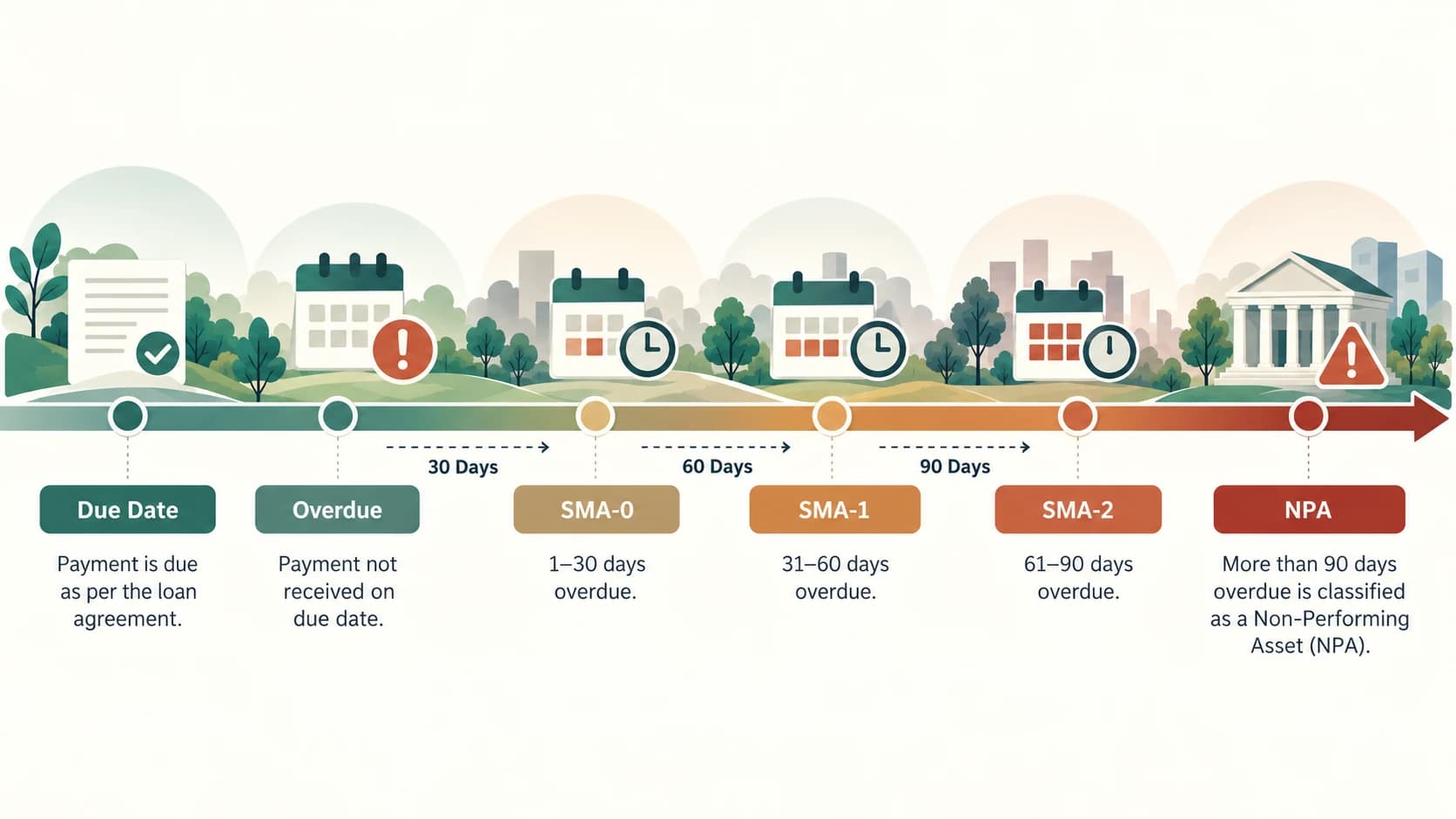
4. What does overdue mean?
An amount is overdue when it is not paid on the due date fixed by the bank.
Example:
EMI due: 1 January.
Not paid on that date.
It becomes overdue from the due date under the applicable day-end process.
The account does not immediately become NPA.
It progresses through the early-stress framework before crossing the NPA threshold.
5. Day-end classification
RBI requires overdue, SMA and NPA status to be determined as part of the bank's day-end process.
This matters because NPA recognition is:
- objective;
- date-based;
- system-driven.
Banks cannot simply delay NPA recognition because the borrower promises to pay "next week".
6. Example - term loan timeline
Suppose an EMI is due on 1 January and remains unpaid.
Conceptually:
- Day 1 onward: overdue;
- SMA classification progresses as the overdue period increases;
- beyond the 90-day threshold: NPA.
The precise calendar classification is handled by the bank's day-end process.
7. Cash Credit and Overdraft - "out of order"
A CC/OD account is not judged only by a scheduled EMI.
It is a running account.
Therefore RBI uses the concept out of order.
A CC/OD account is treated as out of order if, broadly:
- outstanding remains continuously above the sanctioned limit/drawing power for 90 days; or
- even if within the limit, there are no credits continuously for 90 days; or
- credits during the previous 90 days are insufficient to cover the interest debited for that period.
This prevents a borrower from keeping a technically "within-limit" account that is economically inactive and unable to service interest.
8. Why CC/OD uses a different rule
Suppose a business has:
Cash Credit limit = ₹1 crore.
There is no fixed EMI.
If the account simply remains utilised without meaningful business credits, risk is still rising.
The out-of-order test measures:
- limit breach;
- absence of credits; and
- failure of credits to service interest.
9. Bills purchased and discounted
A bill purchased or discounted becomes NPA when it remains overdue for more than the regulatory 90-day period.
The principle is the same:
the expected cash inflow did not arrive.
10. Agricultural advances
Agricultural lending has special crop-cycle recognition rules.
Short-duration crops
Loan becomes NPA if principal or interest remains overdue for two crop seasons.
Long-duration crops
Loan becomes NPA if principal or interest remains overdue for one crop season.
The crop season is determined under the applicable state-level banking framework.
11. Why agriculture uses crop seasons
Agricultural cash flow is seasonal.
A farmer may receive meaningful cash only after:
- harvesting;
- sale of produce.
Therefore the repayment cycle cannot always be evaluated like a monthly salary loan.
12. Agricultural loans outside the special farm-credit list
Not every loan to an agriculturist receives crop-season treatment.
Agricultural loans outside the specified qualifying farm-credit categories are generally classified using normal delinquency rules.
So:
"Borrower is a farmer" does not automatically mean crop-season NPA rules apply to every loan.
13. Government-guaranteed advances
Government guarantees have special prudential treatment.
The detailed treatment can differ depending on whether:
- Central Government guarantee; or
- State Government guarantee
is involved.
For general Banking Awareness, learn that Government guarantee does not mean:
"the loan can never become stressed."
Income-recognition and asset-classification rules still matter.
14. NPA classification is borrower-wise
A major RBI principle is:
classification is generally borrower-wise, not merely facility-wise.
If one material credit facility to a borrower becomes NPA, the bank generally treats the borrower's other facilities with that bank according to the NPA framework rather than pretending each facility is economically isolated.
This avoids cosmetic classification.
15. Example - borrower-wise classification
A business has with Bank A:
- term loan;
- cash credit;
- bank guarantee devolvement.
If one facility becomes non-performing under RBI's rules, the bank must consider the borrower's facilities together under the applicable borrower-wise rule.
16. Income recognition once a loan becomes NPA
Bank accounting changes significantly after NPA classification.
For a standard loan:
interest can generally be recognised on accrual basis.
For an NPA:
unrealised interest should not simply be recognised as profit.
The bank moves to a recovery-based approach.
This is why RBI's framework is called:
Income Recognition, Asset Classification and Provisioning — IRACP
17. Accrual vs cash basis
Accrual basis
Income is recorded when earned, even if cash has not yet been received.
Cash / realisation basis
Income is recognised when actually received.
For NPAs, RBI restricts recognition of unrealised interest because counting unpaid interest as profit would overstate bank earnings.
18. Reversal of unrealised income
If interest had earlier been accrued into income but the account later becomes NPA, unrealised income may need to be reversed according to RBI rules.
This protects the bank's financial statements from showing profit that was never received.
19. Why NPA recognition matters
Correct NPA recognition affects:
- profit;
- provisioning;
- capital;
- reported asset quality;
- investor confidence;
- supervisory assessment;
- lending capacity.
Delaying NPA recognition can make a weak bank look healthier than it really is.
20. Gross NPA
Gross NPA broadly represents the total amount of loans classified as non-performing before deducting eligible provisions and adjustments.
Gross NPA ratio is commonly expressed relative to gross advances.
Conceptually:
Gross NPA shows the scale of stressed recognised loans before provision offsets.
21. Net NPA
Net NPA adjusts Gross NPA for specified provisions and related items.
It therefore gives a sense of the bank's remaining unprovided NPA exposure.
Do not confuse:
- Gross NPA = recognised bad/stressed loan stock;
- Net NPA = residual exposure after eligible provisioning adjustments.
22. Gross NPA ratio vs Net NPA ratio
A bank may have the same Gross NPA ratio as another bank but a lower Net NPA ratio because it has made more provisions.
Therefore provisioning strength matters.
23. Slippage
Slippage refers to loans moving from standard to NPA status.
Higher slippage means new NPAs are being created rapidly.
Banks monitor:
- slippages;
- upgrades;
- recoveries;
- write-offs.
24. Upgradation
An NPA does not remain NPA forever.
RBI permits upgradation to standard when the required arrears are cleared and the account satisfies the applicable conditions.
For ordinary NPA accounts, upgradation generally requires payment of the entire arrears of principal and interest, not merely one overdue instalment.
If the borrower has multiple credit facilities with the bank, all relevant arrears must be regularised under the borrower-wise framework.
25. "Evergreening" of loans
Evergreening refers to practices that artificially make a stressed account look regular without genuine repayment capacity.
Example:
bank provides fresh finance mainly so borrower can repay overdue interest on the old loan.
Regulators oppose such cosmetic regularisation because it hides true credit risk.
26. Why objective classification protects depositors
A bank's shareholders and managers may prefer to delay admitting losses.
Objective NPA rules reduce this discretion.
They force banks to:
- recognise stress;
- stop overstating income;
- provision for loss;
- take corrective action.
This protects the broader financial system.
Quick check - BA-07-01
- Does NPA mean the bank has lost 100% of the loan?
- What is the normal term-loan NPA threshold?
- What does "out of order" refer to?
- How are short-duration crop loans treated?
- Is NPA classification generally borrower-wise or only facility-wise?
- Why is unrealised interest on NPAs not treated like normal accrued income?
Quick answers
- No.
- Principal/interest overdue for more than 90 days.
- The RBI test used for CC/OD and similar revolving facilities.
- NPA after overdue for two crop seasons under the qualifying agricultural framework.
- Generally borrower-wise.
- Because recognising unpaid income would overstate earnings and asset quality.