
Asset Classification, Provisioning and Special Mention Accounts
Asset Classification, Provisioning and Special Mention Accounts. A detailed chapter in NPAs, Stressed Assets & Recovery, with explanations and examples for Indian banking examinations.
By Akhilesh Saini · Reviewed 7 Oct 2026
1. NPA is not the final classification
Once a loan becomes NPA, banks classify it according to:
- duration of non-performance;
- degree of weakness;
- recoverability;
- security.
The main categories are:
- Standard
- Sub-standard
- Doubtful
- Loss
2. Standard asset
A standard asset is performing normally and does not show more than the normal level of credit risk for its category.
"Standard" does not mean risk-free.
Every loan has some risk.
Banks therefore make a general provision even on many standard assets.
3. Sub-standard asset
A sub-standard asset is an asset that has remained NPA for a period less than or equal to 12 months.
The account has clear credit weaknesses.
There is a distinct possibility of loss if the weaknesses are not corrected.
4. Doubtful asset
An asset becomes doubtful when it has remained in the sub-standard category for 12 months.
At this stage:
- collection becomes more uncertain;
- security value matters more;
- provisioning rises substantially.
5. Loss asset
A loss asset is one where loss has been identified by:
- the bank;
- internal auditor;
- external auditor; or
- RBI inspection,
but the amount has not yet been fully written off.
The asset may still have some salvage/recovery value, but its recognition as a normal recoverable bank asset is no longer justified.
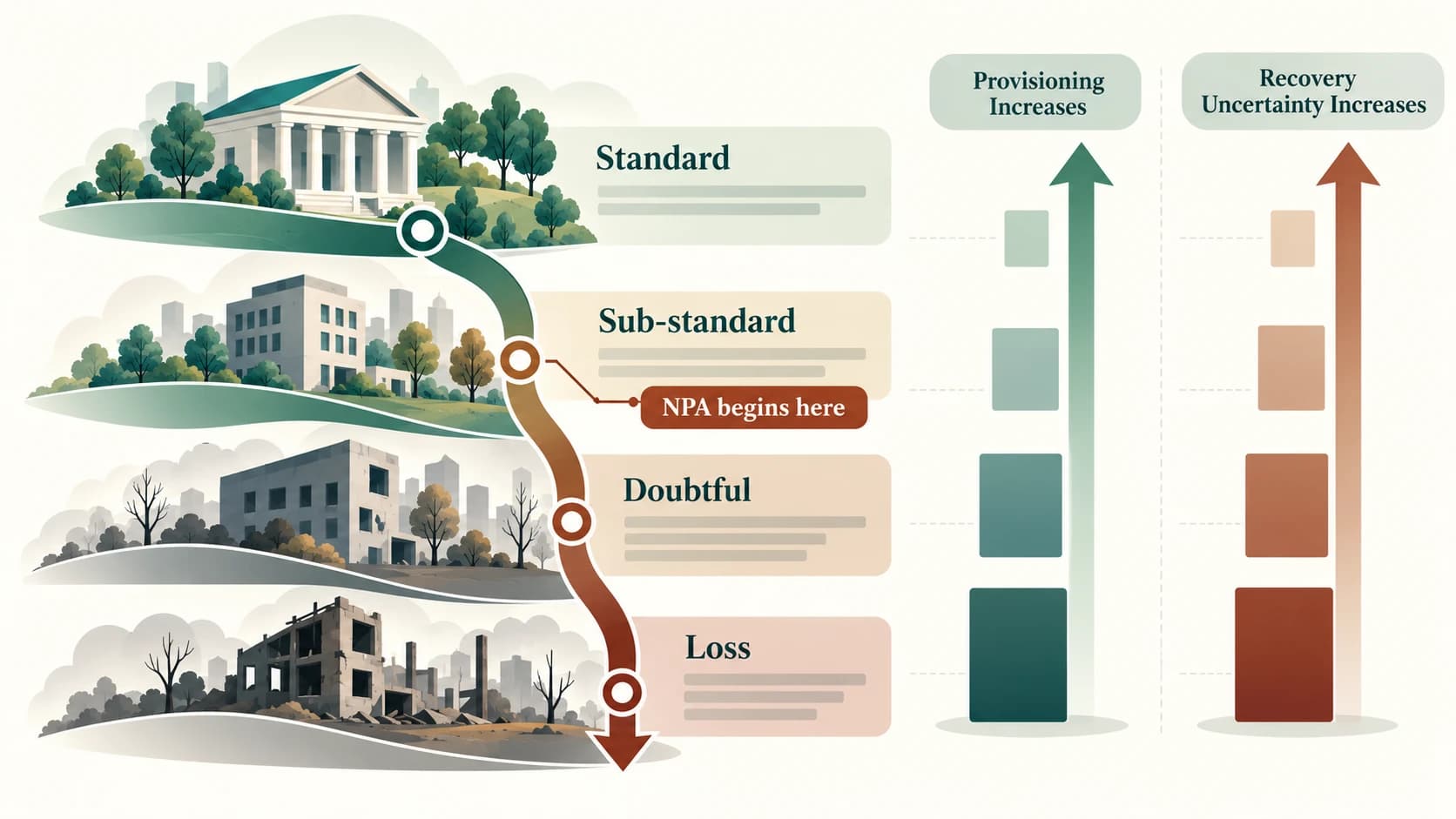
6. Classification ladder
A useful mental model:
Standard
↓ stress/default
NPA - Sub-standard
↓ remains NPA
Doubtful
↓ severe/non-recoverable weakness
Loss
This is a risk-deterioration ladder.
7. Why provisioning exists
Suppose a bank has a ₹100 crore loan that may not be fully recovered.
If the bank continues to show the full ₹100 crore as a healthy asset and reports profit normally, its financial statements become misleading.
A provision recognises expected/identified loss by setting aside part of profit/capital resources.
8. Provision is not a separate cash box
A common misunderstanding is:
"Bank takes ₹15 and puts it in a physical reserve drawer."
Provisioning is an accounting recognition of expected loss.
It reduces:
- reported profit; and
- the net carrying value/economic cushion against the asset.
9. Provisioning becomes stricter as risk rises
Core principle:
Higher credit deterioration → higher provisioning requirement.
This is why:
- standard assets have lower general provisions;
- sub-standard assets have higher provisions;
- doubtful assets have much higher provisions;
- loss assets require 100% provision/write-off.
10. Sub-standard provisioning
Under the current RBI commercial-bank framework:
- secured sub-standard assets generally require 15% provision on total outstanding;
- unsecured sub-standard exposures generally require a higher provision.
This is because unsecured exposure has less recovery cushion.
11. Unsecured exposure
RBI defines an unsecured exposure for this purpose through the low realisable value of security relative to the outstanding exposure.
The important exam concept is:
unsecured NPA → higher expected loss → higher provision.
12. Doubtful asset provisioning
For doubtful assets:
Unsecured portion
100% provision.
Secured portion
Provision rises depending on how long the asset has remained doubtful.
Current commercial-bank schedule:
- up to 1 year doubtful: 25%;
- 1 to 3 years doubtful: 40%;
- more than 3 years doubtful: 100%.
The longer the debt remains doubtful, the more likely security value/recovery deteriorates.
13. Loss assets
Loss assets should be written off.
If they remain in the books:
100% provision is required.
14. Standard asset provisioning
Banks also make provisions on performing loans.
Rates vary by category.
For example, current RBI rules prescribe different standard-asset provisioning for:
- farm credit;
- housing;
- small/micro enterprises;
- commercial real estate;
- other loans.
Because these percentages can change, they should be treated as current-data facts rather than permanent visual content.
15. Why a standard loan needs provision
Even a currently performing loan can default in future.
A general standard-asset provision recognises the statistical possibility of future loss.
This is a prudential buffer.
16. Provisioning vs capital
Provisioning and capital are related but different.
Provision
Absorbs expected/identified losses associated with assets.
Capital
Provides a broader buffer against unexpected losses and supports the bank's solvency.
Detailed capital adequacy belongs in Module 14.
17. What is an SMA?
SMA means:
Special Mention Account
It identifies early stress before NPA.
The idea is:
do not wait for 90 days before noticing trouble.
18. SMA categories
For normal loan accounts under the current RBI framework:
SMA-0
Amount overdue up to 30 days.
SMA-1
Overdue more than 30 days and up to 60 days.
SMA-2
Overdue more than 60 days and up to 90 days.
After crossing the NPA recognition threshold, the account becomes NPA.
19. SMA is not NPA
This distinction is frequently tested.
SMA indicates:
- incipient stress;
- early delinquency.
NPA indicates:
- regulatory non-performance beyond the recognition threshold.
Therefore:
SMA-2 is serious, but it is still not automatically the same as NPA until the NPA threshold is crossed.
20. SMA for CC/OD
For revolving facilities such as CC/OD, RBI uses a related but slightly different early-stress classification.
The focus is on how long the outstanding remains continuously above:
- sanctioned limit; or
- drawing power.
This reflects the nature of revolving credit.
21. Why SMA matters
SMA allows banks to:
- contact borrower early;
- diagnose cause;
- stop deterioration;
- restructure where viable;
- improve cash flow monitoring;
- coordinate with other lenders.
Early action usually gives more recovery options than late legal enforcement.
22. CRILC
CRILC stands for:
Central Repository of Information on Large Credits
RBI uses CRILC to collect/report large-credit information from applicable lenders.
It helps regulators and lenders identify:
- multiple borrowing;
- default;
- SMA status;
- system-wide exposure.
23. Why CRILC is important
Suppose Borrower X defaults at Bank A but continues appearing regular at Bank B.
Without information sharing:
Bank B may continue lending without seeing the stress.
CRILC improves system-wide visibility.
24. Default is a lagging indicator
RBI's Prudential Framework explicitly recognises that default is already a late sign of financial stress.
Banks are expected to start resolution even before default where warning signs are visible.
Examples:
- falling sales;
- delayed receivables;
- stock build-up;
- bounced payments;
- rating downgrade;
- declining account turnover.
25. Early Warning Signals - EWS
Banks use early-warning systems to identify deterioration.
Potential signals include:
- frequent cheque returns;
- delayed stock statements;
- unexplained diversion of funds;
- sudden related-party transactions;
- decline in turnover;
- persistent over-limit position;
- unpaid statutory dues;
- auditor resignation;
- litigation.
EWS is not the same as NPA.
It is a risk-management tool.
26. Provisioning Coverage Ratio - PCR
PCR broadly indicates the extent to which Gross NPAs are covered by provisions.
Higher coverage can mean the bank has recognised more loss cushion against NPAs.
But PCR must be interpreted with:
- NPA quality;
- write-offs;
- recovery;
- collateral;
- loan mix.
27. Gross NPA ratio
Conceptually:
Gross NPAs ÷ Gross Advances × 100
This shows the proportion of loans classified as NPA before provision adjustments.
28. Net NPA ratio
Net NPA adjusts the NPA stock for specified provisions and related items.
It reflects the remaining uncovered NPA burden.
The exact regulatory formula contains accounting adjustments.
For exam preparation, understand the concept rather than memorising a simplified formula that may omit regulatory deductions.
29. Provisioning affects profit
Higher provision:
- reduces current profit;
- strengthens loss absorption.
This creates a difficult but necessary trade-off.
A bank that recognises problems early may show lower profit today but stronger financial health later.
30. "Window dressing" of NPAs
Banks must not:
- temporarily credit an account;
- provide artificial funds;
- restructure without economic justification
merely to avoid NPA recognition.
Objective classification rules are designed to prevent such window dressing.
Quick check - BA-07-02
- How long can an NPA remain sub-standard before becoming doubtful?
- What is a loss asset?
- Why does provision increase as an asset deteriorates?
- Is SMA-2 already an NPA?
- What are SMA-0, SMA-1 and SMA-2 designed to identify?
- What does CRILC help track?
Quick answers
- Up to 12 months.
- An asset where loss has been identified but it has not been fully written off.
- Because expected recovery becomes more uncertain.
- No.
- Early/incidental stages of repayment stress.
- Large-credit exposure, default and stress information.