
Stressed Assets, Restructuring, Write-Offs and Wilful Default
Stressed Assets, Restructuring, Write-Offs and Wilful Default. A detailed chapter in NPAs, Stressed Assets & Recovery, with explanations and examples for Indian banking examinations.
By Akhilesh Saini · Reviewed 7 Oct 2026
1. What is a stressed asset?
"Stressed asset" is a broader concept than NPA.
Stress can begin before formal NPA classification.
A stressed borrower may have:
- declining cash flow;
- overdue instalments;
- covenant breaches;
- high leverage;
- SMA status;
- restructuring need;
- NPA status.
Therefore:
all NPAs are stressed assets, but not all stressed assets are necessarily NPAs.
2. Resolution vs recovery
Resolution
Attempts to preserve/reorganise viable economic value.
Examples:
- rescheduling;
- debt restructuring;
- change in ownership;
- debt-equity conversion;
- additional finance;
- compromise settlement.
Recovery
Focuses on collecting dues.
Examples:
- security enforcement;
- DRT;
- legal suit;
- IBC recovery/resolution;
- sale to ARC.
Resolution may lead to better recovery than immediate enforcement.
3. RBI Prudential Framework for Resolution of Stressed Assets
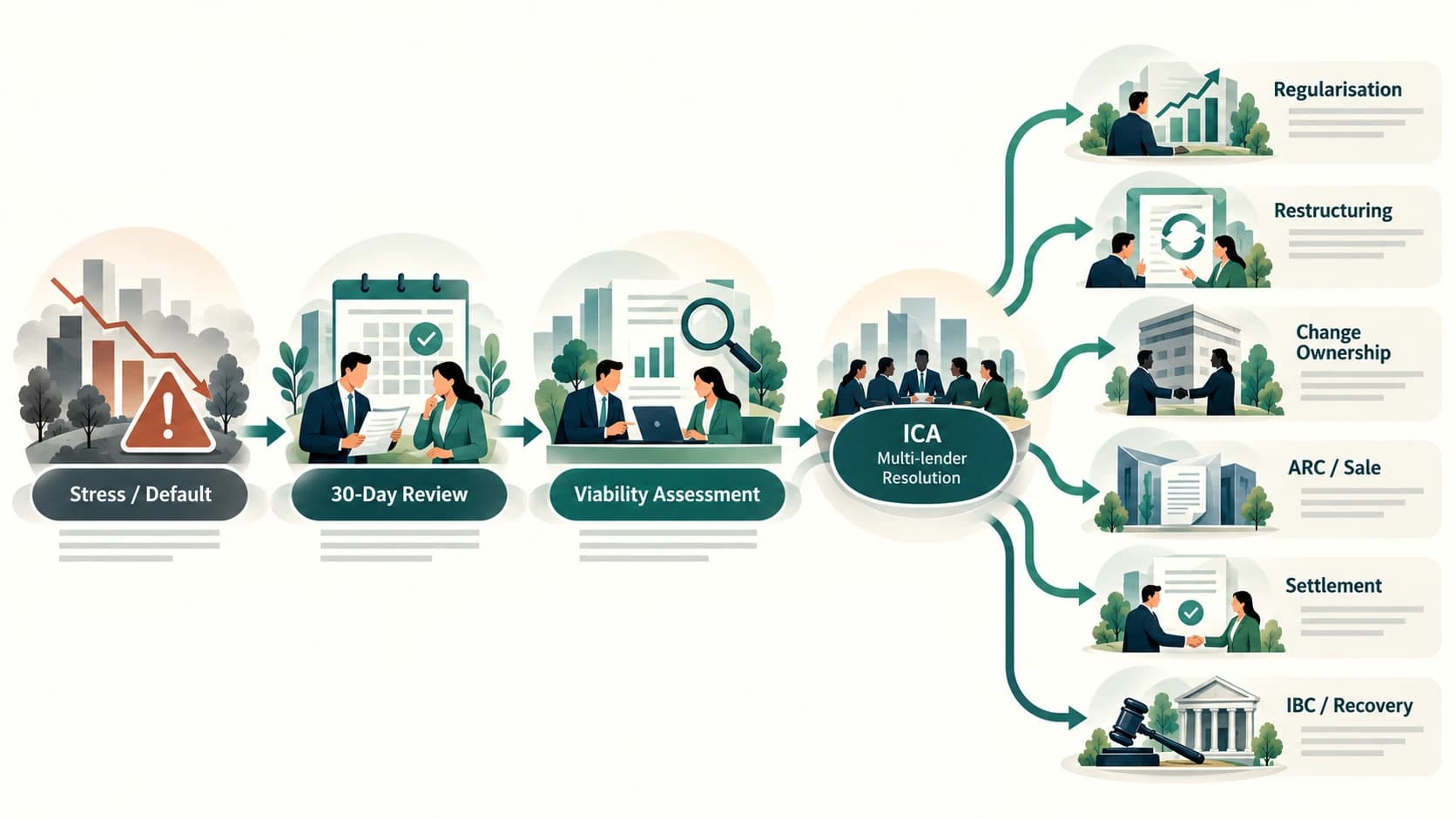
RBI's 2019 Prudential Framework created a principle-based system for timely resolution of stress.
The objective is:
- early recognition;
- coordinated lender action;
- credible resolution;
- disincentive for delay.
4. 30-day review period
Once a borrower is reported in default by a lender, lenders undertake a 30-day review period.
During this period they can decide:
- whether borrower is viable;
- whether resolution is possible;
- what form the resolution should take;
- whether legal action should begin.
5. Inter-Creditor Agreement - ICA
If a borrower has multiple lenders and a resolution plan is pursued, lenders enter an ICA under the framework.
The ICA creates common decision rules.
Current RBI framework provides that a resolution decision supported by:
- lenders representing 75% by value of outstanding credit; and
- 60% of lenders by number
can bind the participating lenders under the ICA.
This helps reduce holdout problems.
6. What can a resolution plan include?
A resolution plan can include:
- regularisation;
- sale of exposure;
- restructuring;
- change in ownership;
- debt conversion;
- additional finance;
- compromise settlement;
- insolvency process.
The correct choice depends on borrower viability and recovery value.
7. Restructuring
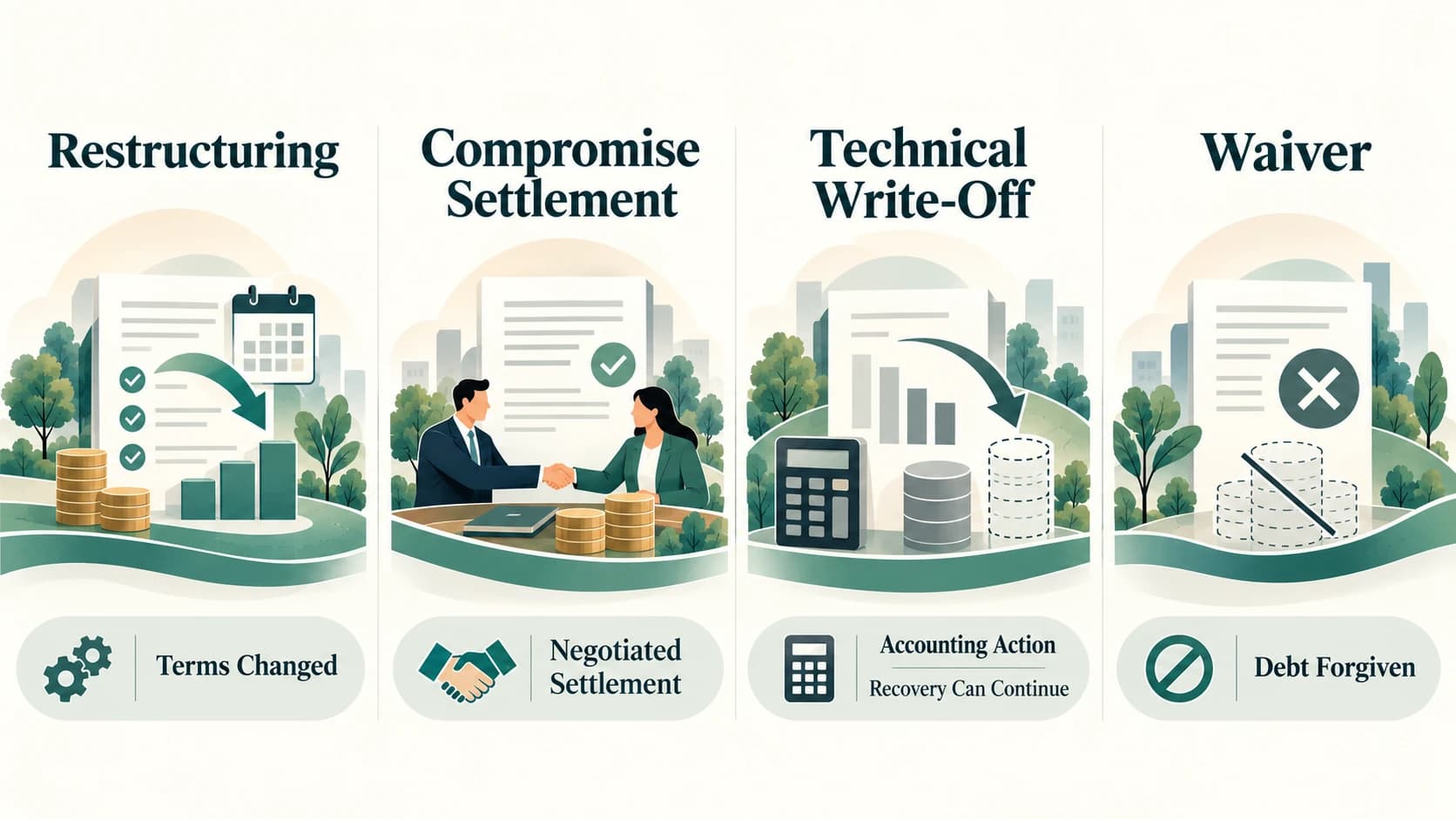
A restructuring occurs when a lender grants a concession to a borrower facing financial difficulty by changing the original terms.
Possible changes:
- repayment tenor;
- instalment amount;
- interest schedule;
- moratorium;
- conversion of debt;
- reduction/waiver of part of contractual claim under approved plan.
The exact regulatory definition is technical.
The key idea is:
terms change because the borrower cannot reasonably meet the original contract.
8. Restructuring is not always "helping a bad borrower"
A viable business may be temporarily stressed because:
- project delay;
- market shock;
- cash-flow mismatch;
- demand collapse;
- commodity shock.
If restructuring creates a realistic repayment structure and preserves value, it may produce more recovery than liquidation.
9. Moral hazard in restructuring
Restructuring can be abused.
Borrowers may expect:
"If I cannot pay, bank will always extend the loan."
Banks may also use restructuring to postpone NPA recognition.
Therefore RBI requires:
- viability;
- prudential classification;
- provisioning;
- Board-approved policies;
- monitoring.
10. Restructuring and asset classification
Restructuring does not automatically make an NPA healthy.
Under RBI's general prudential approach:
- concessions due to financial difficulty can result in classification/provisioning consequences;
- upgrade requires satisfactory performance under applicable rules.
Do not assume:
restructured = standard.
11. Additional finance
A resolution plan may include additional finance to keep a viable business operating.
This can fund:
- working capital;
- completion of project;
- essential operations.
Without new money, an otherwise viable restructuring may fail.
12. Compromise settlement
A compromise settlement is a negotiated arrangement where the lender agrees to accept a settled amount in full and final settlement of its claims under the approved framework.
The settlement amount can be lower than contractual dues.
This is not the same as:
- routine repayment;
- automatic loan waiver.
13. Why would a bank accept a compromise settlement?
Because expected recovery through litigation may be:
- lower;
- slower;
- more expensive;
- uncertain.
Example:
Contractual dues = ₹100.
Expected legal recovery after years = ₹45.
Borrower offers ₹60 now.
A properly approved settlement may maximise net present recovery.
14. RBI's 2023 compromise-settlement framework
RBI harmonised compromise-settlement and technical-write-off rules across regulated entities.
The framework emphasises:
- Board-approved policy;
- delegated authority;
- independent approval hierarchy;
- transparency;
- staff accountability;
- reporting.
Compromise settlement is therefore a formal recovery tool, not an informal concession.
15. Technical write-off
A technical write-off is an accounting action.
The loan may be removed from the bank's active balance-sheet books at the Head Office level after required provisioning, while recovery efforts can continue.
This is one of the most misunderstood banking terms.
16. Technical write-off is not waiver
Write-off
Accounting treatment.
Waiver
Borrower's legal obligation is forgiven/released under an authorised waiver/settlement.
A write-off does not automatically mean:
borrower no longer owes money.
Banks can continue:
- recovery;
- legal action;
- enforcement.
17. Why banks write off NPAs
A bank may write off because:
- asset is fully provided;
- recovery is uncertain;
- balance sheet should not carry old unrecoverable assets;
- tax/accounting treatment allows;
- recovery can be pursued off-balance sheet.
Write-off cleans accounting presentation.
It does not necessarily end recovery.
18. Write-off vs compromise settlement
Write-off
Bank accounting action.
Compromise settlement
Negotiated agreement with borrower.
They can occur together or separately.
19. Waiver
A waiver is a deliberate release of some or all borrower obligation.
Loan waivers are often policy decisions in special circumstances.
A waiver is economically and legally different from a technical write-off.
20. What is default?
Default means the borrower failed to pay/perform as required.
Default can happen because of:
- genuine financial distress;
- business failure;
- accident;
- job loss;
- poor management;
- fraud;
- deliberate non-payment.
Therefore:
default is not automatically wilful default.
21. Wilful default
RBI's 2024 Directions create a specific procedure for classifying a borrower/guarantor as a wilful defaulter.
Wilful default broadly involves deliberate or culpable conduct such as:
- default despite capacity to pay;
- diversion of borrowed funds;
- siphoning of funds;
- disposal/removal of secured assets without lender knowledge.
22. Default despite capacity
Example:
Borrower has adequate liquid resources but deliberately chooses not to repay the bank.
This is different from:
borrower genuinely cannot pay.
23. Diversion of funds
Borrowed funds are used for purposes different from those for which the loan was granted.
Example:
Loan sanctioned for factory machinery.
Funds diverted to an unrelated speculative investment.
24. Siphoning of funds
Siphoning is more serious.
Funds leave the borrowing enterprise and are not available:
- for the stated purpose; or
- as identifiable assets of the borrower.
25. Disposal of secured assets
If a borrower disposes/removes assets given as security without the lender's knowledge, this can form part of wilful-default assessment.
26. Wilful default requires process
RBI requires a transparent mechanism.
Classification is not supposed to be based on one officer's casual opinion.
The process involves:
- identification;
- show-cause notice;
- opportunity for representation;
- committee review;
- reasoned decision.
This reflects principles of natural justice.
27. Current threshold
Under the current RBI Directions, lenders examine wilful default in NPA accounts with outstanding amount of ₹25 lakh and above, subject to the Directions.
Because thresholds can change, this belongs in current data.
28. Consequences of wilful default
Consequences can include:
- restrictions on further institutional finance;
- reporting to CICs;
- recovery/legal action;
- possible criminal proceedings where facts warrant;
- reputational impact;
- promoter/director consequences under the rules.
This is why wilful-defaulter classification is serious.
29. Wilful default vs fraud
They overlap in some cases but are not identical.
Wilful default
Focuses on deliberate default/diversion/siphoning/security disposal under RBI's wilful-defaulter framework.
Fraud
Involves deception, dishonesty or fraudulent conduct under the applicable legal/regulatory framework.
A borrower can:
- be wilful defaulter without a criminal fraud conviction;
- be involved in fraud with additional criminal/regulatory consequences.
Do not use the terms interchangeably.
30. Wilful default vs genuine business failure
Business failure can occur despite honest effort.
Example:
- sudden demand collapse;
- natural disaster;
- input-cost shock.
If the borrower lacks capacity to repay, that is not automatically wilful default.
The lender must examine conduct, capacity and use of funds.
31. Guarantor and wilful default
A guarantor can also face consequences where the guarantee is invoked and the guarantor has capacity but deliberately fails to honour the obligation, subject to RBI's framework.
This reinforces the point from Module 06:
a guarantee creates a real contingent obligation.
32. CRILC, CICs and stress reporting
Stress information moves through systems such as:
- CRILC;
- Credit Information Companies.
This helps lenders see:
- defaults;
- multiple exposures;
- wilful-default reporting;
- resolution status.
Quick check - BA-07-03
- Is every stressed asset already an NPA?
- What is restructuring?
- What is the difference between write-off and waiver?
- Does technical write-off stop recovery?
- Is every default a wilful default?
- Name two situations that may amount to wilful default.
Quick answers
- No.
- Modification of loan terms because borrower faces financial difficulty, under applicable framework.
- Write-off is accounting treatment; waiver releases borrower obligation.
- No.
- No.
- Default despite capacity, diversion, siphoning, or unauthorised disposal of secured assets.