
Loan Recovery: SARFAESI, DRTs, IBC and Asset Reconstruction Companies
Loan Recovery: SARFAESI, DRTs, IBC and Asset Reconstruction Companies. A detailed chapter in NPAs, Stressed Assets & Recovery, with explanations and examples for Indian banking examinations.
By Akhilesh Saini · Reviewed 7 Oct 2026
1. Recovery is not one single legal route
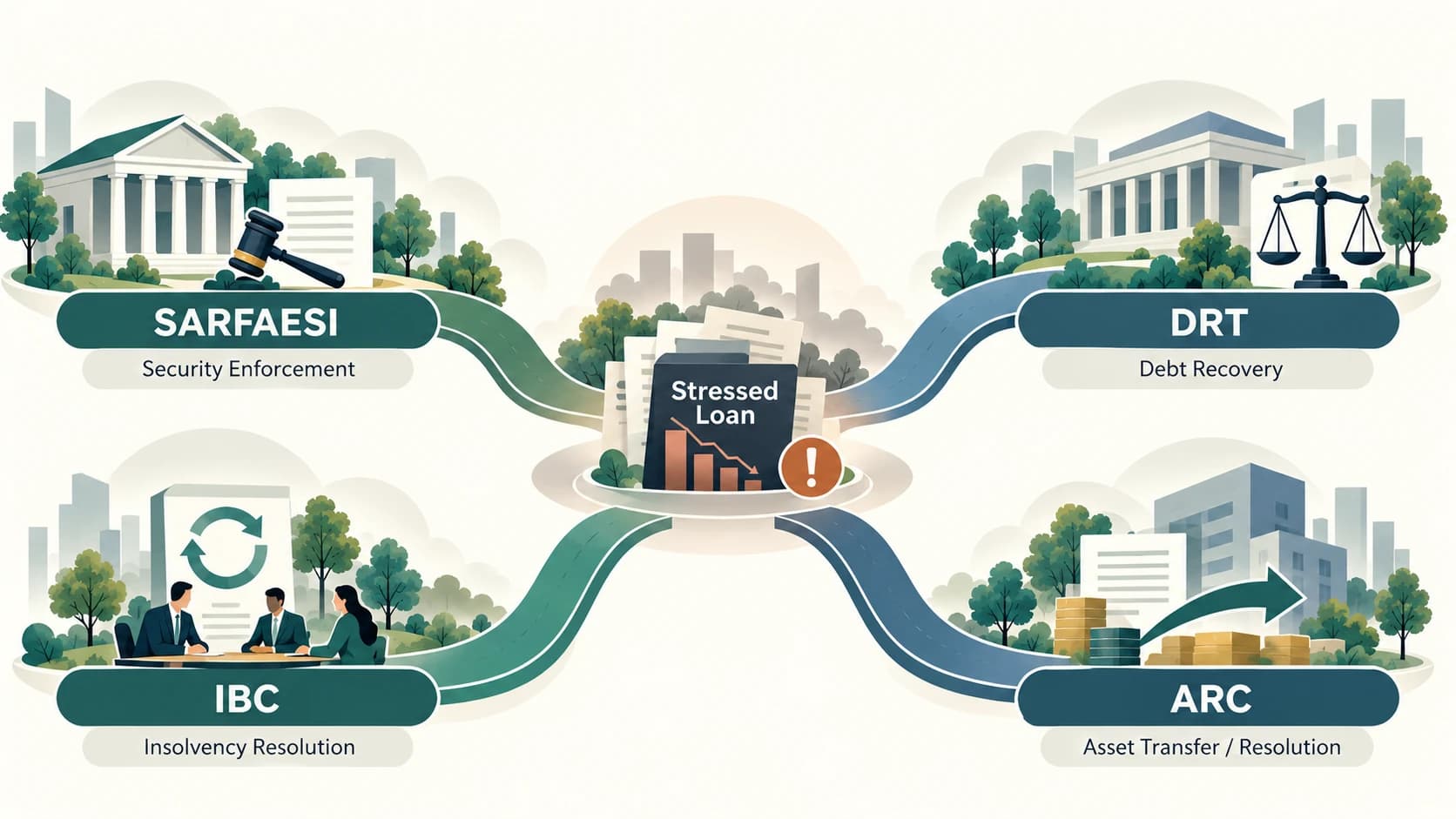
When a borrower defaults, a bank may choose among several recovery/resolution mechanisms.
Major Indian mechanisms include:
- contractual recovery;
- enforcement of security;
- SARFAESI;
- Debts Recovery Tribunals;
- Insolvency and Bankruptcy Code;
- Lok Adalats in eligible cases;
- compromise settlement;
- sale of stressed assets to ARCs.
The correct route depends on:
- borrower type;
- loan size;
- security;
- viability;
- number of lenders;
- legal status;
- recovery prospects.
2. Recovery vs resolution
Recovery
Goal: collect money.
Resolution
Goal: reorganise a viable debtor or asset so value is preserved and creditors recover more.
IBC is called an insolvency resolution framework, although it can end in liquidation.
SARFAESI is primarily a secured-creditor enforcement framework.
3. SARFAESI Act, 2002
SARFAESI stands for:
Securitisation and Reconstruction of Financial Assets and Enforcement of Security Interest Act, 2002
It was designed to allow secured creditors to enforce security interests more efficiently without first having to obtain a traditional civil-court decree in every case, subject to statutory procedure and exclusions.
4. Why SARFAESI was important
Before modern recovery laws, secured lenders could face long delays in ordinary civil courts.
SARFAESI provides a structured process for:
- enforcing security;
- taking possession;
- management takeover in permitted cases;
- sale of secured assets;
- asset reconstruction.
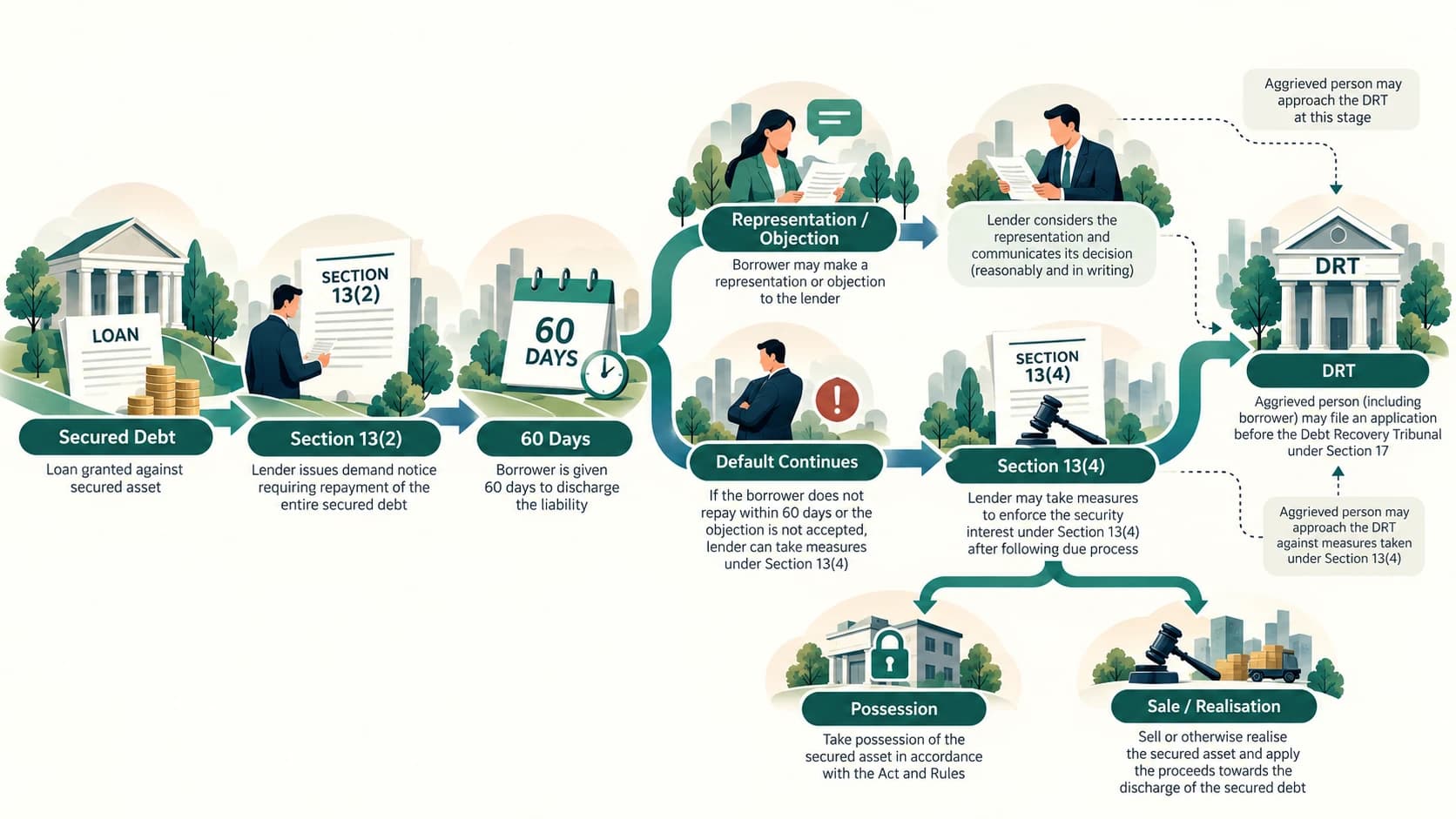
5. Section 13 demand notice
Under Section 13(2), after the secured debt meets the statutory conditions, the secured creditor can issue a demand notice requiring the borrower to discharge liability within 60 days.
This is a classic banking-exam fact.
6. Borrower's representation
The borrower can make:
- representation;
- objection.
The secured creditor must consider it under the statutory framework.
SARFAESI is not:
"bank can seize property the next morning."
There is a legal sequence.
7. Section 13(4) measures
If the borrower fails to comply with the demand notice, the secured creditor may take permitted measures under Section 13(4), including broadly:
- taking possession of secured assets;
- taking over management in eligible cases;
- appointing a manager;
- requiring specified third parties to pay amounts due to the borrower.
The exact remedy depends on the asset and law.
8. Magistrate assistance
Under Section 14, the secured creditor can seek assistance from the:
- Chief Metropolitan Magistrate; or
- District Magistrate
for taking possession of secured assets/documents under the Act.
9. Borrower's remedy before DRT
A person aggrieved by SARFAESI enforcement measures can approach the Debts Recovery Tribunal under Section 17.
This creates judicial/tribunal review.
Therefore SARFAESI is not a system without legal remedy.
10. SARFAESI does not apply to every loan
The Act contains:
- thresholds;
- exclusions;
- security requirements;
- procedural conditions.
For evergreen study, understand the mechanism.
For a real case, the latest statutory text and judicial interpretation must be checked.
11. Secured vs unsecured recovery
SARFAESI is strongest where there is an enforceable security interest.
An unsecured personal loan does not magically gain a mortgaged property because the borrower defaults.
Banks may need:
- DRT;
- civil/recovery proceedings;
- insolvency;
- settlement
depending on facts.
12. Debts Recovery Tribunals - DRTs
DRTs were created under the Recovery of Debts and Bankruptcy Act, 1993.
Their purpose is expeditious adjudication and recovery of debts due to:
- banks;
- financial institutions.
13. Why DRTs were created
Ordinary civil courts faced large volumes and delays.
Specialised tribunals were created to speed bank debt recovery.
The structure includes:
- DRT;
- Debts Recovery Appellate Tribunal - DRAT.
14. DRT and SARFAESI are connected but different
DRT under Recovery of Debts and Bankruptcy Act
Bank can file recovery proceedings for debt adjudication/recovery.
DRT under SARFAESI
Borrower/aggrieved person can challenge secured-creditor enforcement measures.
Same tribunal system, different legal role.
15. Recovery Certificate
After adjudication, DRT can issue a Recovery Certificate.
Recovery Officer then proceeds to recover dues using powers available under the statute.
16. DRT vs civil court
DRT is a specialised tribunal.
It does not mean:
- no appeals;
- no legal procedure;
- no judicial scrutiny.
Appeals lie to DRAT under the statutory framework.
17. Insolvency and Bankruptcy Code - IBC
The Insolvency and Bankruptcy Code, 2016 created a consolidated insolvency-resolution framework.
For corporate persons, the core process is:
Corporate Insolvency Resolution Process - CIRP
The central philosophy is:
resolve the debtor as a going concern where possible, rather than merely seize individual assets piecemeal.
18. Who can initiate CIRP?
Subject to the Code:
- financial creditor;
- operational creditor;
- corporate applicant
can initiate proceedings through the prescribed sections.
For Banking Awareness, banks are typically financial creditors.
19. NCLT
For corporate insolvency, the adjudicating authority is the:
National Company Law Tribunal - NCLT
Appeals go to:
National Company Law Appellate Tribunal - NCLAT
and thereafter to the Supreme Court on questions permitted by law.
20. Admission and moratorium
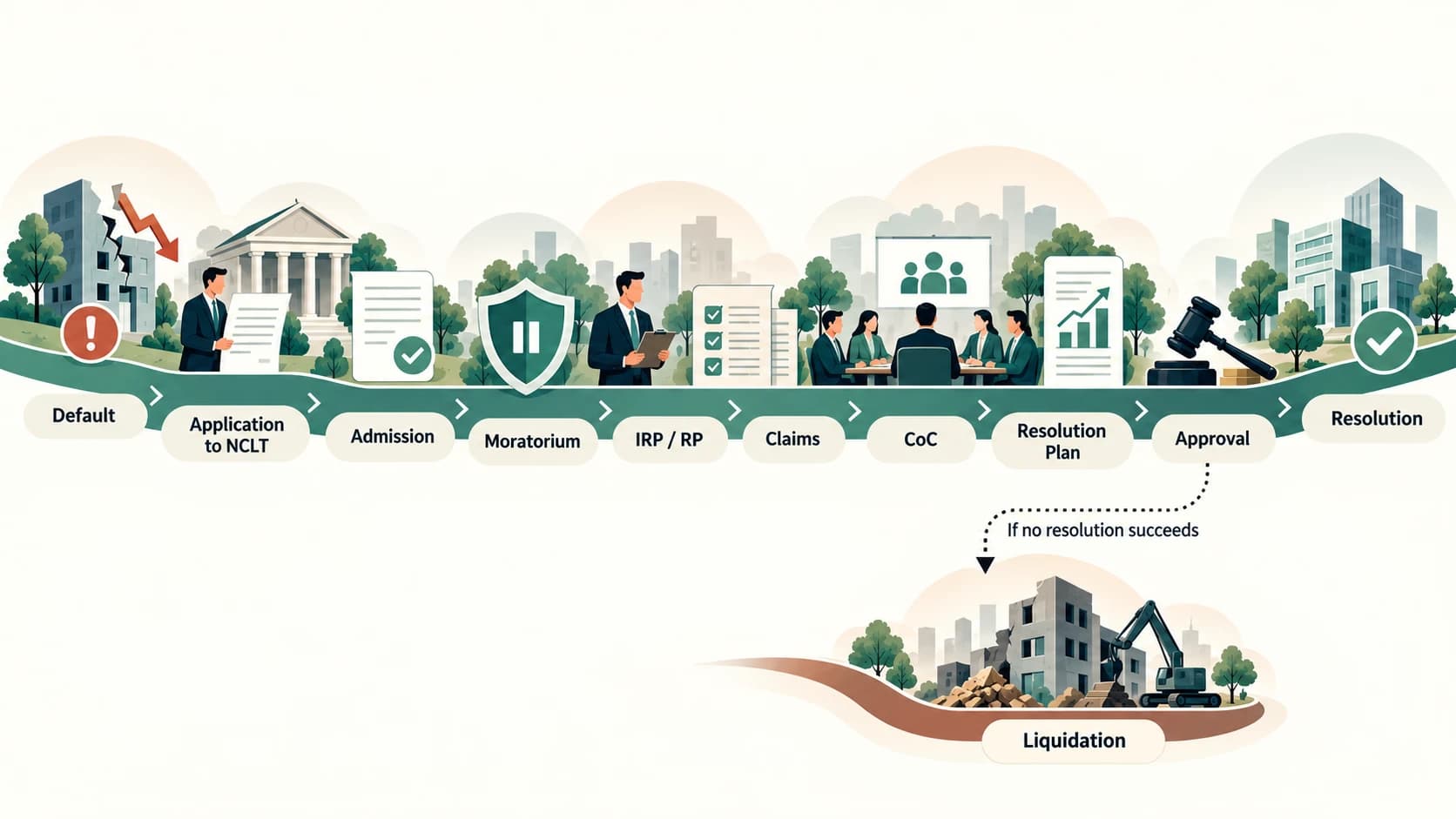
Once a CIRP application is admitted:
- insolvency commencement begins;
- a moratorium operates under the Code;
- specified enforcement/recovery actions are stayed/restricted;
- an Interim Resolution Professional is appointed.
The moratorium is designed to stop a destructive race among creditors.
21. Insolvency Professional
The Interim Resolution Professional / Resolution Professional:
- takes control of the insolvency process;
- collects claims;
- manages process;
- forms Committee of Creditors;
- invites resolution plans;
- ensures compliance.
Management powers of the corporate debtor change substantially during CIRP.
22. Committee of Creditors - CoC
The Committee of Creditors is primarily composed of financial creditors under the Code, subject to statutory provisions.
The CoC evaluates:
- viability;
- resolution plans;
- commercial terms.
This represents a shift toward creditor-in-control during insolvency.
23. CIRP timeline
The IBC begins with a statutory 180-day resolution period.
The Code provides an extension framework.
The statute also sets an overall timeline that has been subject to important Supreme Court interpretation and exceptional extensions.
For exam purposes:
remember 180 days as the base CIRP period and 330 days as the statutory outer framework commonly discussed, while recognising that jurisprudence has qualified the word "mandatory" in exceptional cases.
24. Resolution plan
Potential resolution applicants submit plans.
A plan may include:
- change of ownership;
- debt haircut;
- new capital;
- asset sale;
- operational restructuring;
- debt conversion.
The CoC votes according to the IBC threshold and the approved plan goes to NCLT.
25. Haircut
A haircut is the reduction between creditors' admitted contractual claims and the value realised/accepted under a resolution.
Example:
Claim = ₹100.
Resolution recovery = ₹45.
Haircut = ₹55, or 55%.
A haircut does not mean the lender casually "forgives" money.
It reflects economic recovery value in a stressed situation.
26. Liquidation
If no acceptable resolution succeeds, the corporate debtor may enter liquidation under the Code.
Liquidation means:
- assets are realised;
- proceeds distributed under the statutory waterfall.
IBC prefers resolution where feasible, but liquidation is the fallback.
27. IBC vs SARFAESI
| SARFAESI | IBC |
|---|---|
| Security enforcement | Insolvency resolution |
| Primarily secured-creditor action | Collective creditor process |
| Focus on secured assets | Focus on debtor/entity as a whole |
| DRT remedy for aggrieved person | NCLT adjudicating authority |
| Can lead to asset sale | Can lead to resolution plan or liquidation |
28. IBC vs DRT
DRT
Focuses on recovery/adjudication of debt.
IBC
Focuses on insolvency resolution of the debtor.
A bank may use different routes depending on objective.
29. Asset Reconstruction Company - ARC
An ARC specialises in acquiring and resolving stressed financial assets.
ARCs are registered and regulated by RBI under the SARFAESI framework.
Their role is to:
- acquire stressed loans from lenders;
- aggregate debt;
- restructure;
- enforce security;
- settle;
- change management in permitted cases;
- resolve/recover assets.
30. Why would a bank sell an NPA to an ARC?
A bank may prefer:
- immediate cash/recovery;
- transfer of recovery burden;
- balance-sheet clean-up;
- specialised resolution expertise.
The ARC takes over the financial asset and tries to maximise recovery.
31. ARC purchase does not erase borrower liability
Selling a stressed loan to an ARC changes the creditor/holder of the financial asset.
The borrower does not receive automatic forgiveness.
The ARC can pursue recovery/resolution under law.
32. Security Receipts - SRs
ARCs can use trusts and issue Security Receipts to qualified buyers under the regulatory framework.
SR value depends on realisation from the underlying stressed assets.
This means SRs carry recovery risk.
33. Asset reconstruction measures
RBI's ARC Directions recognise resolution tools such as:
- rescheduling;
- enforcement of security;
- settlement;
- change/takeover of management;
- sale/lease of business;
- conversion of debt into equity;
- other reconstruction measures.
ARC is therefore not simply a "debt collection agency".
34. Sale of stressed loans
RBI permits transfer of loan exposures under a regulated framework.
A bank may transfer stressed exposure to:
- ARC;
- eligible lender/transferee.
Transfer pricing reflects expected recovery value.
Selling at a discount creates accounting consequences for the lender.
35. Compromise settlement vs ARC sale
Compromise settlement
Bank/ARC settles directly with borrower.
ARC sale
Bank transfers the financial asset to another entity.
They are separate tools.
36. Lok Adalat
Lok Adalats can support settlement/recovery of eligible smaller-value disputes according to the Legal Services Authorities framework.
They are useful because they emphasise:
- settlement;
- lower procedural burden.
They are not substitutes for SARFAESI/IBC in every case.
37. Recovery through guarantor
Bank can enforce valid guarantee according to law.
A guarantor's liability can be significant.
Recovery against guarantor can run alongside other remedies subject to legal rules.
38. Recovery through collateral
A bank may realise:
- pledged goods;
- hypothecated assets;
- mortgaged property;
- assigned receivables.
The legal route depends on security type.
This connects directly to Module 06.
39. Recovery is not the same as harassment
Banks and recovery agents must follow:
- law;
- fair-practice standards;
- customer-protection rules.
Default does not permit:
- threats;
- intimidation;
- unlawful seizure.
Customer-protection rules are covered in Module 12.
40. Choosing a recovery mechanism
A bank asks:
- Is borrower viable?
- Is security enforceable?
- Are there multiple lenders?
- Is there a corporate debtor?
- Will a restructuring maximise value?
- Is insolvency more appropriate?
- Would an ARC sale improve recovery?
- How long/costly is litigation?
Recovery strategy is an economic decision as well as a legal one.
Quick check - BA-07-04
- What does SARFAESI stand for?
- What is the Section 13(2) demand-notice period?
- Which tribunal hears challenges to SARFAESI measures?
- What is the basic purpose of DRT?
- What is CIRP?
- What does an ARC do?
Quick answers
- Securitisation and Reconstruction of Financial Assets and Enforcement of Security Interest Act.
- 60 days.
- DRT.
- Expeditious adjudication/recovery of debts due to banks and financial institutions.
- Corporate Insolvency Resolution Process under IBC.
- Acquires and resolves stressed financial assets.