
Priority Sector Lending: Targets and Categories
Priority Sector Lending: Targets and Categories. A detailed chapter in Priority Sector, Rural & MSME Banking, with explanations and examples for Indian banking examinations.
By Akhilesh Saini · Reviewed 7 Oct 2026
1. What is Priority Sector Lending?
Priority Sector Lending, or PSL, is the regulatory framework through which RBI requires banks to direct a prescribed share of their lending toward sectors that are important for:
- socio-economic development;
- employment;
- agriculture;
- small enterprise;
- basic services; and
- financial inclusion.
The underlying problem is simple:
a borrower can be economically productive and creditworthy, yet still be underserved because the loan is small, costly to administer, geographically remote or difficult to secure with conventional collateral.
PSL tries to correct this credit-allocation gap.
2. PSL is not the same as subsidised lending
A priority-sector loan is not automatically:
- interest-free;
- subsidised;
- guaranteed by Government; or
- exempt from normal credit appraisal.
Banks must still assess:
- repayment capacity;
- purpose;
- credit risk;
- documentation;
- security where applicable.
PSL changes classification and regulatory allocation, not the basic need for sound lending.
3. Why does India use PSL?
Markets can naturally favour:
- larger borrowers;
- highly collateralised lending;
- urban borrowers;
- easily scalable loans.
But the economy also needs credit for:
- small farmers;
- micro enterprises;
- low-income households;
- education;
- affordable housing;
- renewable energy;
- social infrastructure.
PSL creates a minimum institutional-credit commitment.
4. Major priority-sector categories
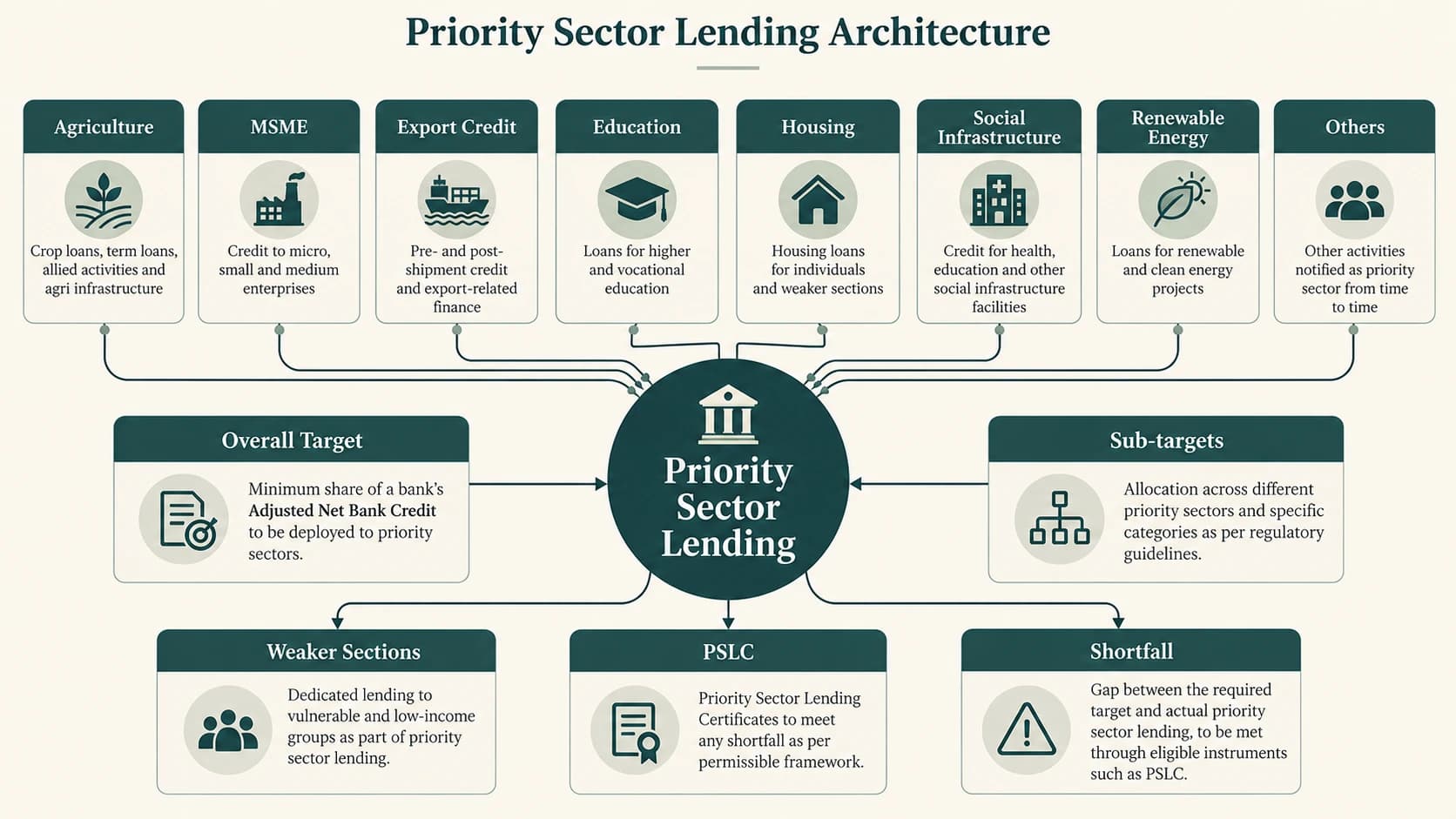
Under RBI's present framework, the principal categories are:
- Agriculture
- Micro, Small and Medium Enterprises
- Export Credit
- Education
- Housing
- Social Infrastructure
- Renewable Energy
- Others
Some categories also contain:
- sectoral sub-limits;
- borrower limits;
- overlapping weaker-section classification.
5. Overall target vs sub-target
Suppose a bank has:
- overall PSL target;
- agriculture target;
- micro-enterprise target;
- weaker-section target.
Meeting the overall target does not necessarily mean every sub-target has been met.
Example:
A bank could have enough total priority-sector lending but too little credit to:
- agriculture; or
- micro enterprises.
Therefore RBI monitors both:
overall achievement and sub-target achievement.
6. ANBC
ANBC stands for:
Adjusted Net Bank Credit
It is a regulatory measure used as one base for computing PSL targets.
Conceptually, it begins with net bank credit and then makes specified additions/deductions for items such as:
- deposits in eligible funds for PSL shortfall;
- eligible PSLC positions;
- specified long-term-bond exemptions;
- certain investments;
- other items prescribed by RBI.
It is not simply:
"total loans shown in the bank balance sheet."
7. CEOBSE
CEOBSE stands for:
Credit Equivalent of Off-Balance Sheet Exposures
Banks can have credit exposure through:
- guarantees;
- letters of credit;
- other contingent facilities.
CEOBSE converts off-balance-sheet risk into a credit-equivalent amount.
For PSL targeting, RBI uses the relevant base such as:
ANBC or CEOBSE, whichever is higher.
8. Why "whichever is higher"?
Without this rule, a bank with large off-balance-sheet business might have a lower apparent PSL obligation than its actual credit-risk footprint.
Using the higher base strengthens consistency.
9. Agriculture sub-target
Agriculture is a major PSL category.
The current framework separately recognises:
- total agriculture;
- Non-Corporate Farmers;
- Small and Marginal Farmers.
This prevents a bank from meeting an agriculture target only by making large loans to agribusiness entities.
10. Non-Corporate Farmers - NCF
NCFs include, broadly:
- individual farmers;
- Small and Marginal Farmers;
- proprietorship firms of farmers directly engaged in agriculture/allied activities;
- qualifying SHGs/JLGs of individual farmers.
This sub-target preserves credit flow to the actual farming household/individual segment.
11. Small and Marginal Farmers - SMFs
For PSL purposes, the current RBI framework broadly recognises:
Marginal farmer
Landholding up to 1 hectare.
Small farmer
Landholding above 1 hectare and up to 2 hectares.
The framework also includes eligible:
- tenant farmers;
- oral lessees;
- sharecroppers;
- landless agricultural labourers;
- specified allied-activity borrowers;
- qualifying SHGs/JLGs.
12. Micro-enterprise sub-target
A separate micro-enterprise sub-target protects the smallest business borrowers within the wider MSME category.
Without it, banks could meet MSME lending largely through:
- larger small enterprises; or
- medium enterprises.
The sub-target ensures that micro units receive direct attention.
13. Weaker Sections
"Weaker Sections" is an overlapping PSL classification.
Examples include:
- Small and Marginal Farmers;
- SC/ST beneficiaries;
- SHGs/JLGs;
- certain artisans and village industries;
- specified women beneficiaries;
- beneficiaries under Government-sponsored programmes;
- qualifying low-income microfinance borrowers.
A loan may therefore count simultaneously toward:
- a sector category; and
- the weaker-section sub-target.
14. Why overlapping categories matter
Suppose Bank A lends to a small marginal farmer.
That loan may count toward:
- agriculture;
- Non-Corporate Farmers;
- Small and Marginal Farmers;
- Weaker Sections;
- overall PSL.
This does not mean five separate loans exist.
One loan can contribute to multiple regulatory sub-targets when it satisfies the definitions.
15. Priority Sector Lending Certificates - PSLCs
A PSLC is a tradable certificate representing priority-sector achievement.
The key idea:
the PSL achievement can be transferred between banks without transferring the underlying loan or its credit risk.
If Bank A exceeds its agriculture target and Bank B has a shortfall:
Bank A can sell an appropriate PSLC to Bank B.
16. Why PSLCs exist
Banks have different business models.
Example:
- rural bank may naturally generate more agriculture loans;
- metropolitan bank may have less direct rural origination.
PSLCs create flexibility while preserving the system-wide target.
17. Main PSLC types
The RBI framework recognises PSLC categories corresponding to major target/sub-target needs, including:
- Agriculture;
- Small & Marginal Farmers;
- Micro Enterprises;
- General.
The exact counting rules should be checked from current RBI instructions.
18. PSLC does not transfer credit risk
This is a classic confusion.
If Bank A sells a PSLC to Bank B:
- the loan remains on Bank A's books;
- Bank A keeps the borrower relationship;
- Bank A retains credit risk;
- Bank B buys only the PSL achievement.
19. PSL shortfall
If banks fail to meet prescribed PSL targets, RBI can require contribution of the shortfall to designated funds.
Examples can include funds maintained with:
- NABARD;
- SIDBI;
- NHB;
- MUDRA,
depending on RBI/Government allocation.
20. Rural Infrastructure Development Fund - RIDF
RIDF is associated with NABARD and was created to support rural infrastructure.
PSL shortfall allocations can be directed to RIDF or other eligible funds.
This creates an indirect development channel:
if a bank cannot deliver enough qualifying priority credit directly, part of the shortfall can be channelled to development funds.
21. District weighting
PSL policy also tries to correct regional credit imbalance.
RBI can assign higher achievement weight to incremental PSL in low-credit districts and lower weight in high-credit districts.
This gives banks an incentive to expand where institutional credit is scarce.
22. PSL categories can change
RBI periodically revises:
- loan limits;
- eligible activities;
- target structure;
- on-lending rules;
- district weights.
Therefore learn:
- the architecture permanently; and
- the current numbers separately.
23. PSL and interest rates
Priority-sector status does not create one universal interest rate.
Pricing follows:
- RBI lending-rate rules;
- lender policy;
- Government interest-subvention scheme where applicable.
A KCC crop loan under an interest-subvention scheme is different from a normal MSME term loan even though both may be PSL.
24. No service charges on very small PSL loans
RBI provides special protection for very small priority-sector loans, including restrictions on certain loan-related service charges up to the current prescribed threshold.
The exact limit is update-sensitive and belongs in current data.
25. PSL and credit quality
Banks must not sacrifice underwriting simply to meet targets.
Poor PSL underwriting can lead to:
- NPAs;
- borrower over-indebtedness;
- misuse of schemes.
Priority lending should mean:
greater access to viable borrowers,
not:
automatic lending without appraisal.
Quick check - BA-08-01
- What is the main purpose of PSL?
- Does PSL mean every loan is subsidised?
- What does ANBC stand for?
- What does CEOBSE capture?
- Does sale of a PSLC transfer the underlying loan?
- Can one loan count toward more than one PSL sub-target?
Quick answers
- To ensure adequate institutional credit flow to important and underserved sectors.
- No.
- Adjusted Net Bank Credit.
- Credit-equivalent amount of off-balance-sheet exposures.
- No.
- Yes, if it satisfies overlapping classifications.