
Priority Sector, Rural & MSME Banking
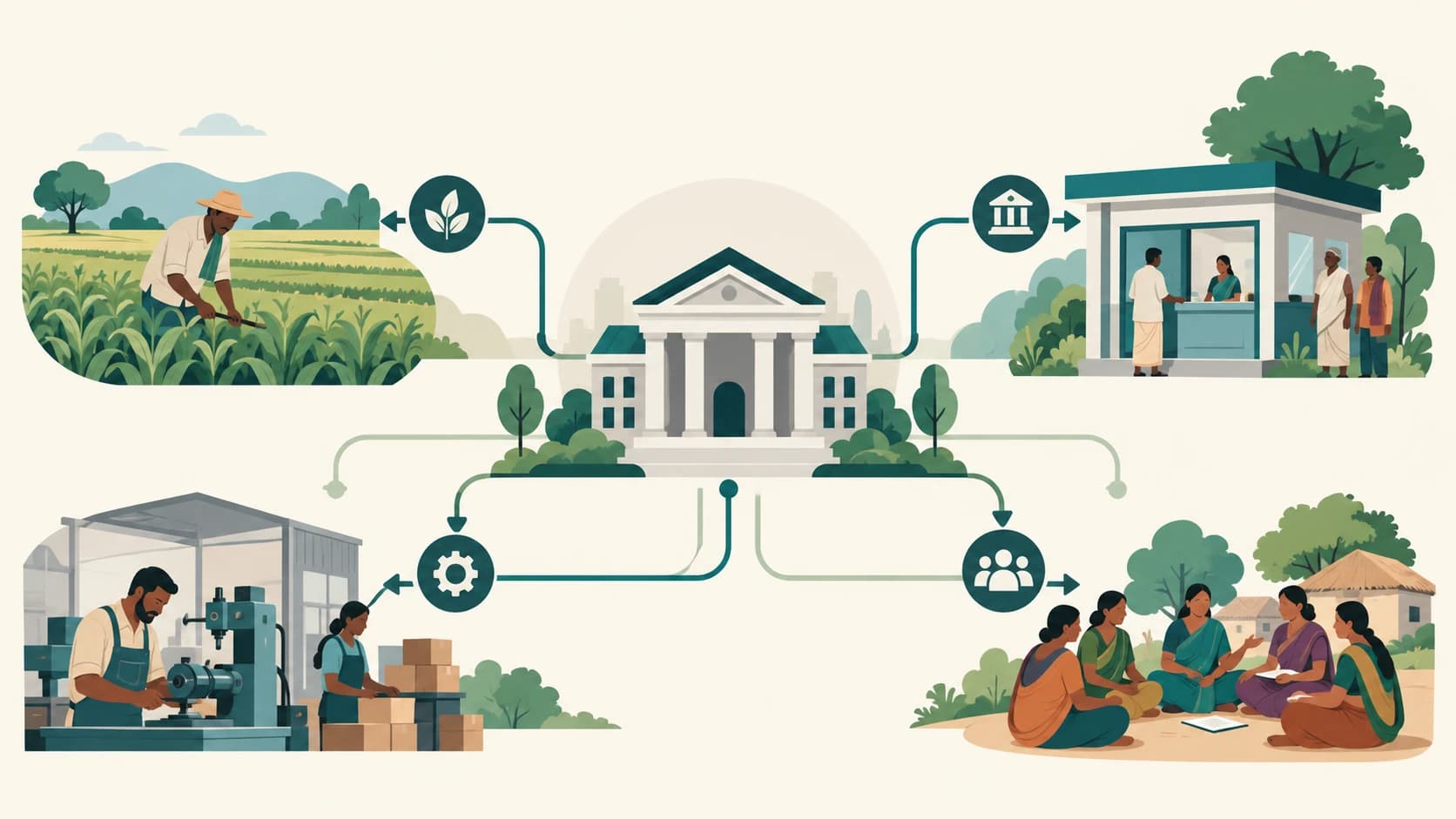
Indian banking is not designed only to lend where profits are easiest to earn. Public policy also directs formal credit toward sectors that are economically important but can remain underserved because borrowers are small, geographically dispersed, lack conventional collateral or have irregular income. This module explains how Priority Sector Lending, agricultural credit, rural institutions, MSME finance and group-based microfinance fit together.
Recommended foundation: Module 02 - Indian Banking System; Module 06 - Lending, Credit & Interest Rates.
Purpose of this module: Indian banking is not designed only to lend where profits are easiest to earn. Public policy also directs formal credit toward sectors that are economically important but can remain underserved because borrowers are small, geographically dispersed, lack conventional collateral or have irregular income. This module explains how Priority Sector Lending, agricultural credit, rural institutions, MSME finance and group-based microfinance fit together.
What you will learn
By the end of Module 08, you should be able to:
- explain why Priority Sector Lending exists;
- distinguish the overall PSL target from sectoral sub-targets;
- explain ANBC, CEOBSE, PSLC and priority-sector shortfall;
- identify the major RBI priority-sector categories;
- explain the difference between agriculture, non-corporate farmers and small/marginal farmers;
- distinguish farm credit, agriculture infrastructure and ancillary activities;
- explain the Kisan Credit Card model;
- distinguish crop loans from agricultural term loans;
- explain the role of NABARD in rural credit;
- explain why Regional Rural Banks were created;
- remember the RRB ownership ratio and sponsor-bank model;
- explain the present "One State-One RRB" consolidation model;
- distinguish RRBs from co-operative banks and PACS;
- explain the three-tier Short-Term Co-operative Credit Structure;
- explain why PACS are not the same as banks;
- understand RBI and NABARD roles in rural co-operative banking;
- apply the current MSME classification based on investment and turnover;
- explain Udyam registration and Udyam Assist;
- understand how banks finance MSME working capital and term requirements;
- explain collateral-free MSE lending and the role of CGTMSE;
- explain TReDS and receivables discounting;
- define a microfinance loan under the RBI framework;
- explain household-income and indebtedness safeguards in microfinance;
- distinguish SHGs, JLGs and individual microfinance borrowers;
- explain NABARD's SHG-Bank Linkage model; and
- recognise which numerical limits and policy rules must remain separately updateable.
Chapters
Priority Sector Lending: Targets and Categories
Priority Sector Lending: Targets and Categories. A detailed chapter in Priority Sector, Rural & MSME Banking, with explanations and examples for Indian banking examinations.
Agricultural and Rural Credit
Agricultural and Rural Credit. A detailed chapter in Priority Sector, Rural & MSME Banking, with explanations and examples for Indian banking examinations.
Regional Rural Banks
Regional Rural Banks. A detailed chapter in Priority Sector, Rural & MSME Banking, with explanations and examples for Indian banking examinations.
Co-operative Credit Structure and Co-operative Banks
Co-operative Credit Structure and Co-operative Banks. A detailed chapter in Priority Sector, Rural & MSME Banking, with explanations and examples for Indian banking examinations.
MSME Banking and Credit
MSME Banking and Credit. A detailed chapter in Priority Sector, Rural & MSME Banking, with explanations and examples for Indian banking examinations.
Microfinance, SHGs and Joint Liability Groups
Microfinance, SHGs and Joint Liability Groups. A detailed chapter in Priority Sector, Rural & MSME Banking, with explanations and examples for Indian banking examinations.