
Regional Rural Banks
Regional Rural Banks. A detailed chapter in Priority Sector, Rural & MSME Banking, with explanations and examples for Indian banking examinations.
By Akhilesh Saini · Reviewed 7 Oct 2026
1. Why were RRBs created?
India already had:
- commercial banks; and
- co-operative institutions.
Yet large rural areas remained underserved.
RRBs were designed as a hybrid institution combining:
- commercial-bank professionalism;
- local rural orientation;
- Government ownership/support.
2. Origins
RRBs began in 1975.
The statutory framework was later provided by the:
Regional Rural Banks Act, 1976
Their mandate focuses on the rural economy and credit access.
3. Primary objective
RRBs were created to provide banking and credit facilities particularly to:
- Small and Marginal Farmers;
- agricultural labourers;
- artisans;
- small entrepreneurs;
- rural borrowers;
- priority-sector segments.
They also mobilise rural deposits.
4. RRB ownership structure
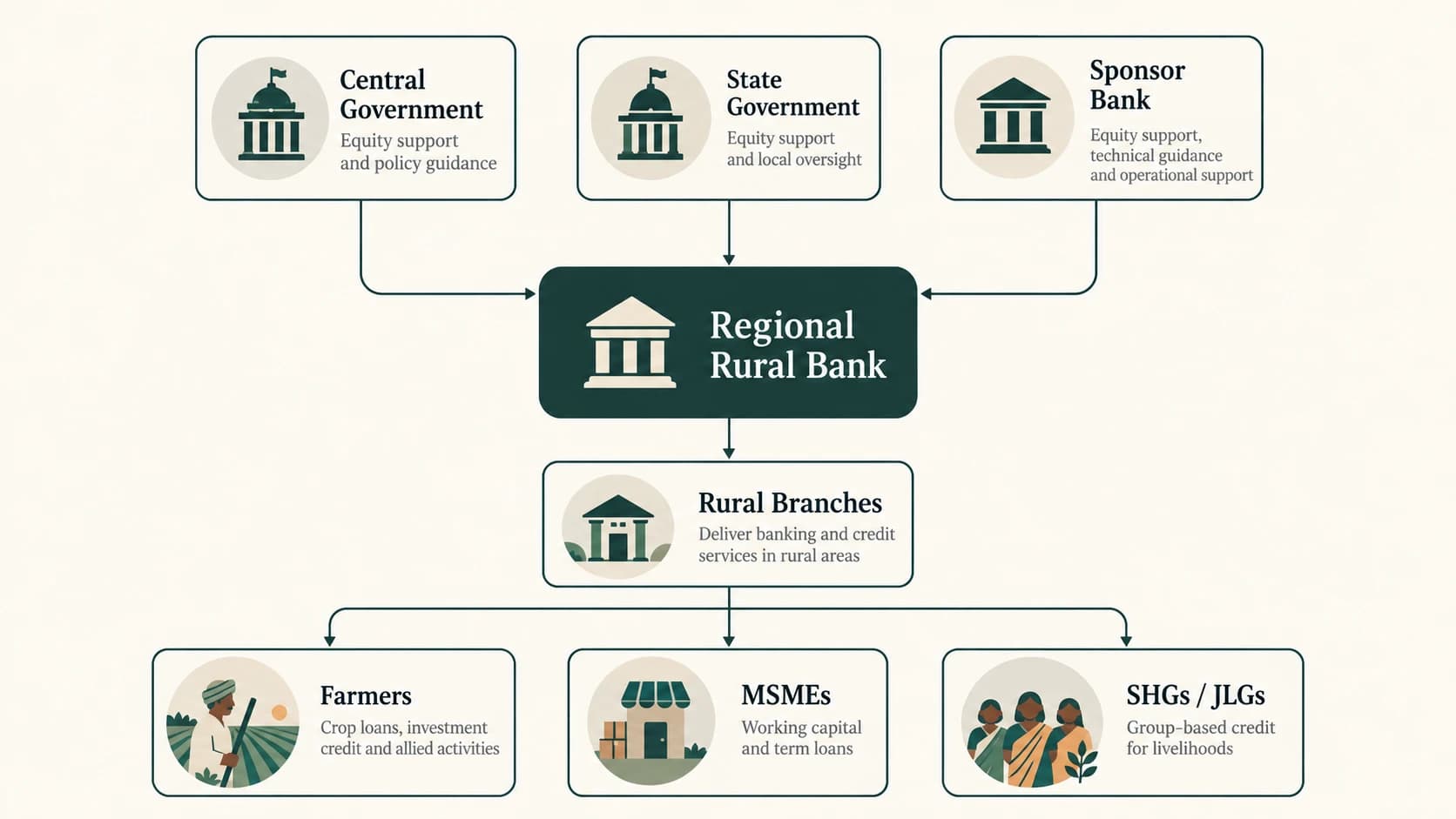
The classic ownership ratio is:
- Central Government - 50%
- State Government - 15%
- Sponsor Bank - 35%
Memory rule:
50 : 15 : 35
This is one of the most important RRB exam facts.
5. What is a Sponsor Bank?
Each RRB has a sponsor bank.
The sponsor bank supports areas such as:
- management;
- training;
- technology;
- systems;
- expertise;
- operational support.
RRBs are independent banking entities but receive institutional support from their sponsor banks.
6. RRB area orientation
RRBs were historically linked to specified districts/regions.
Their business model is heavily focused on:
- rural;
- semi-urban;
- agriculture;
- MSME;
- Government schemes;
- financial inclusion.
7. RRBs accept deposits
RRBs are banks.
They can provide normal banking services such as:
- savings/current deposits;
- term deposits;
- remittances;
- loans;
- digital banking.
They are not merely Government loan-disbursement offices.
8. RRBs and PSL
RRBs have a higher overall PSL requirement than ordinary domestic commercial banks.
This reflects their developmental mandate.
Their credit portfolio naturally concentrates in:
- agriculture;
- micro enterprises;
- weaker sections.
9. RRBs and agriculture
RRBs are important channels for:
- crop loans;
- KCC;
- allied activities;
- rural enterprises;
- SHG/JLG finance.
Their local presence can improve borrower knowledge and appraisal.
10. Regulation and supervision
RRBs operate under a multi-institution framework involving:
- Government of India;
- RBI;
- NABARD;
- sponsor banks;
- State Governments.
RBI handles banking regulation while NABARD has an important supervisory/development role in the rural financial-institution framework.
11. Why RRB amalgamation happened
A large number of small RRBs created issues such as:
- high overhead;
- fragmented technology;
- weak scale;
- uneven profitability;
- duplicated administration.
Government therefore pursued multiple phases of consolidation.
12. One State-One RRB
The recent consolidation strategy follows:
One State-One RRB
The objective is to create larger institutions with:
- stronger capital;
- better technology;
- lower operating cost;
- simplified management;
- wider reach.
13. Current RRB structure
The fourth phase of amalgamation became effective on 1 May 2025.
The number of RRBs fell from:
- 43 before the phase
to:
- 28 after consolidation.
The number of RRBs is a living fact and should remain updateable.
14. Branch network
Government sources report:
- more than 22,000 RRB branches;
- service across roughly 700 districts;
- very high rural/semi-urban concentration.
This scale makes RRBs a major rural-banking network.
15. RRB vs commercial bank
| Feature | RRB | Ordinary Commercial Bank |
|---|---|---|
| Primary orientation | Rural / priority sector | Broad universal banking |
| Ownership | Central + State + Sponsor Bank | Government/private/foreign depending on bank |
| Area focus | Historically regional/state-oriented | Wider network |
| PSL target | Higher overall target | Lower overall target for normal domestic banks |
| Sponsor bank | Yes | Not applicable |
16. RRB vs co-operative bank
RRB:
- statutory company/bank under RRB Act;
- ownership shared by Government and sponsor bank.
Co-operative bank:
- co-operative ownership structure;
- members are central to ownership/governance.
They are different institutional families.
17. RRB vs Small Finance Bank
Both focus strongly on underserved segments, but:
RRB:
- Government/sponsor-bank ownership model;
- rural development mandate.
SFB:
- licensed differentiated bank;
- privately/otherwise owned subject to licensing framework;
- operates under SFB-specific business model.
18. Technology transformation
RRBs increasingly use:
- Core Banking;
- mobile banking;
- digital payments;
- centralised technology.
Post-amalgamation, technology integration is a major operational focus.
19. Profitability vs developmental mandate
RRBs must balance:
- financial sustainability; and
- rural-development obligations.
A rural bank cannot survive indefinitely if:
- costs remain too high;
- asset quality is weak.
Developmental banking still requires commercial discipline.
20. Why RRBs remain exam-relevant
RRBs connect many Banking Awareness topics:
- PSL;
- NABARD;
- agriculture;
- KCC;
- rural financial inclusion;
- Government schemes;
- co-operative comparison;
- bank amalgamation.
Quick check - BA-08-03
- In which year were RRBs first established?
- Which Act provides the main statutory framework?
- What is the RRB ownership ratio?
- What is the role of the sponsor bank?
- What is "One State-One RRB"?
- Is an RRB a co-operative bank?
Quick answers
- Regional Rural Banks Act, 1976.
- 50:15:35 - Central Government:State Government:Sponsor Bank.
- Institutional/managerial/technical support.
- Consolidation toward one RRB for each covered State/UT.
- No.