
Agricultural and Rural Credit
Agricultural and Rural Credit. A detailed chapter in Priority Sector, Rural & MSME Banking, with explanations and examples for Indian banking examinations.
By Akhilesh Saini · Reviewed 7 Oct 2026
1. Why agricultural credit is different
Agricultural borrowers often face:
- seasonal income;
- monsoon/weather risk;
- price volatility;
- small landholdings;
- lack of formal title;
- irregular cash flow.
A salary loan can be structured around monthly income.
Agriculture may require:
- seasonal crop finance;
- harvest-linked repayment;
- working capital for allied activities;
- long-term asset finance.
2. Three broad agriculture PSL components
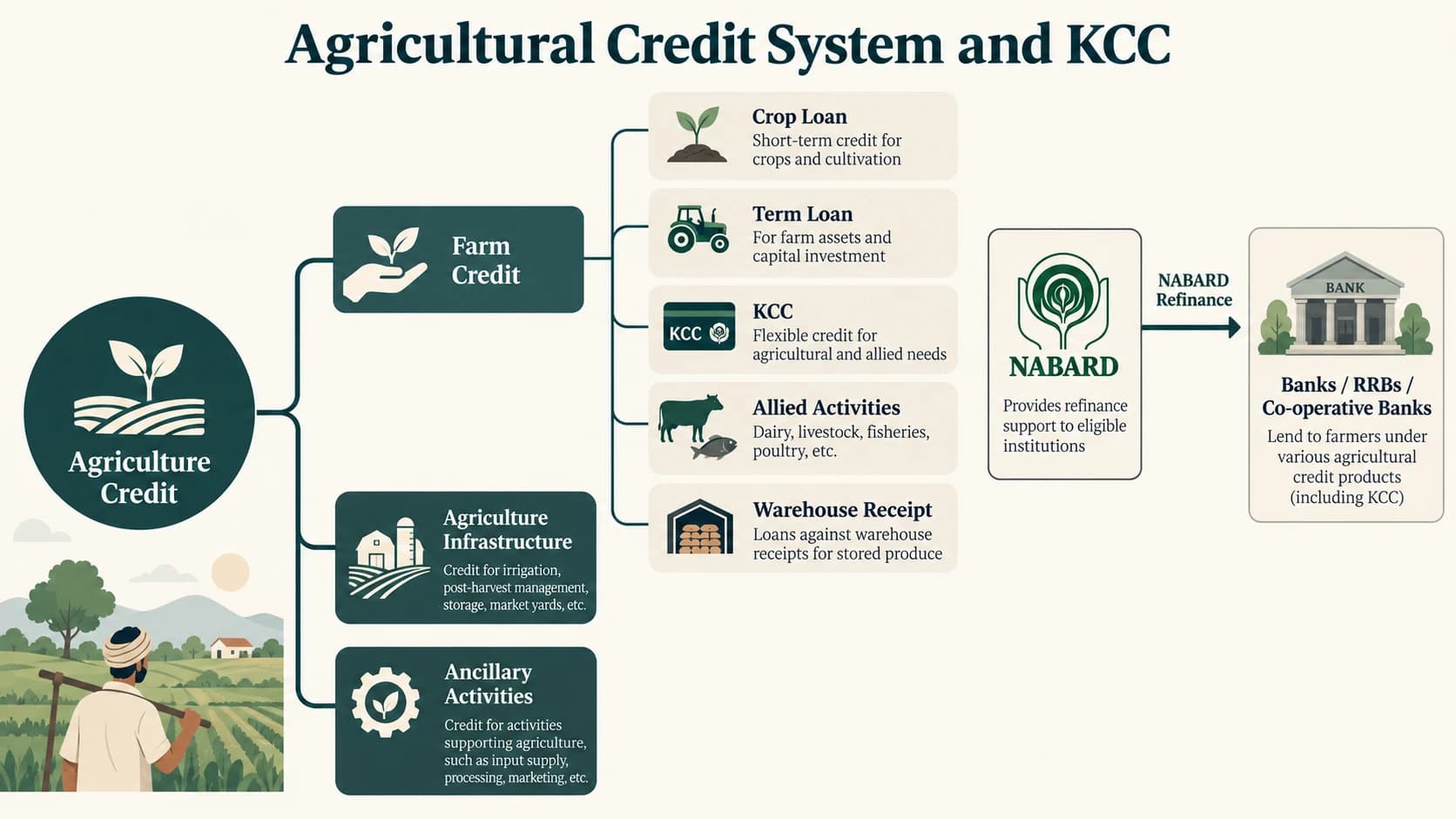
RBI's agriculture classification broadly covers:
- Farm Credit
- Agriculture Infrastructure
- Ancillary Activities
This is a useful exam framework.
3. Farm credit
Farm credit includes direct finance for agriculture and allied activities.
Examples:
- crop production;
- horticulture;
- dairy;
- fisheries;
- poultry;
- animal husbandry;
- beekeeping;
- sericulture;
- farm machinery;
- irrigation;
- pre-harvest and post-harvest activity.
4. Crop loan
A crop loan is usually a short-term loan to finance one or more crop cycles.
It can fund:
- seeds;
- fertilisers;
- pesticides;
- labour;
- cultivation operations.
Repayment aligns broadly with:
- harvest; and
- sale proceeds.
5. Agricultural term loan
A term loan finances longer-life assets.
Examples:
- tractor;
- irrigation equipment;
- dairy unit;
- pump set;
- farm mechanisation;
- orchard development.
Unlike a crop loan, it is repaid over multiple years/instalments.
6. Allied activities
Agriculture is wider than crop cultivation.
Allied activities include:
- dairy;
- fisheries;
- animal husbandry;
- poultry;
- beekeeping;
- sericulture;
- related activities recognised by RBI.
This is important because rural income is often diversified.
7. Pre- and post-harvest credit
Farm credit can support:
Pre-harvest
- spraying;
- cultivation;
- harvesting preparation.
Post-harvest
- sorting;
- grading;
- transport;
- temporary storage.
Credit therefore follows the full farm-value cycle.
8. Warehouse-receipt finance
Farmers may store produce instead of immediately selling after harvest.
A lender can finance against:
- Negotiable Warehouse Receipts;
- electronic NWRs;
- other eligible warehouse receipts.
This can help reduce distress sales.
The current limits differ by receipt type and borrower category and should remain updateable.
9. Agriculture infrastructure
Agriculture infrastructure can include:
- warehouses;
- cold storage;
- silos;
- grading facilities;
- supply-chain infrastructure;
- irrigation-related infrastructure;
- other eligible infrastructure listed by RBI.
These loans support the agricultural ecosystem rather than one crop cycle.
10. Ancillary activities
Ancillary activities support agriculture indirectly.
Examples may include:
- food and agro-processing;
- agri-startups;
- producer organisations;
- agriculture services.
RBI maintains an eligible framework and borrower limits.
11. Farmer Producer Organisations - FPOs
FPOs/FPCs aggregate farmers for:
- input purchase;
- production;
- processing;
- marketing;
- better bargaining.
Certain loans to FPOs/FPCs qualify under agriculture PSL subject to conditions.
The concept is important because small farms gain scale through collective organisation.
12. Kisan Credit Card - KCC
The KCC scheme was launched to give farmers a flexible credit mechanism.
Instead of repeatedly applying for a new crop loan, the farmer receives an assessed credit limit.
The KCC can cover:
- crop cultivation;
- post-harvest expenses;
- household consumption linked to farming needs;
- working capital for farm assets;
- allied activities;
- investment credit within the product framework.
13. Why KCC is useful
Traditional loan:
separate application every time.
KCC:
revolving/composite credit access within an assessed limit.
This improves:
- timeliness;
- convenience;
- repeat access.
14. KCC and allied sectors
KCC coverage was extended to working-capital needs of activities such as:
- animal husbandry;
- dairy;
- fisheries.
This reflects the broader definition of rural livelihoods.
15. KCC limit vs interest-subvention eligibility
Do not confuse:
- total KCC credit limit; and
- amount qualifying for a concessional interest-subvention scheme.
A Government may enhance the card limit while maintaining a different sub-limit for subsidy.
Exam questions can test this distinction.
16. Collateral-free agriculture credit
RBI/Government periodically revise the threshold below which eligible agricultural loans are extended without collateral.
The durable concept is:
smaller farm borrowers receive a simplified collateral framework to improve access.
17. Modified Interest Subvention Scheme - MISS
Interest subvention reduces the effective cost of eligible short-term agricultural credit.
The framework can contain:
- concessional lending rate;
- Government subvention to lender;
- prompt-repayment incentive to farmer.
Current limits/rates can change through Budget or scheme guidelines.
18. Small and Marginal Farmers
A large part of Indian agriculture consists of small holdings.
PSL therefore creates a dedicated SMF sub-target.
It covers qualifying:
- small/marginal landholders;
- tenant farmers;
- sharecroppers;
- oral lessees;
- landless labourers in specified conditions;
- groups of SMFs.
19. Tenant farmers and title problem
A tenant farmer may cultivate land without formal ownership.
Traditional collateral-based lending can exclude such borrowers.
Possible institutional solutions include:
- JLG finance;
- SHG structures;
- crop/production records;
- alternative appraisal.
20. NABARD
NABARD stands for:
National Bank for Agriculture and Rural Development
It is India's apex development financial institution for agriculture and rural development.
Major roles include:
- refinance;
- development support;
- supervision of specified rural co-operative institutions;
- rural infrastructure;
- financial inclusion;
- SHG/JLG promotion;
- institutional development.
21. NABARD refinance
A bank may lend to a farmer.
NABARD can refinance eligible portions of the bank's agricultural/rural lending.
Conceptually:
NABARD → bank / RRB / co-operative bank → ultimate rural borrower
Refinance expands the lender's resource capacity.
22. Refinance is not the farmer's direct loan
A common confusion:
"NABARD gives every crop loan directly to the farmer."
Usually, the retail loan is made by:
- commercial bank;
- RRB;
- co-operative bank;
- eligible institution.
NABARD operates significantly through refinance and development support.
23. Ground Level Credit - GLC
Government fixes annual Ground Level Credit targets for agriculture and allied activities.
These can be distributed by:
- region;
- lending agency;
- crop vs term lending.
GLC is a policy target for actual institutional credit flow.
24. RIDF and rural infrastructure
The Rural Infrastructure Development Fund, operated through NABARD, supports projects such as:
- roads;
- bridges;
- irrigation;
- rural infrastructure.
It is linked historically to the PSL-shortfall mechanism.
25. Natural calamity relief
Agricultural credit is exposed to:
- drought;
- flood;
- cyclone;
- crop failure.
RBI has a separate framework enabling banks to provide relief such as:
- restructuring/rescheduling;
- conversion of short-term crop loans;
- fresh finance.
This is different from casually waiving the loan.
26. Crop insurance vs crop credit
KCC/loan:
provides finance.
Crop insurance:
covers specified agricultural risks.
They are complementary but different products.
Quick check - BA-08-02
- Name the three broad agriculture PSL components.
- What is the main difference between a crop loan and agricultural term loan?
- What is the purpose of a Kisan Credit Card?
- Why are warehouse receipts useful in farm finance?
- What is NABARD's refinance role?
- Is crop insurance the same as crop credit?
Quick answers
- Farm Credit, Agriculture Infrastructure and Ancillary Activities.
- Crop loan is short-term production finance; term loan finances longer-life assets.
- Flexible/repeat access to assessed agricultural and allied credit.
- They can support finance against stored produce and reduce distress selling.
- It provides eligible funding support to lending institutions for rural/agricultural credit.
- No.