
Co-operative Credit Structure and Co-operative Banks
Co-operative Credit Structure and Co-operative Banks. A detailed chapter in Priority Sector, Rural & MSME Banking, with explanations and examples for Indian banking examinations.
By Akhilesh Saini · Reviewed 7 Oct 2026
1. What is a co-operative?
A co-operative is an organisation owned and controlled by its members for mutual benefit.
In a co-operative financial institution:
customers/members can also be owners.
This is fundamentally different from a normal shareholder-owned commercial bank.
2. Why co-operative credit developed
Rural borrowers historically faced:
- dependence on moneylenders;
- very small loan sizes;
- local information gaps;
- weak collateral.
Co-operative credit tried to use:
- local membership;
- mutual knowledge;
- community-based ownership.
3. Two broad co-operative banking segments
Indian co-operative finance can be understood as:
Urban co-operative banks
Serve mainly urban/semi-urban members.
Rural co-operative credit institutions
Serve agriculture/rural credit.
This module focuses mainly on the rural credit structure.
4. Short-Term Co-operative Credit Structure - STCCS
The classic STCCS has three tiers:
State Co-operative Bank - StCB
↓
District Central Co-operative Bank - DCCB
↓
Primary Agricultural Credit Society - PACS
Memory:
State → District → Village
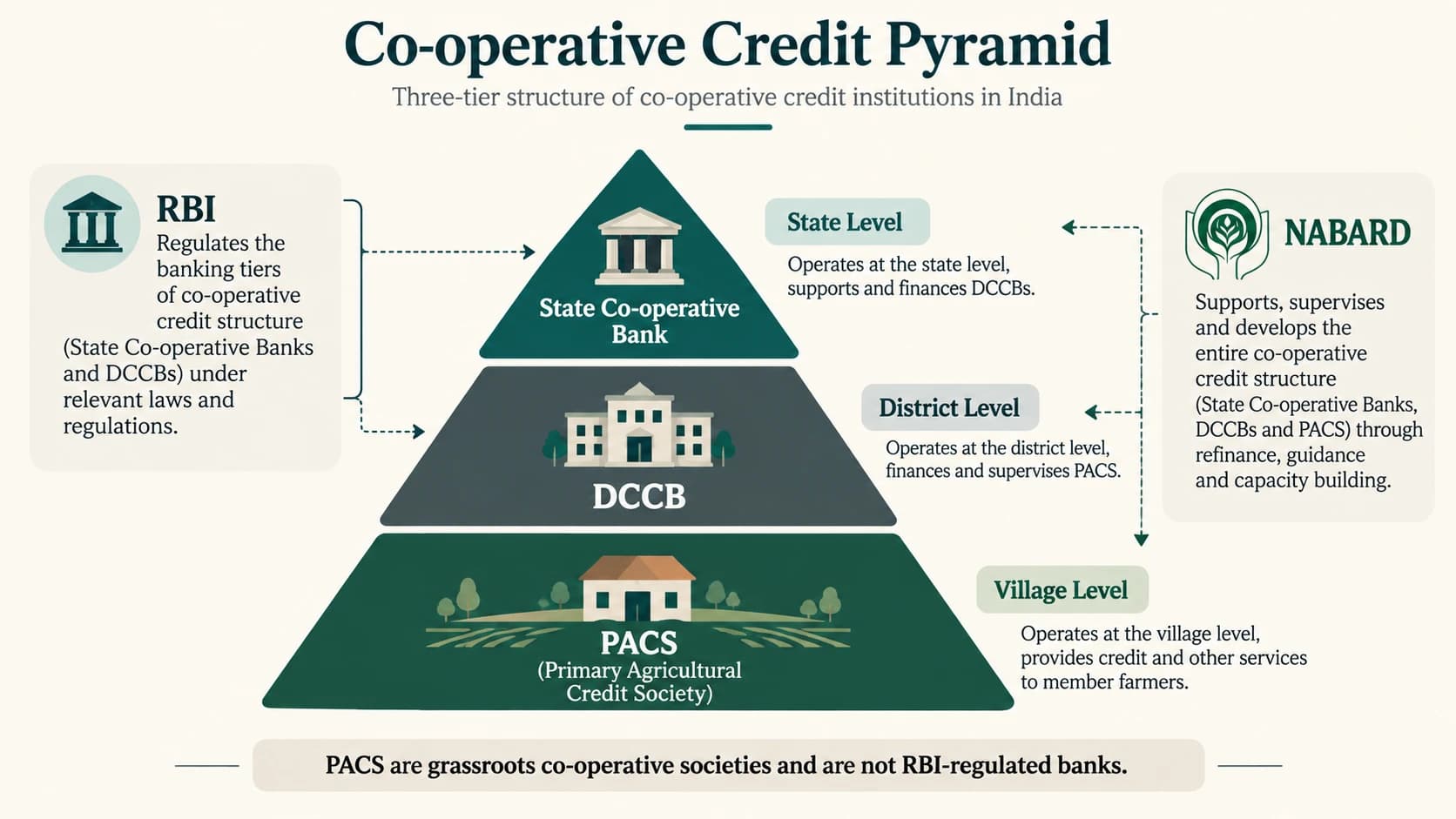
5. State Co-operative Bank
StCB operates at the state/apex level.
Functions can include:
- apex financing;
- banking services;
- support to DCCBs;
- channel for NABARD refinance;
- state-wide co-operative credit coordination.
6. District Central Co-operative Bank
DCCB operates at the district/intermediate level.
It links:
- StCB/NABARD funding; and
- PACS/local borrowers.
DCCBs can also provide direct banking services.
7. Primary Agricultural Credit Society - PACS
PACS operates at the village/local level.
It is the closest rural co-operative credit institution to farmers.
PACS activities can include:
- crop credit;
- input distribution;
- rural services;
- procurement;
- storage;
- other multipurpose activities.
8. PACS is not the same as a bank
This is a major exam fact.
PACS are co-operative credit societies.
They are not banks under the Banking Regulation Act in the same way as StCBs/DCCBs/UCBs.
Therefore they are not directly regulated by RBI as banks.
9. Who regulates PACS?
PACS are primarily governed through:
- State co-operative laws;
- Registrar of Co-operative Societies;
- applicable Government/co-operative framework.
NABARD supports their development and institutional strengthening.
10. RBI and NABARD roles
For rural co-operative banks:
RBI
Regulates banking aspects of:
- State Co-operative Banks;
- District Central Co-operative Banks.
NABARD
Carries out important supervisory functions for StCBs/DCCBs and supports development/refinance.
This creates a specialised rural-institution architecture.
11. Long-Term Co-operative Credit Structure
Long-term rural credit historically includes:
- State Co-operative Agriculture and Rural Development Banks - SCARDBs;
- Primary Co-operative Agriculture and Rural Development Banks - PCARDBs.
The structure is not identical in every state.
Long-term institutions traditionally finance:
- land development;
- irrigation;
- farm investment;
- long-life rural assets.
12. Short-term vs long-term structure
STCCS
Mainly:
- crop loans;
- seasonal agricultural operations;
- working capital.
Long-term co-operative structure
Mainly:
- investment credit;
- land improvement;
- durable rural assets.
13. Co-operative bank vs PACS
| Feature | StCB / DCCB | PACS |
|---|---|---|
| Bank under banking law | Yes, subject to applicable framework | No |
| RBI regulation | Yes | No direct RBI banking regulation |
| NABARD role | Supervision/development/refinance | Development/support |
| Level | State / District | Village/local |
| Deposit services | Banking services | Society-based services subject to law |
14. Urban Co-operative Banks - UCBs
UCBs form a separate co-operative banking segment.
They are:
- member-owned;
- banking entities;
- regulated by RBI under applicable law.
They are not part of the rural three-tier STCCS.
15. Co-operative principle
A key co-operative principle is member orientation.
This can create strengths:
- local knowledge;
- community trust;
- small-borrower access.
But it can also create governance risks if:
- local influence dominates credit decisions;
- professional management is weak;
- political interference rises.
16. Dual-control issue
Co-operative banks historically faced a form of dual/multiple control because:
- co-operative society aspects came under State/Government law;
- banking functions came under RBI/banking law.
Legal reforms have strengthened RBI's role in banking regulation of co-operative banks.
17. Why NABARD matters
NABARD helps rural co-operative institutions through:
- refinance;
- supervision;
- technology;
- capacity building;
- institutional development.
It is not simply a lender of last resort.
18. PACS computerisation
Government and NABARD have been implementing a large PACS computerisation programme.
The objective includes:
- common software;
- better accounting;
- transparency;
- wider services;
- integration with higher tiers.
This is a living modernisation initiative.
19. PACS as Multi-Service Centres
PACS are increasingly encouraged to diversify beyond crop credit into:
- storage;
- input services;
- processing;
- rural business;
- community services.
This can strengthen their financial sustainability.
20. Strength of the co-operative model
Local knowledge can reduce information asymmetry.
A village society may understand:
- farmer's land;
- cropping pattern;
- repayment culture;
- local conditions
better than a distant urban office.
21. Weaknesses
Common structural challenges can include:
- governance;
- political interference;
- weak capital;
- poor recovery;
- technology gaps;
- uneven professionalism.
Reform focuses on strengthening these weaknesses while preserving local reach.
Quick check - BA-08-04
- Name the three tiers of STCCS.
- Which institution operates at village level?
- Is PACS regulated by RBI as a bank?
- Who regulates banking functions of StCBs/DCCBs?
- What is the broad role of NABARD?
- Are UCBs part of the rural three-tier STCCS?
Quick answers
- StCB, DCCB, PACS.
- PACS.
- No.
- RBI.
- Supervision, refinance, development and institutional support.
- No.