
MSME Banking and Credit
MSME Banking and Credit. A detailed chapter in Priority Sector, Rural & MSME Banking, with explanations and examples for Indian banking examinations.
By Akhilesh Saini · Reviewed 7 Oct 2026
1. Why MSMEs matter to banks
MSMEs contribute to:
- employment;
- manufacturing;
- services;
- exports;
- local enterprise;
- supply chains.
But they can face credit barriers because:
- formal financial statements may be limited;
- collateral may be weak;
- receivables can be delayed;
- business cash flow is volatile.
2. What is an MSME?
MSME means:
Micro, Small and Medium Enterprise
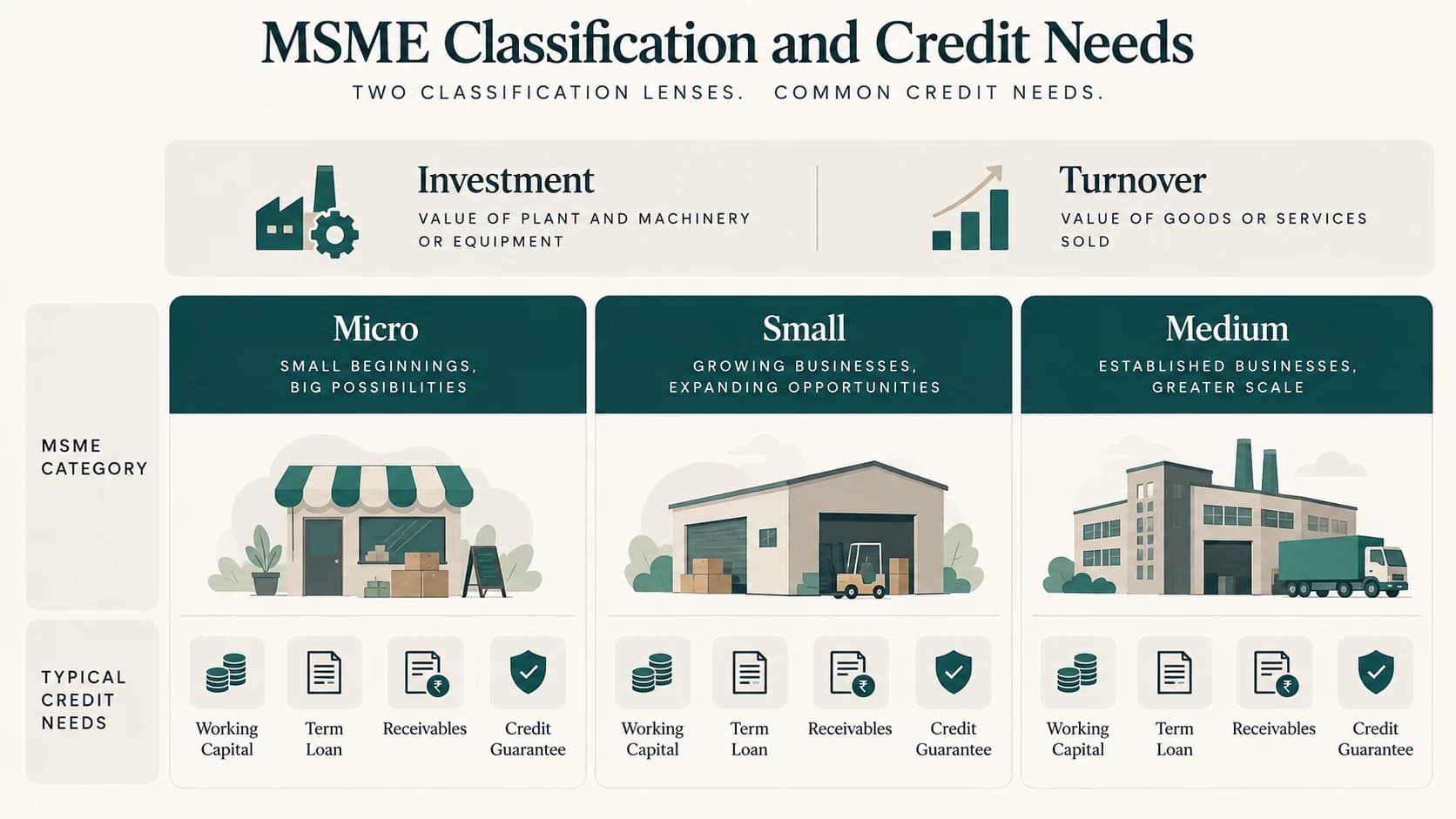
India classifies MSMEs using a composite criterion involving:
- investment in plant/machinery/equipment; and
- annual turnover.
The current numerical thresholds are stored in the module's current-data box.
3. Manufacturing and services use the same classification framework
Older MSME rules separated:
- manufacturing; and
- services.
The current framework uses a unified classification.
This makes the system simpler.
4. Why both investment and turnover?
Investment shows:
- productive asset scale.
Turnover shows:
- business scale/activity.
Using both creates a broader measure than relying only on machinery value.
5. Udyam Registration
Udyam is the official MSME registration system.
Eligible enterprises register digitally and receive:
- Udyam Registration Number;
- certificate.
For PSL purposes, banks use the classification reflected in the Udyam framework.
6. Udyam Assist Platform
Very small informal micro enterprises may not initially be in the formal Udyam system.
The Udyam Assist mechanism brings eligible informal micro enterprises into the formal ecosystem.
RBI recognises eligible Udyam Assist Certificates for PSL classification as micro enterprises.
7. MSME and priority sector
Under the current RBI PSL framework:
qualifying bank loans to MSMEs are eligible for classification under the MSME priority-sector category.
A separate micro-enterprise sub-target ensures the smallest units receive credit.
8. Working capital for MSMEs
MSMEs need working capital for:
- inventory;
- receivables;
- wages;
- utilities;
- operations.
Common facilities:
- cash credit;
- overdraft;
- working-capital demand loan;
- bill discounting;
- receivables finance.
9. Term finance for MSMEs
Term loans finance:
- machinery;
- equipment;
- factory expansion;
- technology;
- vehicles;
- long-life business assets.
An MSME can therefore have both:
- working-capital finance; and
- term finance.
10. Composite loan
RBI's MSME-lending framework permits banks to offer a composite loan within the prescribed limit.
A composite facility combines:
- working capital; and
- term loan
under one sanction arrangement.
This helps smaller businesses avoid multiple processes.
11. Collateral-free MSE loans
RBI's framework mandates collateral-free lending for eligible Micro and Small Enterprise loans up to the prescribed regulatory threshold.
Banks may also extend collateral-free treatment above that threshold under specified policy conditions.
The exact limit is update-sensitive.
12. Why collateral-free lending matters
A viable entrepreneur may have:
- business skill;
- orders;
- cash flow
but no property to mortgage.
Collateral requirements can exclude exactly the businesses that need formal finance most.
13. Credit Guarantee Fund Trust for Micro and Small Enterprises - CGTMSE
CGTMSE is a joint initiative associated with:
- Government of India; and
- SIDBI.
It provides guarantee cover to eligible lenders for qualifying MSE credit.
14. Guarantee is not a grant
CGTMSE does not mean:
borrower does not repay.
The borrower remains responsible for repayment.
The guarantee protects the lending institution against a specified portion of loss under scheme conditions.
15. Current guarantee ceiling
The current bank-scheme guarantee ceiling was enhanced from:
- ₹5 crore
to:
- ₹10 crore
for qualifying guarantees approved from 1 April 2025.
This is living scheme data.
16. Project viability
The basic idea behind credit guarantees is:
lend based on viable business cash flow rather than insisting that every entrepreneur own collateral.
This supports first-generation entrepreneurs.
17. TReDS
TReDS stands for:
Trade Receivables Discounting System
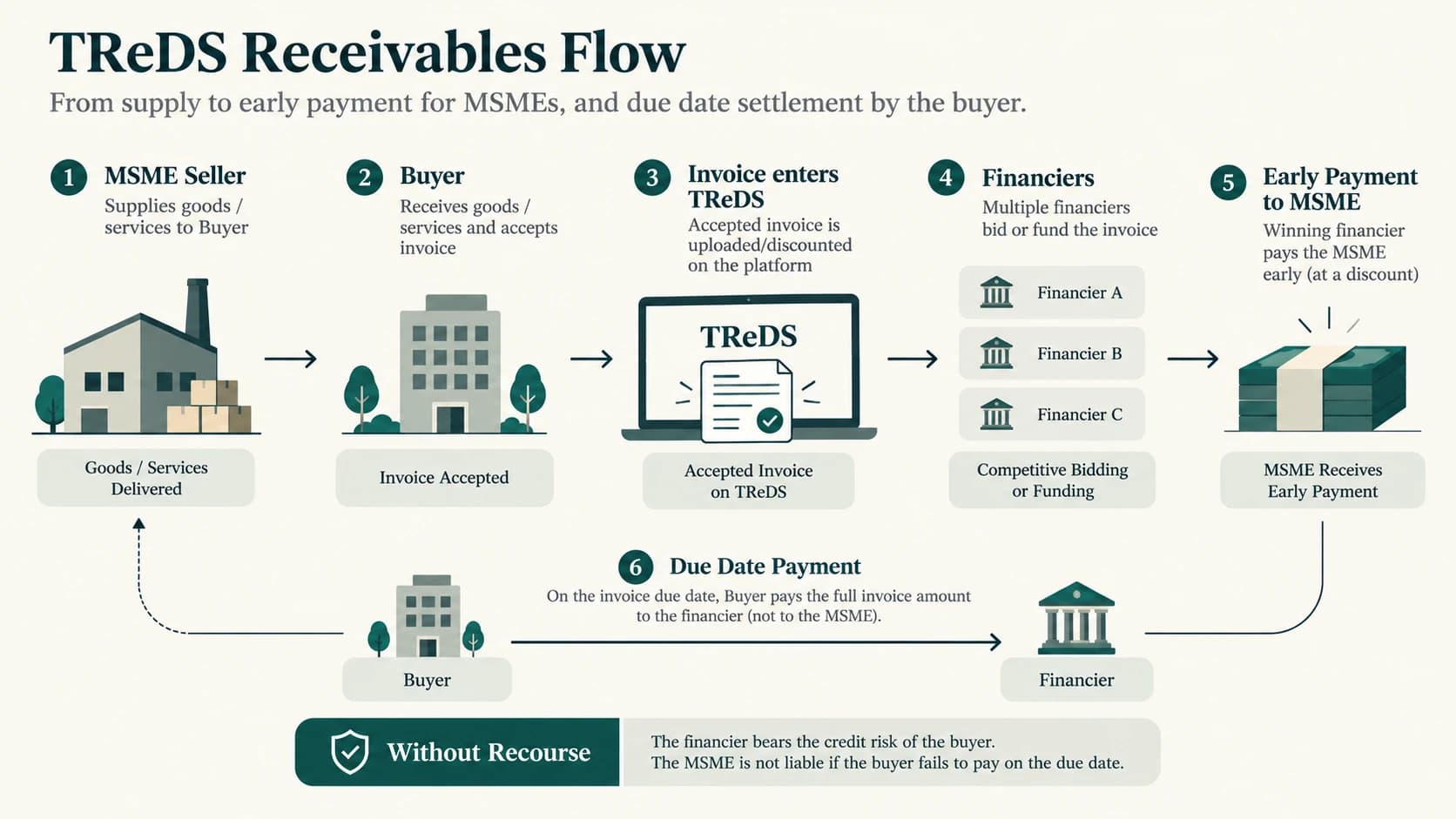
It is an electronic platform for financing MSME trade receivables through multiple financiers.
18. Why TReDS is needed
Suppose an MSME sells goods worth ₹20 lakh to a large company.
Buyer pays after 60 days.
The MSME still needs cash today for:
- wages;
- raw material;
- next order.
TReDS allows the receivable/invoice to be financed before the buyer's due date.
19. TReDS participants
Main participants:
- MSME seller;
- buyer;
- financier.
Financiers can include permitted:
- banks;
- NBFC-Factors;
- other authorised institutions.
20. Factoring and reverse factoring
Factoring
MSME seller initiates financing of the receivable.
Reverse factoring
Buyer initiates/anchors the financing arrangement.
TReDS supports both structures.
21. Without recourse to MSME
RBI's TReDS framework is designed so eligible transactions are without recourse to the MSME seller.
If the buyer fails to pay, the financier does not simply push the payment risk back to the MSME seller under the normal TReDS transaction framework.
22. Delayed payments problem
A profitable MSME can still fail because customers pay late.
This is a working-capital problem, not necessarily a profitability problem.
Receivables financing is therefore central to MSME banking.
23. MSME loan pricing
Floating-rate MSME loans are covered by the relevant RBI benchmark rules explained in Module 06.
Loan pricing still depends on:
- benchmark;
- spread;
- risk;
- business profile;
- security/guarantee.
PSL status does not create one standard MSME rate.
24. Credit assessment
Banks evaluate MSMEs through:
- financial statements;
- GST data;
- bank transactions;
- cash flow;
- Udyam data;
- bureau information;
- digital footprints;
- collateral/guarantee;
- industry risk.
Digital credit assessment is becoming more important.
25. Turnover method for working capital
Banks can use turnover-based methods for qualifying smaller working-capital borrowers under regulatory guidelines.
The concept:
estimated annual sales → estimate working-capital need → borrower contributes margin → bank funds balance.
Exact thresholds belong in current instructions.
26. Delayed payment and MSMED Act
The MSMED Act includes a mechanism relating to delayed payment to Micro and Small Enterprises.
For exam purposes, remember:
- payment discipline is a policy concern;
- delayed receivables can weaken liquidity;
- TReDS and statutory mechanisms are complementary tools.
27. MSME restructuring
A viable MSME in temporary stress may be eligible for:
- restructuring;
- resolution;
- relief measures
under prevailing RBI rules.
This should not be confused with:
- automatic waiver;
- evergreen renewal.
Detailed stress treatment belongs in Module 07.
28. MSME vs Startup
A startup and MSME are not identical categories.
A business can be:
- MSME but not startup;
- startup and MSME;
- startup but outside MSME classification.
The legal definitions come from different policy frameworks.
29. MSME vs microfinance
MSME refers to an enterprise classification.
Microfinance refers primarily to small collateral-free household credit under the RBI microfinance framework.
The word "micro" appears in both, but the systems are different.
Quick check - BA-08-05
- What two criteria determine MSME classification?
- What is Udyam?
- Do all MSME loans automatically have the same interest rate?
- What does CGTMSE provide?
- What is the purpose of TReDS?
- Is an MSME automatically a startup?
Quick answers
- Investment and annual turnover.
- Official MSME registration/classification system.
- No.
- Credit guarantee support for qualifying MSE lending.
- Electronic financing/discounting of MSME receivables.
- No.