
Microfinance, SHGs and Joint Liability Groups
Microfinance, SHGs and Joint Liability Groups. A detailed chapter in Priority Sector, Rural & MSME Banking, with explanations and examples for Indian banking examinations.
By Akhilesh Saini · Reviewed 7 Oct 2026
1. What is microfinance?
Microfinance provides small-scale financial services to lower-income households that may not have conventional access to formal credit.
It can support:
- livelihoods;
- consumption smoothing;
- emergency needs;
- microenterprise;
- household investment.
But modern microfinance regulation focuses strongly on preventing:
- over-indebtedness;
- coercive recovery;
- opaque pricing.
2. RBI definition of a microfinance loan
Under the current RBI framework, a microfinance loan is broadly:
a collateral-free loan to an eligible low-income household within the prescribed household-income threshold.
The loan's end-use does not by itself determine whether it is microfinance.
3. Household approach
RBI assesses eligibility and indebtedness at the household level.
The household unit broadly includes:
- husband;
- wife;
- unmarried children,
under the current framework.
This prevents multiple family members from borrowing independently without considering total household debt.
4. Income threshold
The RBI framework uses an annual household-income limit.
The current threshold belongs in the module's current-data box.
The durable principle is:
microfinance regulation targets low-income households rather than defining microfinance merely by small loan size.
5. Collateral-free requirement
If a loan is backed by security such as:
- gold;
- equipment;
- hypothecated asset,
it does not fit the regulatory definition of a collateral-free microfinance loan.
6. Repayment-obligation cap
RBI requires regulated entities to control the total monthly debt burden of the household.
The current ceiling is expressed as a percentage of monthly household income.
Importantly, the calculation considers:
- microfinance loans; and
- other household loans.
This reduces multiple-lending risk.
7. Why household indebtedness matters
Suppose a household earns ₹30,000 per month.
It has:
- Loan A EMI ₹6,000;
- Loan B EMI ₹5,000;
- proposed Loan C EMI ₹7,000.
Total after new loan:
₹18,000.
Even if Loan C looks small in isolation, total household debt burden may be too high.
8. Pricing of microfinance
RBI requires regulated entities to maintain:
- Board-approved pricing policy;
- transparent interest/charges;
- disclosure;
- fair conduct.
The modern framework does not rely only on one simple universal rate cap.
9. Key Facts / fact sheet
Borrowers must receive clear information about:
- interest;
- fees;
- repayment;
- grievance redressal;
- charges.
Transparency matters because borrowers can be financially vulnerable.
10. Recovery conduct
Microfinance recovery must not involve:
- intimidation;
- harassment;
- abusive behaviour;
- coercive methods.
Responsible recovery is part of borrower protection.
11. Who can provide regulated microfinance?
RBI's framework covers regulated entities such as:
- commercial banks;
- RRBs;
- co-operative banks specified in the framework;
- NBFCs;
- NBFC-MFIs;
- other regulated lenders within scope.
12. MFI vs microfinance loan
MFI means an institution specialising in microfinance.
But a microfinance loan can also be provided by:
- a bank;
- RRB;
- SFB;
- other regulated lender.
Therefore:
microfinance is a type of credit; MFI is a type of institution/business model.
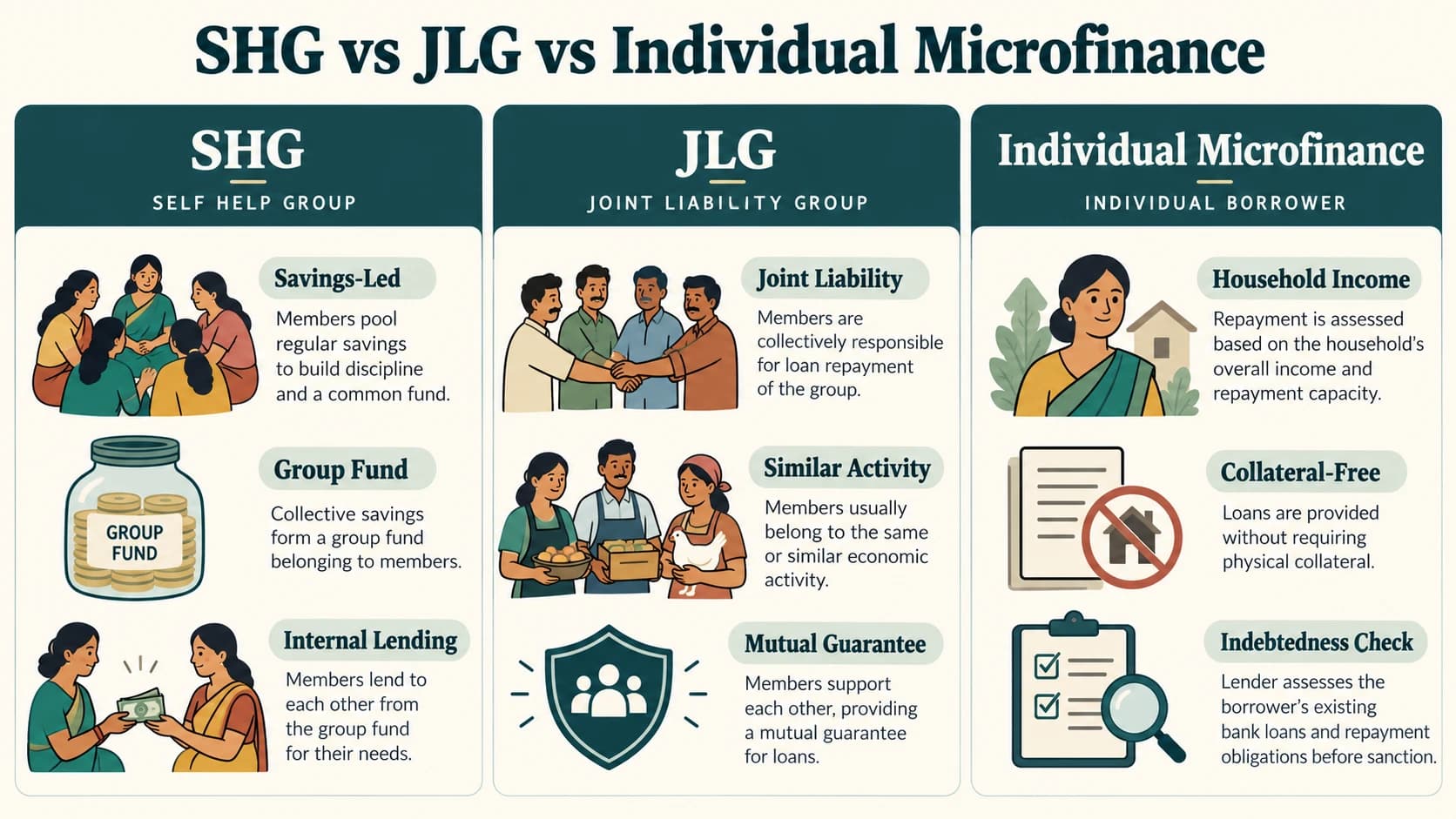
13. Self Help Group - SHG
An SHG is a small voluntary group whose members:
- save regularly;
- meet regularly;
- build a common fund;
- lend internally;
- develop collective credit discipline.
SHGs are strongly associated with women's financial inclusion in India.
14. SHG-Bank Linkage Programme - SHG-BLP
NABARD launched the SHG-Bank Linkage Programme on a pilot basis in 1992.
The model links informal groups to formal banks.
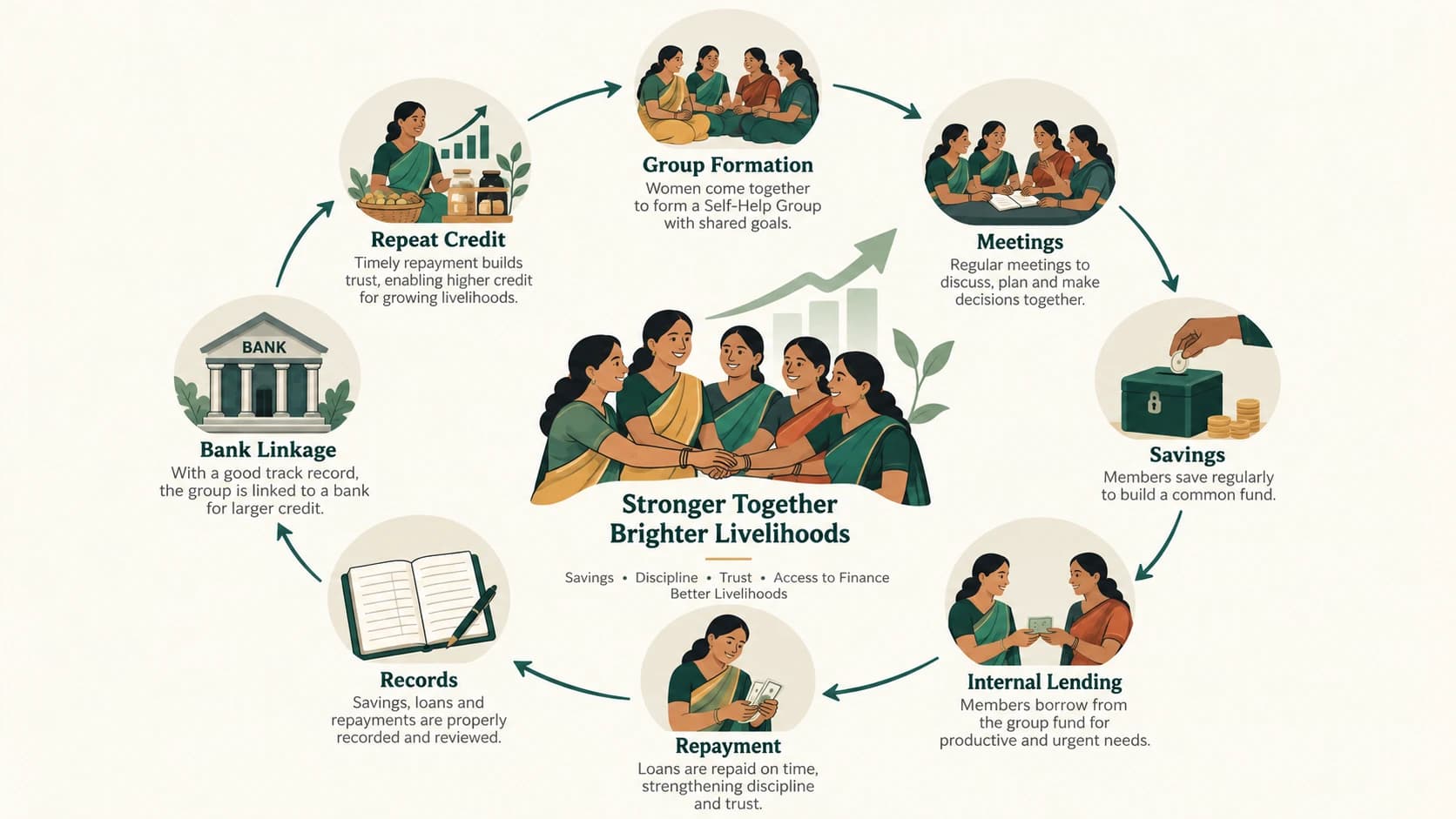
Typical progression:
Group formation
↓
Regular savings
↓
Internal lending
↓
Credit discipline
↓
Bank savings account
↓
Bank loan / repeat linkage
15. Savings-led model
SHG-BLP is not simply:
"bank gives loan to a group of poor people."
The classic model emphasises:
- savings first;
- group discipline;
- peer knowledge;
- internal lending;
- later bank linkage.
This creates an information and trust record.
16. NABARD Panchsutras
Good-quality SHGs are often associated with five basic practices:
- regular meetings;
- regular savings;
- internal lending;
- timely repayment;
- proper books of accounts.
These are commonly known as the Panchsutras.
17. How bank lends to SHG
The bank can provide a bulk loan to the SHG.
The SHG then allocates funds among members according to:
- group decisions;
- member needs;
- internal rules.
The bank does not necessarily make a separate retail loan to every member.
18. Why SHG lending can work without conventional collateral
The model uses:
- peer knowledge;
- social capital;
- savings behaviour;
- group discipline;
- repeat relationships
instead of relying only on property collateral.
19. SHGs and priority sector
Qualifying SHG loans can count under:
- agriculture;
- microenterprise;
- weaker sections;
- other PSL categories,
depending on purpose and borrower characteristics.
20. Joint Liability Group - JLG
A JLG is an informal group of borrowers who are engaged in similar economic activities and agree to take joint responsibility for repayment.
NABARD's classic JLG model commonly uses:
- small groups;
- often 4 to 10 members;
- mutual guarantee;
- individual or group loans.
21. Who uses JLGs?
JLGs are particularly useful for:
- tenant farmers;
- oral lessees;
- sharecroppers;
- small/marginal farmers;
- asset-poor rural borrowers.
These borrowers may lack:
- clear land title;
- conventional collateral.
22. JLG savings requirement
Unlike SHG, regular group savings is not the central mandatory feature of the traditional JLG model.
The main purpose is:
credit access through joint liability.
23. SHG vs JLG
| Feature | SHG | JLG |
|---|---|---|
| Core foundation | Savings + group development | Credit + joint liability |
| Regular savings | Central feature | May be voluntary/not essential |
| Internal lending | Common | Not the primary structure |
| Typical use | Broad livelihood/social finance | Credit for similar economic activity |
| Security logic | Group discipline/social collateral | Mutual guarantee/joint liability |
| Strong rural use | Yes | Yes |
24. JLG vs individual loan
Individual loan:
- borrower alone is contractually responsible.
JLG finance:
- group members jointly undertake repayment responsibility according to product structure.
This can substitute partly for conventional collateral.
25. SHG vs MFI group lending
SHG-BLP:
- savings-led;
- group may borrow directly from a bank;
- strongly associated with NABARD/NRLM ecosystem.
MFI group lending:
- lender/MFI originates microfinance to borrowers/groups;
- follows RBI's regulated microfinance framework where applicable.
They can serve similar households but the institutional model differs.
26. DAY-NRLM
Deendayal Antyodaya Yojana - National Rural Livelihoods Mission supports large numbers of women's SHGs and rural livelihood institutions.
Banks provide:
- savings linkage;
- credit linkage;
- repeat finance
within the scheme framework.
Detailed Government-scheme features belong in Module 09.
27. SHG credit grows with track record
A well-performing group can obtain larger repeat finance as:
- savings history improves;
- internal discipline develops;
- repayment track record strengthens.
This is relationship-based lending.
28. Microfinance and credit bureaus
Regulated lenders use Credit Information Companies to assess:
- existing loans;
- household indebtedness;
- repayment behaviour.
This helps prevent over-lending.
29. Financial inclusion vs over-indebtedness
More credit is not always better.
Responsible microfinance must balance:
- access;
- affordability;
- repayment capacity;
- borrower dignity;
- sustainable lending.
30. Current scale of SHG-BLP
NABARD's latest published microfinance reports show that SHG-BLP is one of the world's largest group-based financial-inclusion programmes.
Quick check - BA-08-06
- What is the core RBI feature of a microfinance loan?
- Why is repayment assessed at household level?
- What is the core difference between SHG and JLG?
- In which year did NABARD launch SHG-BLP?
- What are the Panchsutras?
- Does a microfinance loan have to be provided by an MFI?
Quick answers
- Collateral-free loan to an eligible low-income household under the regulatory framework.
- To capture total indebtedness and prevent over-borrowing.
- SHG is savings-led; JLG is primarily credit/joint-liability-led.
- Regular meetings, savings, internal lending, timely repayment and proper books.
- No.