Financial Inclusion, Business Correspondents, JAM and DBT
Financial Inclusion, Business Correspondents, JAM and DBT. A detailed chapter in Financial Inclusion & Government Financial Schemes, with explanations and examples for Indian banking examinations.
By Akhilesh Saini · Reviewed 7 Oct 2026
1. What is financial inclusion?
Financial inclusion means ensuring that individuals and businesses can access and use appropriate formal financial services at an affordable cost.
These services include:
- savings;
- deposits;
- payments;
- remittances;
- credit;
- insurance;
- pension;
- financial advice.
A useful definition is:
Financial inclusion is meaningful access plus actual, responsible use of formal finance.
2. Account opening is only the first step
Suppose a person has a bank account but:
- the branch is 40 km away;
- the account is never used;
- the person cannot understand the product;
- transaction costs are high;
- credit is unavailable.
That person is only partially included.
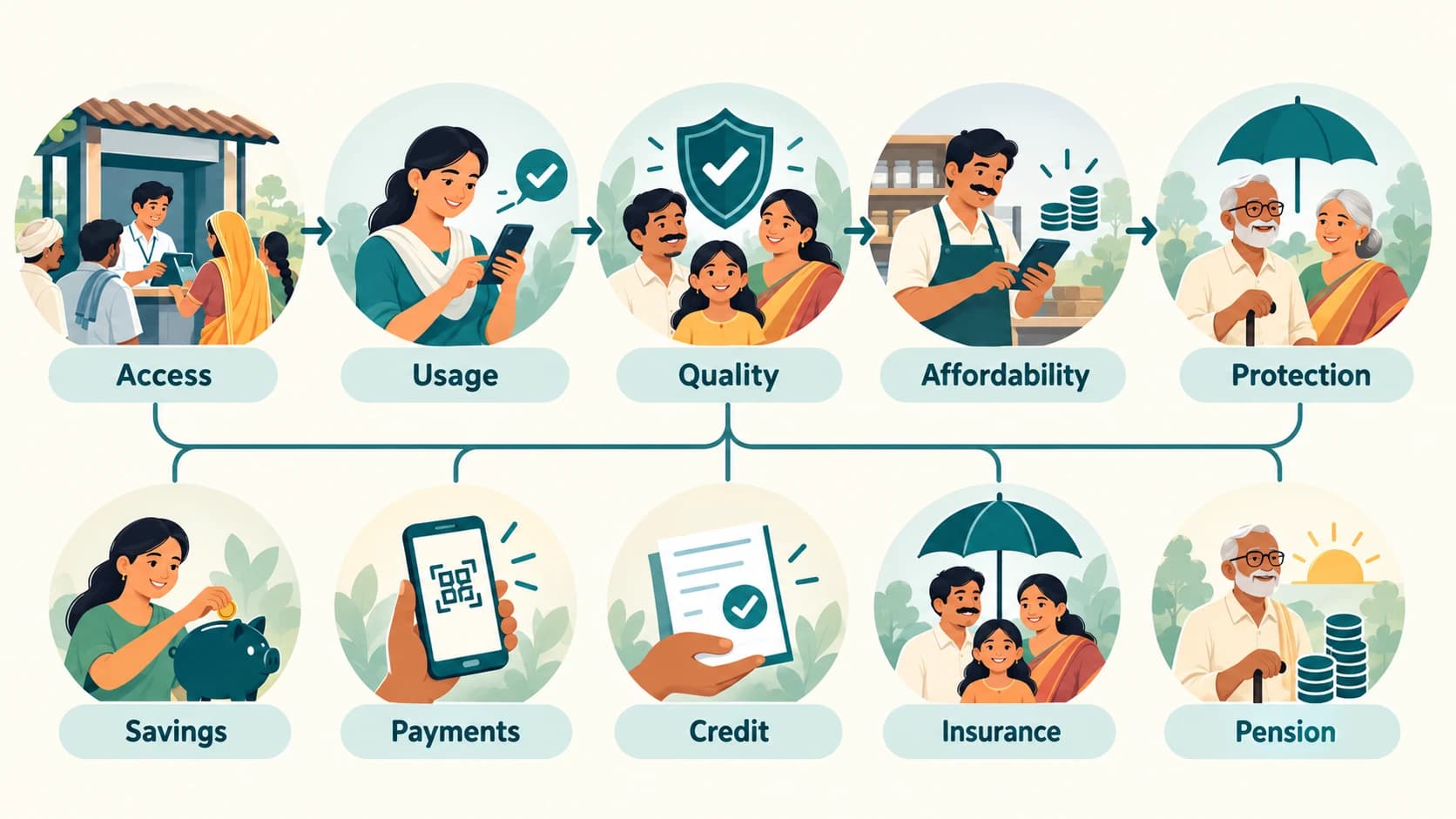
True inclusion requires:
- Access
- Usage
- Quality
- Affordability
- Safety / consumer protection
3. Financial exclusion
Financial exclusion occurs when people depend primarily on:
- cash;
- informal moneylenders;
- unregulated savings arrangements;
- costly remittance channels.
Reasons include:
- poverty;
- geographic isolation;
- lack of documents;
- low financial literacy;
- irregular income;
- small transaction size;
- disability/digital barriers.
4. Why banks may underserve low-income areas
A small transaction can cost almost as much operationally as a large transaction.
For a traditional branch:
- building;
- staff;
- cash;
- security;
- technology
create fixed costs.
If each customer maintains a very small balance, a branch-only model may be expensive.
Financial inclusion therefore requires lower-cost delivery channels.
5. Business Correspondent - BC
A Business Correspondent is an agent/intermediary engaged by a bank to provide specified banking services on the bank's behalf.
Common name:
Bank Mitra
The BC model expands banking without requiring a full branch at every location.
6. BC is not a separate bank
A BC represents the bank.
The customer's account remains with the bank.
The BC does not become:
- deposit owner;
- independent deposit-taking bank;
- insurer simply because insurance enrolment is facilitated.
The bank remains responsible for the relationship within the regulatory framework.
7. Services through BCs
BC outlets can facilitate services such as:
- account opening support;
- cash deposits;
- cash withdrawals;
- remittances;
- balance enquiry;
- Aadhaar-enabled transactions;
- loan application support;
- recovery/follow-up within permitted rules;
- Government-benefit access;
- insurance/pension enrolment support.
Exact services depend on bank authorisation and technology.
8. Why BCs are important
BCs reduce:
- travel time;
- branch congestion;
- transaction cost.
They increase:
- last-mile banking;
- rural reach;
- financial inclusion;
- availability of cash-in/cash-out points.
9. Technology in BC banking
A modern BC outlet can use:
- micro-ATM;
- biometric authentication;
- Aadhaar Enabled Payment System;
- RuPay card;
- mobile connectivity;
- Core Banking connectivity.
This allows a village outlet to perform transactions linked to the bank's central system.
10. Banking Outlet
RBI's banking-outlet framework recognises certain fixed points manned by:
- bank staff; or
- Business Correspondents
as banking outlets when prescribed service conditions are met.
This reflects a regulatory shift from:
only physical branch = banking presence
to:
branch + technology-enabled BC outlet = banking network.
11. BC vs Business Facilitator
The two concepts are related but not identical.
Business Facilitator
Typically helps with:
- awareness;
- application collection;
- borrower identification;
- counselling;
- follow-up.
It does not generally handle cash transactions as a BC does.
Business Correspondent
Can perform permitted banking transactions on behalf of the bank.
12. Financial literacy
Access to finance can become dangerous without understanding.
Financial literacy teaches:
- saving;
- budgeting;
- interest;
- borrowing;
- insurance;
- fraud prevention;
- grievance redressal.
A financially included borrower should understand:
credit must be repaid.
13. Financial Literacy Centres
Banks support financial-literacy efforts through structured programmes and Financial Literacy Centres under the wider inclusion/Lead Bank framework.
The objective is not to sell one product.
It is to improve informed financial decision-making.
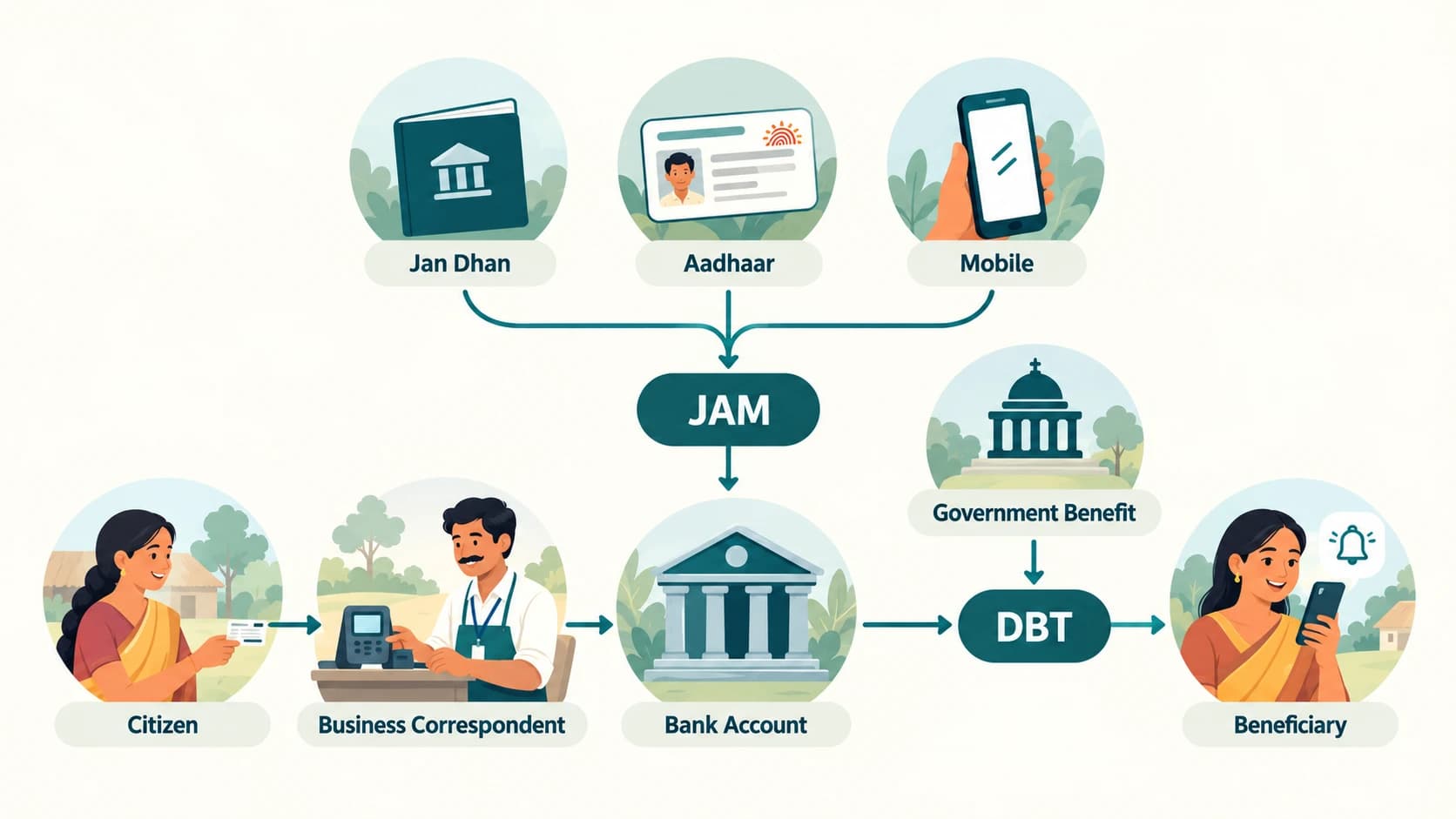
14. JAM
JAM stands for:
- Jan Dhan
- Aadhaar
- Mobile
JAM is an architecture rather than one single scheme.
It combines:
- bank account;
- digital identity;
- mobile communication.
15. Why JAM matters
Consider a Government benefit.
Without JAM:
- beneficiary list may contain duplicates;
- payment may pass through multiple intermediaries;
- beneficiary may travel to collect cash.
With an appropriate digital architecture:
- beneficiary identity can be validated;
- payment can be sent electronically;
- transaction information can reach the beneficiary.
16. Direct Benefit Transfer - DBT
DBT is the mechanism through which Government benefits are transferred directly to eligible beneficiaries.
Benefits can include:
- cash transfer;
- subsidy;
- pension;
- scholarship;
- wage/assistance payment.
The exact channel varies by scheme.
17. DBT does not mean every Government scheme uses the same technology
Some transfers may use:
- account number + IFSC;
- Aadhaar-based routing;
- other approved Government payment architecture.
Do not assume:
every DBT requires identical routing.
18. Aadhaar seeding
Aadhaar seeding means linking Aadhaar details with the beneficiary's bank account record after required consent/process.
For Aadhaar-based DBT routing, the bank can map the Aadhaar-linked account through NPCI's mapper.
19. NPCI mapper
A person can hold multiple bank accounts.
For Aadhaar-based payment routing, the mapped DBT-enabled account is used according to the current NPCI/Aadhaar-bank seeding arrangement.
This is different from saying:
Aadhaar itself is the bank account.
It is only an identifier/routing component.
20. Aadhaar Payments Bridge
The Aadhaar Payments Bridge helps route eligible Aadhaar-based Government payments into bank accounts.
Conceptual flow:
Government department
↓
Payment system / NPCI routing
↓
Aadhaar mapped to bank
↓
Beneficiary account credited
21. Aadhaar Enabled Payment System - AePS
AePS allows customers to perform permitted bank transactions using Aadhaar-based authentication at participating BC/micro-ATM points.
Common transaction types include:
- cash withdrawal;
- balance enquiry;
- mini statement;
- certain transfers/services.
AePS is a transaction channel.
APB is a payment-routing mechanism.
They should not be confused.
22. DBT and leakages
DBT aims to reduce:
- duplicate/fake beneficiaries;
- intermediary delays;
- cash-handling leakages.
But system design must also handle:
- authentication failure;
- bank-account errors;
- connectivity;
- beneficiary grievance.
23. Exception handling
Financial inclusion must not become exclusion through technology.
Government/Aadhaar rules include alternative/exception processes where authentication or Aadhaar-related issues arise, subject to scheme requirements.
The broader principle is:
technology should improve access, not become an unreasonable barrier.
24. Mobile in JAM
Mobile numbers can support:
- SMS alerts;
- OTP;
- account information;
- fraud warning;
- transaction confirmation.
Mobile connectivity makes digital finance more usable.
25. Financial inclusion and digital payments
Digital payment systems reduce the need for physical cash.
But inclusion requires:
- safe authentication;
- accessible devices;
- affordable connectivity;
- grievance support.
Digital access without digital literacy can create fraud risk.
26. Inclusion and credit
An active formal bank account can create a transaction history.
Over time, this can help lenders understand:
- cash flow;
- repayment capacity;
- regularity of income.
This may support more formal credit.
27. Inclusion and social security
Once a person has a functional account, banks can distribute:
- insurance;
- pension;
- credit;
- Government benefits.
This is why PMJDY is often described as a platform for wider financial services.
28. Dormant account is not full inclusion
A large account-opening number alone can exaggerate success.
More meaningful indicators include:
- transaction activity;
- deposits;
- credit use;
- insurance coverage;
- pension participation;
- digital payments.
Quick check - BA-09-01
- Is financial inclusion the same as opening an account?
- What does BC stand for?
- Is a BC an independent bank?
- What does JAM stand for?
- What is DBT?
- What is the difference between APB and AePS?
Quick answers
- No.
- Business Correspondent.
- No.
- Jan Dhan-Aadhaar-Mobile.
- Direct transfer of eligible Government benefits to beneficiaries.
- APB routes Aadhaar-based payments; AePS is a customer transaction/authentication channel.