
Financial Inclusion & Government Financial Schemes
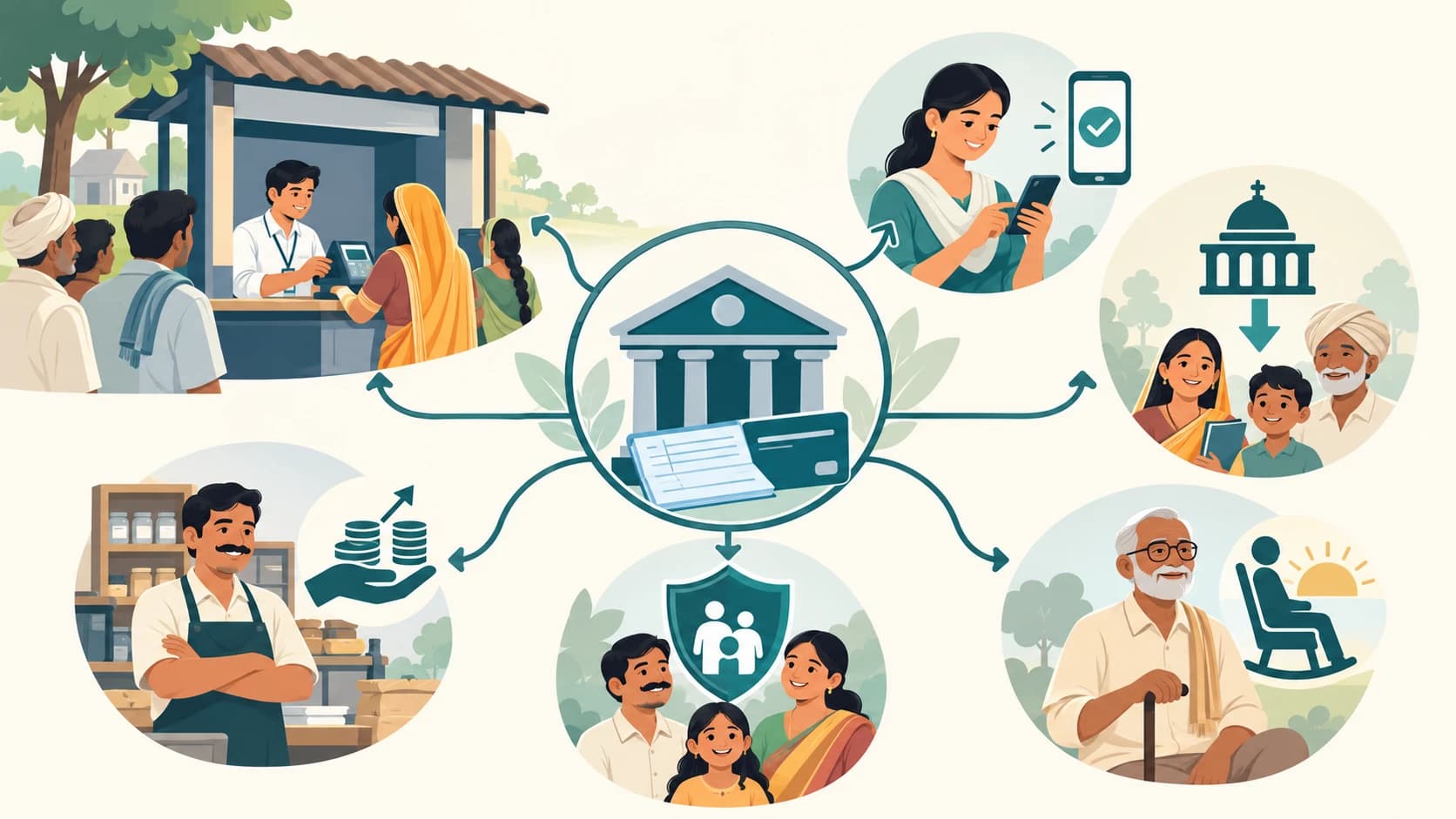
Financial inclusion is the point where banking infrastructure, technology, social-security products and Government schemes meet the ordinary citizen. A bank account alone is not complete inclusion. A financially included person should be able to access and use safe savings, payments, credit, insurance and pension services at reasonable cost. This module explains the institutional architecture—Business Correspondents, JAM and DBT—and then studies the major account, credit, insurance, pension and livelihood schemes that repeatedly appear in banking examinations.
Recommended foundation: Module 08 - Priority Sector, Rural & MSME Banking.
Purpose of this module: Financial inclusion is the point where banking infrastructure, technology, social-security products and Government schemes meet the ordinary citizen. A bank account alone is not complete inclusion. A financially included person should be able to access and use safe savings, payments, credit, insurance and pension services at reasonable cost. This module explains the institutional architecture—Business Correspondents, JAM and DBT—and then studies the major account, credit, insurance, pension and livelihood schemes that repeatedly appear in banking examinations.
What you will learn
By the end of Module 09, you should be able to:
- define financial inclusion beyond mere account opening;
- distinguish access, usage, quality and affordability in financial inclusion;
- explain the Business Correspondent model and Bank Mitras;
- distinguish a Business Correspondent from a bank branch;
- explain the role of financial literacy in inclusion;
- explain JAM - Jan Dhan, Aadhaar and Mobile;
- explain how DBT moves Government benefits into beneficiary accounts;
- distinguish Aadhaar seeding, NPCI mapping and bank-account ownership;
- explain the architecture and benefits of PMJDY;
- explain why PMJDY is more than a zero-balance account;
- explain RuPay, overdraft, DBT and social-security linkages under PMJDY;
- explain PMMY and the role of MUDRA;
- distinguish Shishu, Kishore, Tarun and Tarun Plus;
- explain why MUDRA loans are not subsidies;
- explain the original Stand-Up India framework and its current status;
- distinguish PMMY from Stand-Up India;
- explain PMJJBY as life insurance;
- explain PMSBY as accident insurance;
- explain APY as a guaranteed-pension scheme;
- distinguish insurance premium from pension contribution;
- explain JanSamarth as a unified digital credit-linked Government scheme portal;
- explain PM SVANidhi, PMEGP and PM Vishwakarma;
- distinguish credit, subsidy, guarantee and insurance support;
- recognise historical/closed schemes versus currently active schemes; and
- identify which numerical scheme details must remain independently updateable.
Chapters
Financial Inclusion, Business Correspondents, JAM and DBT
Financial Inclusion, Business Correspondents, JAM and DBT. A detailed chapter in Financial Inclusion & Government Financial Schemes, with explanations and examples for Indian banking examinations.
Pradhan Mantri Jan-Dhan Yojana
Pradhan Mantri Jan-Dhan Yojana. A detailed chapter in Financial Inclusion & Government Financial Schemes, with explanations and examples for Indian banking examinations.
MUDRA, PMMY and Stand-Up India
MUDRA, PMMY and Stand-Up India. A detailed chapter in Financial Inclusion & Government Financial Schemes, with explanations and examples for Indian banking examinations.
PMJJBY, PMSBY and Atal Pension Yojana
PMJJBY, PMSBY and Atal Pension Yojana. A detailed chapter in Financial Inclusion & Government Financial Schemes, with explanations and examples for Indian banking examinations.
Major Government Credit and Financial-Sector Schemes for Bank Exams
Major Government Credit and Financial-Sector Schemes for Bank Exams. A detailed chapter in Financial Inclusion & Government Financial Schemes, with explanations and examples for Indian banking examinations.