
Pradhan Mantri Jan-Dhan Yojana
Pradhan Mantri Jan-Dhan Yojana. A detailed chapter in Financial Inclusion & Government Financial Schemes, with explanations and examples for Indian banking examinations.
By Akhilesh Saini · Reviewed 7 Oct 2026
1. What is PMJDY?
PMJDY stands for:
Pradhan Mantri Jan-Dhan Yojana
It was launched on 28 August 2014 as a National Mission for Financial Inclusion.
Its purpose is to expand access to:
- basic bank account;
- remittance;
- credit;
- insurance;
- pension.
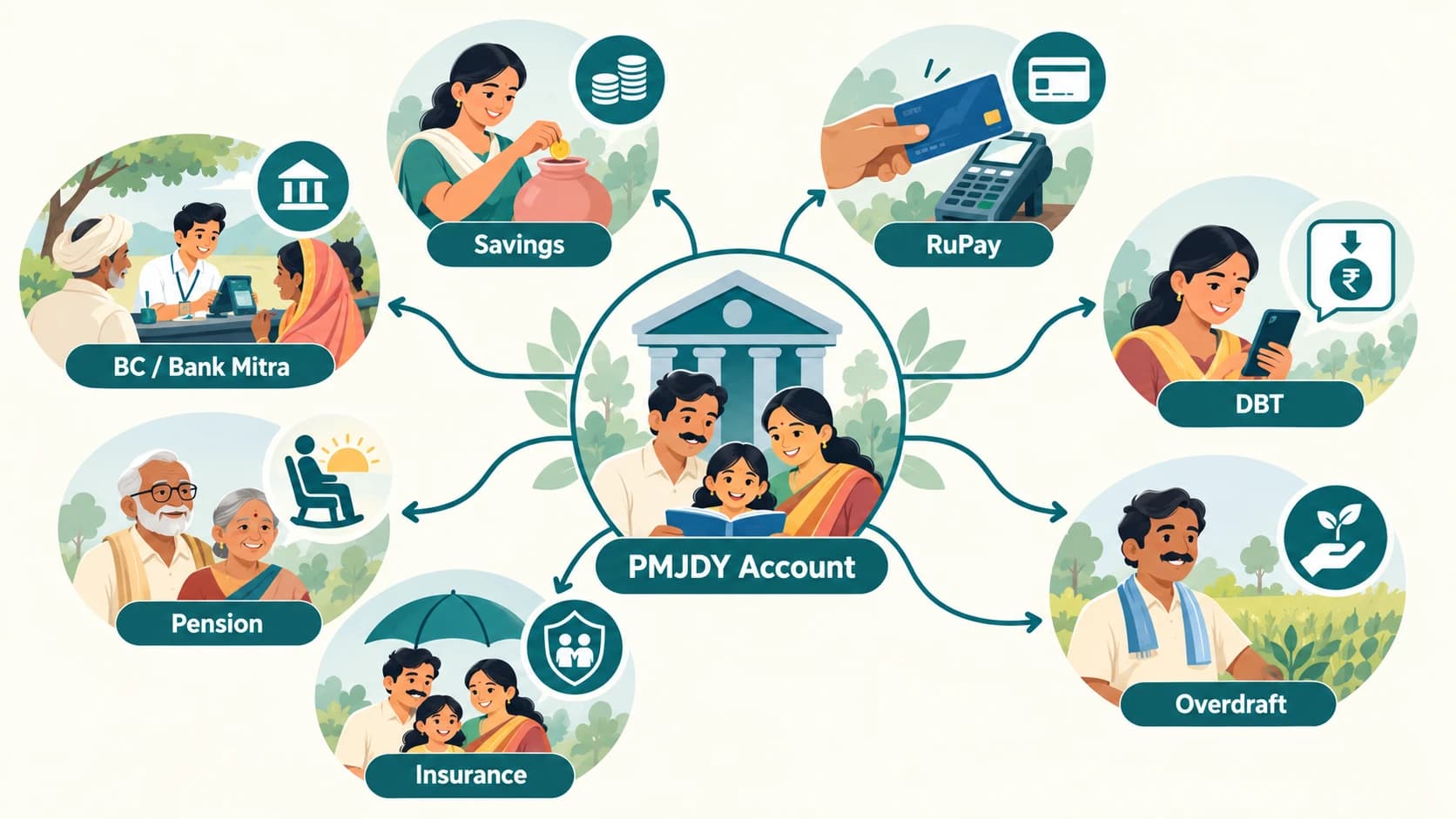
2. PMJDY is an ecosystem, not just an account
The account is the entry point.
The wider ecosystem connects the customer to:
- RuPay debit card;
- DBT;
- overdraft;
- insurance;
- pension;
- digital payments.
Therefore:
PMJDY should be remembered as a financial-inclusion platform.
3. Basic Savings Bank Deposit account
A PMJDY account is essentially a basic savings bank account for an unbanked person within the scheme framework.
Key principles include:
- no minimum balance requirement;
- deposit earns interest;
- access to basic banking services.
Detailed BSBDA rules were introduced in Module 05.
4. Zero balance does not mean "no money needed forever"
"Zero balance" means:
no compulsory minimum balance is required.
It does not mean:
- the account always has zero funds;
- withdrawals can exceed the balance;
- overdraft is automatic.
5. RuPay debit card
Eligible PMJDY account holders receive a RuPay debit card.
RuPay supports:
- ATM withdrawals;
- merchant payments;
- digital transactions.
The card also connects with the scheme's accident-insurance feature under applicable conditions.
6. Accident insurance
The current PMJDY scheme page provides accident insurance linked to the RuPay card.
The present cover amount and eligibility conditions are update-sensitive.
Important distinction:
RuPay accident cover is not the same as PMSBY.
They are separate insurance arrangements.
7. Overdraft facility
Eligible PMJDY account holders can access an overdraft facility subject to:
- satisfactory operation;
- bank eligibility;
- scheme conditions.
This converts the PMJDY relationship from:
only savings
to:
possible formal small-value credit.
8. Overdraft is a loan
A PMJDY overdraft:
- must be repaid;
- can carry interest;
- requires eligibility.
It is not free Government money.
9. PMJDY and DBT
Government benefits can be transferred to eligible PMJDY accounts.
This makes PMJDY a major account layer for:
- subsidy;
- pension;
- welfare;
- Government assistance.
10. PMJDY and JAM
Jan Dhan provides the bank-account component of JAM.
Aadhaar can support identity/routing where applicable.
Mobile provides communication/digital access.
Thus:
PMJDY is the "J" in JAM.
11. PMJDY and Business Correspondents
PMJDY accounts can be opened/serviced through:
- bank branch; or
- Business Correspondent / Bank Mitra outlet,
subject to the bank's process.
This is crucial for villages without nearby branches.
12. Insurance/pension linkage
PMJDY customers can access schemes such as:
- PMJJBY;
- PMSBY;
- APY,
subject to scheme eligibility.
The bank account becomes the:
- premium-debit account;
- benefit/claim-payment account;
- contribution account.
13. Why PMJDY changed inclusion strategy
Older inclusion often focused on:
- branch expansion.
PMJDY combined:
- mass account opening;
- BC network;
- Aadhaar;
- mobile;
- RuPay;
- DBT;
- social security.
That integration made it operationally different from a standalone basic-account programme.
14. Account ownership matters
A PMJDY account belongs to the customer.
Government does not "own" the account merely because welfare payments enter it.
It is a bank deposit account.
15. PMJDY account vs ordinary savings account
Both are savings accounts, but PMJDY is specifically designed for financial inclusion and linked benefits.
| Feature | PMJDY basic account | Ordinary savings account |
|---|---|---|
| Minimum balance | No minimum balance requirement under scheme | Product dependent |
| Inclusion focus | Yes | General |
| RuPay linkage | Scheme feature | Bank/product dependent |
| DBT suitability | Strong focus | Can also receive DBT |
| Eligible overdraft | Scheme-specific | Product/credit dependent |
16. PMJDY is not mandatory for every DBT beneficiary
A person can receive eligible Government payments into another suitably enabled bank account under the applicable scheme/payment framework.
PMJDY is a major inclusion route, not the only bank account in India.
17. Women and PMJDY
A significant share of PMJDY beneficiaries are women.
This can improve:
- control over household finances;
- direct receipt of benefits;
- access to formal savings.
Current beneficiary numbers belong in the snapshot, not the evergreen concept.
18. Rural and semi-urban role
PMJDY has a large rural/semi-urban footprint.
This reflects:
- BC network;
- RRB/PSB participation;
- inclusion mission.
19. Deposits in PMJDY accounts
Deposits have increased significantly over time.
This matters because it shows:
many accounts are used for more than one-time opening.
Account activity is a better inclusion indicator than gross account count alone.
20. Financial literacy challenge
Opening an account is easy compared with ensuring the customer understands:
- PIN safety;
- UPI fraud;
- overdraft repayment;
- insurance renewal;
- nomination.
PMJDY therefore works best with financial literacy.
21. PMJDY account can become inoperative
A PMJDY account is still a normal bank account for operational purposes.
If it is unused for a long period, inoperative-account rules can apply.
Those rules were covered in Module 05.
22. PMJDY and credit history
If an eligible customer uses and repays an overdraft responsibly, that can help create a formal credit record.
Financial inclusion can therefore become a ladder:
account → transactions → small credit → stronger formal-finance history
Quick check - BA-09-02
- When was PMJDY launched?
- Does a PMJDY account require a minimum balance?
- Is a PMJDY overdraft free money?
- What payment card is linked with PMJDY?
- Which part of JAM does PMJDY represent?
- Can PMJDY link customers to insurance and pension schemes?
Quick answers
- 28 August 2014.
- No.
- No.
- RuPay debit card.
- Jan Dhan / bank account.
- Yes.