
MUDRA, PMMY and Stand-Up India
MUDRA, PMMY and Stand-Up India. A detailed chapter in Financial Inclusion & Government Financial Schemes, with explanations and examples for Indian banking examinations.
By Akhilesh Saini · Reviewed 7 Oct 2026
1. Why micro-enterprise credit needs special schemes
A micro entrepreneur may have:
- skill;
- customers;
- business idea;
but little:
- collateral;
- documentation;
- formal credit history.
Government-backed credit architecture tries to bring such borrowers into formal lending.
Two highly exam-relevant programmes are:
- PMMY / MUDRA;
- Stand-Up India.
2. What is PMMY?
PMMY stands for:
Pradhan Mantri MUDRA Yojana
It was launched on 8 April 2015.
Objective:
provide institutional collateral-free credit to micro enterprises.
3. MUDRA
MUDRA stands for:
Micro Units Development and Refinance Agency
MUDRA supports the micro-enterprise credit ecosystem.
In exam questions:
- PMMY = the loan scheme;
- MUDRA = the institutional/refinance/credit-support architecture associated with it.
Do not use the terms as though they are always exactly the same entity.
4. Who can receive MUDRA credit?
PMMY supports eligible micro enterprises in:
- manufacturing;
- trading;
- services;
- specified allied-to-agriculture activities such as dairy, poultry and beekeeping.
It is not primarily a crop-loan scheme.
5. Term loan and working capital
PMMY can support:
Term loan
For:
- machinery;
- equipment;
- vehicles;
- business assets.
Working capital
For:
- inventory;
- daily operating expenses;
- short-term business needs.
6. Shishu
Shishu is the smallest PMMY category.
It is designed for:
- very small/new micro-enterprise needs.
Think:
early stage.
7. Kishore
Kishore represents a larger financing stage.
Think:
growing business.
8. Tarun
Tarun is the larger traditional PMMY band.
Think:
more established micro enterprise requiring greater finance.
9. Tarun Plus
Tarun Plus was introduced for eligible entrepreneurs who:
- previously availed a Tarun-category loan;
- successfully repaid it;
- require a larger next-stage loan.
This creates a formal "graduation" path.
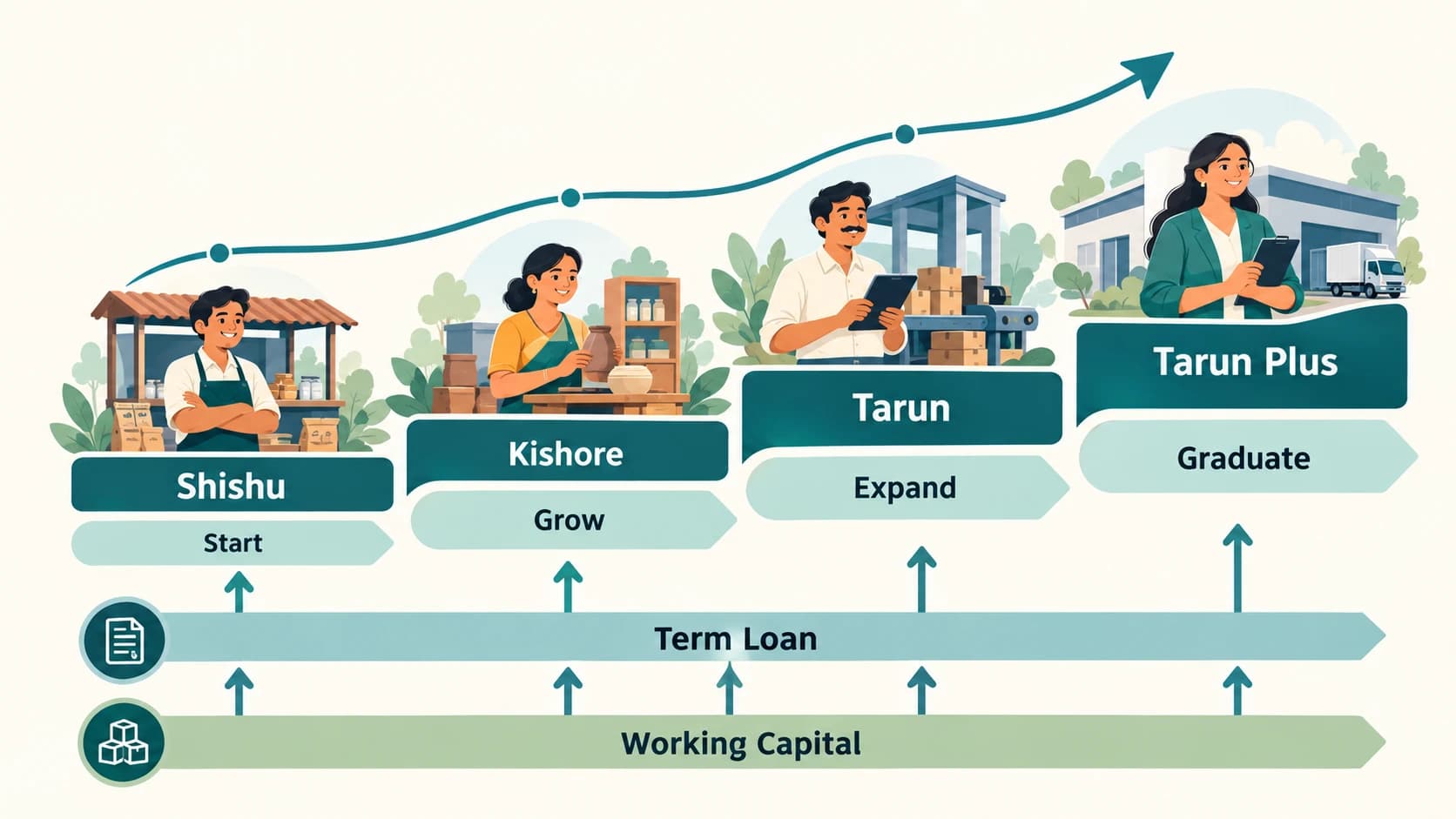
10. Why four categories exist
The categories reflect business progression:
Shishu → Kishore → Tarun → Tarun Plus
The objective is not simply to label loan size.
It is to create a growth ladder.
11. PMMY is collateral-free
DFS describes PMMY as collateral-free institutional credit.
That does not mean:
- no underwriting;
- no documents;
- no repayment.
The lender still assesses viability.
12. PMMY is not a subsidy
This is one of the most common exam misconceptions.
A MUDRA loan:
- is a bank/NBFC/MFI credit facility;
- must be repaid;
- carries applicable interest.
PMMY does not automatically give a capital subsidy merely because the borrower is small.
13. Member Lending Institutions
PMMY credit can be provided through eligible institutions such as:
- Public Sector Banks;
- Private Sector Banks;
- Foreign Banks;
- RRBs;
- Small Finance Banks;
- NBFCs;
- MFIs;
- NBFC-MFIs.
This wide lender network supports scale.
14. MUDRA Card
The MUDRA ecosystem has also used card-based/digital working-capital access for eligible borrowers.
The broader idea is:
make micro-business working capital flexible rather than always disbursing one fixed lump sum.
15. Credit guarantee support
Government credit-guarantee architecture can support eligible PMMY loans.
Guarantee reduces lender loss exposure.
It does not remove borrower repayment obligation.
16. What was Stand-Up India?
Stand-Up India was launched on 5 April 2016.
Its original objective was to promote entrepreneurship among:
- Scheduled Castes;
- Scheduled Tribes;
- women.
17. Stand-Up India loan structure
The original framework facilitated a composite loan for eligible borrowers.
"Composite" means it could include:
- term loan; and
- working capital.
18. Greenfield enterprise
Stand-Up India focused on greenfield enterprises.
Greenfield means:
first venture in the specified sector/business activity for that beneficiary under the scheme conditions.
It was not designed primarily to refinance an old existing business loan.
19. Eligible sectors
The scheme covered greenfield projects in:
- manufacturing;
- services;
- trading;
- eligible agriculture-allied activities.
20. Branch-level inclusion objective
The original design aimed to facilitate bank loans to:
- at least one SC/ST entrepreneur; and
- at least one woman entrepreneur
per Scheduled Commercial Bank branch.
This is a branch-network approach to inclusive entrepreneurship.
21. Non-individual enterprise ownership
Where the enterprise was not individually owned, the qualifying SC/ST or woman entrepreneur needed the prescribed minimum:
- shareholding; and
- controlling stake.
The idea was to prevent only nominal eligibility.
22. Margin and borrower contribution
Stand-Up India combined bank finance with:
- eligible scheme convergence;
- borrower contribution;
- margin.
This shows an important principle:
Government-supported credit does not always mean 100% bank funding.
23. Handholding support
The Stand-Up India architecture emphasised:
- project guidance;
- training;
- application support;
- bank linkage.
Credit access depends not only on money.
First-time entrepreneurs may need:
- mentoring;
- compliance support;
- market knowledge.
24. Current status of Stand-Up India
The original Stand-Up India scheme cycle was stated by DFS to operate up to 31 March 2025.
The Union Budget 2025-26 announced a successor-type first-time entrepreneur scheme for women and SC/ST entrepreneurs.
At the latest official reporting reviewed for this module, the announced successor had not yet been fully operationalised.
For exams:
distinguish the Stand-Up India 2016-2025 framework from any future successor scheme launched later.
25. PMMY vs Stand-Up India
| Feature | PMMY | Stand-Up India original framework |
|---|---|---|
| Main focus | Micro-enterprise credit | Inclusive greenfield entrepreneurship |
| Target group | Eligible micro enterprises | SC/ST and women entrepreneurs |
| Enterprise stage | New or existing/growing micro units subject to category | Greenfield enterprise |
| Credit bands | Shishu/Kishore/Tarun/Tarun Plus | Composite loan range under scheme |
| Collateral | Collateral-free framework | Credit/guarantee framework subject to scheme |
| Status | Active | Original cycle stated through 31 March 2025 |
26. MUDRA vs MSME classification
A borrower can be:
- an MSME; and
- a MUDRA borrower.
But the two frameworks are not identical.
MSME classification uses:
- investment;
- turnover.
PMMY uses:
- scheme eligibility;
- micro-enterprise loan categories.
27. MUDRA vs microfinance
MUDRA supports micro-enterprise credit.
Microfinance focuses on collateral-free low-income household credit under RBI's microfinance framework.
A tiny shopkeeper might encounter both systems, but the regulatory concepts differ.
Quick check - BA-09-03
- When was PMMY launched?
- What does MUDRA stand for?
- Is a MUDRA loan a subsidy?
- Name the four current PMMY categories.
- What does greenfield mean in Stand-Up India?
- Is the original Stand-Up India scheme cycle the same as the announced post-2025 successor scheme?
Quick answers
- 8 April 2015.
- Micro Units Development and Refinance Agency.
- No.
- Shishu, Kishore, Tarun and Tarun Plus.
- A new/first venture under the scheme conditions.
- No.