
Major Government Credit and Financial-Sector Schemes for Bank Exams
Major Government Credit and Financial-Sector Schemes for Bank Exams. A detailed chapter in Financial Inclusion & Government Financial Schemes, with explanations and examples for Indian banking examinations.
By Akhilesh Saini · Reviewed 7 Oct 2026
1. Why this lesson exists
Government schemes change more frequently than core banking concepts.
A student should not memorise hundreds of schemes.
For banking exams, focus on schemes that:
- use banks/financial institutions;
- involve formal credit;
- provide subsidy/guarantee/insurance;
- are nationally significant;
- appear in financial-inclusion policy.
This lesson covers the most important architecture.
2. JanSamarth
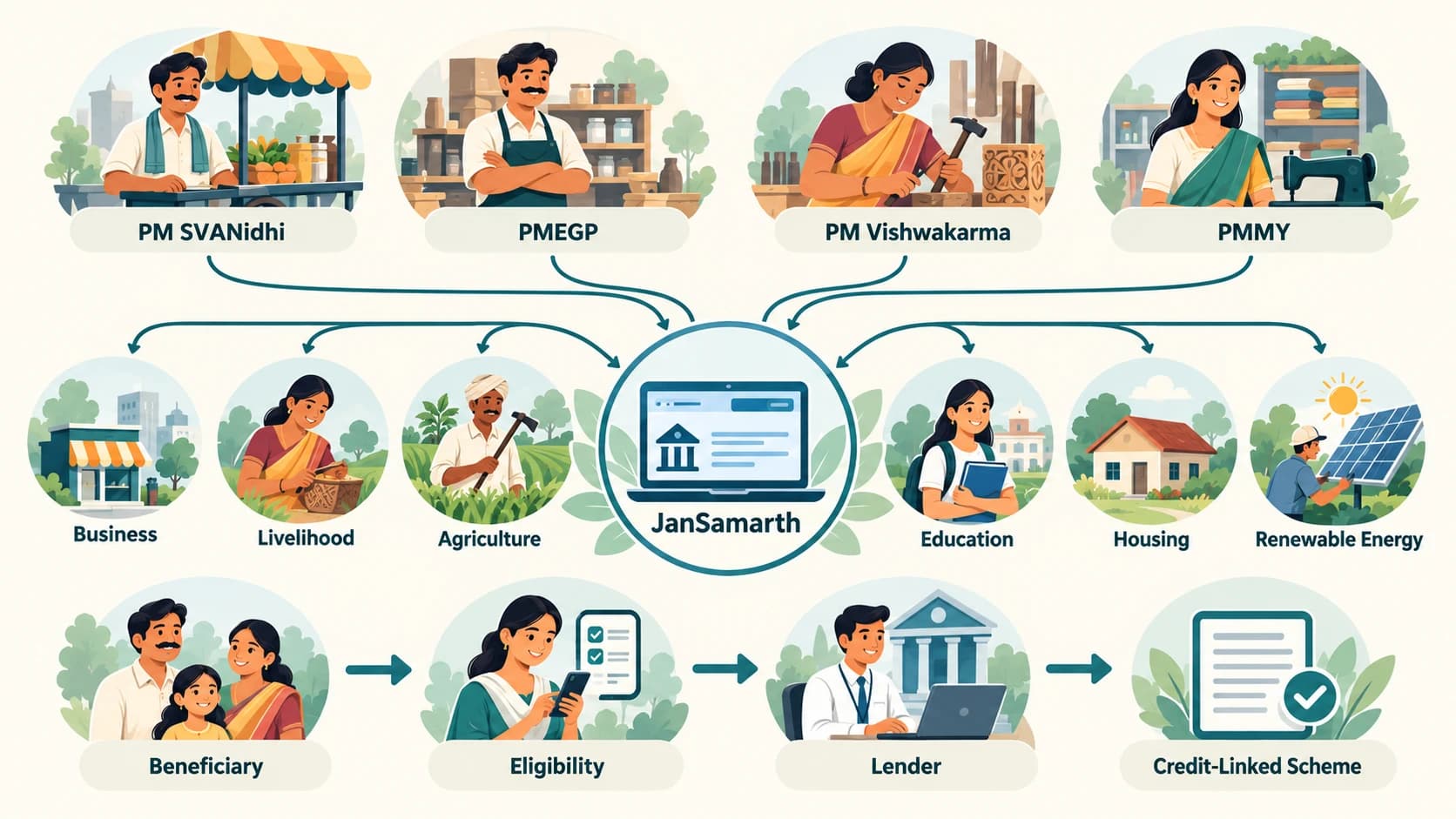
JanSamarth is a national digital portal for credit-linked Government schemes.
It was launched on 6 June 2022.
It is not itself one loan scheme.
It is a common access platform connecting:
- beneficiaries;
- lenders;
- Government schemes;
- nodal agencies.
3. Why JanSamarth matters
Before a common portal, a borrower might need to search:
- separate Ministry website;
- separate bank forms;
- different eligibility rules.
JanSamarth aims to provide:
- digital eligibility assessment;
- scheme discovery;
- application;
- lender integration;
- status tracking.
4. Portal vs scheme
A common exam trap:
JanSamarth is a scheme.
Better answer:
JanSamarth is a portal/platform for multiple credit-linked Government schemes.
5. Scheme categories
The number of schemes/categories on JanSamarth can change.
Current reporting shows categories spanning areas such as:
- agriculture;
- business activity;
- education;
- housing;
- livelihood;
- renewable energy.
Remember the platform purpose, not only the current count.
6. PM SVANidhi
PM SVANidhi stands for:
Prime Minister Street Vendor's AtmaNirbhar Nidhi
It was launched in June 2020 to provide working-capital support to street vendors.
7. PM SVANidhi credit model
The scheme provides progressively larger working-capital loans after successful repayment.
This creates a credit ladder:
first tranche
↓ satisfactory repayment
second tranche
↓ satisfactory repayment
third tranche
The exact tranche values are current scheme data.
8. Why progressive tranches?
A lender initially has limited information about a very small informal borrower.
Successful repayment creates:
- credit history;
- behavioural evidence.
The next loan can therefore be larger.
This is formalisation through credit behaviour.
9. PM SVANidhi and digital payments
The scheme incentivises digital transactions.
The restructured scheme also includes a UPI-linked RuPay credit-card facility for eligible vendors.
This combines:
- livelihood credit;
- digital payments;
- formal credit history.
10. PM SVANidhi extension
The scheme's lending period has been extended to March 2030 under the restructured framework.
Operational details can still change.
11. PMEGP
PMEGP stands for:
Prime Minister's Employment Generation Programme
It is a credit-linked subsidy programme for setting up micro-enterprises.
This is different from PMMY.
12. PMEGP structure
PMEGP combines:
- bank loan;
- beneficiary contribution;
- Government margin-money subsidy.
Therefore:
PMEGP is not just a normal loan.
13. Nodal agency
At the national level, PMEGP is implemented through the:
Khadi and Village Industries Commission - KVIC
State-level implementation also involves:
- KVIC directorates;
- KVIB;
- District Industries Centres;
- banks.
14. New enterprise focus
PMEGP primarily supports creation of new micro-enterprises, subject to the current guidelines.
The scheme also contains a second-loan/upgradation component for eligible successful units.
15. Subsidy vs loan
Suppose project cost = ₹10 lakh.
Funding can contain:
- borrower contribution;
- bank finance;
- eligible margin-money subsidy.
The borrower does not receive the entire project cost as a free grant.
16. PMEGP vs PMMY
| Feature | PMEGP | PMMY |
|---|---|---|
| Core model | Credit-linked subsidy | Collateral-free micro-enterprise credit |
| Subsidy | Yes, margin-money subsidy | Not automatically |
| Main objective | Generate self-employment through new micro units | Provide institutional credit to micro enterprises |
| Nodal architecture | KVIC / Ministry MSME | DFS / MUDRA / lending institutions |
17. PM Vishwakarma
PM Vishwakarma was launched in September 2023.
It supports traditional artisans/craftspeople across specified trades.
The scheme combines:
- recognition;
- skill training;
- toolkit support;
- credit;
- digital transaction incentives;
- marketing support.
18. Credit under PM Vishwakarma
The scheme provides collateral-free enterprise-development loans in two tranches.
The durable idea is:
skill + tools + credit + market support.
19. Why PM Vishwakarma is different from PMMY
PMMY is a broad micro-enterprise credit scheme.
PM Vishwakarma specifically targets identified traditional artisans and craftspeople and adds:
- skill;
- toolkit;
- recognition;
- marketing.
A beneficiary may interact with multiple financial programmes, but eligibility/rules are separate.
20. PM Vishwakarma credit guarantee
Government support helps lenders extend collateral-free credit.
As always:
guarantee protects lender; borrower must repay.
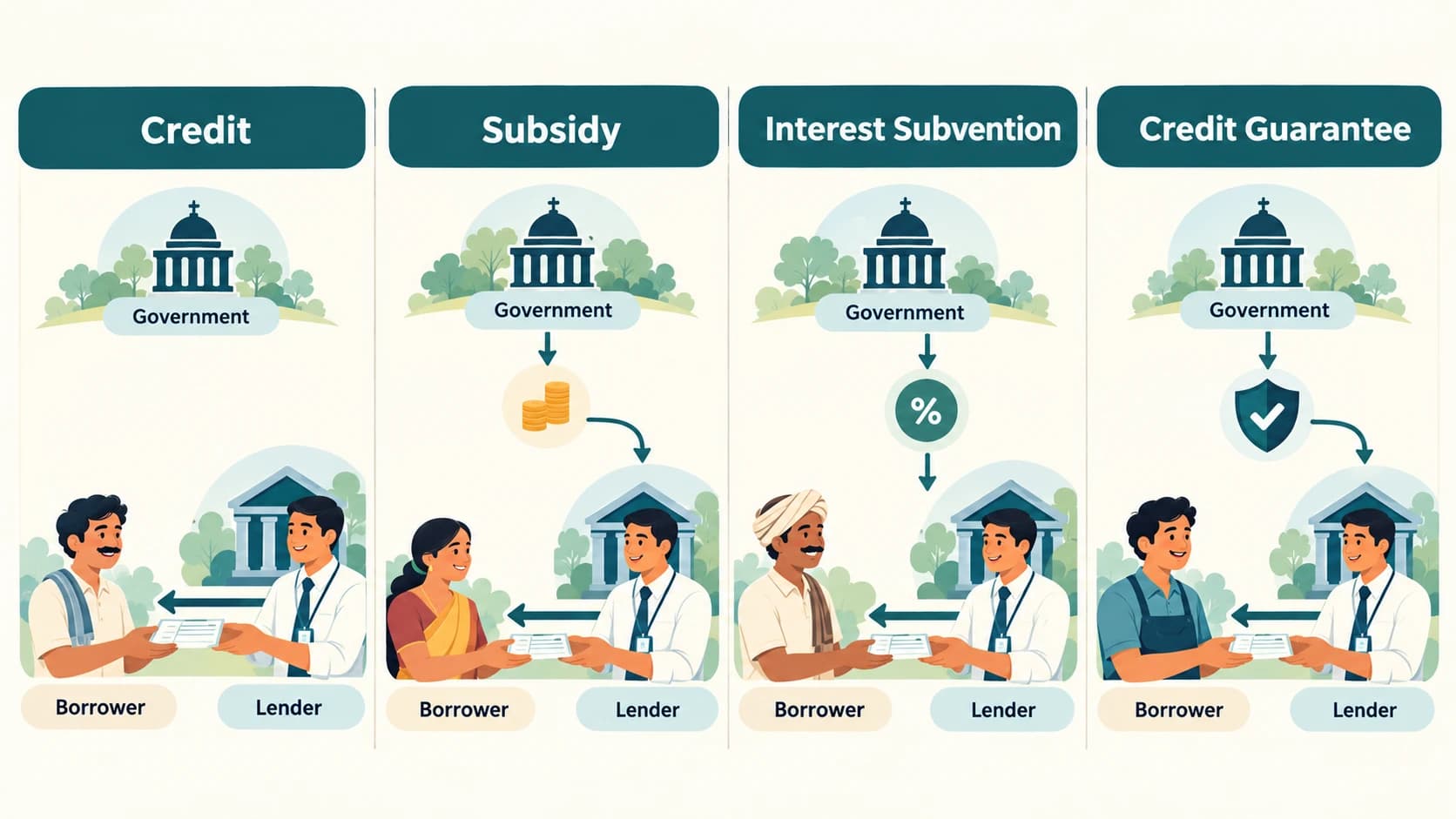
21. Credit-linked subsidy vs interest subvention vs guarantee
These terms are often confused.
Credit-linked subsidy
Government pays a part of eligible project cost/benefit linked to credit.
Example:
PMEGP margin-money subsidy.
Interest subvention
Government bears/reimburses part of the interest cost.
Example:
certain agricultural or artisan schemes.
Credit guarantee
A guarantee fund bears specified lender loss if the borrower defaults.
Example:
CGTMSE/other guarantee funds.
They are different support mechanisms.
22. Direct cash benefit vs credit
DBT:
- Government transfers a benefit/subsidy.
Credit scheme:
- lender provides repayable money.
Do not call a bank loan a DBT benefit.
23. Scheme status matters
Government schemes may be:
- active;
- extended;
- restructured;
- closed;
- replaced;
- only announced.
For exam preparation:
always check operational status before memorising a scheme as "current".
24. Example - Stand-Up India status
The original Stand-Up India framework is still exam-relevant.
But its stated original operational period ended.
A successor was announced but should not be treated as active until officially operationalised.
This illustrates why:
current awareness must sit separately from evergreen conceptual teaching.
25. Historical emergency credit schemes
Crisis-period programmes such as ECLGS may remain relevant for:
- banking history;
- economic-policy current affairs.
But if their operational period has ended, they should not be taught as ordinary current lending schemes.
26. JanSamarth and future scheme changes
Because JanSamarth can add/remove schemes, its current scheme count should be maintained as live data.
The evergreen fact is:
it is a unified credit-linked Government-scheme portal.
27. How to study Government schemes
For every scheme, memorise six questions:
- What problem does it solve?
- Who is the target beneficiary?
- Is it credit, subsidy, insurance, pension or guarantee?
- Which institution/Ministry administers it?
- Which bank/financial channel delivers it?
- What current limits/eligibility need updating?
This method is better than memorising random numbers.
28. Scheme-comparison framework
| Scheme | Core purpose | Financial mechanism |
|---|---|---|
| PMJDY | Bank-account inclusion | Basic account + linked services |
| PMMY | Micro-enterprise finance | Collateral-free credit |
| PMJJBY | Life risk | Term insurance |
| PMSBY | Accident risk | Accident insurance |
| APY | Old-age income | Pension |
| PM SVANidhi | Street-vendor working capital | Progressive collateral-free credit |
| PMEGP | Self-employment | Bank credit + margin-money subsidy |
| PM Vishwakarma | Traditional artisan upliftment | Skills + tools + concessional credit |
| JanSamarth | Scheme access | Digital portal |
Quick check - BA-09-05
- Is JanSamarth one loan scheme or a common portal?
- What type of borrower does PM SVANidhi target?
- Is PMEGP a pure loan scheme?
- What is the nodal national agency for PMEGP?
- What type of beneficiary does PM Vishwakarma target?
- What is the difference between interest subvention and credit guarantee?
Quick answers
- Common portal.
- Street vendors.
- No; it is credit-linked subsidy.
- KVIC.
- Traditional artisans/craftspeople in identified trades.
- Subvention reduces interest cost; guarantee protects lender against specified credit loss.