
NBFCs: Meaning, Types and RBI Regulation
NBFCs: Meaning, Types and RBI Regulation. A detailed chapter in NBFCs & Development Financial Institutions, with explanations and examples for Indian banking examinations.
By Akhilesh Saini · Reviewed 8 Oct 2026
1. What is an NBFC?
NBFC stands for Non-Banking Financial Company.
An NBFC is a company carrying on specified financial business, such as lending or investment, whose regulatory treatment is determined mainly under Chapter IIIB of the Reserve Bank of India Act, 1934, relevant other laws and RBI directions.
Typical activities include:
- lending for vehicles, consumer purchases and businesses;
- investment/credit finance;
- housing finance;
- microfinance;
- factoring of receivables;
- infrastructure finance; and
- specialised activities such as peer-to-peer platforms and account aggregation.
A company does not become an NBFC merely because it provides credit once. Its principal business matters.
2. Principal-business / 50–50 test
RBI's long-standing explanatory framework uses a principal-business test:
- Financial assets constitute more than 50% of the company's total assets (net of intangible assets); and
- Income from financial assets constitutes more than 50% of gross income.
Both are examined together; the shorthand is the 50–50 test.
Example
A manufacturing firm sells machines and gives occasional customer credit. Its principal business may remain manufacturing.
A finance company holds mainly customer loans and earns mainly interest/financial income. It is far more likely to fall within the NBFC framework.
Exam trap: One large investment transaction does not, by itself, turn an ordinary trading company into an NBFC. Exemptions and specific regulatory categories still matter.
3. Why NBFCs exist alongside banks
Commercial banks cannot efficiently serve every type of financing need. NBFCs can specialise in:
- vehicle/equipment lending;
- small-ticket consumer loans;
- loans against gold or other permitted security;
- MSME and supply-chain finance;
- specialised asset underwriting;
- mortgage/housing finance; and
- microfinance or digital servicing.
Their advantage can be specialised credit assessment and distribution, rather than the same deposit-and-payments model as a bank.
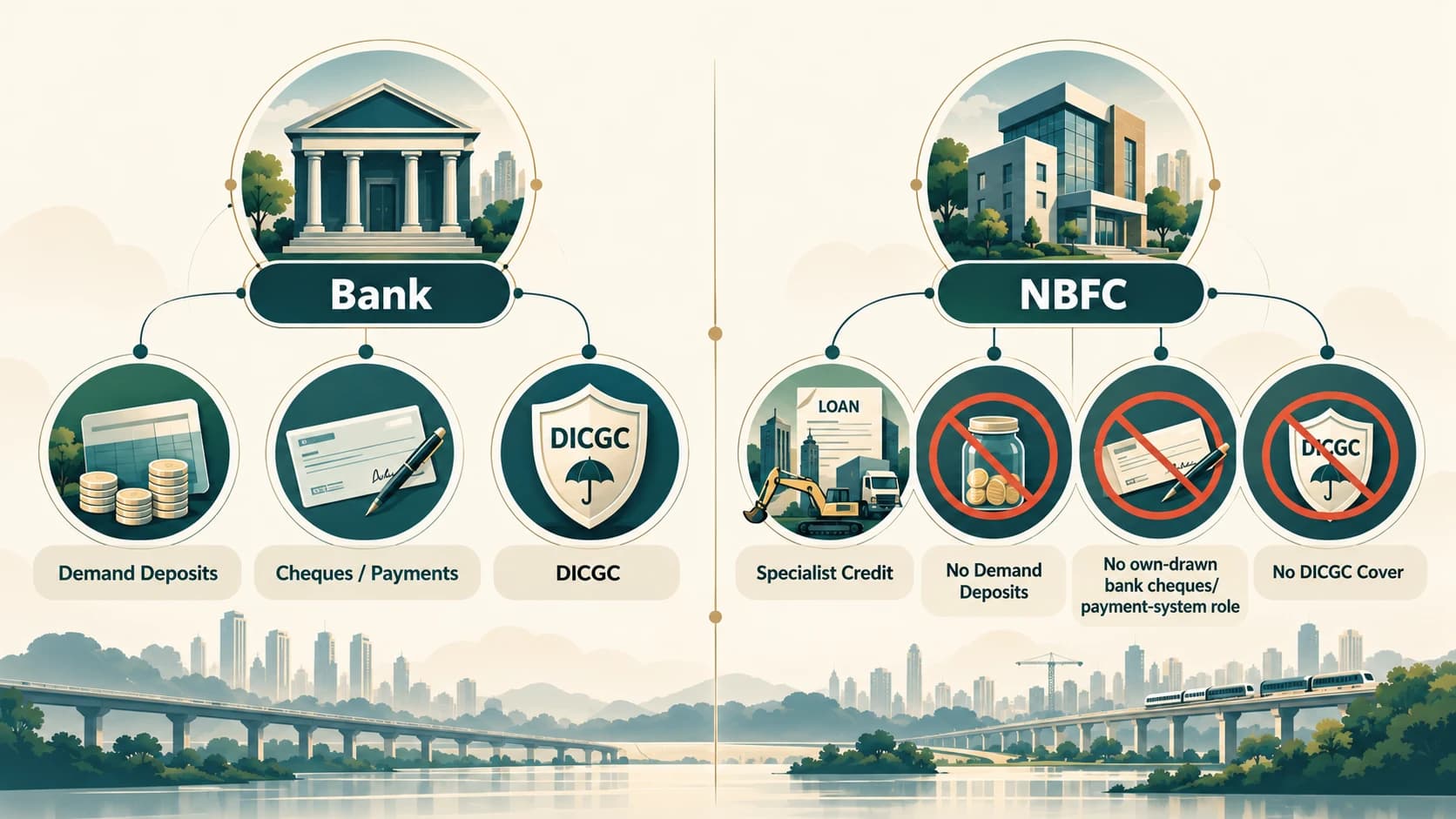
4. Bank vs NBFC — master comparison
| Feature | Bank | NBFC |
|---|---|---|
| Core permission | Banking business under applicable licence/law | Specified financial activities under NBFC regulatory registration and other permissions |
| Demand deposits | Can accept, subject to type/licence | Cannot accept demand deposits |
| Public term deposits | Banks subject to deposit rules | Only specifically permitted NBFCs, subject to restrictive RBI rules |
| Own cheques | Bank accounts may support cheques drawn on bank | Cannot issue cheques drawn on itself in the manner banks do |
| Payment-system membership | Banks participate under applicable payment rules | Not equivalent to a bank's payment/settlement status |
| DICGC deposits | Eligible bank deposits covered subject to limit | NBFC deposits are not DICGC insured |
| Lending | Yes | Yes, for authorised types |
| Primary regulator for RBI-registered entity | RBI and other applicable agencies | RBI, subject to exemptions and category-specific framework |
Memory rule: No demand deposits, no own-bank cheques, no DICGC cover — three classic NBFC distinctions.
5. Deposit-taking vs non-deposit-taking NBFCs
NBFC-D — deposit-taking NBFC
Certain eligible RBI-authorised NBFCs may accept public deposits under strict terms and conditions.
This is not the same as:
- a savings account;
- a current account; or
- deposits insured by DICGC.
NBFC-ND — non-deposit-taking NBFC
This class does not accept public deposits. It may raise permitted funds via:
- capital;
- bank borrowings;
- debentures;
- commercial paper;
- other lawful wholesale funding.
An NBFC-ND can still lend extensively. Non-deposit-taking does not mean non-lending.
6. Public deposits vs public funds
These terms are not identical.
Public deposit is a legal/regulatory category with specific inclusions and exclusions.
Public funds has a broader prudential meaning and can include borrowings, debentures, commercial paper and other outside funding even when not legally classed as public deposits.
Thus a company that does not accept public deposits may nevertheless use public funds.
This matters when applying RBI's registration, layer and compliance rules.
7. RBI Certificate of Registration — CoR
NBFC activities generally require RBI registration under Section 45-IA of the RBI Act unless a particular exemption or special statute applies.
Registration and commencement of business are governed by:
- RBI Act;
- required net-owned-fund criteria;
- company/management suitability;
- classification;
- category-specific conditions.
Important: A company's incorporation certificate from the Registrar of Companies is not automatically permission to conduct regulated NBFC activity.
8. Regulatory exemptions
Not every finance-related entity is regulated as a normal RBI-registered NBFC. Depending on activity and statute, specific categories may come under other regulators or exemptions.
Examples requiring separate legal treatment include:
- insurers;
- certain securities-market intermediaries;
- chit-fund businesses;
- co-operative societies;
- Nidhis; and
- certain narrowly defined non-customer-facing entities.
Do not conclude that all institutions handling money are the same kind of RBI-regulated NBFC.
9. Main NBFC activity types
| Type | Main idea | Representative activity |
|---|---|---|
| NBFC-ICC | Investment and Credit Company | Loans, asset finance, investment business |
| NBFC-MFI | Microfinance-focused NBFC | Collateral-free eligible household loans |
| HFC | Housing Finance Company | Housing mortgage and housing-related finance |
| NBFC-Factor | Receivables factoring | Financing trade receivables |
| NBFC-IFC | Infrastructure Finance Company | Financing infrastructure activities |
| IDF-NBFC | Infrastructure Debt Fund NBFC | Specified infrastructure debt/refinance |
| CIC | Core Investment Company | Group company shareholding/investment structure |
| NBFC-AA | Account Aggregator | Customer-consented financial-information sharing |
| NBFC-P2P | Peer-to-peer lending platform | Matches lenders and borrowers under platform rules |
| SPD | Standalone Primary Dealer | Government-securities market-making/primary dealer activities |
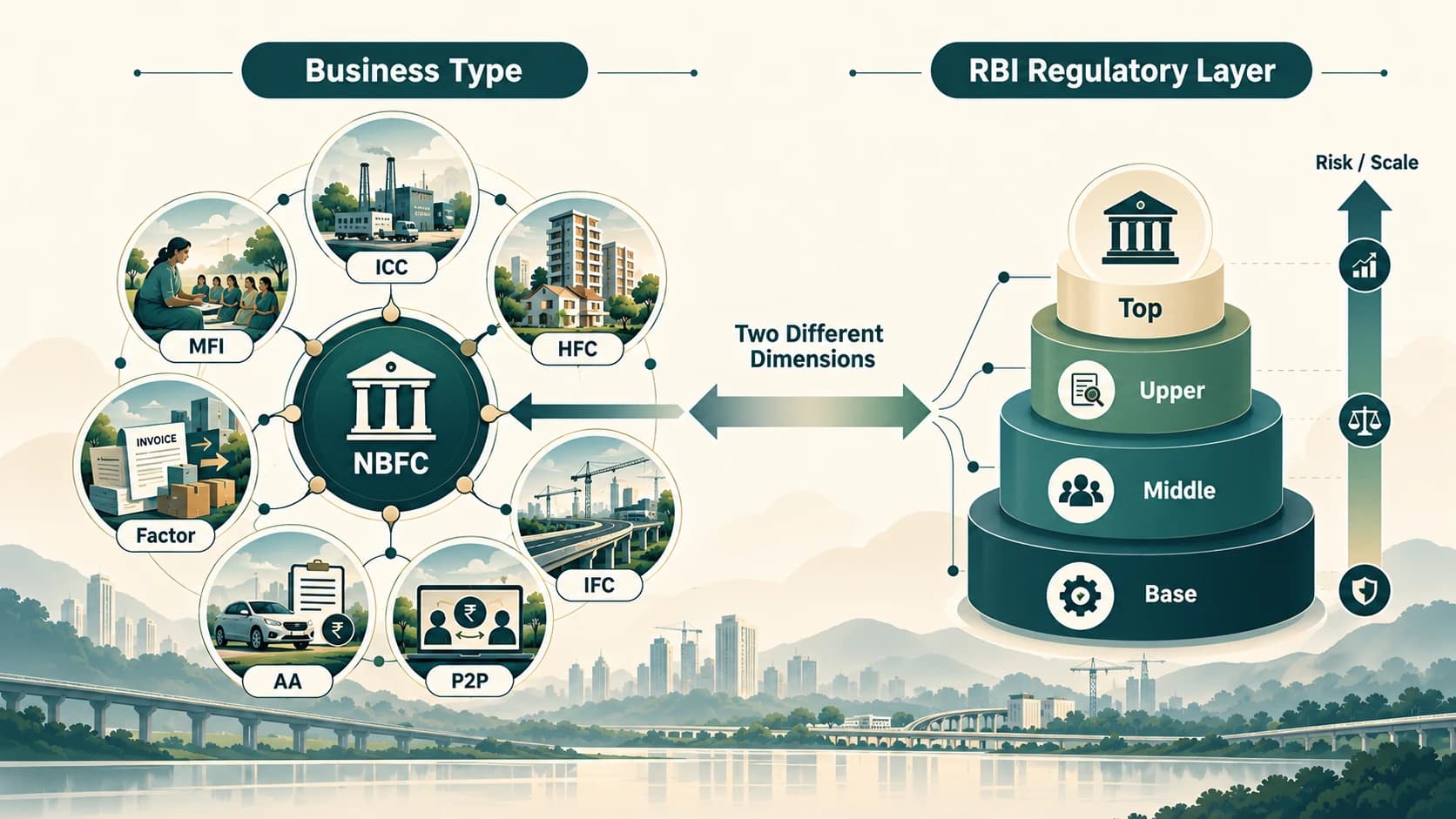
Some are separate recognised categories; others follow category-specific directions. The regulatory layer is not the same thing as the business type.
10. NBFC-ICC
An Investment and Credit Company is the broad lending/investment category. It can fund:
- vehicles;
- consumer durable purchases;
- MSMEs;
- equipment;
- general-purpose credit; and
- eligible investments.
Do not confuse NBFC-ICC with the Insolvency and Bankruptcy Code or bank's Internal Complaints Committee (also abbreviated ICC in unrelated contexts).
11. NBFC-MFI
A microfinance-focused NBFC specialises in collateral-free loans to eligible low-income households. Classification as an NBFC-MFI involves RBI-prescribed qualifying-asset conditions and other requirements.
Module 08 introduced household-level microfinance rules. Here the important distinction is:
Microfinance loan = product; NBFC-MFI = regulated institution type.
Commercial banks and other regulated lenders may also make microfinance loans without becoming NBFC-MFIs.
12. HFC
A Housing Finance Company focuses on housing-related credit. Some HFCs are RBI-regulated NBFCs under a special framework that draws on the National Housing Bank Act and RBI directions.
Historical change: HFC registration, regulation and supervision shifted from NHB to RBI in August 2019. NHB continues as the apex developmental/refinance institution in housing finance.
13. NBFC-Factor
A factor acquires or finances trade receivables.
Example:
- Supplier sells goods on 60-day credit.
- A factor advances money against the receivable under the agreed arrangement.
- Cash reaches the supplier before the buyer's payment date.
This connects with the TReDS concept in Module 08. Factoring and an ordinary unsecured personal loan are different products.
14. Infrastructure-focused NBFCs
An NBFC-IFC directs a substantial proportion of assets to infrastructure lending, while an IDF-NBFC is a specialised structure for eligible infrastructure debt as defined by RBI.
Infrastructure credit has distinctive challenges:
- long construction period;
- uncertain project cash flow;
- large single exposures;
- refinancing needs; and
- asset-liability mismatch.
This is one reason a separate infrastructure DFI, NaBFID, also exists.
15. Core Investment Company — CIC
A CIC principally holds investments in group companies and is not an ordinary diversified consumer lender.
RBI uses specific conditions concerning:
- group investments;
- net assets;
- public funds;
- governance; and
- registration/exemptions.
Do not interpret the word investment to mean every mutual fund or investment adviser is a CIC.
16. NBFC-Account Aggregator — NBFC-AA
An Account Aggregator enables consent-based financial data sharing between Financial Information Providers (FIPs) and Financial Information Users (FIUs).
Simple process:
- Customer gives explicit consent for specified data and use.
- Data is requested from participating FIP(s).
- Secure transfer occurs under technical/regulatory rules.
- The receiving FIU uses the data within the authorised purpose.
An AA is not a lender merely by being an AA and is not a credit bureau calculating a credit score from its own data store. The actual technical and consent requirements follow RBI's special directions.
17. NBFC-P2P
A P2P platform intermediates between willing lenders and borrowers. It does not turn lender exposure into an insured bank deposit.
Borrower default remains a material risk. A regulated platform must comply with its permitted role and cannot simply represent itself as guaranteeing borrower repayment.
18. Why scale-based regulation exists
NBFCs vary enormously in size and risk. Applying exactly the same complex standards to every tiny finance company and major systemically relevant NBFC would be inefficient.
RBI therefore uses Scale Based Regulation — SBR, matching regulatory intensity to:
- size;
- activity;
- funding;
- customer interface; and
- systemic risk.
19. Four SBR layers
Base Layer — BL
Typically covers smaller non-deposit-taking NBFCs and certain activities expressly assigned to BL. Baseline prudential and conduct rules apply.
Middle Layer — ML
Covers larger non-deposit-taking NBFCs, deposit-taking NBFCs and some specified activities. Additional governance, risk-management and prudential requirements apply.
Upper Layer — UL
Applies to NBFCs meeting RBI's prevailing upper-layer identification criteria. Enhanced regulation addresses greater potential systemic impact.
Top Layer — TL
Intended for exceptional increases in systemic risk and ideally remains empty.
Crucial: RBI amended the current identification architecture; do not memorise a historical risk-scoring shortlist as the permanent 2026 Upper Layer definition. The live threshold belongs in the current snapshot.
20. Why a ₹1,000 crore threshold matters
The present broad asset-size distinction between smaller and larger non-deposit-taking NBFCs uses the RBI-defined threshold (with group aggregation and special-activity rules).
The educational lesson is not the number alone. It is that:
larger NBFCs can create greater market, liquidity and interconnectedness risk and therefore receive stronger prudential oversight.
21. Risk management in NBFCs
An NBFC must manage:
- Credit risk: borrowers do not repay.
- Liquidity risk: liabilities fall due before loan cash flows return.
- Market/interest risk: rates and asset prices move.
- Operational risk: systems/process failures.
- Conduct risk: customers are misled or mistreated.
- Concentration risk: too much lending to one borrower, sector or geography.
An NBFC may hold long-term loans financed by short-term market borrowing; this creates asset-liability mismatch (ALM).
22. Capital, provisioning and asset quality
RBI's modern framework covers, as applicable:
- capital adequacy;
- exposure norms;
- asset classification;
- provisioning;
- liquidity standards;
- governance;
- KYC/AML;
- customer protection;
- credit reporting.
Do not assume bank and NBFC provisioning/capital requirements are identical in every respect. Category and layer matter.
23. NBFC lending rates
An NBFC's lending-rate model can differ from a bank's internal/external benchmark arrangements, subject to the relevant RBI pricing and fair-conduct framework.
For borrowers, compare:
- APR / overall cost;
- processing charges;
- repayment terms;
- penal charges;
- prepayment conditions;
- disclosure and grievance arrangements.
24. NBFC vs fintech app
A mobile lending app may be:
- a user interface for a regulated bank;
- a user interface for an RBI-regulated NBFC;
- a service provider; or
- an unregulated/unauthorised operator.
The app brand is not proof that it itself holds an RBI lending licence. Always identify the actual lender and its regulatory status.
25. Core recap — NBFC
Remember three dimensions:
- What it does: ICC, MFI, HFC, Factor, IFC, AA, P2P and other categories.
- How it funds itself: deposit-taking permission or non-deposit wholesale funding.
- How it is regulated: RBI registration, special directions and SBR layer.
These dimensions are related but should never be treated as interchangeable.
Quick check — BA-10-01
- What does NBFC stand for?
- What two tests underpin the historical principal-business/50–50 concept?
- May a normal NBFC accept demand deposits?
- Are NBFC deposits insured by DICGC?
- What are RBI's four SBR layers?
- Does an Account Aggregator automatically grant loans?
- Who regulates HFCs now?
Answers: (1) Non-Banking Financial Company; (2) financial assets and financial income each exceed the relevant 50% test; (3) no; (4) no; (5) BL, ML, UL, TL; (6) no; (7) RBI.