
NABARD
NABARD. A detailed chapter in NBFCs & Development Financial Institutions, with explanations and examples for Indian banking examinations.
By Akhilesh Saini · Reviewed 8 Oct 2026
1. Full form and identity
NABARD = National Bank for Agriculture and Rural Development.
It was established on 12 July 1982 under the National Bank for Agriculture and Rural Development Act, 1981.
It is a statutory development financial institution whose focus is agriculture, rural finance, rural livelihoods, institutional development and related infrastructure.
NABARD is an All India Financial Institution, not a conventional retail savings bank.
2. Why NABARD was created
Farmers and rural enterprises need credit, but sustainable rural development also requires:
- irrigation;
- storage;
- roads;
- sound RRBs;
- co-operative banks;
- financial inclusion;
- local planning;
- training and institutional strength.
A purely commercial loan-focused approach would not necessarily create all these foundations. NABARD was created to combine finance, development and supervision.
3. Historical background
The earlier Agricultural Refinance Corporation and Agricultural Refinance and Development Corporation helped channel development-oriented agricultural funds.
NABARD took over relevant functions from:
- RBI's Agricultural Credit Department;
- RBI's Rural Planning and Credit Cell; and
- the Agricultural Refinance and Development Corporation (ARDC).
This explains why NABARD is connected historically to RBI but has a different rural-development mandate.
4. Ownership
NABARD is wholly owned by the Government of India. RBI divested its remaining stake in 2019.
Exam trap: Older textbooks may call NABARD an RBI-owned institution. That is outdated.
5. Core functions: five-part model
A useful exam mnemonic is:
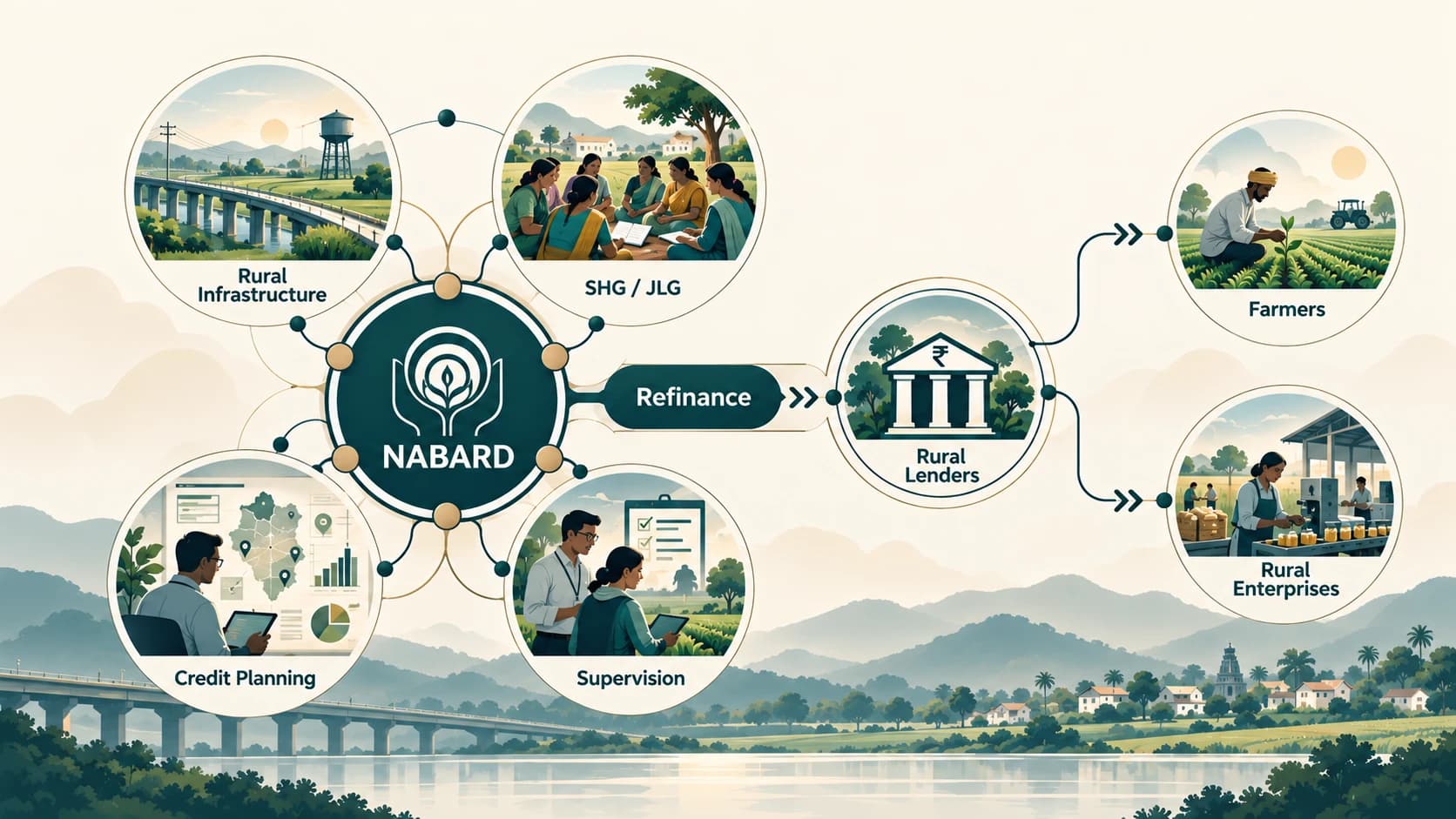
Refinance → Rural development → Supervision → Credit planning → Infrastructure finance.
NABARD's functions are broader than any one of these.
6. What is refinance?
Refinance is finance provided to the institution that has already lent or will lend to the ultimate borrower, within scheme rules.
Example:
- A Regional Rural Bank finances an agricultural activity.
- NABARD provides eligible refinance to that RRB.
- The RRB continues managing its borrower and loan.
Conceptual chain:
NABARD → rural lending institution → farmer / rural borrower.
7. Short-term refinance
Short-term refinance supports agricultural production and working-capital needs through eligible lending institutions.
Typical underlying activity:
- crop cultivation;
- production-related rural credit;
- seasonal procurement/marketing where permitted.
The RRB/co-operative bank remains the front-end customer institution.
8. Medium-/long-term refinance
Investment-credit refinance helps finance productive assets and long-term rural improvements:
- dairy and fisheries;
- irrigation;
- tractors and equipment;
- rural enterprises;
- warehouses;
- agricultural processing;
- other eligible farm and off-farm projects.
Longer-term finance is important because the returns from these investments develop over years, not immediately after a crop season.
9. NABARD and RRBs
Regional Rural Banks combine:
- Government ownership;
- sponsor-bank support;
- rural credit operations.
NABARD helps RRBs through:
- inspection/supervision under statutory/regulatory arrangements;
- institutional development;
- training;
- refinance;
- financial inclusion and credit planning.
Do not confuse this with NABARD owning every RRB. RRB ownership was explained in Module 08.
10. NABARD and rural co-operative banks
NABARD works with:
- State Co-operative Banks (StCBs);
- District Central Co-operative Banks (DCCBs);
- rural co-operative institutions.
It undertakes supervision/inspection of designated institutions under the applicable arrangement, while RBI regulates banking functions.
Important distinction: PACS are village-level co-operative societies and not ordinary RBI-licensed banks.
11. Rural Infrastructure Development Fund — RIDF
The Rural Infrastructure Development Fund was established at NABARD to support eligible rural infrastructure.
It is linked to the wider system of priority-sector lending shortfall allocation.
Potential project areas include:
- minor irrigation;
- rural roads;
- bridges;
- water infrastructure;
- other approved rural public assets.
This is distinct from an individual farmer's KCC crop loan.
12. Why RIDF matters
Suppose rural borrowers cannot access farm produce markets due to bad roads.
More crop lending alone may not solve the problem.
Investment in rural roads and storage can improve farmers' ability to:
- reach buyers;
- reduce wastage;
- obtain better prices.
NABARD therefore supports development conditions around the credit system.
13. NABARD Infrastructure Development Assistance — NIDA
NIDA is a mechanism for eligible rural-infrastructure financing beyond the simple retail-loan model.
NABARD can finance projects of eligible Government/public entities or other permitted bodies in accordance with its schemes.
Do not confuse NIDA with RIDF. Both concern infrastructure, but funding structures and eligible entities can differ.
14. Credit planning and PLPs
NABARD prepares/publishes Potential Linked Credit Plans (PLPs) for districts.
These assess possible lending needs based on:
- agriculture;
- allied activities;
- MSMEs;
- infrastructure gaps;
- local development potential.
Banks and district-level credit committees can use PLP insights in annual credit planning.
15. NABARD and ground-level credit
Ground Level Credit (GLC) refers broadly to credit reaching the agriculture/rural sector from lending institutions.
NABARD helps monitor and support such credit flow.
GLC is not the same as NABARD's own refinance disbursement.
16. SHG–Bank Linkage Programme
The SHG–Bank Linkage Programme (SHG-BLP), introduced on a pilot basis in 1992, links savings-led groups with formal banks.
NABARD promotes:
- group development;
- savings discipline;
- group records;
- credit linkage;
- repeat funding and livelihoods.
Module 08 explained the difference between SHGs and JLGs.
17. Joint Liability Groups
NABARD promotes JLG financing for groups such as:
- tenant farmers;
- sharecroppers;
- small farmers lacking formal collateral.
A JLG relies on joint repayment responsibility and members' knowledge of one another.
18. Farmer Producer Organisations — FPOs
FPOs can aggregate small producers to improve:
- purchasing power;
- marketing;
- value addition;
- finance access.
NABARD supports FPO formation and capacity building under applicable programmes.
19. Financial inclusion and rural innovation
NABARD's developmental work can include:
- digital payments access;
- co-operative/RRB technology improvement;
- training;
- financial literacy;
- women-led enterprises;
- rural innovation and market access.
These activities complement its lending and refinance operations.
20. NABARD's supervisory function — nuance
A very common oversimplification is:
“NABARD regulates all rural banks.”
A better statement:
RBI regulates banking under the applicable legal framework; NABARD performs important statutory inspection/supervisory and development functions for specified rural financial institutions.
NABARD is not a substitute for RBI as the nation's central bank.
21. Does NABARD give every farmer a direct loan?
No. Most ordinary retail farm lending flows through:
- banks;
- RRBs;
- co-operative banks;
- other eligible lending institutions.
NABARD does have specified direct finance and project/infrastructure programmes, but this does not make it an ordinary walk-in retail farm-loan bank.
22. NABARD and PSL
NABARD and priority-sector lending are connected through:
- agriculture credit;
- refinance;
- rural infrastructure;
- RIDF/shortfall mechanism;
- institutions serving priority borrowers.
PSL targets are set through RBI's framework; NABARD supports the ecosystem that helps meet them.
23. A short worked example
A co-operative bank finances 500 small dairy farmers. To expand the programme, it needs longer-term institutional liquidity.
NABARD's eligible refinance can supplement the co-operative bank's funding, while the co-operative bank:
- assesses the individual borrowers;
- documents the loans;
- services repayments.
If the district also lacks milk chilling capacity, separate infrastructure support may improve the value chain.
24. NABARD as development bank
NABARD succeeds not only if its loan book grows, but if rural financial institutions and rural borrowers become stronger over time.
Its mandate combines:
finance + planning + development + supervision.
Quick check — BA-10-02
- NABARD's full form?
- Establishment year and Act?
- Define refinance in one sentence.
- Is RIDF a normal farmer savings account?
- What is a Potential Linked Credit Plan?
- Who owns NABARD now?
- Does NABARD replace RBI as banking regulator?
Answers: (1) National Bank for Agriculture and Rural Development; (2) 1982, NABARD Act 1981; (3) funds given to an eligible lender to support its underlying lending; (4) no, rural infrastructure fund; (5) district credit potential plan; (6) Government of India; (7) no.