
SIDBI
SIDBI. A detailed chapter in NBFCs & Development Financial Institutions, with explanations and examples for Indian banking examinations.
By Akhilesh Saini · Reviewed 8 Oct 2026
1. Full form and identity
SIDBI means Small Industries Development Bank of India.
It was established on 2 April 1990 under the Small Industries Development Bank of India Act, 1989.
SIDBI is the principal financial institution for the promotion, financing and development of the MSME sector and for coordinating institutions that perform similar functions.
It is one of India's five RBI-regulated All India Financial Institutions.
2. Why India needed SIDBI
Many small businesses need money but struggle to obtain formal loans because they may have:
- little conventional collateral;
- a short business history;
- weak financial records;
- irregular receivable collections;
- small ticket sizes with high bank processing costs.
SIDBI strengthens the financing infrastructure for these enterprises instead of requiring ordinary commercial banks alone to solve every problem.
3. A principal financial institution is not a normal savings bank
SIDBI does not perform the same primary function as a commercial bank receiving savings/current deposits from the general public.
Its main purpose is to help create sustainable finance and institutional capacity for MSMEs through:
- refinance/wholesale lending;
- direct finance;
- credit guarantees and risk sharing through appropriate arrangements;
- developmental and ecosystem support;
- venture/equity-linked channels where authorised.
4. What does MSME mean?
MSME means Micro, Small and Medium Enterprise.
India uses a composite framework based on:
- investment in plant/machinery/equipment; and
- turnover.
The current rupee thresholds were covered in Module 08 and are living facts. This chapter focuses on the financial needs of those enterprises.
5. SIDBI's core functions
A useful memory framework is:
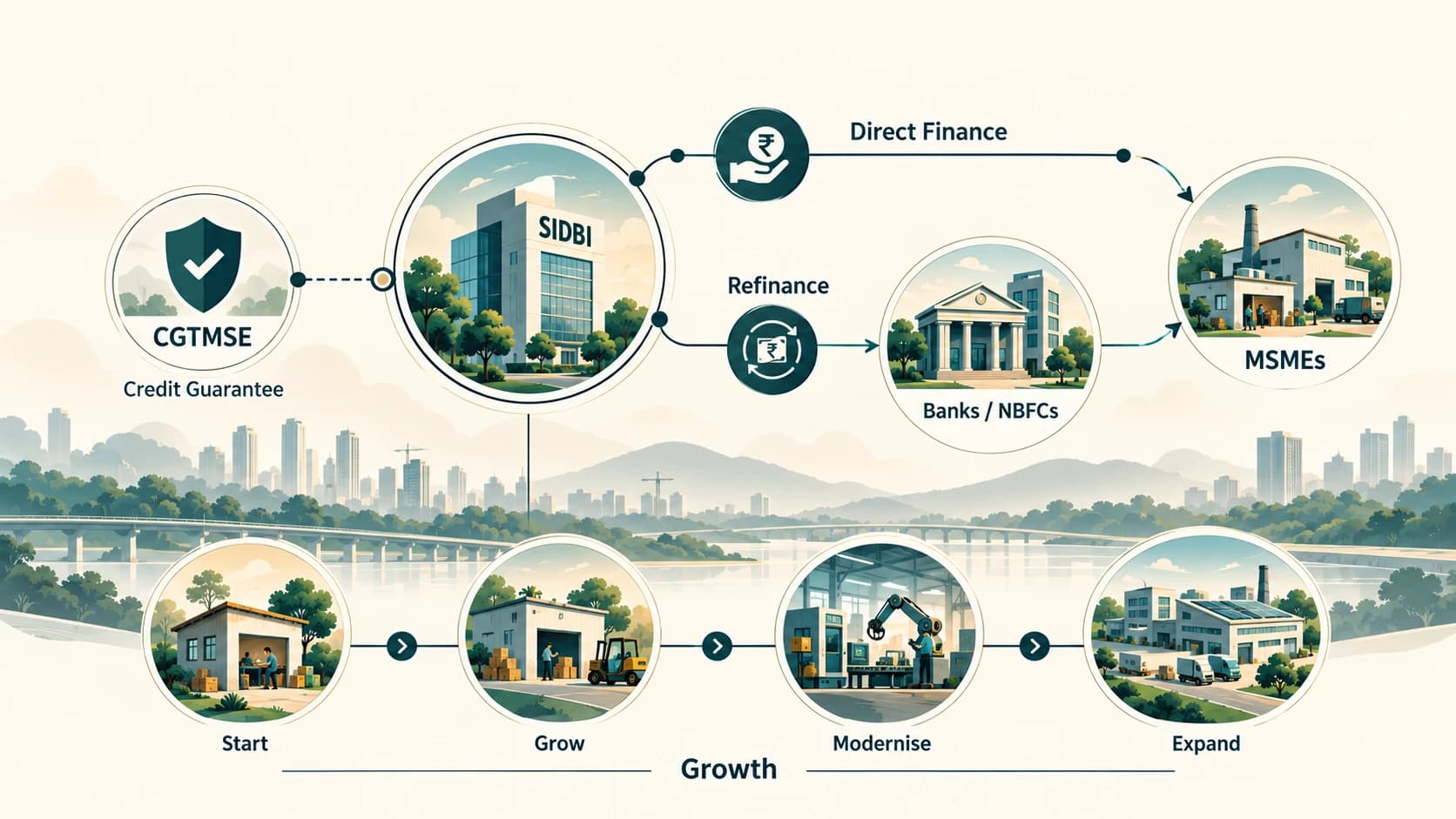
Refinance → Direct finance → Enterprise development → Risk sharing → MSME ecosystem.
6. Refinance to banks and other lenders
SIDBI can provide institutional finance/refinance to eligible Primary Lending Institutions (PLIs) such as:
- banks;
- NBFCs;
- microfinance institutions;
- other permitted intermediaries.
Illustration:
- NBFC provides machinery loans to small workshops.
- SIDBI supplies an eligible line/refinance to the NBFC.
- NBFC remains responsible for its borrowers.
The objective is to increase the volume and quality of MSME credit reaching borrowers.
7. Why refinance helps MSMEs
A smaller lender may know local businesses well but face high funding costs.
Wholesale funding from a development institution can improve:
- financing capacity;
- loan tenor;
- product availability;
- overall credit delivery.
This does not imply that every downstream MSME borrower gets a uniform Government-fixed rate. Actual pricing depends on schemes, costs and borrower risk.
8. Direct finance
SIDBI also provides direct financial assistance under authorised programmes.
Potential uses include:
- expansion;
- modernisation;
- machinery and equipment;
- working capital;
- technology upgrading;
- green and energy-efficient investment;
- other eligible MSME needs.
Refinance vs direct finance: In refinance, SIDBI funds the lending institution; in direct finance, it provides credit to the eligible enterprise or project itself.
9. MSME life-cycle approach
A new enterprise and a mature exporter do not need the same product.
Startup/early-stage unit
May need:
- seed/venture ecosystem support;
- small working capital;
- technical guidance.
Growing enterprise
May need:
- machinery loan;
- receivables finance;
- a longer working-capital line.
Established enterprise
May need:
- expansion/project finance;
- exports support;
- technology upgrade;
- risk-management tools.
SIDBI's mandate covers the financing ecosystem across much of this journey.
10. SIDBI and CGTMSE
CGTMSE stands for Credit Guarantee Fund Trust for Micro and Small Enterprises.
The Trust was created by Government of India and SIDBI to facilitate guarantees for eligible MSE loans.
Do not confuse:
- SIDBI: DFI that can support financing and ecosystem development.
- CGTMSE: guarantee trust that can cover an eligible lender's specified loss in accordance with scheme rules.
11. Credit guarantee is not loan waiver
Example:
- Eligible bank finances a viable small workshop.
- The bank obtains guarantee coverage under the prescribed CGTMSE scheme.
- If the borrower defaults, the lender may claim the eligible guaranteed part after following the scheme process.
The borrower does not automatically cease owing the debt. The guarantee supports the lender's risk appetite.
12. SIDBI and MUDRA
The micro-enterprise credit ecosystem includes MUDRA and PMMY discussed in Module 09.
MUDRA is institutionally associated with SIDBI's development ecosystem, but it is not simply another name for SIDBI.
PMMY categories and current loan bands should remain in Module 09's living current data instead of being copied repeatedly here.
13. SIDBI and TReDS
Micro and small businesses can struggle because buyers pay invoices after long credit periods.
TReDS supports electronic trade-receivables discounting through permitted financiers.
SIDBI's wider MSME mandate supports development of credit channels and complementary ecosystem institutions; don't confuse its functions with those of RBI/NPCI as regulators/operators of other systems.
14. Receivable financing example
An MSME makes components worth ₹20 lakh for a major company. Payment is due in 60 days.
The MSME needs raw materials immediately for the next order.
If the accepted receivable can be financed, the enterprise can obtain funds without waiting 60 days. This addresses working-capital timing, not necessarily loss-making operations.
15. Development beyond lending
SIDBI can support capacity building and ecosystem development through programmes focused on:
- financial/digital literacy for MSMEs;
- entrepreneurship support;
- formalisation;
- technology;
- green transition;
- cluster-based competitiveness;
- institutional capacity.
The specific names and budgets of these programmes change and should be maintained as current data.
16. Cluster-development approach
Many small enterprises are concentrated in local industry clusters:
- textiles;
- engineering goods;
- leather;
- food processing;
- handicrafts.
A cluster may benefit from:
- common facilities;
- better infrastructure;
- improved market links;
- finance and technical assistance.
The benefit can exceed what individual isolated loans achieve.
17. Green and sustainable MSME finance
Energy-efficient machines can reduce a workshop's power bill but require upfront investment.
Financing such an upgrade can:
- improve productivity;
- cut recurring costs;
- reduce environmental impact.
Developmental finance can support both enterprise viability and wider public objectives.
18. SIDBI and startups — carefully distinguish tools
Startup development involves many financing structures:
- loans;
- guarantees;
- venture funds;
- fund-of-funds arrangements;
- grants through separate programmes.
These are not interchangeable. A venture-capital investment is an ownership-risk instrument, not an ordinary repayable bank term loan.
SIDBI may act as implementing/partner institution for authorised fund structures, but current fund sizes and participation conditions need separate verification.
19. SIDBI and priority-sector lending
Eligible MSME loans by banks can count toward RBI's Priority Sector Lending targets. SIDBI's refinance and credit-support arrangements can help lenders reach more such borrowers.
But SIDBI does not set RBI's PSL percentages.
20. How SIDBI differs from NABARD
| Feature | SIDBI | NABARD |
|---|---|---|
| Primary focus | MSMEs | Agriculture and integrated rural development |
| Common refinancing recipients | MSME-oriented banks/NBFCs/MFIs | Rural banks/co-operative banks and eligible institutions |
| Development priorities | Enterprise growth, clusters, technology, MSME finance | Farm/off-farm rural development, infrastructure, RRB/co-operative strengthening |
| Important associated concept | CGTMSE / MSME financing | RIDF / rural institutional refinance |
There is overlap: a rural microenterprise may benefit from both rural and MSME ecosystems. Focus is different, not entirely exclusive.
21. SIDBI and EXIM Bank
SIDBI helps MSMEs become stronger and more competitive.
Exim Bank helps eligible Indian businesses participate in international trade and overseas projects.
An exporting MSME may therefore interact with:
- SIDBI-type MSME development finance; and
- Exim Bank / commercial-bank export finance.
22. Why SIDBI matters for banking exams
Typical useful questions concern:
- full form;
- establishment year;
- legal foundation;
- purpose;
- refinance;
- direct vs indirect assistance;
- CGTMSE relationship;
- differences from NABARD and Exim Bank.
Do not spend disproportionate time memorising short-lived scheme names and individual executives in an evergreen chapter.
Quick check — BA-10-03
- SIDBI's full form?
- When was SIDBI established?
- What sector is its primary mandate?
- Can SIDBI support both direct credit and refinance?
- What does CGTMSE do?
- Does a CGTMSE guarantee automatically waive a borrower's debt?
Answers: (1) Small Industries Development Bank of India; (2) 2 April 1990; (3) MSMEs; (4) yes, under applicable programmes; (5) credit-guarantee protection for eligible MSE lending; (6) no.