
EXIM Bank and Export-Credit Support
EXIM Bank and Export-Credit Support. A detailed chapter in NBFCs & Development Financial Institutions, with explanations and examples for Indian banking examinations.
By Akhilesh Saini · Reviewed 8 Oct 2026
1. Full form and historical identity
Exim Bank = Export-Import Bank of India.
It was established under the Export-Import Bank of India Act, 1981 and commenced operations in March 1982.
It is India's specialist DFI for promoting, facilitating and financing international trade and investment.
2. Why an Exim Bank is needed
An ordinary domestic business may buy raw materials, sell products and receive payment within India.
Exporting introduces extra challenges:
- overseas buyer risk;
- currency risk;
- international shipping/documentation;
- longer delivery/payment cycles;
- foreign-law disputes;
- project execution abroad;
- country and political risks.
Exim Bank supports export capability and internationalisation using finance, advisory and risk-support channels.
3. Exim Bank is an AIFI, not a retail current-account bank
The word Bank in its name does not mean it operates like an ordinary retail commercial bank offering unrestricted public savings/current accounts.
Its mandate is specialised:
- export credits;
- trade and project finance;
- overseas lines of credit;
- financing export-oriented companies;
- overseas investment support;
- export capability development.
4. The export production-to-payment cycle
A typical export cycle is:
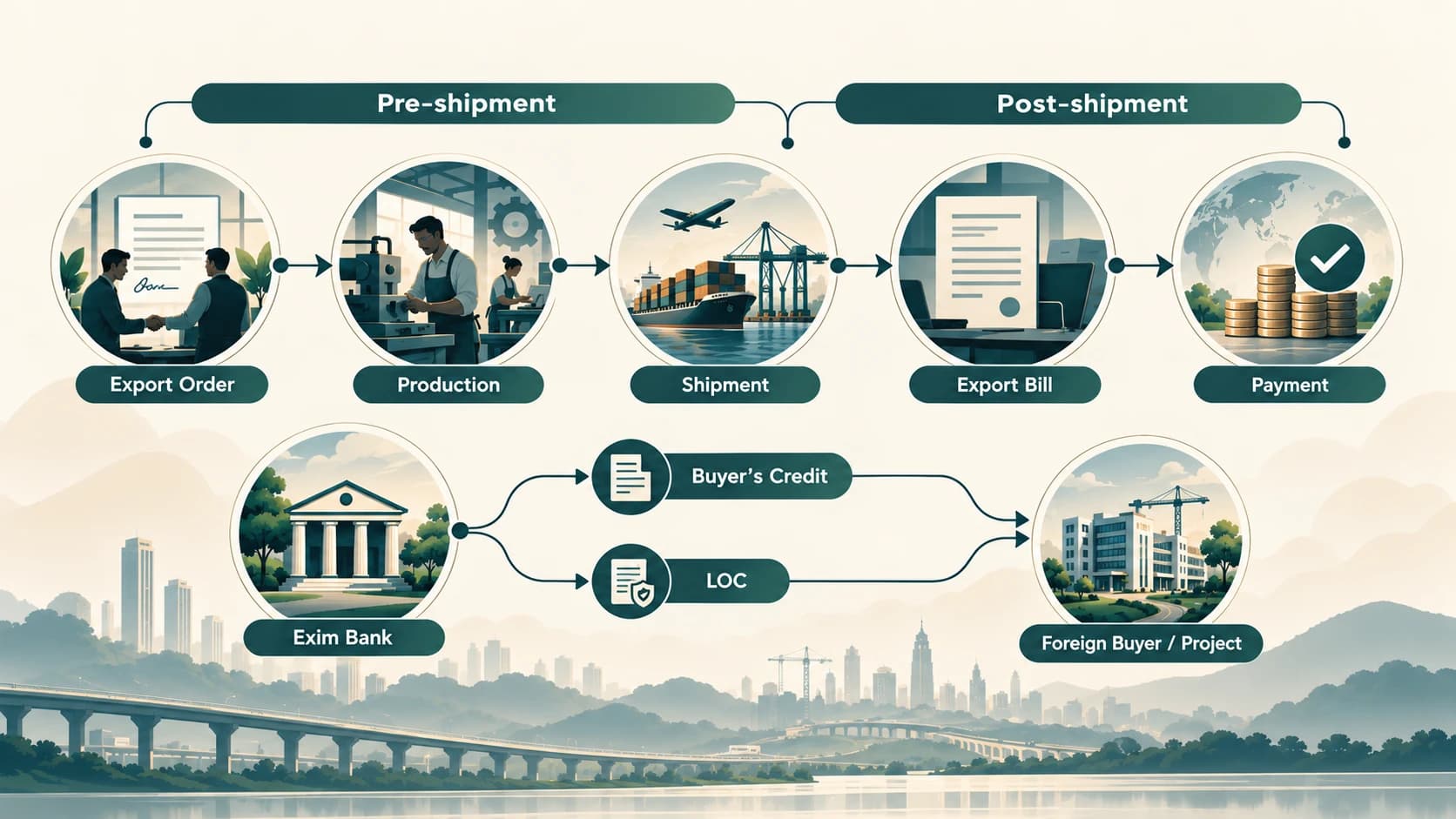
Order received → raw materials → production → shipment → export bill → overseas payment.
Different finance is needed before shipment and after shipment.
5. Pre-shipment credit
Pre-shipment finance supports activities before goods/services are shipped.
Uses may include:
- raw materials;
- wages;
- manufacturing;
- processing;
- packing;
- pre-export project mobilisation.
It is often called packing credit in bank-exam material, subject to the specific product context.
6. Pre-shipment example
An exporter receives an order for ₹50 lakh of engineering goods but needs ₹30 lakh for components and labour.
Pre-shipment finance can bridge the gap until production and shipment.
The loan is based on a viable export transaction and lender underwriting; it is not a subsidy or a risk-free advance.
7. Post-shipment credit
After goods are shipped, the buyer may have 60, 90 or more days before payment is due.
The exporter may finance the shipment receivable instead of waiting until maturity.
Examples of relevant mechanisms include:
- export bills purchased/discounted;
- deferred-payment financing;
- post-shipment credit under agreed terms.
8. Post-shipment example
A company ships goods today but its foreign customer pays in 90 days.
Post-shipment finance helps the exporter obtain liquidity during that period, subject to credit and transaction conditions.
9. Pre-shipment vs post-shipment
| Pre-shipment | Post-shipment |
|---|---|
| Before goods are shipped | After shipment |
| Funds production and preparation | Funds receivables/payment waiting period |
| Often called packing-credit finance | Often linked to export bills / deferred payment |
| Main need: production liquidity | Main need: collection-period liquidity |
Memory rule: Prepare before; collect after.
10. Supplier's credit
Supplier's credit broadly means the supplier/exporter extends credit to an overseas buyer, often supported by bank finance.
The foreign buyer can pay over the contracted period while the supplier receives funds under the financing arrangement.
11. Buyer's credit
Buyer's credit is finance extended to an overseas buyer (or relevant foreign project company/entity) so that it can purchase eligible Indian goods or services.
From the Indian exporter's perspective, financing the buyer can make a large export contract possible.
12. Buyer's-credit example
A foreign infrastructure company needs Indian equipment worth ₹200 crore but cannot pay fully on delivery.
An eligible Exim Bank financing structure supports the buyer's deferred payment while allowing the Indian supplier to receive financing/payment on agreed terms.
This converts a funding problem for the overseas customer into a potential Indian export opportunity.
13. Supplier's credit vs buyer's credit
The central difference is whose payment obligation is financed directly:
- Supplier's credit: exporter extends deferred terms, supported by funding.
- Buyer's credit: finance is provided to the foreign buyer/project entity to purchase Indian exports.
Product design can be more complex, but this distinction is exam-relevant.
14. Project exports
Project exports occur when Indian firms execute significant overseas contracts, such as:
- engineering, procurement and construction (EPC);
- rail and transport projects;
- power infrastructure;
- water systems;
- industrial plants;
- other eligible services/turnkey projects.
Such projects may involve a multi-year cash-flow cycle.
15. Why project exports need specialised finance
An exporter may face:
- advance equipment purchase;
- performance guarantees;
- foreign-currency needs;
- buyer milestone payments;
- project completion risk.
Exim Bank's export-project finance and advisory support can address different stages of the project life cycle.
16. Lines of Credit — LOC
A Line of Credit is an agreed credit facility through which an eligible foreign institution, Government or buyer can finance purchase of qualifying Indian goods/services/projects.
India Exim Bank extends LOCs:
- commercially; and
- with Government of India support under applicable policy arrangements.
17. Government of India-supported LOCs
Government-supported lines of credit to partner countries can pursue two goals:
- development partnership and infrastructure support in the recipient country; and
- facilitation of Indian exports and project execution.
Exim Bank acts as the financing/operating institution under the approved arrangement.
18. LOC does not mean a free grant
A line of credit is a financing arrangement with credit terms, not automatically a non-repayable grant.
Government concessionality, if provided, affects financing terms; it does not convert the entire instrument into a gift by definition.
19. India Development and Economic Assistance Scheme — IDEAS
The Government of India uses the IDEAS framework for eligible concessional LOCs to partner countries.
Exim Bank's operational role can include:
- credit documentation;
- disbursement;
- monitoring;
- repayment and project finance coordination.
The exact concessionality, sourcing conditions and country-wise commitments change and belong in living data.
20. Exim Bank and overseas investment finance
Export growth can also involve Indian companies establishing:
- overseas joint ventures;
- subsidiaries;
- manufacturing/service operations;
- market and distribution networks.
Exim Bank can support eligible overseas investment finance according to its products and rules.
This is not the same as freely allowing every resident to borrow unlimited foreign currency.
21. Export capability vs one shipment
Exim Bank's mandate extends beyond financing one invoice. It can assist with:
- export-product development;
- market studies;
- overseas opportunities;
- advisory support;
- international competitiveness;
- value-chain expansion.
This developmental role is why it is an AIFI.
22. Letter of Credit and Bank Guarantee
Exports often use trade-finance instruments introduced in Module 06:
- Letter of Credit (LC): documentary payment undertaking under specified terms.
- Bank Guarantee (BG): commitment that becomes payable under the guarantee terms, typically upon relevant default or non-performance.
Neither eliminates all transaction, country or operational risks.
23. What is ECGC?
ECGC Limited is an export credit risk-insurance/guarantee institution associated with protecting eligible exporters and banks against specified commercial/political payment risks.
Do not confuse it with Exim Bank:
- Exim Bank: finance and facilitate trade/investment.
- ECGC: provide eligible export-credit insurance/guarantees.
A financing facility and an insurance cover may complement one another but remain legally distinct.
24. Export credit insurance example
An exporter sells on credit to an overseas customer. The foreign buyer becomes insolvent.
An eligible ECGC policy may cover specified loss according to policy terms and exclusions.
An Exim Bank export financing facility, by contrast, supplies or structures credit. It does not automatically insure the entire receivable.
25. Country risk
International finance may be affected by:
- exchange restrictions;
- political instability;
- sovereign payment difficulties;
- regulatory interventions;
- foreign-currency shortages.
Credit appraisal for overseas projects therefore includes more than assessing the private buyer's balance sheet.
26. Exchange-rate risk
Suppose an Indian exporter expects USD payment in three months.
The INR value of that receivable can change if USD/INR changes.
Hedging instruments and foreign-exchange risk management are separate from whether the buyer ultimately pays.
Exam distinction: currency risk and credit/default risk are different risks.
27. Exim Bank and RBI
Exim Bank is a statutory All India Financial Institution regulated/supervised by RBI under the relevant AIFI framework.
It is not RBI itself, and it is not the same as the foreign-trade department of a commercial bank.
28. Exim Bank vs SIDBI
An exporting MSME may receive:
- MSME ecosystem assistance from SIDBI; and
- trade/export finance and internationalisation support from Exim Bank or a commercial bank.
The borrower sector can overlap, but the institutional mandates differ.
29. Exam-useful permanent facts
Remember:
- full name: Export-Import Bank of India;
- Act: 1981;
- operations began: 1982;
- AIFI with international trade/investment focus;
- pre-shipment vs post-shipment;
- buyer's vs supplier's credit;
- LOC / project exports;
- Exim Bank vs ECGC.
Quick check — BA-10-04
- When did Exim Bank start operations?
- What is pre-shipment credit used for?
- What is post-shipment credit used for?
- What does a buyer's-credit facility finance?
- Is a Government-supported LOC necessarily a grant?
- Exim Bank or ECGC: which provides export-credit insurance?
Answers: (1) March 1982; (2) production/preparation before shipment; (3) financing the receivable after shipment; (4) eligible foreign buyer purchase of Indian goods/services; (5) no; (6) ECGC.