
NHB, NaBFID and Other Development Finance Institutions
NHB, NaBFID and Other Development Finance Institutions. A detailed chapter in NBFCs & Development Financial Institutions, with explanations and examples for Indian banking examinations.
By Akhilesh Saini · Reviewed 8 Oct 2026
1. What is a Development Financial Institution?
A Development Financial Institution (DFI) is a financial institution designed to address a persistent financing gap in strategically important economic activities.
Such gaps can arise because:
- projects require long funding tenors;
- returns occur gradually;
- commercial lenders find risk hard to assess;
- infrastructure or housing creates wider social benefits;
- a sector needs institutional development in addition to funds.
DFIs can provide refinance, direct finance, guarantees, advisory support and market development depending on their statutory mandates.
2. DFI vs commercial bank
A commercial bank primarily mobilises deposits, supports payments and provides broad banking services.
A DFI generally concentrates on one or more specialised areas:
- agriculture and rural development;
- MSMEs;
- international trade;
- housing finance;
- infrastructure.
The names of some DFIs contain "Bank", but that does not mean they function as ordinary retail deposit banks.
3. Five RBI-regulated All India Financial Institutions
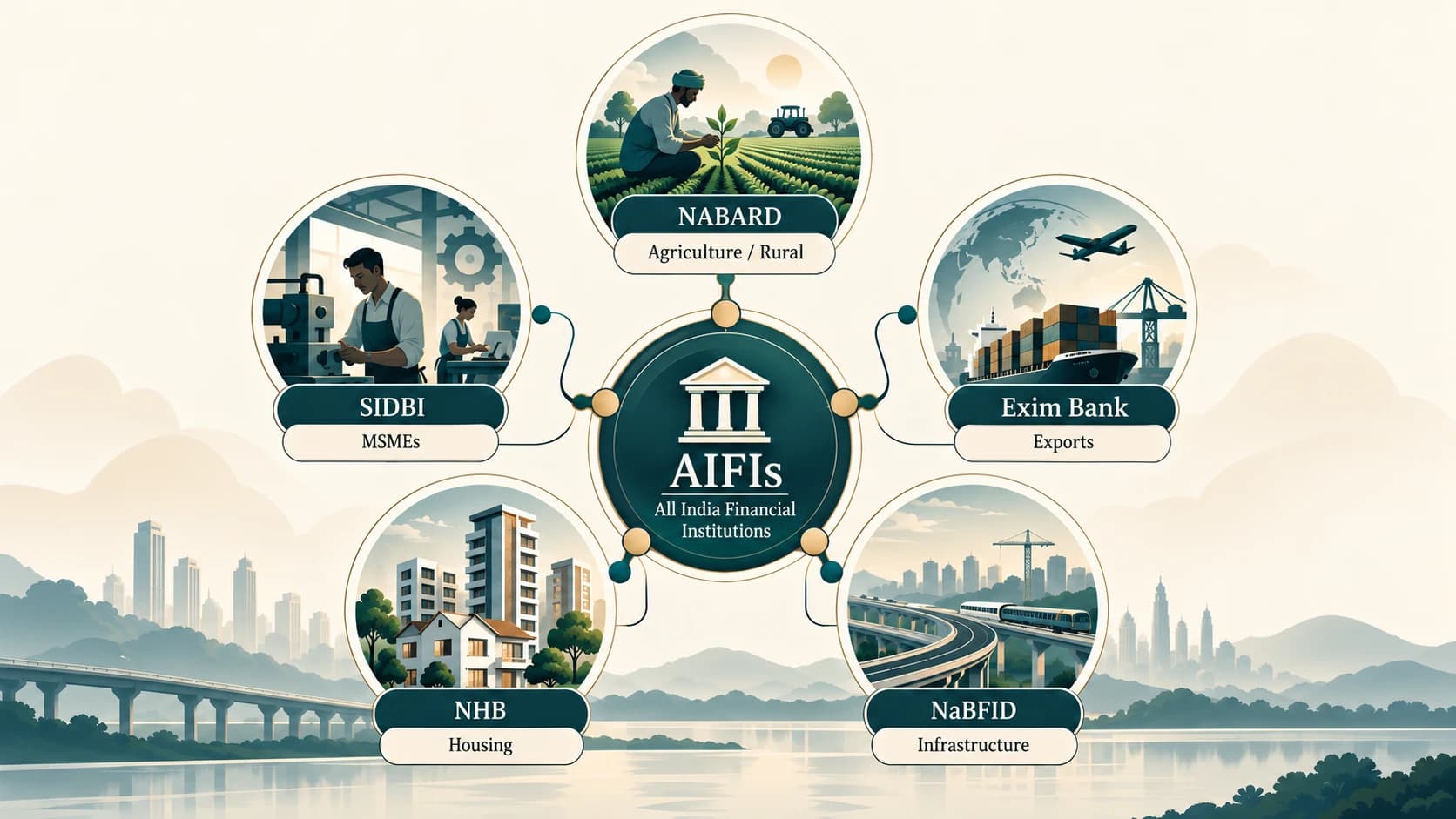
The main AIFIs covered by RBI's regulatory framework are:
- NABARD — agriculture and rural development;
- SIDBI — MSMEs;
- Exim Bank — export/import and overseas trade/investment;
- NHB — housing finance development/refinance;
- NaBFID — long-term infrastructure financing and market development.
This list is exceptionally useful for bank-exam preparation.
4. NHB — full form and establishment
NHB = National Housing Bank.
It was established on 9 July 1988 under the National Housing Bank Act, 1987.
It was designed as the apex developmental institution for housing finance and to help create an effective housing-finance system.
5. Why housing finance needs an apex institution
A housing loan often has a long tenor. A housing lender may need long-term stable funding while the borrower's repayments arrive over many years.
NHB strengthens this ecosystem through:
- refinance to eligible lenders;
- support for housing-finance development;
- research and housing-finance market knowledge;
- specified financing and promotional activities.
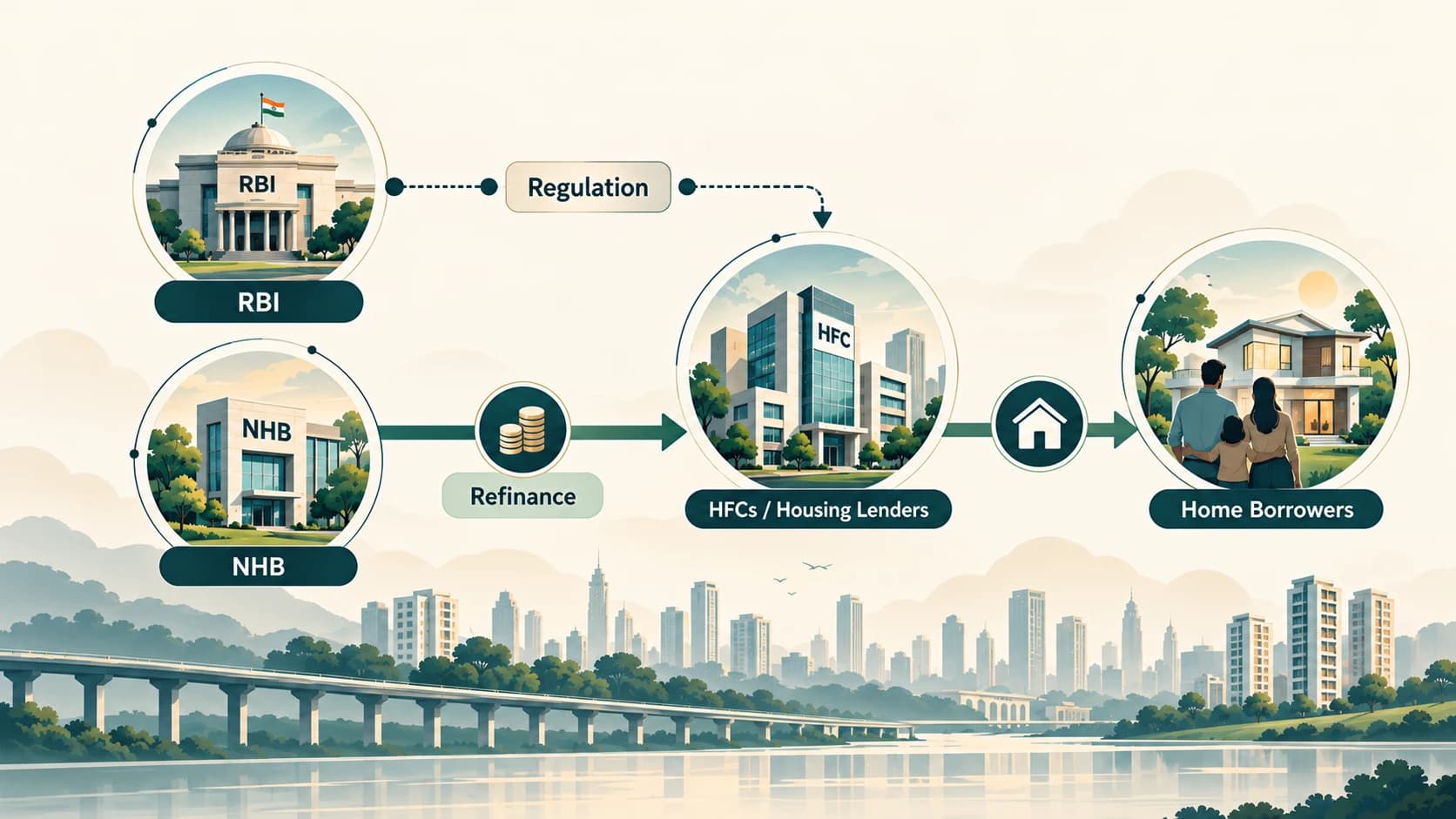
6. NHB refinance
Consider:
- An HFC grants eligible housing loans to home buyers.
- Those borrowers repay over many years.
- NHB provides the HFC eligible refinance, improving its long-term funding capacity.
Thus:
NHB → primary housing lender → home borrower.
NHB's direct lending to eligible public housing agencies or infrastructure projects, where permitted, is different from offering an ordinary personal home loan to every walk-in citizen.
7. Primary Lending Institutions in housing
Institutions eligible for NHB refinance can include, subject to scheme terms:
- Housing Finance Companies;
- Scheduled Commercial Banks;
- RRBs;
- other specified primary lenders.
Eligibility and refinancing terms can vary by institution and programme.
8. NHB vs HFC
NHB is the apex development institution.
An HFC typically originates home loans directly to eligible borrowers.
The relationship is often:
- NHB: wholesale refinance and sector development;
- HFC: retail mortgage underwriting, servicing and collections.
9. Who regulates HFCs?
The key historical change:
The powers of registering, regulating and supervising Housing Finance Companies were transferred from NHB to RBI effective 9 August 2019.
Therefore the statement "NHB currently regulates all HFCs" is an outdated exam trap.
NHB remains central to housing-finance development and refinance, but RBI is the HFC regulator under the current framework.
10. NHB ownership change
NHB was originally wholly owned by RBI.
After RBI divested its stake in 2019, Government of India holds 100% ownership.
Many older exam books contain the earlier RBI ownership statement. Do not reproduce it as current.
11. NHB RESIDEX
NHB RESIDEX is NHB's residential property price index initiative.
It provides information useful for:
- housing-market trends;
- lenders and risk managers;
- policymakers;
- economists and researchers.
A property price index is not itself a housing loan or subsidy.
12. NHB and affordable housing
Housing development may involve:
- affordable-housing refinance facilities;
- special project financing;
- Government programme implementation roles;
- technical/market-development assistance.
Specific subsidy schemes, eligibility criteria and current NHB refinance rates should be updated separately.
13. NaBFID — full form
NaBFID = National Bank for Financing Infrastructure and Development.
It was set up under the National Bank for Financing Infrastructure and Development Act, 2021.
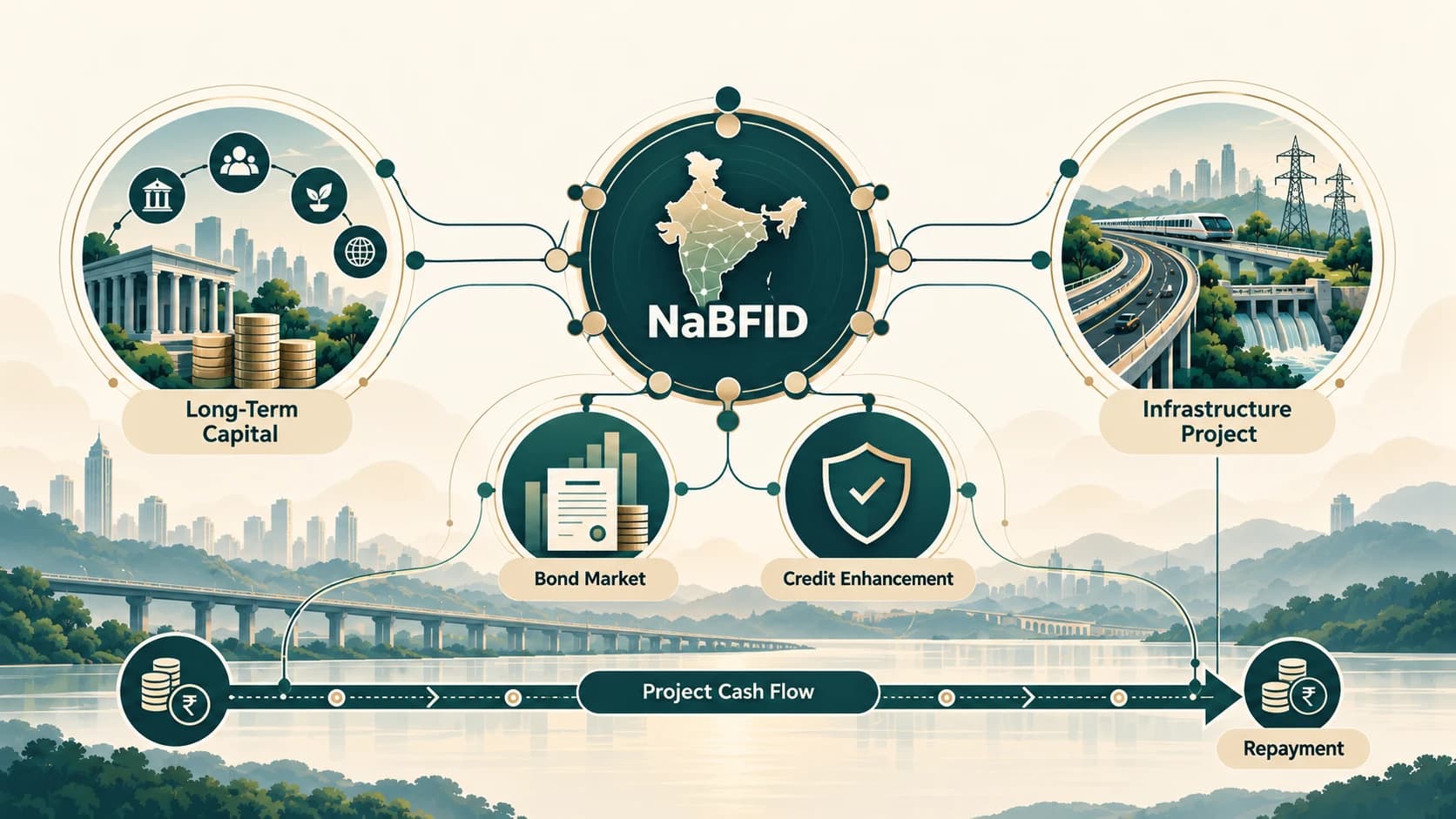
Its main objective is to facilitate long-term infrastructure financing and develop the institutions and markets needed for infrastructure capital.
14. Important NaBFID milestones
- Act received Presidential assent in March 2021.
- Act came into force in April 2021.
- RBI recognised NaBFID for regulation/supervision as an AIFI in 2022.
- Commercial operations commenced in December 2022.
These are historical facts rather than temporary current values.
15. Why infrastructure finance is difficult
An infrastructure project may require:
- large initial construction spending;
- many years before revenue begins;
- long concession periods;
- legal/regulatory permissions;
- complex project risks;
- stable long-term funds.
Examples:
- roads and rail infrastructure;
- power/transmission;
- water infrastructure;
- ports/logistics;
- eligible social and urban infrastructure.
16. Asset–liability mismatch in infrastructure
Suppose a lender funds a 20-year infrastructure loan with borrowings that mature in one year.
The lender must repeatedly refinance short-term liabilities, creating rollover/liquidity risk.
A DFI that mobilises suitable longer-term resources can reduce part of this structural mismatch.
17. Developmental and financial objectives
NaBFID has two closely linked objectives:
Financial
Provide eligible direct or indirect infrastructure financing, investment and financial support.
Developmental
Strengthen infrastructure-finance markets and the enabling ecosystem, including:
- long-term bond markets;
- credit enhancement;
- financing instruments;
- institutional investment participation;
- coordination and advisory capacity.
This dual mandate is central to understanding NaBFID.
18. Long-term non-recourse finance
Non-recourse / limited-recourse project finance relies substantially on project cash flows and contracted protections rather than automatically on the sponsor's entire balance sheet.
Example:
A toll road project's debt may be repaid principally from the project's revenue under the agreed financing structure.
This requires careful assessment of:
- construction risk;
- traffic/demand;
- concession terms;
- maintenance costs;
- regulatory risk.
Non-recourse does not mean the lender has no risk or no legal protections.
19. NaBFID and bond-market development
Infrastructure cannot be funded sustainably only through short-term bank deposits.
Long-dated bonds can connect projects with:
- insurance funds;
- pension funds;
- institutional investors;
- long-term capital pools.
NaBFID's developmental objective includes deepening relevant financing and risk-management markets.
20. Credit enhancement
A project's standalone bond credit quality may be too weak for some long-term investors.
Credit enhancement adds eligible support that reduces expected loss or strengthens payment certainty for bondholders, subject to the structure.
This can make infrastructure securities more investible. It is not a blanket sovereign guarantee and does not eliminate risk.
21. Co-financing and risk sharing
A DFI may work with:
- commercial banks;
- institutional investors;
- multilateral development banks;
- Governments;
- project sponsors.
Joint structures can spread exposures and finance larger projects than a single lender would prudently fund.
22. NaBFID vs NHB
| NHB | NaBFID |
|---|---|
| Housing finance ecosystem | Broad infrastructure finance |
| Established 1988 | Established under 2021 Act |
| Housing refinance, promotion and research | Long-term project finance, infrastructure financial-market development |
| Supports primary housing lenders | Can finance eligible infrastructure projects and develop market instruments |
Housing itself is a part of the built environment, but NHB and NaBFID do not have identical mandates.
23. NaBFID vs NBFC-IFC
Both may finance infrastructure, but their legal identities differ.
- NaBFID: statutory DFI/AIFI created by an Act of Parliament.
- NBFC-IFC: company registered in an RBI-regulated specialised NBFC category.
Financing the same sector does not make two institutions the same category.
24. Historical development-finance evolution
India has had different industrial and sectoral development institutions over time, including historical roles of:
- IFCI;
- ICICI before its merger with ICICI Bank;
- IDBI before/through its banking transformation;
- other specialised financial organisations.
These examples illustrate how institutional forms change. Do not include every historically important finance institution in the current five RBI-regulated AIFI list.
25. Development-bank finance vs Government scheme
NHB or NaBFID is an institution.
An interest-subsidy programme, guarantee scheme or housing-support scheme is a policy programme.
An institution may implement or finance a programme, but they are not the same thing.
26. All-five institution comparison
| Institution | Establishment / Act | Primary focus | Typical channel |
|---|---|---|---|
| NABARD | 1982 / 1981 Act | Agriculture, rural development, rural institutions | Refinance, rural infrastructure, development and supervision |
| SIDBI | 1990 / 1989 Act | MSMEs | Refinance, direct credit, capacity building and risk-sharing ecosystem |
| Exim Bank | 1982 / 1981 Act | International trade and overseas investment | Export finance, project exports, LOCs, advisory |
| NHB | 1988 / 1987 Act | Housing finance | Refinance, development, housing-market research |
| NaBFID | 2021 / 2021 Act | Long-term infrastructure | Project finance, market development, credit enhancement |
27. Can an institution have overlapping beneficiaries?
Yes. Imagine a rural MSME exporting engineered equipment used in an overseas transport project.
Possible connections:
- NABARD: rural institutional/area development, if eligible;
- SIDBI: MSME enterprise finance or ecosystem support;
- Exim Bank: export/project finance;
- NaBFID: domestic qualifying infrastructure project finance, if relevant;
- NHB: housing sector, generally not the natural choice for that export transaction.
The most useful exam approach is to identify the dominant purpose.
28. DFI regulation is not the same as NBFC regulation
RBI regulates five AIFIs under a dedicated AIFI framework and regulates registered NBFCs under their own directions.
Even though both are non-retail financial institutions, they do not share one universal legal and capital rulebook.
29. The role of long-term finance in economic development
Short-term bank credit is useful for everyday business liquidity. Development needs may also require:
- long gestation periods;
- project and market expertise;
- patient institutional capital;
- coordinated investment;
- external benefits that are not captured by immediate profits.
DFIs exist to reduce these financing and coordination gaps while still managing financial risk.
Quick check — BA-10-05
- NHB full form and establishment year?
- Which institution regulates Housing Finance Companies now?
- Who owns NHB now?
- NaBFID was established under which Act?
- Why is NaBFID different from a normal retail bank?
- Name the five RBI-regulated AIFIs.
- Which AIFI is most directly associated with housing refinance?
Answers: (1) National Housing Bank, 1988; (2) RBI; (3) Government of India; (4) NaBFID Act, 2021; (5) dedicated long-term infrastructure finance and market development; (6) NABARD, SIDBI, Exim Bank, NHB, NaBFID; (7) NHB.